

“Uncut Gems”
Spanish Title: Diamantes en Bruto
Year of Production: 2019
Directors: Benny Safdie and Josh Safdie
Director of Photography: Darius Khondji, ASC, AFC
Lenses: Panavision C Series, E Series, G Series, T Series, ATZ1 and ATZ2 zooms
Film Stock: Kodak 5219 500T
Format and Aspect Ratio: 35mm anamorphic Panavision + ARRI Alexa Mini ARRIRAW, 2.39:1 / 2.40:1
Other: 4K Digital Intermediate
Viewed on: HDTV
Celluloid, digital capture, pushed negative, long anamorphic lenses and constant pressure in Darius Khondji’s cinematography for the Safdie brothers’ Uncut Gems.
The Film
Howard Ratner, a Jewish jeweler in New York’s Diamond District, is drowning in debt. Played by Adam Sandler, he sees one possible way out: a rare Ethiopian opal that he hopes to sell at auction for an enormous profit. But nothing in Howard’s life moves in a straight line. His lover, his wife, a basketball star, his family, his creditors, and his own compulsive need to gamble all become part of a single mechanism of pressure.
That mechanism is also the dramatic principle behind Benny and Josh Safdie’s direction. Uncut Gems is not simply a story about chaos. It is a film built as chaos, with scenes that overlap, accelerate, interrupt one another, and rarely allow the viewer to settle. For much of its 135-minute running time, the picture moves at an almost punishing rhythm, carried by Sandler in one of the strongest dramatic performances of his career.
At times, the action becomes deliberately hard to process. The viewer is placed inside Howard’s own state of agitation, where every solution immediately creates another problem. The film can be exhausting, and occasionally confusing, but that confusion is not accidental. It is part of the way the Safdies structure experience: plot, sound, performance, camera and editing all push in the same direction.
The Cinematographer
The director of photography was Darius Khondji, ASC, AFC, who first came to prominence through his work with Marc Caro and Jean-Pierre Jeunet on Delicatessen (1991) and La Cité des Enfants Perdus (1995), before becoming a major figure with Se7en (David Fincher, 1995).
His career has been unusually varied. He has worked with Alan Parker, Roman Polanski, Woody Allen, Michael Haneke, James Gray, Alejandro González Iñárritu, Ari Aster, and the Safdies themselves. Few cinematographers have moved so naturally between stylization, classicism, darkness, realism and formal experimentation.
Visual Style Analysis
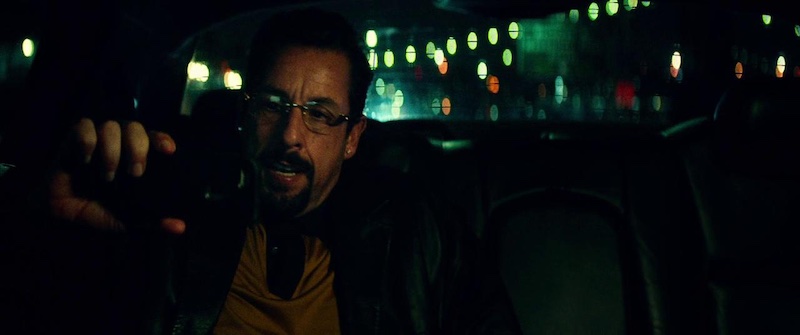
Visually, Uncut Gems is built around pressure: pushed 35mm negative, digital night material, long anamorphic lenses, shallow focus, mixed color contamination and a camera that keeps Howard Ratner trapped inside his own instability.
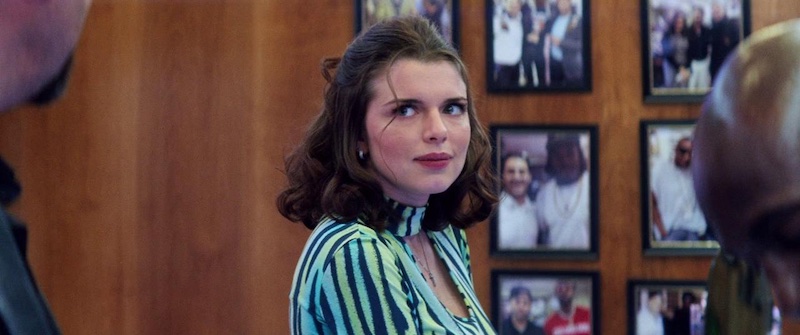
Much of the film’s force comes directly from Khondji’s cinematography. The Safdie brothers were already drawn to celluloid, as Good Time had carried a strong 35mm texture. According to Khondji, he introduced them more fully to the possibilities of the anamorphic format, only for the directors to push it into an even more aggressive dramatic language. That is very much the feeling of the finished film. Anamorphic photography is not used here for elegance or spectacle. It is used for pressure.
The film was not shot entirely on 35mm. Night exteriors and certain night interiors, where the New York cityscape had to be integrated more freely into the image, were photographed with the ARRI Alexa Mini at ISO 1600. That digital material was later graded to sit as close as possible to the film negative. Khondji also pushed Kodak 5219 500T by one stop as a general approach, and occasionally by two stops. On an HD stream, the join between film and digital is difficult to detect, which is perhaps the greatest compliment to the method.
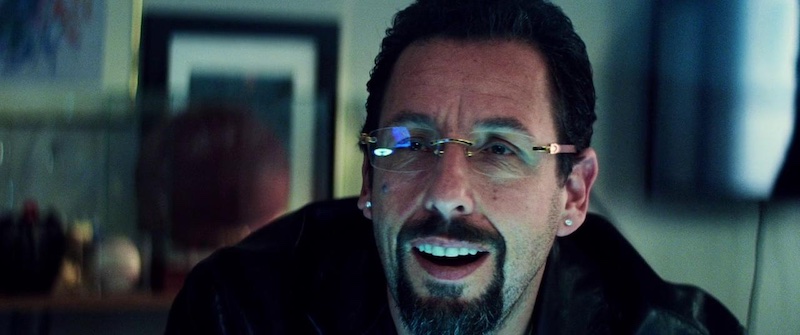
Uncut Gems has a visible layer of grain throughout. Sometimes that grain comes from the pushed 35mm negative; elsewhere, it was added in post-production to help the digital footage merge with the celluloid material. In his interview with Benjamin Bergery for American Cinematographer, Khondji explained that underexposing and pushing the Alexa, combined with a light Black Pro-Mist filter on the lenses, helped bring the two formats closer together.
What is most interesting is that the image does not try to hide its roughness. The mixture of 35mm, digital capture, pushed negative, underexposed Alexa footage, filtration and added grain produces an image that feels abrasive by design. It is not a polished hybrid. It is a controlled loss of control, which is exactly what the film needs.
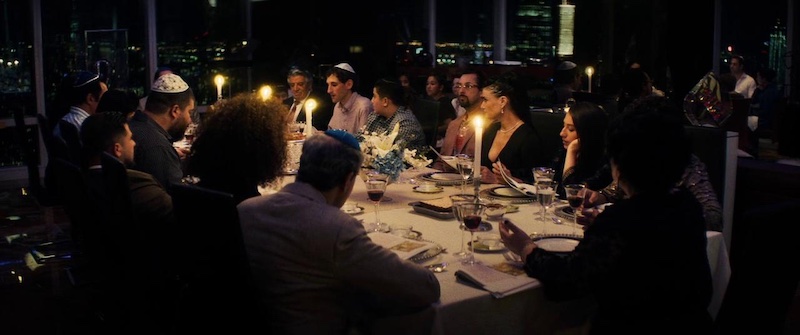
The cinematography is central to the way the film produces anxiety. Khondji does not simply photograph Howard’s panic; he builds a visual method around it. Long anamorphic lenses, shallow focus, compressed space, unstable backgrounds and constant camera proximity make the world feel crowded even when the frame is carefully controlled.
Much of the picture was shot on long anamorphic focal lengths, often from around 75mm up to 500mm. This compresses space aggressively. Faces, objects, reflections, windows, jewelry, bodies and background lights are pushed into the same visual field. Howard is not merely placed within his environment; the environment seems to press against him.
The Panavision lenses — mainly C Series, but also E Series, G Series, T Series and ATZ zooms — are not used for classical anamorphic beauty. They are used for pressure. Their compression, elliptical bokeh, flares and imperfect edges turn the background into an active part of the image. Jewelry, reflections, faces, windows and streetlights all seem to compete for space in the same frame.
Because the camera is often moving, frequently on Steadicam, and because the lenses are long and used nearly wide open, focus becomes a major expressive element. The acknowledgment of Preston’s Light Ranger system in the credits is telling. This was not simply a stylistic choice. It was a technically extreme way of shooting, where the focus puller had to survive inside the same instability that defines the film.
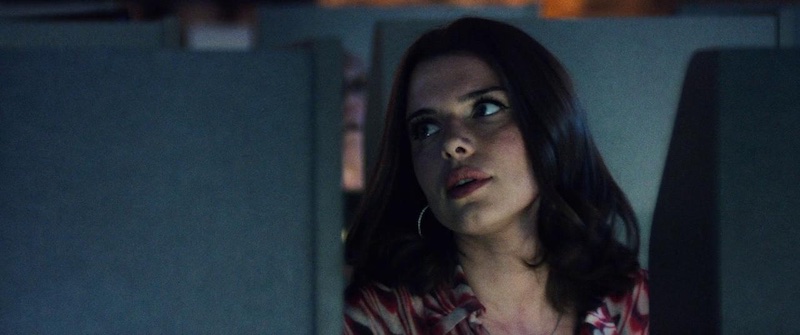
The Safdies’ camera is intensely attached to Howard. It follows him, crowds him, waits for him, loses him and finds him again. That makes the film’s final shift in attention especially effective. When the film finally moves away from Howard and toward another character, the effect is not only narrative. The camera’s relationship to the story changes, and the audience feels that change immediately.
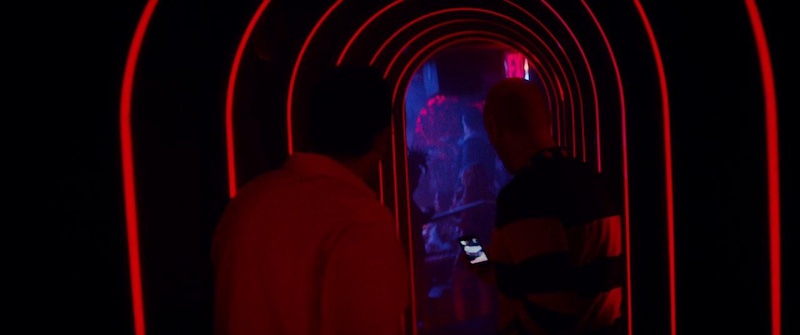
In lighting terms, Khondji appears to embrace imperfection as a route to intimacy and authenticity. His career makes it clear that he is entirely capable of precise, polished, highly controlled lighting. Here, however, polish would have been the wrong language. In the night exteriors and in interiors such as cars or the dinner sequence, he often relies on small RGB LED units to suggest mercury-vapor sources, sodium tones, or saturated practical contamination.
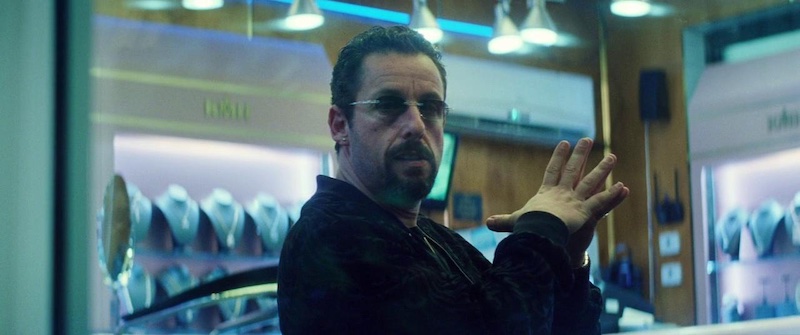
These lights do not dominate the city. They supplement it. They give shape to faces and bodies while allowing New York itself to provide much of the atmosphere, with all its reflections, flares, mixed color temperatures and uncontrolled highlights. The light often feels found, even when it has clearly been shaped.
The daytime interiors and street work follow a similar logic. Khondji allows overexposure, hard reflections, greenish and cyan casts, saturated skin tones, and abrupt changes in color temperature. The image is not careless, but it is intentionally unruly. It belongs to a modern visual culture shaped by LEDs, mixed sources, reflective surfaces and a broader tolerance for color conflict inside the frame.
Conclusion
The sound design reinforces the same strategy. Ambient noise, music, overlapping voices and even the directional placement of dialogue in the front channels contribute to a feeling of constant pressure. The viewer is not simply watching Howard’s crisis from the outside. The film builds a sensory environment around it.
That immersive quality is also where the film risks demanding too much from the viewer. The plot depends on a succession of gambles, escapes, coincidences and escalations that require a considerable suspension of disbelief. Yet the staging and visual style are so forceful that the film often overcomes those reservations through momentum alone.
From a cinematographic standpoint, Uncut Gems shows a virtually unrestrained Darius Khondji. He is less concerned with technical polish than with finding the right process for the story. The apparent roughness is not a flaw but part of the design. It gives the film its sense of danger, improvisation and lack of control.
That energy was evidently present behind the camera as well. Principal photography lasted only twenty-nine days, followed by two additional days of reshoots. The speed of the production is visible in the finished work, not as a limitation, but as a kind of charge. Uncut Gems looks and feels like a film made under pressure, which is precisely why it fits its protagonist so well.
ON FILM & DIGITAL
© Ignacio Aguilar, 2026.
This article is part of ON FILM & DIGITAL’s English-language cinematography reviews and essays.
These texts are not plot summaries or general film reviews, but cinematography-focused essays written from the perspective of a working cinematographer.
The Author
Ignacio Aguilar is available for cinematography work, creative collaborations, lectures, workshops and international projects. He is a Sony Independent Certified Expert (ICE) and Cooke Optics Spanish Ambassador for Cooke SP3 lenses. Contact here.