

La Pasajera
International Title: The Passenger
Year of Production: 2021
Directors: Raúl Cerezo, Fernando González Gómez
Director of Photography: Ignacio Aguilar AEC
Camera: RED Ranger Gemini
Lenses: Atlas Orion anamorphic lenses, Cooke Varotal 25-250mm T4
Filters: Harrison & Harrison Double Fog 1/4, Low Contrast, Black Pro-Mist, split diopters, close-up diopters
Format & Aspect Ratio: RedCode RAW (5K anamorphic), 2.39:1
Other: Full-scale van interior set on pneumatic motion platform, greenscreen work, extensive digital intermediate and VFX integration
An English-language case study on The Passenger cinematography, covering anamorphic format, blue night exteriors, van-set design, camera movement and evolving visual language.
By Ignacio Aguilar AEC, 2026.
Trailer
If you would like to see the finished film before reading the case study, here is the official trailer of The Passenger / La Pasajera.
The Film
This article is a cinematography case study of The Passenger (La Pasajera), focusing on anamorphic format, blue night exteriors, van-set design and a visual language shaped under pressure. When I think back on The Passenger, what I remember most clearly is the sense that the film was discovering its visual identity as we made it. It was my first feature as a cinematographer, and from the outset it presented the kind of contradictions that often generate the most interesting problems. It was a genre film, certainly, but also a road movie, a chamber piece, a creature feature, and at times something close to black comedy. It wanted to be tense, strange and physical, but also entertaining and emotionally alive. Much of it unfolds inside a moving van, in a cramped, unstable space with very little room to hide. At the same time, the story opens out onto roads, forests, a village square and a roadside bar that seem to belong to a wider, stranger landscape. That tension interested me immediately. The challenge was never simply to make the film look “good”, but to give it scale, atmosphere and a genuine cinematic identity while working within very real practical and financial constraints. I never felt The Passenger could be photographed in a neutral or merely functional way. Raúl Cerezo and Fernando González Gómez were clear from the beginning that the film needed a strong visual personality, and I felt exactly the same. It had to move between realism and stylisation without ever rupturing its own world. It had to allow comedy and horror to inhabit the same frame. It had to feel tactile and dangerous, but never too clean, too polished or too controlled.
The Passenger Cinematography Approach
One of the first important decisions was to shoot anamorphic. For me, that was never simply a matter of format, but of tone. Anamorphic immediately pushed the film into more expressive territory. It gave us softness, instability, flare, texture and atmosphere. From the beginning, I felt the story resisted a hard, overly clinical digital image. I wanted something that could hold smoke, darkness, skin, practical effects and night air without feeling sterile. The frame needed to feel inhabited. It needed body.

The Van as a Cinematic Space
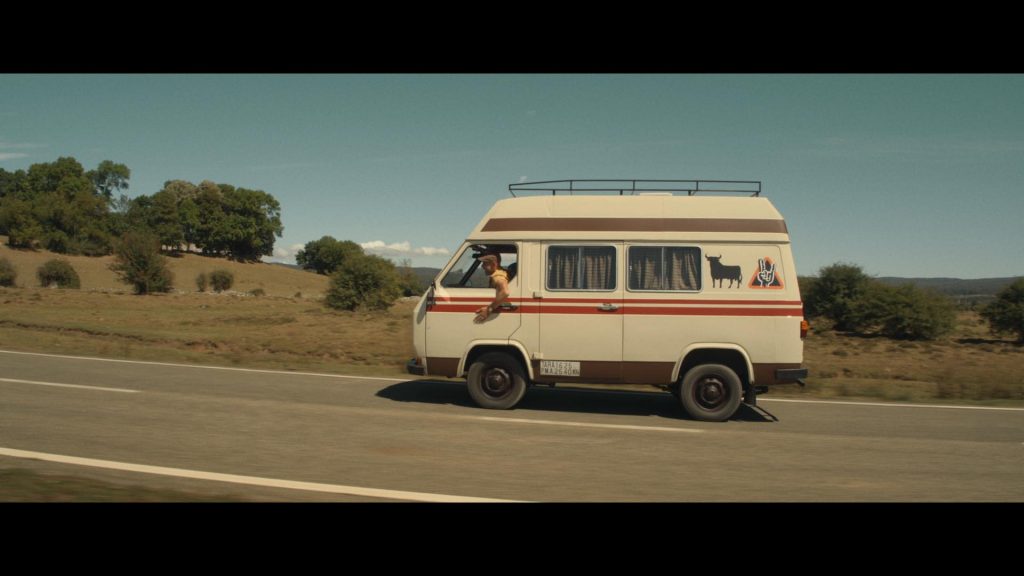
The van, of course, was the centre of everything. Once you accept that most of your film will take place inside a moving vehicle, you also accept that the entire photographic strategy has to be built around that fact. Shooting everything in the real van would have been too restrictive for camera, lighting, performance and effects work, so a full-scale interior replica was built on a pneumatic motion platform. That set became essential, not merely as a technical solution but as the place where much of the film’s language could actually be invented. At the same time, the real van remained indispensable, because certain angles, certain details and certain fragments of geography only existed there. The film was constantly negotiating between two realities: the physical truth of the real vehicle and the expressive freedom of the constructed one. What mattered most to me in that space was avoiding monotony. A concept like this can very quickly become repetitive if the camera feels trapped inside the premise. I did not want the film to become a succession of static interiors with movement happening around them. I wanted the camera to remain alert, searching, responsive to the emotional shifts inside the van. That became one of the guiding ideas of the shoot: the camera should not simply submit to the movement of the vehicle, but retain a life of its own. That independence allowed the film to breathe. It allowed us to move into faces, drift across the interior, and subtly rearrange emotional power within the frame. Even when the world is physically small, the image still needs to feel alive.
Designing the Night
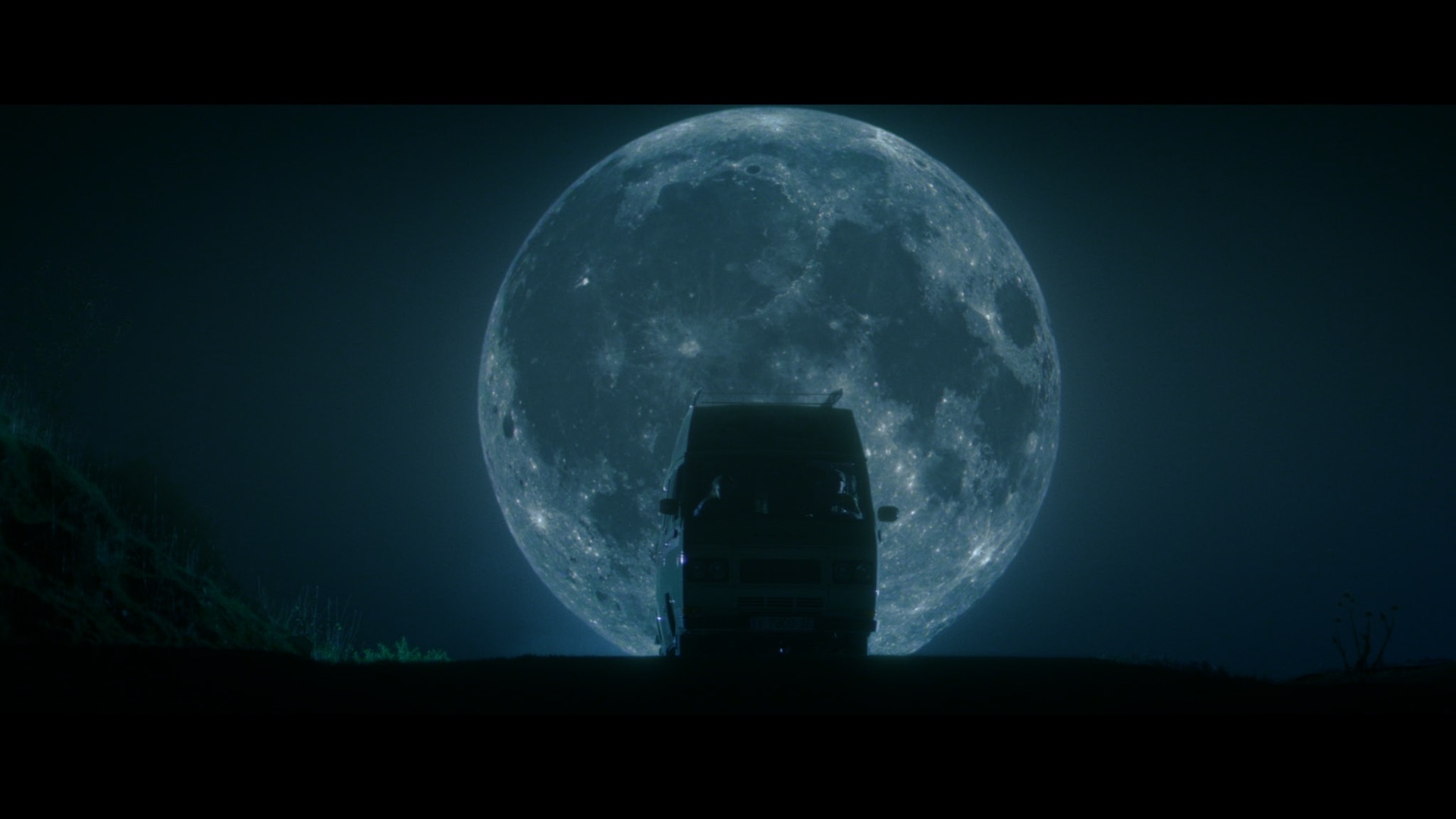
The exterior nights presented a very different challenge, and in many ways they came to define the film’s personality. My initial instinct was to think in relatively classical terms: larger sources, more distance, a greater sense of scale in the forest and on the road. But production realities quickly pushed us towards a leaner, more improvised solution. Rather than resisting that, I tried to let it shape the film. In the end, the night work became one of the clearest examples of how limitation can become style. The night in The Passenger was never meant to be realistic in any documentary sense. I wanted a cinematic night: a night with pressure, seduction and atmosphere. I have always loved films in which night is not simply the absence of light, but a dramatic material in itself. A film like this needed darkness, but not dead darkness. It needed mystery, but also beauty. It had to isolate the characters while suggesting that something larger and more threatening surrounded them. That is where the dominant blue atmosphere of the film began to emerge. It was not intended as realism, but as an expressive world: a genre night, filtered through memory and cinema.

Like many visual ideas, however, that atmosphere had to prove itself in practice. One of the first lessons the film taught me was that diffusion and darkness are only beautiful when they are held firmly enough. In the first week of exterior nights I pushed the image towards a softer, more diffused texture. Some of that material still contains things I love. In other moments, I felt I had gone too far. Contrast weakened too much, and what I wanted to feel mysterious risked becoming imprecise. That experience forced me to recalibrate. As the shoot progressed, I began to trust harder light, stronger separation and deeper blacks more decisively. The image grew more assured. In a sense, the film’s night language matured during the shoot itself. It did not arrive fully formed in prep; it evolved under pressure, which is often where the most truthful decisions are made. What remained important throughout was that the film should never rely on a single visual idea repeated mechanically. Even within a coherent visual world, each major section needed its own emotional register. The village sequence became especially important in that respect. By then, much of the film had embraced a cold blue nocturnal language, and I wanted the village to feel like its opposite: warmer, sodium-like, more recognisably Spanish, more rooted in memory and place. That shift mattered because it prevented the film from becoming emotionally monochrome. The village did not abandon stylisation; it simply opened another door within it.


The roadside bar was another crucial moment. Some locations arrive with their own emotional gravity, and that bar was one of them. It felt suspended in time, almost abandoned by the world, yet still full of traces of stories, routines and ghosts. I wanted that sequence to feel like a point of convergence between genres: part horror film, part road movie, part something faintly western. The light there was not simply about mood, but about memory. It had to feel as though the place had absorbed years of smoke, silence and waiting.
Letting the Film Evolve
As the film moved inward again, into the van interiors, the image gradually became less realistic and more expressionistic. The blue ambient world remained central, but the system opened itself to stronger interventions. Red brake-light effects gained greater weight. Green entered almost unexpectedly at first, but soon revealed itself to be exactly right. What interested me in those final sections was the sense that the film had earned greater freedom by then. At the beginning, the image remains closer to a recognisable world. As the story intensifies, the photographic logic also becomes bolder, more feverish and more emotionally charged. Realism ceases to be the most useful criterion. What matters is whether the image carries the same escalating pressure as the narrative. The transformation feels very close to the movement of the film itself. The Passenger begins in a world we can still recognise and gradually slips into something more unstable, more excessive and more hallucinatory. I wanted the image to follow that drift — not by becoming arbitrary, but by becoming more daring precisely where the film asked for it. I have never been especially interested in visual concepts that remain fixed regardless of what the story needs. I prefer an image that listens: an image capable of preserving its identity while still allowing itself to mutate.


Towards the end of the shoot, the production forced that principle even further. Heavy rain prevented us from completing several important exterior shots in the forest, and there was no practical way to return with the whole unit once stage work had expanded beyond its original plan. At that moment, the film presented us with a very simple question: was the visual world strong enough to survive reconstruction? Could missing location material be recreated on stage and still belong to the same film? Those moments are always humbling, because they strip away any romantic notion of control. What remains is the essence of the work: whether the visual logic is coherent enough to be translated. We already knew how those scenes wanted to behave. We knew where the light lived, where the darkness needed to remain, how the bodies should turn, and what kind of tension the frame had to hold. That was what made the reconstruction possible. Not technology alone, but continuity of thought.

Final Thoughts
Looking back now, what I value most about The Passenger is precisely that process of discovery through resistance. We prepared carefully. We designed. We planned. But the film kept pushing back. It forced us to adapt, to simplify, to trust darkness more, to harden the image where softness weakened it, to embrace stronger colour where realism had ceased to be enough, and to keep listening to what the material itself was asking for. In that sense, The Passenger taught me something essential about cinematography. Taste matters, of course. So does preparation. But a film also demands resilience, hierarchy and instinct. It demands the ability to protect an idea while allowing it to change shape. That remains, for me, one of the most beautiful things about cinema. A film is never only the result of a plan. It is also the result of friction: between intention and circumstance, between the imagined film and the possible one, between control and accident. Sometimes the most important decisions are not the ones you arrive with, but the ones you make under pressure, when the film finally reveals what it needs.
I am deeply grateful to Raúl Cerezo and Fernando González Gómez for their trust, ambition and generosity throughout the process, and to the producers José Luis Rancaño and Silvia Melero for sustaining a demanding film with commitment and intelligence. I also want to thank my camera team and my lighting team, whose craft, precision and dedication were essential every single day. Films like this are collective constructions, and whatever visual identity The Passenger has belongs as much to that shared effort as to any one decision made behind the camera. For me, The Passenger remains a film about motion in every sense: bodies in transit, genres colliding, images searching for their proper temperature, and a crew trying to transform limitation into cinema. If the film carries some unease, some atmosphere, and some beauty within its darkness, I think it comes from that tension. The visual language had to travel with it.
Continue Exploring the Project
If you would like to go deeper into the making of the film, the Spanish-language production diary expands on many of the ideas summarised here: prep, lens choices, night exteriors, sodium-lit village scenes, the van simulator, greenscreen work, split diopters, stage interiors and the final reconstruction of missing exterior material. Those five articles are the most complete written account of how The Passenger was photographed.
About the Author
Ignacio Aguilar AEC is a Spanish cinematographer working across feature films and prestige genre projects. His work is defined by atmosphere, period texture, psychological tension, and a strong relationship between colour and dramaturgy. He is particularly drawn to stories in which the image can build emotional density, moral space, and a distinctive visual world. Based in Spain, he is available for international productions.