


“The Reader”
Spanish Title: The Reader (El Lector)
Year of Production: 2008
Director: Stephen Daldry
Directors of Photography: Roger Deakins, ASC, BSC and Chris Menges, ASC, BSC
Lenses: Zeiss Master Prime
Film Stocks: Kodak 5217 (200T), 5218 (500T) and 5219 (500T)
Format and Aspect Ratio: 3-perf Super 35mm, 1.85:1
Other: 2K Digital Intermediate
Awards: Academy Award nomination for Best Cinematography; American Society of Cinematographers nomination; British Society of Cinematographers nomination; BAFTA nomination
Viewed on: 35mm and Blu-ray
Cold postwar light, warmer interiors and an unusually seamless visual unity between Roger Deakins and Chris Menges in Stephen Daldry’s “The Reader” cinematography.
The Film
“The Reader” is the film adaptation of Bernhard Schlink’s novel, set in Germany across several timelines between 1958 and 1995. Michael Berg — played by David Kross as a young man and Ralph Fiennes as an adult — is a 15-year-old student who, by chance, meets Hanna Schmitz, played by Kate Winslet, a tram conductor. After she helps him when he falls ill, an intimate and morally troubling relationship begins between them.
In 1995, the adult Michael is a lawyer. He seems professionally successful, but also emotionally blocked. He is divorced, has a daughter and appears unable to form lasting relationships. The film gradually reveals the reasons that turned him into the person we see in the present.
“The Reader” is controversial in several respects. It is also a film that works very well, even if it is not perfect and leaves several factual and moral uncertainties unresolved. Its strongest asset is the acting: David Kross, Kate Winslet — who won the Academy Award — and Ralph Fiennes give the material a level of gravity that is essential to the film. It also received Academy Award nominations for Best Picture, Best Director for Stephen Daldry, Best Adapted Screenplay for David Hare and Best Cinematography.
The Cinematographers
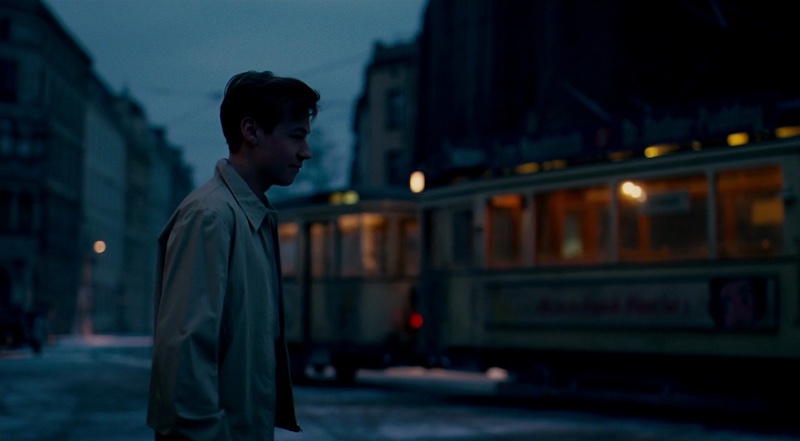
The directors of photography were Roger Deakins [ASC, BSC] and Chris Menges [ASC, BSC], in a shared credit created by the circumstances of production. Deakins was originally the film’s cinematographer and shot all, or at least most, of the material with Ralph Fiennes, and possibly some of the David Kross scenes in the 1966 timeline.
The production was delayed because Nicole Kidman was initially set to play the female lead. When she left the project, shooting stopped for several weeks until Kate Winslet — according to the filmmakers, their original choice — could join the production. By then, Deakins was no longer available and had to be replaced.
The film was fortunate that the replacement was Chris Menges. Like Deakins, Menges is a two-time Academy Award winner for cinematography. Deakins received his Oscars later, for “Blade Runner 2049” (Denis Villeneuve, 2017) and “1917” (Sam Mendes, 2019). Menges won his two Oscars almost consecutively in the 1980s, when he was around 45, for “The Killing Fields” (1984) and “The Mission” (1986), both directed by Roland Joffé.
Menges would later work with Stephen Daldry again on “Extremely Loud & Incredibly Close” (2011), where he replaced Harris Savides, who was originally scheduled to photograph the film but could not begin the shoot because of the illness that would soon take his life.
Visual Style Analysis
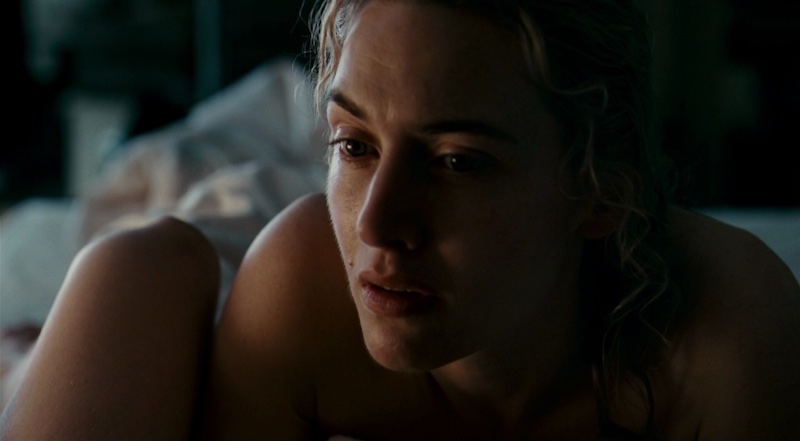
In “The Reader,” Brigitte Broch’s production design and the costumes by Donna Maloney and Ann Roth are essential. They give every timeline a credible, elegant and carefully modulated period appearance. Within that framework, it is not particularly surprising that the transition between Roger Deakins and Chris Menges is almost impossible to detect on screen.
There are two reasons for this. The first is structural: because the story unfolds across several decades, any small visual differences would have been easy to justify dramatically. The second is more important. Deakins and Menges share a related visual philosophy. Both are British cinematographers with a strong feeling for natural light, direct staging and simple, precise solutions. Both also operate the camera, which often gives their images a similar sense of physical placement.
Regardless of who photographed each scene, the image of “The Reader” is defined by a coldness that identifies postwar Germany. That cool atmosphere is often contrasted with warmer light coming from interiors. It is a strong visual idea, and one that Deakins would also explore in his next film, “Doubt,” the project he had to leave for when “The Reader” was delayed.
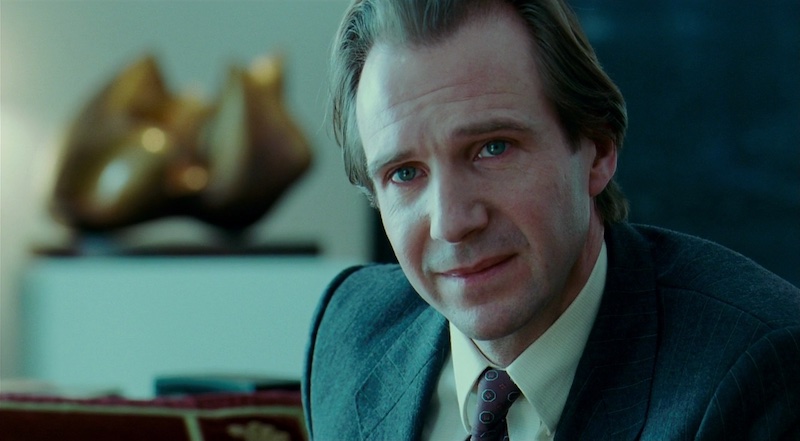
Both Deakins and Menges appear to use large diffused sources outside the sets. The texture is soft but still controlled and contrasty, which suggests high-output units, heavily diffused, carefully cut and often balanced with negative fill so that the soft light does not simply wrap everything.
In Deakins’s scenes, one can recognize his taste for warm interiors motivated by practical sources. Those lamps justify the color temperature, while small units — often the kind of 650W Fresnels or tweenies he has frequently used — are likely bounced into unbleached muslin to support the same warm, slightly yellow tone. The result is not a theatrical warmth, but a controlled domestic warmth that sits against the colder world outside.
The film achieves a realistic but sophisticated atmosphere. On the big screen, it had a fine layer of grain and a great deal of definition, partly because it was shot with ARRI/Zeiss Master Prime lenses, which at that time represented one of the most technically perfect lens series available for cinema. Interestingly, in the trial sequence, Lena Olin’s close-up seems to reveal a different optical character in the bokeh, suggesting the possible use of a Cooke S4, perhaps because a specific telephoto focal length was not available in the Zeiss set or did not yet exist in the series.
The change from Deakins to Menges also coincided with a change of negative stock. Deakins appears to have shot his material on Kodak 5218 (500T), while Menges, when production resumed, used the newer Kodak 5219 (500T), which had just appeared on the market. On 35mm prints, that change was effectively invisible.
Conclusion
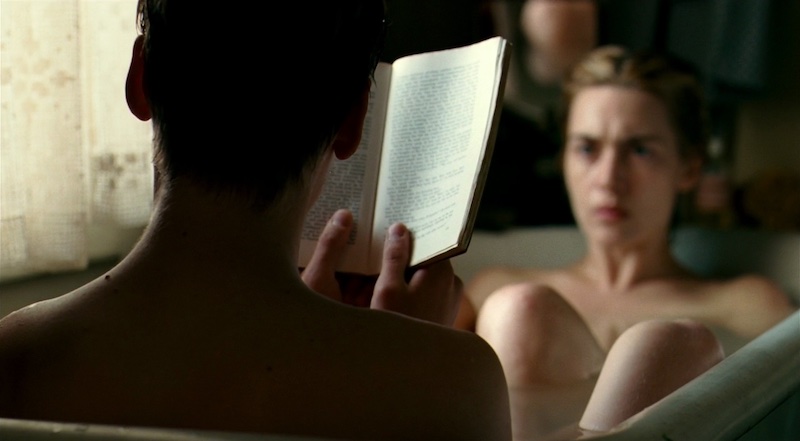
The most delicate scenes in the film may be the early apartment scenes between Kate Winslet and David Kross. They are somber, intimate and built around mixed color temperatures, a quality often associated with Menges, from his Oscar-winning work to later films such as “North Country” and “The Three Burials of Melquiades Estrada.” Pale light enters through the apartment windows and leaves the characters in half-shadow. The sources are soft but often directional, lateral or backlit. The warmer lamp light used for the first readings sits over a cooler blue environment, reinforcing the secrecy of the relationship.
The opening scene in the building entrance is another strong example: figures are held in silhouette against the background exposure. The more remembered exterior images may be the bluish twilight scenes in which David Kross’s character tries to visit Kate Winslet while she is working on the tram. The tram interior is photographed in golden tones, like low-voltage bulbs, while the blue exterior atmosphere surrounds it.
The result is a magnificent piece of cinematography, unusually cohesive despite being the work of two different authors. The unity makes sense because Deakins and Menges are, in many ways, similar cinematographers: practical, restrained, attentive to naturalism and deeply sensitive to the emotional temperature of light.
“The Reader” works both as a realistic period portrait and as a refined visual construction, with the kind of elegant, carefully shaped image often expected from this type of prestige historical drama. It is therefore logical that it received the major cinematography nominations of its season, even if Anthony Dod Mantle’s work on “Slumdog Millionaire” — with all its possible objections — dominated many of the awards.
ON FILM & DIGITAL
© Ignacio Aguilar, 2026.
This article is part of ON FILM & DIGITAL’s English-language cinematography reviews and essays.
The Author
Ignacio Aguilar, AEC is a Spanish cinematographer based in Madrid. His work spans feature films, television, commercials and technical writing on cinematography, with experience in digital cinema, 16mm and 35mm film, anamorphic lenses, large-format digital capture and practical lens testing.
Read more articles and reviews in Spanish at ON FILM & DIGITAL, or visit the main cinematography portfolio at ignacioaguilardop.com.