

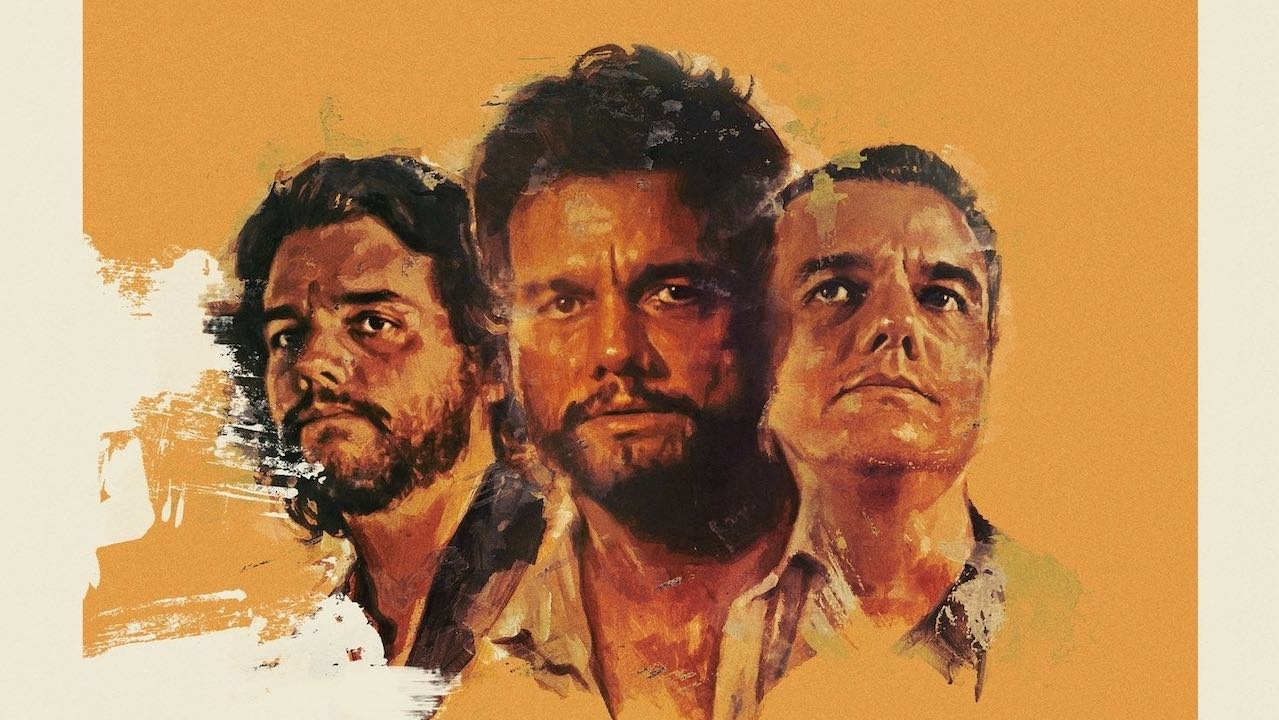
O Agente Secreto / The Secret Agent (2025) – Cinematography by Evgenia Alexandrova
“O Agente Secreto” / “The Secret Agent”
Original Title: “O Agente Secreto”
English / Spanish Title: “The Secret Agent” / “El Agente Secreto”
Year of Production: 2025
Director: Kléber Mendonça Filho
Director of Photography: Evgenia Alexandrova, AFC
Lenses: Panavision B Series, Panavision E Series, Panavision AWZ2.3 37-85mm T2.8 and ATZ 75-210mm T2.8
Format and Aspect Ratio: ARRI Alexa 35 + ARRI Alexa Mini, 2.39:1 / 2.40:1
Other: 4K Digital Intermediate
Viewed on: 4K HDR HDTV
Warm exposure, Panavision anamorphic lenses and a vivid 1977 Brazil in Evgenia Alexandrova’s cinematography for Kléber Mendonça Filho’s political period film.
The Film
The Secret Agent, one of the major international successes of Brazilian cinema in 2025, arrived with considerable prestige: Cannes awards, wide critical attention and four Oscar nominations. Set in 1977, the film follows Armando, played by a magnetic Wagner Moura, as he arrives in Recife under a false identity. His immediate plan is simple: find his son and leave the country. The film then gradually reveals what happened before his arrival, and why he has been forced into hiding.
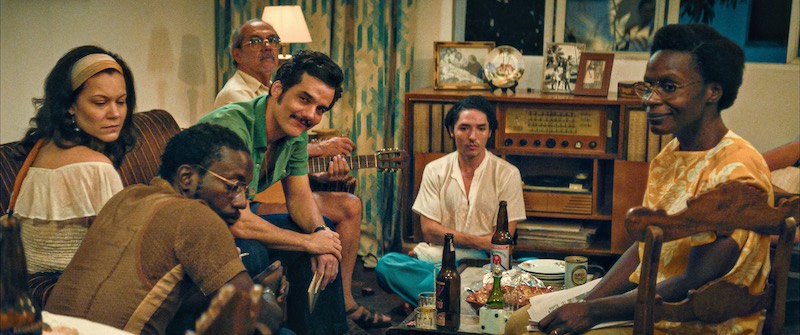
Kléber Mendonça Filho, who wrote and directed the film, does not shape the material as a conventional thriller. The story advances through fragments, digressions and small narrative blocks. Some of them clarify Armando’s situation; others expand the world around him. The cinema, the apartment where dissidents gather, the streets of Recife, and the textures of everyday life under the final years of the Brazilian military dictatorship often seem to interest Mendonça as much as the mechanics of the plot itself.
That is both the film’s strength and its limitation. The Secret Agent builds a rich and highly specific atmosphere, but its narrative movement is not always as forceful as its setting or its lead performance. Moura gives the film a strong dramatic centre, yet the film repeatedly moves away from him, preferring a broader portrait of a time, a place and a political climate. The result is distinctive, but also somewhat frustrating. One feels that the film could have carried both: the density of its world and a more direct dramatic progression.
The Cinematographer
The director of photography is Evgenia Alexandrova, AFC. Born in Russia, she has developed most of her career in France. Her previous work on the Brazilian film Heartless (2023), produced by Mendonça and Emilie Lesclaux among others, appears to have led to this collaboration. Her credits as a cinematographer begin around 2015, mainly with short films, before her first feature, Mi Iubita, Mon Amour (Noémie Merlant, 2021). She later worked again with Merlant on Les Femmes au Balcon (2024), and photographed Avec ou sans Enfants? (Elsa Blayau, 2025).
Visual Style Analysis
Visually, The Secret Agent is less interested in imitating a 1977 photographic process than in building a vivid period world through exposure, color, locations, texture and Panavision anamorphic rendering.
There is an interesting gap between the published technical information and what the image appears to suggest on screen. I would not present this as a contradiction, because mixed lens packages are often used more fluidly than credits or equipment lists imply. But the character of much of the image points, to my eye, less toward older B Series primes than toward Panavision’s anamorphic zooms.
The film was reportedly shot with the ARRI Alexa 35 as the A camera, often operated by Alexandrova herself, with a standard ARRI Alexa Mini used as the B camera. That combination makes sense. Once the material has been graded, and under most normal shooting conditions, the two cameras can be made to sit together convincingly.
The lens package is more revealing. The Panavision B Series has been widely cited as the main set. These are older anamorphic lenses, predating the C Series and generally associated with the late 1960s. Panavision and other sources also credit the E Series, which may have been used for longer focal lengths — especially the well-known 135mm and 180mm E Series lenses.
It is also possible that the E Series was used for the few contemporary scenes, where the interiors make the lens character harder to identify.
However, from what I see on screen, much of the film does not look as if it was shot primarily with B Series or E Series primes. A large part of it appears to have been photographed with the Panavision AWZ2.3 37-85mm T2.8 and ATZ 75-210mm T2.8 anamorphic zooms. These are true 2x anamorphic zooms with front anamorphic elements, and their rendering is quite different from the B Series.
The older B Series primes usually produce a more fragile image, with more visible fall-off, more irregularity away from the centre, and a behaviour closer to the early Panavision anamorphic tradition. The AWZ2.3 and ATZ zooms, by contrast, have a cleaner, more stable, more modern rendering. They are still unmistakably anamorphic, but their sharpness, consistency and distortion pattern give them away. That is why, watching the film, I often felt I was seeing the zooms rather than the older primes.
This matters because the film’s period look does not seem to come primarily from an aggressive film-emulation grade. If there is a 1970s-style LUT, it is not being pushed in an obvious way. The image still has a broadly modern digital texture, consistent with the Alexa 35 and Alexa Mini.
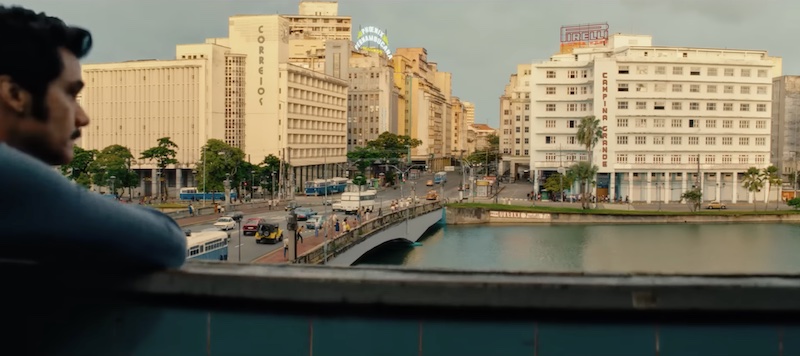
The period feeling comes more from what is placed in front of the lens: locations, color, costume, production design, weather, skin, walls, streets and practical textures. The camera records a constructed 1977 more than it simulates a 1977 photographic process. The Panavision anamorphic package helps soften the digital impression, especially because the zooms are not as clinically sharp as many modern prime lenses.
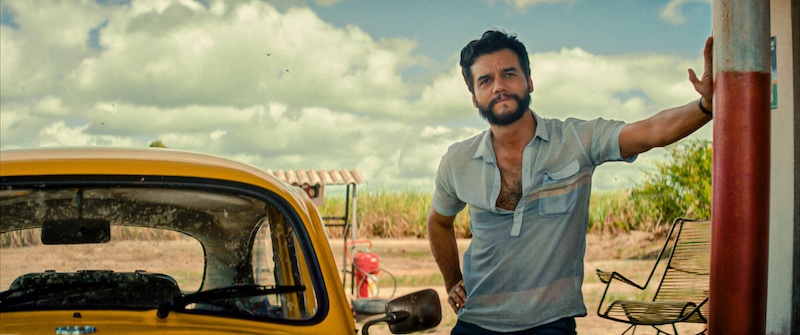
This is where both the film and the cinematography are at their strongest. They create a portrait of Brazil that is nostalgic, colorful and alive, while still being marked by the presence of dictatorship. The image is warm, open and often surprisingly joyful, which gives the political context a more complex visual tone than a darker thriller approach might have produced.
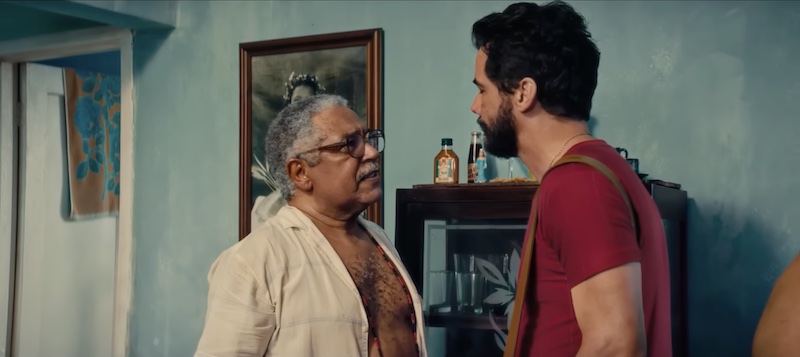
Color is central to that strategy. The 1977 sections are full of warm hues, strong surfaces, textured walls, period interiors and small pockets of local character. One of the best examples is the shopping arcade, with its hair salon connected both to the interior passage and to the street. These spaces feel specific. They could only belong to that city, that climate and that moment.
When the film moves briefly into the contemporary period, the image becomes flatter, cooler and more anonymous. The color drains away. The locations lose much of their personality. Brazil suddenly looks as if it could be almost anywhere. That contrast is simple, but effective. The past is visually dense; the present is more neutral, perhaps even diminished.
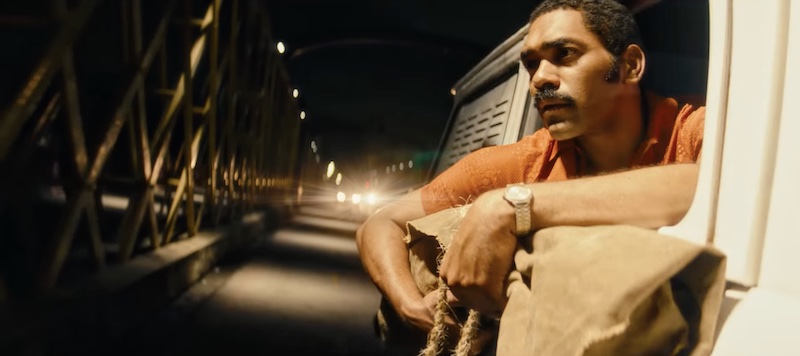
The lighting follows the same general approach. Alexandrova does not pursue a hard, expressionistic thriller style. Many sections are relatively bright, especially for a story built around danger, disappearance and political violence. The exteriors often lean into high exposure, with strong highlights and a great deal of natural brightness. This gives the film freshness, but it also makes its genre identity less precise.
That lack of definition may partly belong to the film itself. The Secret Agent opens many narrative fronts and closes only some of them. Even an important piece of information is withheld until later, changing the viewer’s understanding of what has been happening. As a result, the cinematography sometimes feels as if it is serving a film that prefers accumulation to dramatic focus. Its strongest contribution is not suspense, but atmosphere: heat, color, surfaces, locations and the physical presence of Recife in 1977.
The overexposure strategy gives the film freshness, but it also exposes the limits of digital capture when compared with negative. The Alexa Mini and Alexa 35 are exceptional cameras, especially in the highlights, but a bright exterior pushed toward the top of the curve does not break in the same way on a sensor as it does on film. In O Agente Secreto, that difference remains visible. Sometimes it gives the image a modern clarity that works against the period illusion; at other times, it gives the film precisely the vividness that separates it from a more conventional dictatorship-era drama.
Conclusion
The result is a strong piece of cinematography, though not always a fully controlled one. Its best quality is the way it uses exposure and color to avoid the obvious visual clichés of dictatorship-era drama. It does not make the past look dead, grey or purely oppressive. It makes it bright, populated, contradictory and alive. That may be the film’s most valuable visual idea.
ON FILM & DIGITAL
© Ignacio Aguilar, 2026.
This article is part of ON FILM & DIGITAL’s English-language cinematography reviews and essays.
These texts are not plot summaries or general film reviews, but cinematography-focused essays written from the perspective of a working cinematographer.
The Author
Ignacio Aguilar is available for cinematography work, creative collaborations, lectures, workshops and international projects. He is a Sony Independent Certified Expert (ICE) and Cooke Optics Spanish Ambassador for Cooke SP3 lenses. Contact here.