

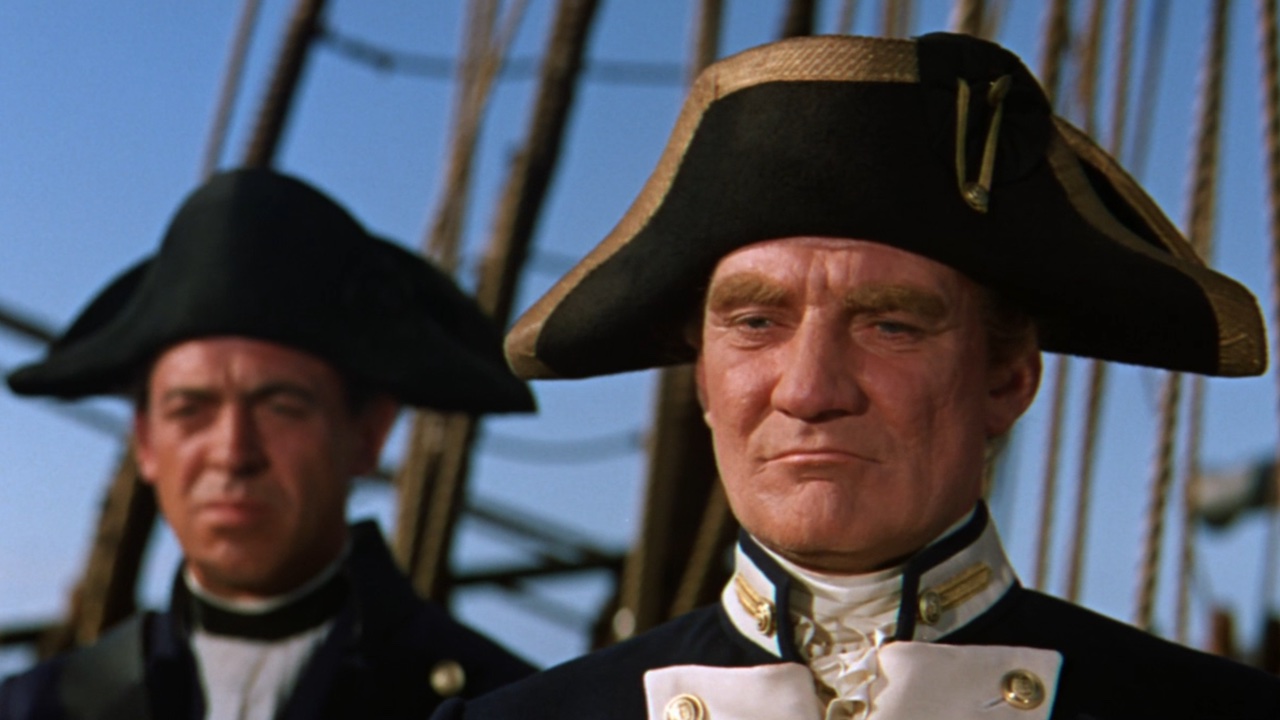
“Mutiny on the Bounty”
Spanish Title: Rebelión a bordo
Year of Production: 1962
Director: Lewis Milestone
Director of Photography: Robert L. Surtees, ASC
Lenses: Panavision APO Panatar
Film Stock: Kodak 5251 (50T)
Format and Aspect Ratio: 65mm anamorphic (Ultra Panavision 70), 2.76:1
Additional Photography: Harold E. Wellman, ASC
Awards: Academy Award nomination for Best Color Cinematography
Viewed on: Blu-ray
Robert L. Surtees turns “Mutiny on the Bounty” into a maritime adventure of enormous scale, making full use of the 65mm anamorphic breadth of Ultra Panavision 70.
The Film
“Mutiny on the Bounty” is the second major Hollywood adaptation of the novel by Charles Nordhoff and James Norman Hall, following the successful 1935 version directed by Frank Lloyd and starring Charles Laughton and Clark Gable. This time, Metro-Goldwyn-Mayer mounted the story as a large-scale production starring Trevor Howard as Captain Bligh and Marlon Brando as his second-in-command, Fletcher Christian.
Together, they command the Bounty, a ship that leaves England in the late 18th century for Tahiti in order to transport breadfruit trees back to the British West Indies. After a difficult voyage, the harsh conditions on board — and, above all, Bligh’s excessive authoritarianism — lead the crew toward mutiny.
The production was notoriously complicated, not only because of its logistics, but also because of an incomplete screenplay that kept changing during the shoot and, apparently, because of Marlon Brando’s difficult behavior. All of this contributed to the departure of the original director, Carol Reed, and to George Seaton handling part of the remaining material near the end of production.
Despite those problems, this version of the story is spectacular, very entertaining and remarkably accomplished. It represents a kind of large-scale adventure filmmaking that disappeared decades ago. Richard Harris, Hugh Griffith and Tarita are also part of the cast, and Bronislau Kaper’s score is one of the film’s major strengths.
The Cinematographer
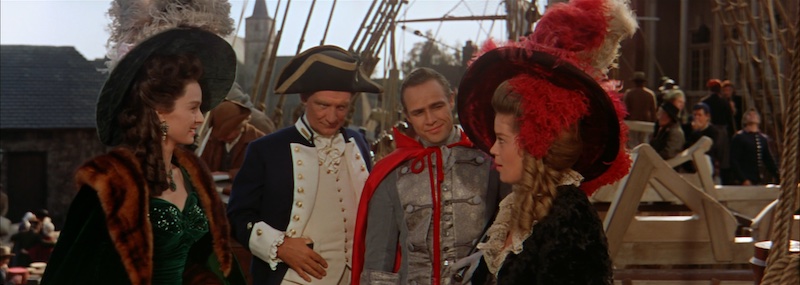
The cinematographer assigned by MGM was Robert L. Surtees [ASC], a logical choice at the time. When “Mutiny on the Bounty” was made, Surtees had just won his third Academy Award for an MGM production, “Ben-Hur” (1959), following earlier Oscars for “King Solomon’s Mines” (1950) and “The Bad and the Beautiful” (1952).
Across his career, Surtees received thirteen additional Academy Award nominations, from “Thirty Seconds Over Tokyo” (1944) to “Same Time, Next Year” (1978), his final film. Much has been written about the fact that seven of those nominations came during his final decade of active work, the 1970s, with films such as “Summer of ’42” (1971), “The Last Picture Show” (1971), “The Sting” (1973) and “The Hindenburg” (1975).
By then, Surtees was one of the last representatives of a classical hard-light style that the new generation of 1970s cinematographers — Gordon Willis, Conrad Hall, Vilmos Zsigmond and others — would largely replace with a more realistic and less heavily lit approach.
Surtees was also a specialist in color and large formats. His command of color was already evident in “Quo Vadis?” (1951), and he introduced the MGM Camera 65 format with “Raintree County” (1957). He also worked in Todd-AO on films such as “Oklahoma!” (1955) and “Doctor Dolittle” (1967). That same year, despite his classical background, he accompanied Mike Nichols extremely well on the emblematic “The Graduate” (1967). He also photographed the unusual horror film “The Other” (1972).
Visual Style Analysis
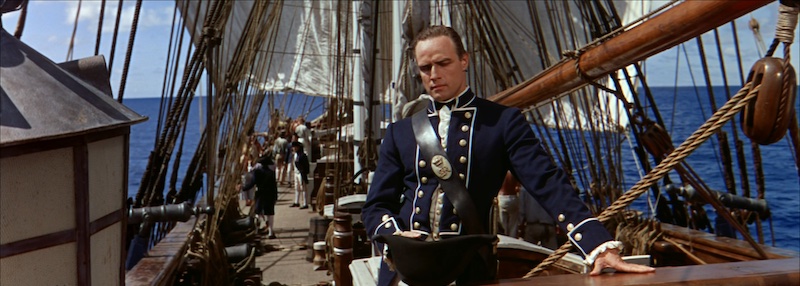
Like “Raintree County” and “Ben-Hur”, “Mutiny on the Bounty” was photographed in Ultra Panavision 70. The format, later revived by Quentin Tarantino and Robert Richardson for “The Hateful Eight” (2015) after having been unused since “Khartoum” in 1966, uses 5-perf 65mm negative, as Super Panavision 70 does. The difference is that Ultra Panavision 70 uses anamorphic lenses with a 1.25x squeeze instead of conventional spherical lenses.
That produces the widest aspect ratio in commercial cinema: 2.76:1. During production, however, it was very likely understood that the film would often be shown in 35mm reduction prints, either 2.35:1 or 2.55:1, or even in spherical 70mm at 2.21:1. For that reason, the extreme edges of the frame rarely contain essential information.
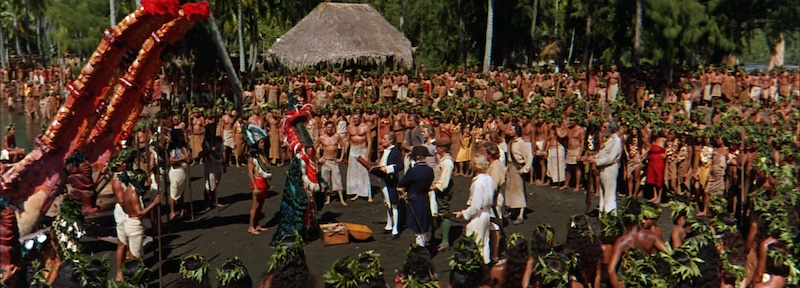
Even so, “Mutiny on the Bounty” uses the full breadth of the format very effectively in many exterior shots. The film was shot at sea, in Tahiti, in Hawaii and in other spectacular locations, and it often understands what Ultra Panavision 70 can do with landscape, ships, bodies and horizon lines. The arrival of the Bounty in Tahiti is especially impressive. In those passages, Surtees shows very clearly why he was reportedly considered by David Lean for “Lawrence of Arabia” before Freddie Young was hired.
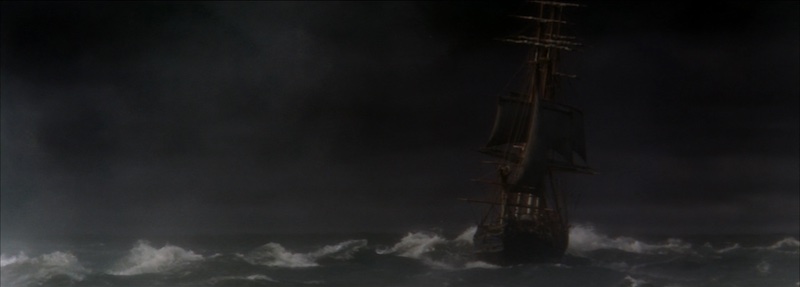
The initial sea voyage is also particularly interesting. In that section, Bligh, in an act of arrogance, decides to take the ship around the dangerous Cape Horn, south of Argentina, rather than sail through calmer waters around southern Africa on the way to Tahiti.
Those scenes combine footage genuinely shot at sea in very rough waters, material photographed in the studio tank and miniature work with the Bounty, also shot in the tank. The sequences have a classical finish, but they are extremely effective. They show that, despite the production’s problems, the MGM team had enormous craft and a very strong sense of cinematic storytelling.
The viewer is not only shown the violence of the sea and the harshness of the voyage. Even on the current, very old and limited Blu-ray, with what appears to be a rudimentary scan, the images can still be astonishing. The high-speed miniature photography is especially impressive, precisely because it helps sell the scale of the storm work.
The deck scenes are also remarkable. They must have been extraordinarily difficult to shoot, since the 2.76:1 frame can include almost half the ship in a single shot. Even so, the filmmakers managed to place the enormous cameras of the period on dollies, tracks and even in unusual positions. Shots of this kind would still be difficult today on a moving ship with much smaller, lighter equipment. In that context, the achievement of “Mutiny on the Bounty” is even more notable.
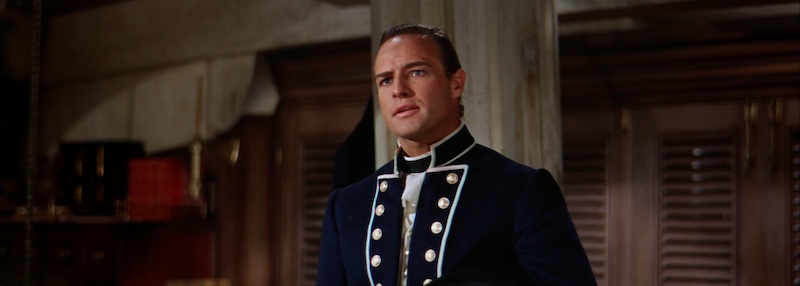
Lighting is perhaps less interesting in the interiors, and in some exteriors the artificial fill light is quite visible, sometimes too visible. The interiors were all shot in the studio, and Surtees appears to have lit them in a very practical classical manner. He seems to have worked toward a generous stop, probably around T5.6, in order to get good lens performance and sufficient depth of field.
That approach created a major problem: the sets were small and cramped, but many large lamps still had to be hidden. With 50 ASA stock, those units had to be powerful — 2K, 5K or 10K sources — in order to expose properly at those stops. The stock itself was relatively new; “Ben-Hur” had still been photographed on 25 ASA negative. As a result, Surtees uses hard, directed light, as he did throughout his career.
Because the sets are especially small for 65mm anamorphic photography, the lighting in “Mutiny on the Bounty” is not as visually interesting as in many of Surtees’s other films. That is not a lack of craft so much as a consequence of format, stop, stock speed and physical constraints.
Overall, the results are very strong. The film has the finish of a major studio production, with extraordinary locations and interiors that are less inspired but still entirely within the conventions of the period. “Mutiny on the Bounty” would be an excellent candidate for a new 4K Blu-ray, new 4K DCPs or even a photochemical presentation in its original format, especially now that large-format cinema has returned to public attention. Few films of its kind make such sustained use of the width and scale of Ultra Panavision 70.
The weakest moments are probably those that, for reasons of logistics, production control or scheduling, were shot in the studio while trying to simulate exterior material. Some scenes use painted backdrops, as in the native dance sequence. Others use location plates projected behind the actors or optical blue-screen work to integrate them into exterior environments. Some night exteriors, including the ending, were also shot on stage.
These moments are noticeable, despite Surtees’s efforts to make them more realistic. Fortunately, they are relatively isolated within such a visually generous production. The film may still carry a somewhat troubled reputation, but it remains highly enjoyable and often spectacular.
Conclusion
“Mutiny on the Bounty” is not the most modern or subtle example of large-format cinematography. Its interiors belong clearly to the classical studio tradition, and some of the process work reveals the limits of production control and optical effects at the time. But as a demonstration of 65mm anamorphic scale, maritime staging and exterior spectacle, it remains a major achievement.
Surtees gives the film a strong, legible and expansive image. At its best — particularly at sea and in Tahiti — the photography has the kind of breadth that only large-format negative and real locations can provide. The current Blu-ray does not seem capable of representing that fully, which makes the film feel like an obvious candidate for a serious restoration and 4K presentation.
For all its production difficulties, “Mutiny on the Bounty” preserves a form of epic adventure filmmaking that is almost impossible to reproduce today: huge physical sets, large-format cameras, real ships, tanks, miniatures, location plates, studio craft and an enormous amount of logistical effort placed directly in front of the camera.
Viewed on Blu-ray
ON FILM & DIGITAL
© Ignacio Aguilar, 2026.
This article is part of ON FILM & DIGITAL’s English-language cinematography reviews and essays.
The Author
Ignacio Aguilar, AEC is a Spanish cinematographer based in Madrid. His work spans feature films, television, commercials and technical writing on cinematography, with experience in digital cinema, 16mm and 35mm film, anamorphic lenses, large-format digital capture and practical lens testing.
Read more articles and reviews in Spanish at ON FILM & DIGITAL, or visit the main cinematography portfolio at ignacioaguilardop.com.