

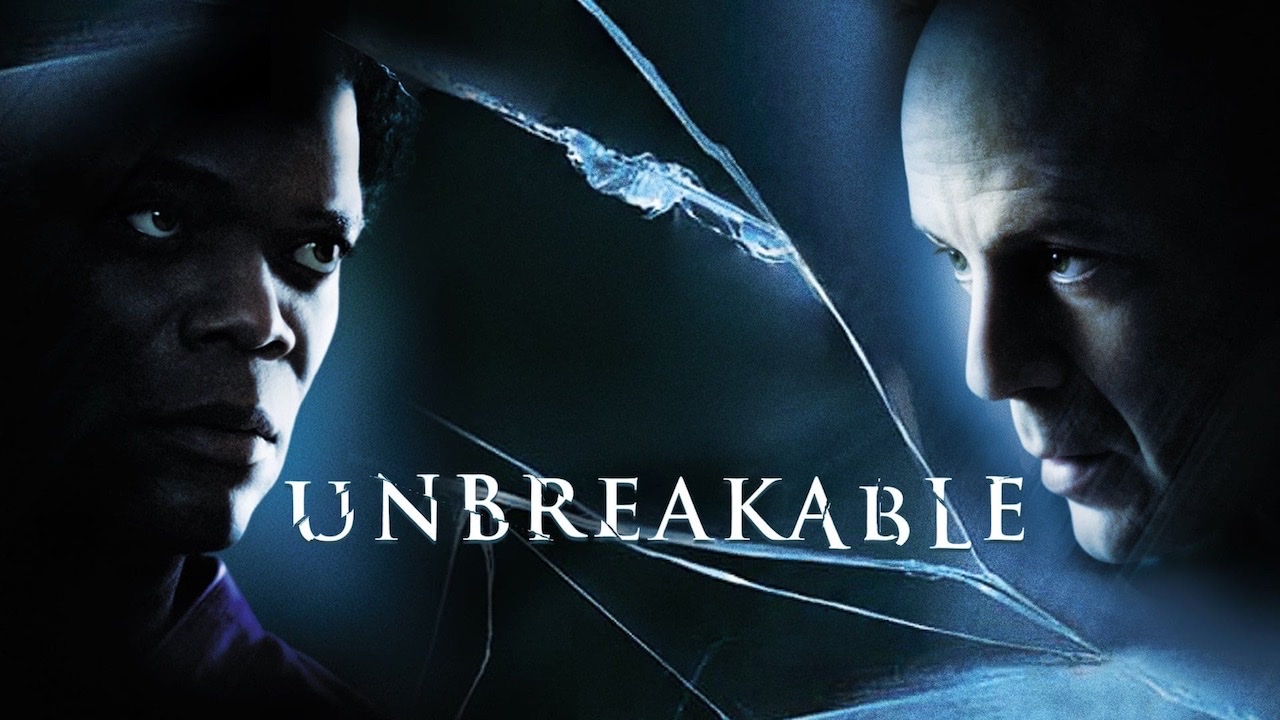
Spanish title: El Protegido
Year of Production: 2000
Director: M. Night Shyamalan
Director of Photography: Eduardo Serra, ASC, AFC
Lenses: Panavision Primo Anamorphic
Film Stock: Kodak 5279 (500T) & 5277 (320T)
Format and Aspect Ratio: 35mm anamorphic (Panavision), 2.4:1
Viewed on 35mm & 4K HDR Blu-ray
In Unbreakable, Eduardo Serra uses naturalistic light, narrative color and precisely controlled anamorphic framing to let the extraordinary emerge from the everyday.
The Film
Probably the finest work by its director, M. Night Shyamalan, who had become suddenly famous just before it with his third feature, the hit The Sixth Sense (1999). This time the story turns on two characters: Elijah (Samuel L. Jackson), a man with a condition that leaves his bones extraordinarily fragile, and David (Bruce Willis), a security guard who is the sole survivor of a train accident near Philadelphia. Elijah approaches David because he believes he possesses a special power, something David himself does not accept.
With simple but highly distinctive staging, Shyamalan builds a deliberately paced film that draws the viewer in through ordinary life, including its family drama, before moving into surprising territory. It is one of those films that becomes more rewarding the less one knows in advance. Robin Wright Penn and Spencer Treat Clark complete the cast.
The Cinematographer
The cinematographer was Portuguese-born Eduardo Serra, ASC, AFC, though the greater part of his career developed in France: Le Mari de la Coiffeuse (1990), La Veuve de Saint-Pierre (2000) and Confidences trop intimes (2004), with Patrice Leconte; or La fleur du mal (2003), La demoiselle d’honneur (2004) and L’ivresse du pouvoir (2006), with Claude Chabrol. His French career went back to the 1980s.
In English-language cinema he first stood out with Vincent Ward on Map of the Human Heart (1993) and What Dreams May Come (1998), while also photographing Jude (1996) for Michael Winterbottom and The Wings of the Dove (Iain Softley, 1997), which earned him an Academy Award nomination. He received a second nomination for his recreation of Vermeer’s light in Peter Webber’s Girl with a Pearl Earring (2003). Later came two collaborations with Edward Zwick, Blood Diamond (2006) and Resistance (2008), and, before his retirement, the final two Harry Potter films, Harry Potter and the Deathly Hallows: Part I and Part II (2010 and 2011), as well as work with filmmakers such as Carlos Saura and Roman Polanski in formats beyond feature films.
Analysis of the Visual Style
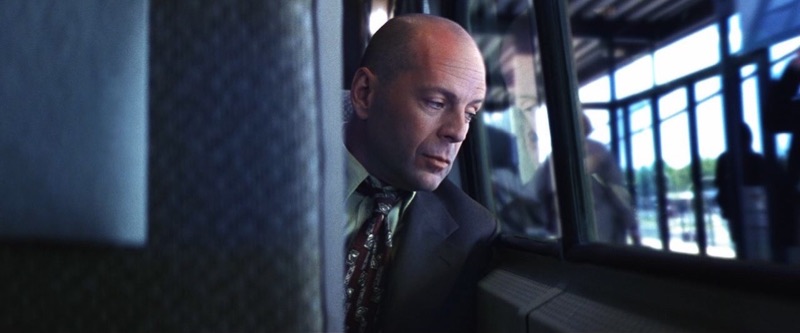
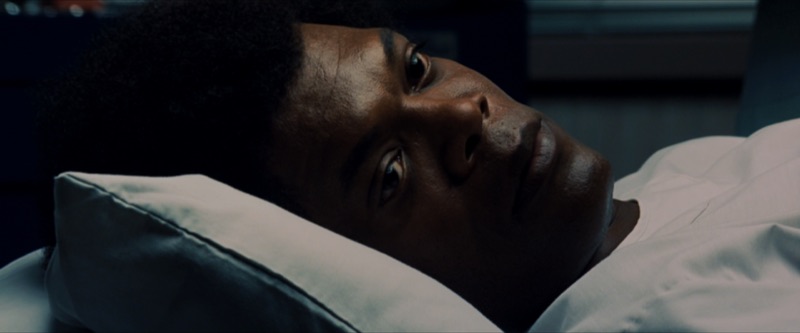
Unbreakable stands out for its deliberate, single-camera staging. M. Night Shyamalan follows the path he had established in The Sixth Sense, but now in anamorphic widescreen, a format he would not use again until Knock at the Cabin many years later. He meticulously choreographs many sequences in what are effectively single takes, with little or no conventional coverage of close-ups, reverse angles and the like. Sometimes he begins with a static camera and one point of interest in the frame; through the introduction of an element—such as the blood in the hospital scene—or gentle tracking moves, the audience’s attention is deliberately transferred elsewhere.
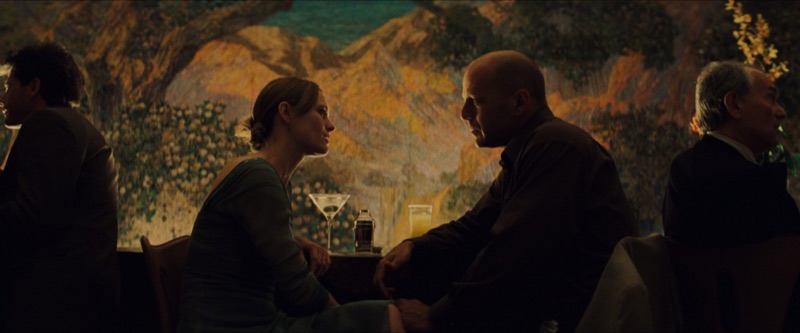
At times Shyamalan even uses handheld camera for dramatic effect, as in the gun sequence or Elijah’s birth, but essentially he resolves the scenes with remarkable simplicity, almost in a European manner. He establishes a clear viewpoint in the staging instead of shooting from every angle and building the film in the editing room. The overall effect is brilliant.
Visually, Unbreakable is equally simple, a consequence of Eduardo Serra’s distinctly naturalistic sensibility. The film does not aim for realism—indeed, it is not realistic—but that philosophy is clear in the way he lights with as few sources as possible, avoiding the typically sophisticated surface of American studio filmmaking. It is especially evident in Bruce Willis and Robin Wright Penn’s domestic scenes, often resolved with a single source on the actors, without fill, backlight or an effort to flatter them. Soft light dominates; at times Kino Flo fluorescents are used directly over the performers, creating the impression of one source without overworking the images.
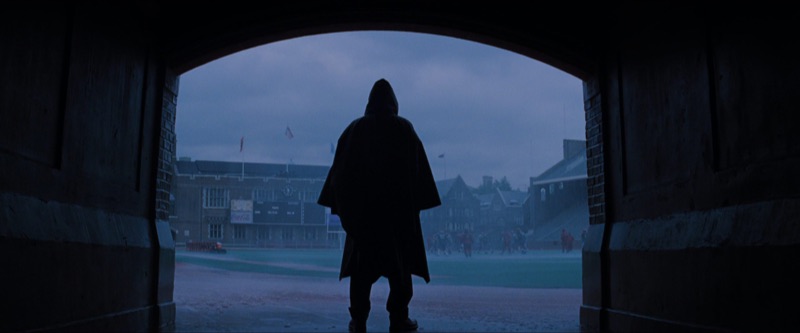
Perhaps most interesting is the presentation of Jackson’s character at different ages, reflected in glass, and the use of color. His flashback scenes are warm, then gradually move toward a colder appearance. By contrast, Willis’s character begins the film in cool light and, as the story advances, his light becomes somewhat warmer; the family scenes are always warm. There are also occasional blue-tinted night exteriors in a classical, contrasty and highly effective style.
Serra used Panavision Primo Anamorphics as his principal lenses, with an occasional zoom throughout the film. For Jackson’s flashbacks he used Kodak 5277 (320T), a relatively grainy and, above all, low-contrast stock. Combined with coral filters, it creates their golden, soft tone; the same stock, without that filtration, was also used for the family scenes. The bulk of the film used Kodak 5279 (500T), the classic stock of the 1990s and 2000s: more saturated, more contrasty and capable of very good blacks.
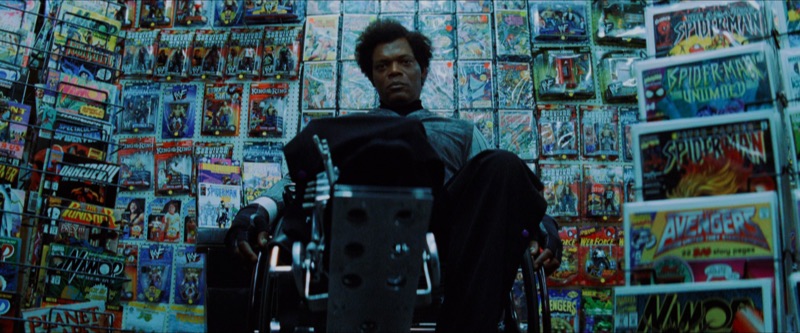
For that reason, the 4K Blu-ray looks very good and remains faithful to the theatrical presentation. Since the film was finished photochemically, some passages appear to use optical transitions, where the quality noticeably degrades.
Final Thoughts
Unbreakable is a very fine piece of work, perhaps—alongside Roger Deakins’s work on The Village (2004)—the strongest cinematography in Shyamalan’s films, within what is probably his most interesting creative period. The precision of the staging and the controlled naturalness of the light make the formal choices inseparable from the narration.
This article is part of ON FILM & DIGITAL’s English-language cinematography reviews and essays.
Ignacio Aguilar, AEC is a cinematographer / director of photography based in Madrid, Spain. His work spans feature films, television, commercials and technical writing on cinematography, with experience in digital cinema, 16mm and 35mm film, anamorphic lenses, large-format digital capture, lens testing and film-based workflows.
He is a member of the Spanish Society of Cinematographers (AEC) and the Spanish Academy of Cinema, a Sony I.C.E. Certified Expert and a Cooke SP3 ambassador. His writing has appeared in American Cinematographer and Camera & Light, and ON FILM & DIGITAL gathers his bilingual essays, technical guides and cinematography reviews.
For professional work, collaborations, lectures, workshops or cinematography consulting, visit his professional biography, selected works or contact page.
The Spanish-language archive is available at ON FILM & DIGITAL.