

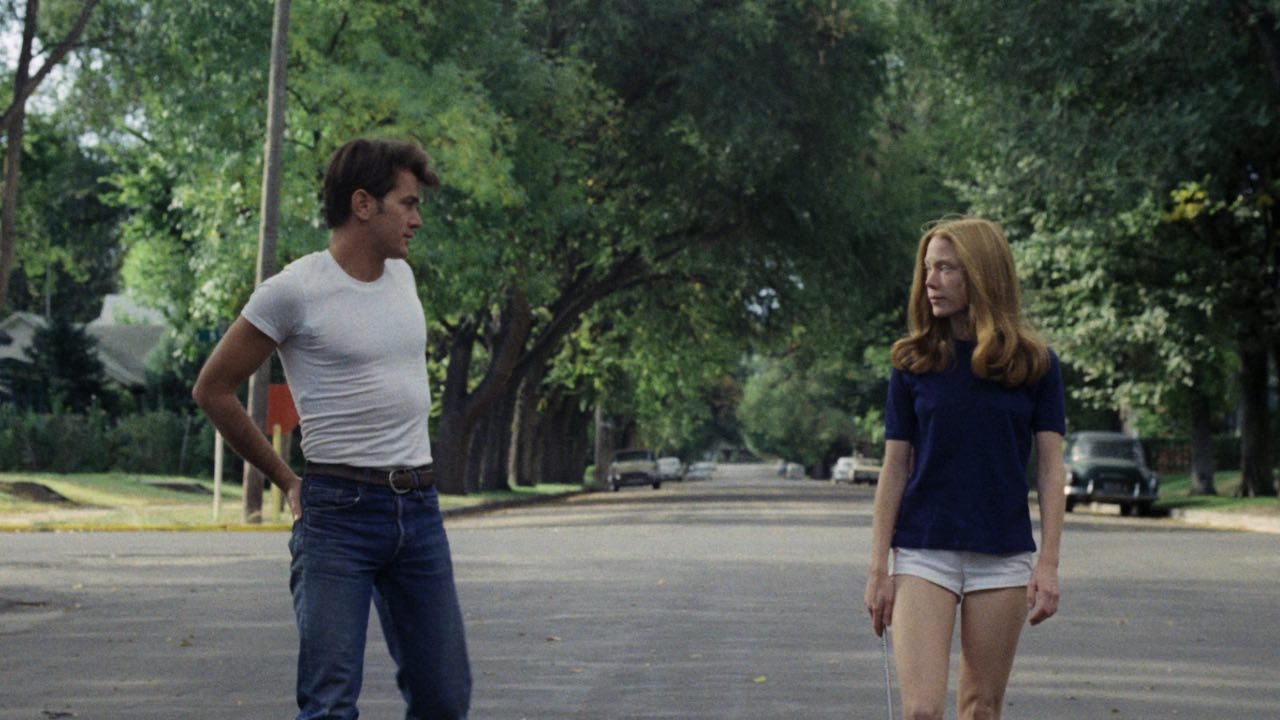
Badlands (1973) – Cinematography by Brian Probyn, Tak Fujimoto and Stevan Larner
“Badlands”
Spanish Title: Malas Tierras
Year of Production: 1973
Director: Terrence Malick
Directors of Photography: Brian Probyn, BSC, Tak Fujimoto, ASC and Stevan Larner, ASC
Lenses: Bausch & Lomb Super Baltar, Angenieux zoom
Film Stock: Kodak 5254 (100T)
Format and Aspect Ratio: 35mm spherical, 1.85:1
Viewed on: Blu-ray
Backlight, overexposure and magic hour: Badlands already announces Terrence Malick’s visual universe in his feature-film debut.
The Film
Badlands was Terrence Malick’s first feature as a director. Its story is already typical of his cinema, both thematically and narratively. A restless young man, Kit Carruthers, played by Martin Sheen, begins a relationship with Holly Sargis, played by Sissy Spacek, a younger and more inexperienced girl living under the control of her father, played by Warren Oates, in a small Texas town during the 1950s.
When the father refuses to accept the relationship, Kit kills him. He and Holly then escape toward the plains of South Dakota, killing several people who cross their path. The film is therefore built around a very familiar American crime narrative, but Malick’s treatment is already something else: less a thriller than a drifting moral and visual fable.
The director’s recurring theme — innocence and the corruption of the spirit — is already fully present in Badlands, even if the scale of production is much smaller than in his later work. The use of music, not composed specifically for the film, and the central role of editing and imagery as narrative structure already reveal the personality of its author with remarkable clarity.
The Cinematographers
For his debut, Terrence Malick worked with three cinematographers. The shoot was started by the British director of photography Brian Probyn, BSC, continued by Tak Fujimoto, ASC, and completed by Stevan Larner, ASC. Whenever a film changes cinematographers for reasons other than scheduling, the exact circumstances are usually difficult to establish, and Badlands is no exception. Probyn appears to have fallen ill during production, possibly because of the difficult conditions of the shoot and Malick’s unusual working methods.
Tak Fujimoto, who would later build an important career, especially with Jonathan Demme on The Silence of the Lambs (1991), and with M. Night Shyamalan on The Sixth Sense (1999), seems to have been Probyn’s camera assistant before assuming the role of cinematographer. For whatever reason, Stevan Larner, who had been Malick’s cinematography teacher at the American Film Institute, was then brought in to finish the picture. Later comments attributed to Malick suggest that Larner was the one of the three with whom he collaborated most closely.
Larner photographed films such as Gray Lady Down (1978) and parts of Burnt Offerings (1976), as well as the prologue and first episode of Twilight Zone: The Movie (1983). His main field, however, was television, where he achieved considerable success.
Visual Style Analysis
According to Malick, each of the three cinematographers shot roughly one third of the film. In any case, Badlands does not suffer from this. The great later Malick collaborators are not yet here — Néstor Almendros on Days of Heaven, John Toll on The Thin Red Line, or Emmanuel Lubezki on The Tree of Life — but the film nevertheless has a coherent and unified style.
That unity probably has a great deal to do with Terrence Malick’s own visual judgment. Almendros would later say that Malick could probably have photographed Days of Heaven himself. Whether taken literally or not, that remark points to something already visible in Badlands: the director’s eye is not simply decorative, but structural.
What is most striking is how different Badlands looks from much American cinema of the period. It feels closer to the European-influenced naturalism that cinematographers such as Almendros, Conrad Hall, Jordan Cronenweth, Vilmos Zsigmond and Gordon Willis were beginning to introduce into the United States at around the same time. That affinity fits Malick’s own influences and talent. It also makes the film’s achievement more impressive, given its low budget and difficult production conditions.
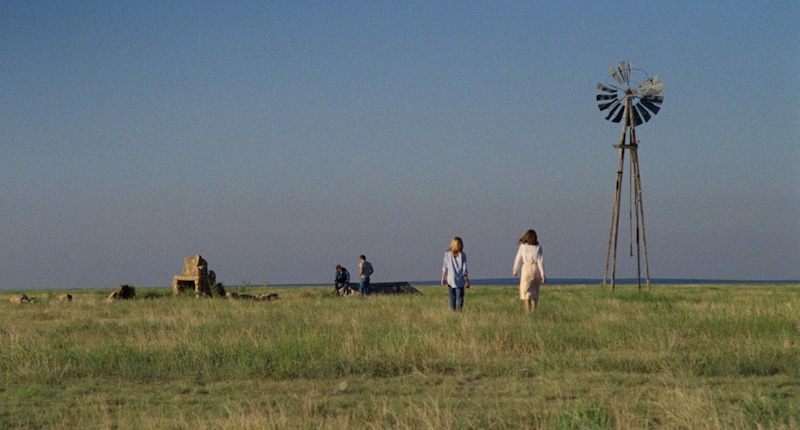
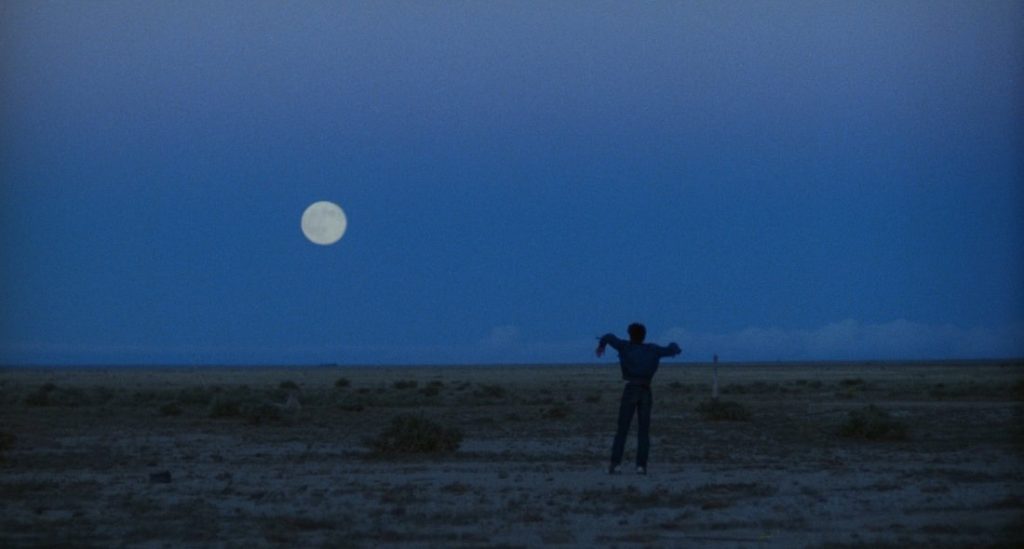
Badlands stands out above all because its image is natural and unforced. In exteriors, there appears to be little or no artificial lighting. The cinematographers follow the path opened by Conrad Hall: many daylight scenes seem to be overexposed in camera and printed down later. This gives the shadows a rich exposure and produces a dense negative. It also reduces the need for fill light purely for exposure, because the shadow areas already contain more information than a standard exposure would provide.
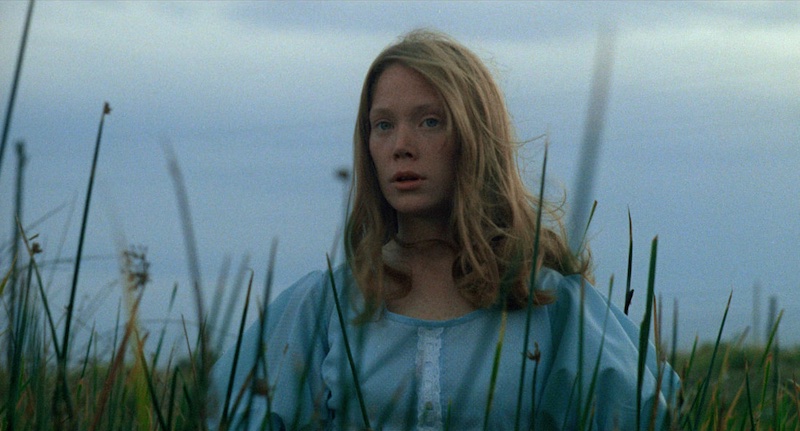
The consequence, logically, is that the skies often burn out or become almost white. This would remain a constant in Malick’s cinema. But many of the exteriors are also photographed against the light, avoiding frontal illumination and often avoiding even side light. A significant number of scenes use magic hour, the moment after the sun has disappeared below the horizon but still illuminates the sky. Malick would later push this approach to its fullest expression in Days of Heaven.
If the exteriors already anticipate both Days of Heaven and, much later, The Tree of Life (2011), the interiors are also unusually modern for the period. Several scenes are lit with a single soft side source, a method that would become fashionable shortly afterward and define the look of many later films. In 1973, however, this was still a demanding and relatively uncommon approach.
The difficulty becomes clearer when one considers the tools available. The film was shot on Kodak 5254, a 100 ASA tungsten-balanced stock, and the ultra-fast lens sets of the 1970s had not yet become widely available. Badlands was photographed with Bausch & Lomb Super Baltar lenses, which generally required T2.8 or T3.2 to produce a reasonably controlled image. Lighting a scene in this soft, lateral manner while maintaining enough exposure on a slow stock was therefore far from trivial.
In exteriors, the film also seems to use a zoom lens from time to time, not for visible zooming but as a variable long focal length. This was almost certainly the Angenieux 25-250mm T3.9. Some shots use shallow depth of field and strong spatial compression in a way that is visually very interesting, especially within the otherwise naturalistic surface of the film.
Conclusion
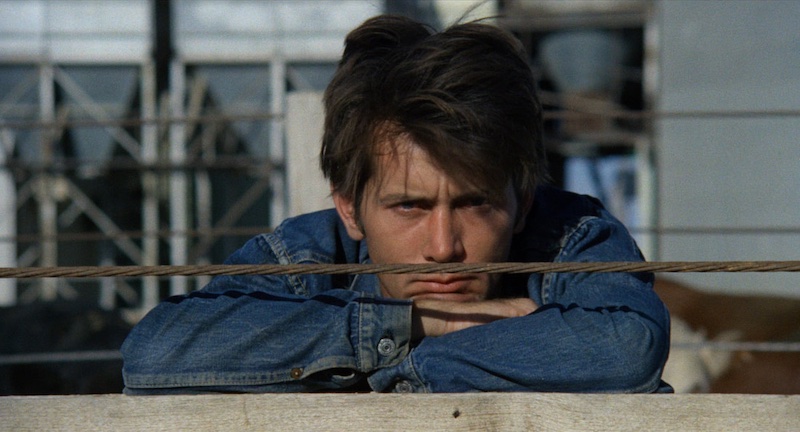
The results are generally remarkable, despite a few isolated problems and one scene that feels visually out of tune with the rest of the film: Martin Sheen working with the cattle, photographed with a great deal of fill light, almost as if it belonged to a different picture. But these exceptions do not diminish the broader achievement. Badlands contains many images that anticipate the major works of one of the filmmakers most deeply interested in cinematographic image-making in the history of cinema.
Malick’s view of human beings is already here: innocence, embodied by Sissy Spacek, placed against the force that corrupts it, embodied by Martin Sheen. His narrative use of voice-over, his preference for sparse dialogue, and above all his ability to make images carry moral and emotional meaning are already fully formed.
Beyond the beauty of the locations themselves, Badlands reveals a gaze: a way of seeing that belongs unmistakably to the director. For a debut feature, the level of talent and maturity is extraordinary.
ON FILM & DIGITAL
© Ignacio Aguilar, 2026.
This article is part of ON FILM & DIGITAL’s English-language cinematography reviews and essays.
These texts are not plot summaries or general film reviews, but cinematography-focused essays written from the perspective of a working cinematographer.
The Author
Ignacio Aguilar, AEC is a Spanish cinematographer based in Madrid. His work spans feature films, television, commercials and technical writing on cinematography, with experience in digital cinema, 16mm and 35mm film, anamorphic lenses, large-format digital capture and practical lens testing.
Read more articles and reviews in Spanish at ON FILM & DIGITAL, or visit the main cinematography portfolio at ignacioaguilardop.com.