


Original Title: Hamnet
Spanish Title: Hamnet
Year of Production: 2025
Director: Chloé Zhao
Director of Photography: Lukasz Zal, PSC
Lenses: Zeiss Super Speed T1.3, Zeiss Standard Speed T2.1, ARRI/Zeiss Master Prime, Angénieux Optimo
Camera and Aspect Ratio: ARRI ALEXA 35, ARRIRAW, 1.78:1
Viewed on: 4K HDR Blu-ray
An Amblin production with a distinctly European visual sensibility: natural light, candlelight and digital period photography by Lukasz Zal, PSC.
The Film
Adapted from Maggie O’Farrell’s novel, Hamnet builds on a few known facts from the life of William Shakespeare, played by Paul Mescal, and imagines how a private tragedy might have shaped the writing of Hamlet. The film, however, is less interested in Shakespeare than in Agnes, played by Jessie Buckley. She remains in the countryside, raising their three children, while Shakespeare lives and works in London.
The film is divided into two very different halves. The first is freer and more compelling, with one major central sequence and a remarkable Jessie Buckley, ideally cast in the role. The second half, more openly tragic, moves toward a fusion of dream imagery and theatrical representation. That idea is not without interest, but the film becomes more forced as it approaches its final image. One can feel the filmmakers aiming for that closing gesture, and some of the path toward it feels overly constructed, including the use of pre-existing music by the film’s composer, Max Richter.
Even so, Hamnet has clearly been one of the major prestige titles of the season. Chloé Zhao, who co-wrote the screenplay and directs after Nomadland, works here with a strong producing team that includes Steven Spielberg and Sam Mendes.
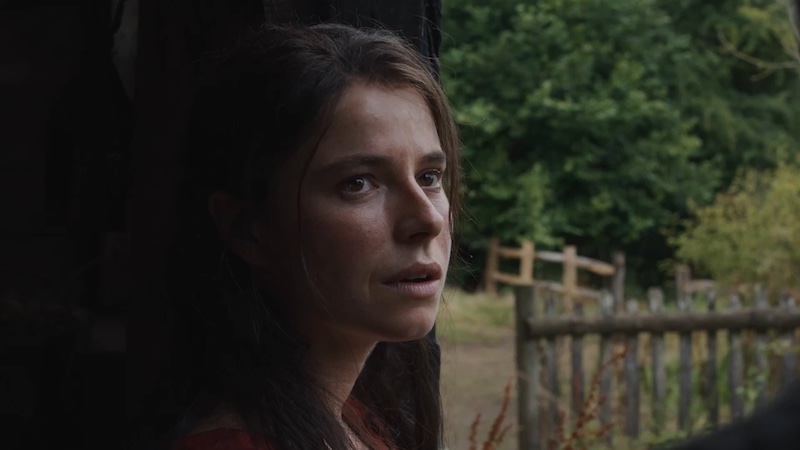
The Cinematographer
The cinematographer is the Polish director of photography Lukasz Zal, PSC, working with Chloé Zhao for the first time. Although he does not photograph an especially large number of feature films, he remains one of the most interesting cinematographers of his generation.
Zal first came to international attention with Pawel Pawlikowski’s Ida (2013). He had originally been the camera operator under veteran cinematographer Ryszard Lenczewski, but during production he took over as cinematographer. Both were nominated for the Academy Award. Zal later worked solo with Pawlikowski on Cold War (2018), for which he won the American Society of Cinematographers Award and received another Oscar nomination.
His next major international work was Jonathan Glazer’s The Zone of Interest (2023), a film about the domestic life of the Auschwitz commandant and his family beside the wall of the concentration camp. At the time of writing, Zal is reportedly shooting Pawlikowski’s new film, apparently again in black and white.
Visual Style Analysis
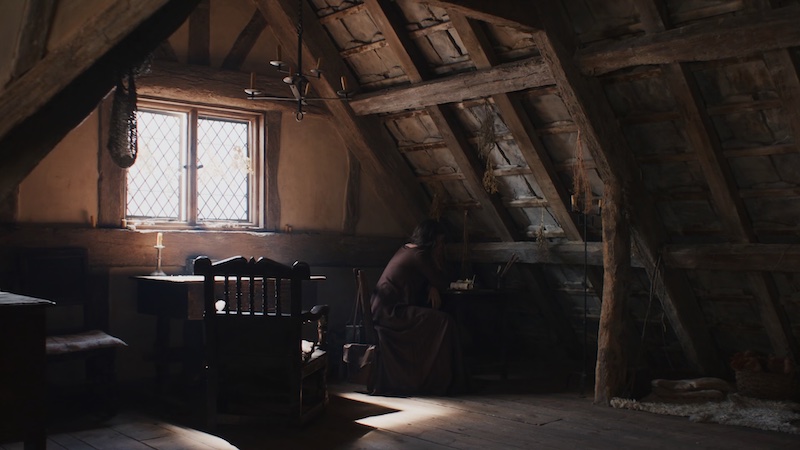
Hamnet is set in the late sixteenth and early seventeenth centuries, so period reconstruction is central to its visual credibility. In that respect, the film is unquestionably well mounted. Zhao and Zal combine studio interiors with real locations and exterior work, while the Globe Theatre was also recreated on a soundstage. The result is convincing. The world feels tactile, coherent and materially believable.
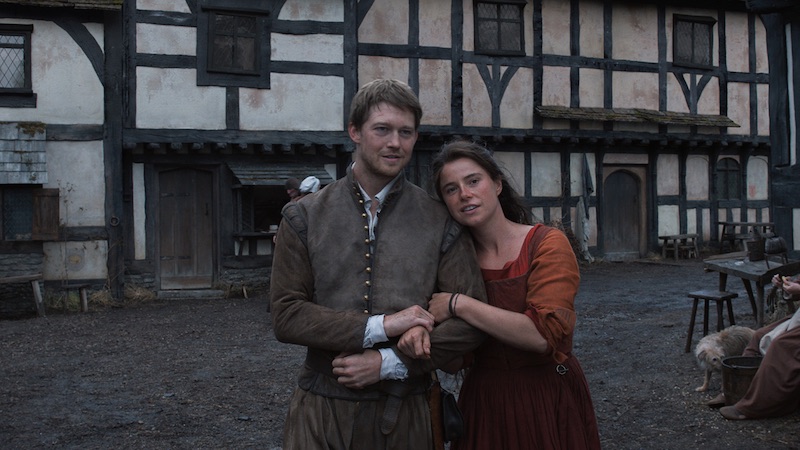
For that reason, one of the most immediate observations one can make about the cinematography of Hamnet is its digital capture. This is, of course, partly subjective. But a period drama, carefully reconstructed and emotionally rooted in a pre-modern world, can become slightly harder to accept when the image remains so clean, sharp and high-definition.
The camera is the ARRI ALEXA 35, used mainly with Zeiss Super Speed T1.3 lenses and supplemented, for focal lengths not available in that set, with Zeiss Standard Speed lenses: 14mm, 20mm, 28mm, 100mm and 135mm. These lenses are several decades old and are generally less contrasty, less hard and less clinically aggressive than many contemporary optics. Even so, the image often remains extremely crystalline and defined, especially in the exterior scenes, which frequently look very sharp.
Nor does the film appear to pursue a strong added texture, or any explicit attempt to imitate photochemical capture. The result is a slightly hyperreal period image. That is not necessarily a defect, but it is the basis from which the film has to be read.
Zal clearly knows how to work with digital cameras and modern lenses. His previous films with Pawlikowski were shot with Ultra Primes, and The Zone of Interest also embraced a very sharp, very controlled and highly realistic digital image. But Hamnet is not as observational as Glazer’s film. It is more lyrical, more emotional and more openly period-based. In that context, 35mm film is missed more strongly.
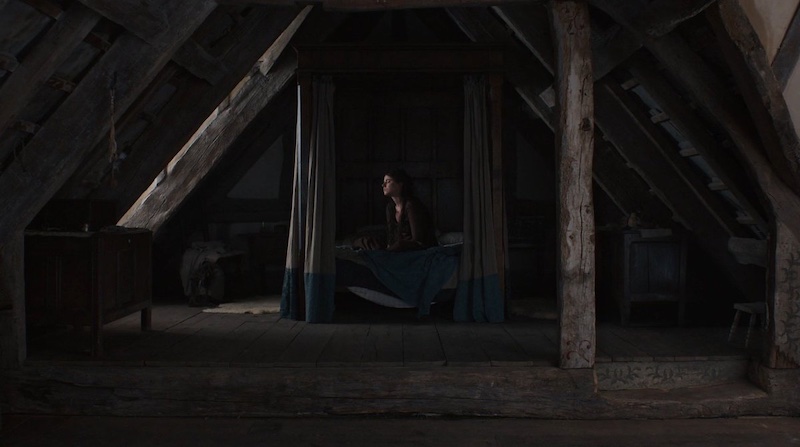
Zal’s main response seems to be in the grade. The film carries very little black density. Put another way, the blacks are consistently lifted. This does bring the image slightly closer to a photochemical feeling, because deep, perfectly solid blacks were not always easy to achieve on film, and many negative stocks did not naturally produce the very dense blacks now common in digital grading.
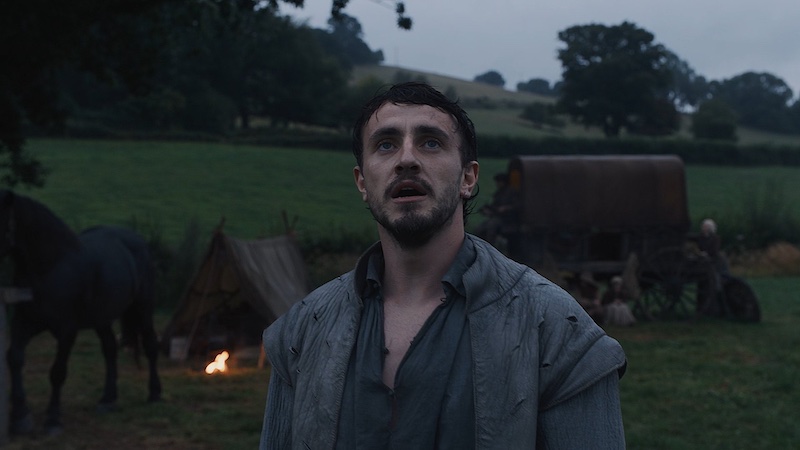
At times, however, the combination produces a curious effect. The image is very sharp and very clean, yet the blacks are soft and grayish. That pairing is not especially common in photochemical cinema. It creates an attractive but somewhat unusual surface: neither fully digital-naturalistic nor fully film-like.
The candlelit scenes are another matter. Some sequences are shot only by candlelight, and sometimes almost by a single candle. In these situations, Zal quite reasonably turns to ARRI/Zeiss Master Primes. Their ability to maintain high image quality, with very limited aberration even wide open at T1.3, makes them especially useful for this kind of work.

In these scenes, Zal keeps the contrast very low and the light levels extremely reduced. Faces are often allowed to fall three or four stops under without any visible anxiety about exposure. Here, the digital image becomes a real advantage. It no longer feels quite so sharp or hyperreal, and it allows the cinematographer to work at levels that would have been far more difficult on film.
These are among the strongest passages in Hamnet. They create intimacy when the characters speak in darkness. They also give the film its most persuasive single-source aesthetic. A single source — sometimes soft, sometimes harder and slightly overexposed — gives the image a less controlled and more truthful quality.
The film does not feel quite as uncontrolled as Zal has suggested in American Cinematographer. But it is valuable to see how he establishes a source, follows its logic from shot to shot and extracts as much contrast as possible from it, with gradual transitions between light and shadow. At its best, the image recalls a cinematic version of Dutch painting from the period, filtered through contemporary digital tools.
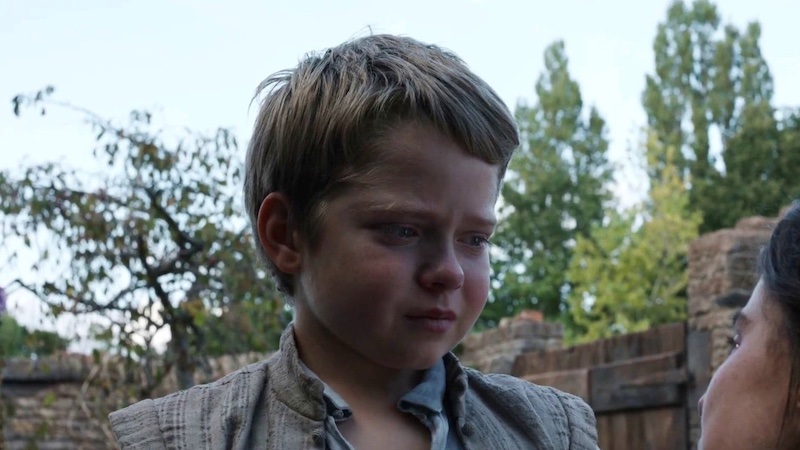
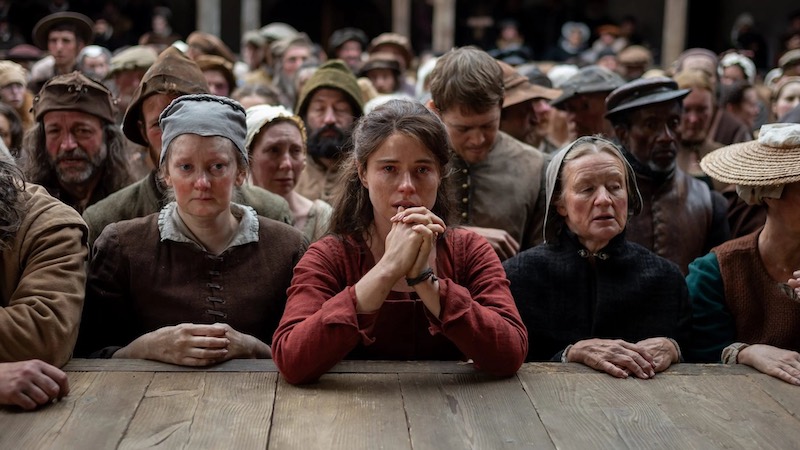
The camerawork is generally very controlled. Zhao and Zal often use high-angle shots that turn the characters into objects of quiet observation. There are many static moments, with wider compositions that distribute several figures across the frame. According to American Cinematographer, the filmmakers considered shooting in 4:3, but ultimately chose the unusual, for cinema, 1.78:1 aspect ratio.
Handheld camera is used more selectively, usually when the emotion of a scene requires greater physical proximity. The birth sequence, by far the strongest in the film, is the clearest example. Zal operated that material himself rather than leaving it to his second operator, and the decision seems to give the scene a more immediate, embodied quality.
Final Thoughts
Hamnet is a film with very solid cinematography, provided one accepts the decision to shoot digitally and the degree of hyperrealism that comes with it. Its European inspiration is clear throughout, and the photography is far removed from standard Hollywood period-drama polish. That is one of its strengths.
There are, however, a few moments that feel slightly emphatic within the film’s own naturalistic logic. Zal has described the artificial light in the forest and theatre scenes as invisible, but some of it is quite perceptible — especially the eye light on Jessie Buckley. These are not serious failures. They are execution details. But they help explain why, in this case, I find the visual concept stronger than the final image on screen.
Viewed on 4K HDR Blu-ray
ON FILM & DIGITAL
© Ignacio Aguilar, 2026.
This article is part of ON FILM & DIGITAL’s English-language cinematography reviews and essays.
The Author
Ignacio Aguilar is available for cinematography work, creative collaborations, lectures, workshops and international projects. He is a Sony Independent Certified Expert (ICE) and Cooke Optics Spanish Ambassador for Cooke SP3 lenses. Contact here.