

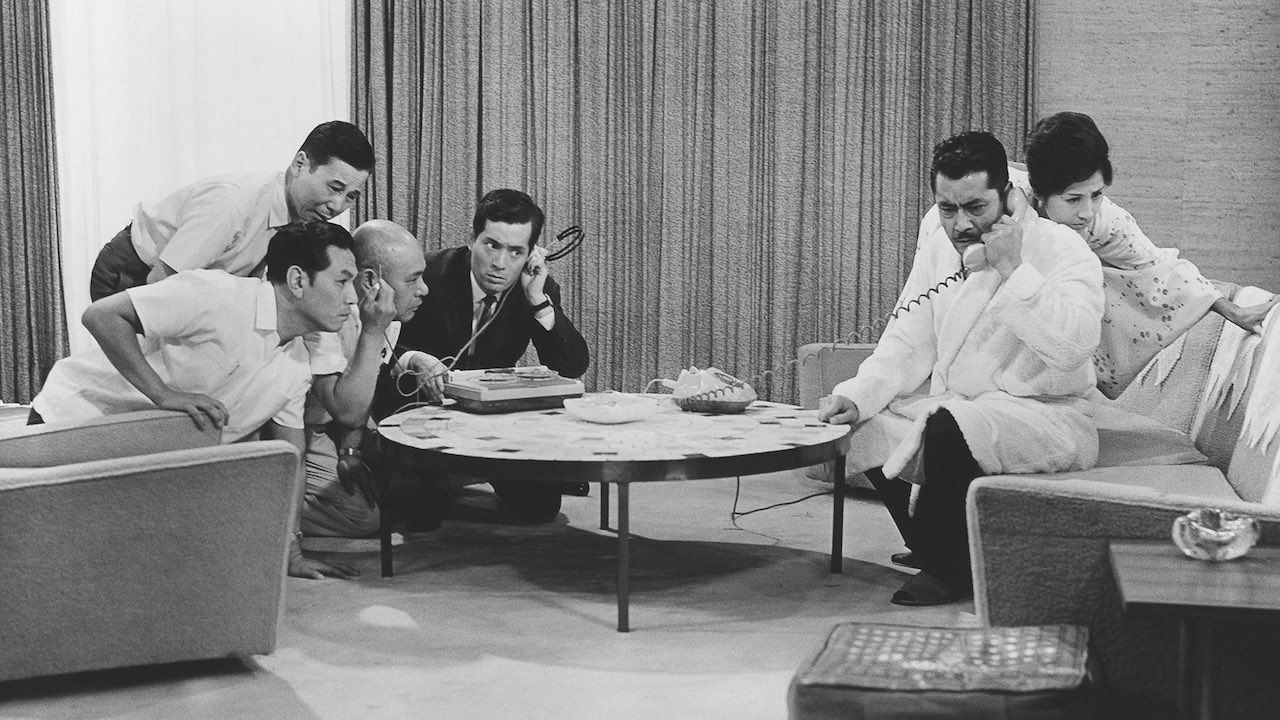
“High and Low”
Spanish Title: El Infierno del Odio
Year of Production: 1963
Director: Akira Kurosawa
Directors of Photography: Asakazu Nakai, Takao Saito
Lenses: TohoScope
Film Stock: likely Kodak Double-X 5222 (EI 200T)
Format and Aspect Ratio: 35mm anamorphic (TohoScope), 2.35:1
Viewed on: Blu-ray
Long lenses, deep focus and tightly controlled widescreen staging define “High and Low,” photographed by Asakazu Nakai and Takao Saito during Kurosawa’s TohoScope period.
The Film
Akira Kurosawa adapted “High and Low” from “King’s Ransom” (1959), a novel by Evan Hunter published under his Ed McBain pseudonym. Hunter also wrote the screenplay for Alfred Hitchcock’s “The Birds,” adapted from Daphne du Maurier and released in 1963. Kurosawa relocates the story to Japan. A shoe-company executive (Toshiro Mifune), locked in a struggle with his partners, plans to buy enough stock to gain control of the company. At precisely that moment, a kidnapper calls to say he has taken the executive’s son and demands a ransom large enough to destroy the takeover. The situation soon becomes more complicated: the kidnapper has made a mistake and abducted the chauffeur’s son instead. Gondo must decide whether to use his money to secure control of the company or save the child of one of his employees.
“High and Low” is one of Kurosawa’s most rigorously constructed films. The first half concentrates almost entirely on Gondo’s moral and financial dilemma, while the second turns into a police procedural observed with extraordinary clarity and physical detail. The shift in mode never feels like a rupture. Both halves are built around control: who can see whom, who has information and who is able to act on it. The result is, to my mind, one of Kurosawa’s finest films — possibly his best — which sets an exceptionally high standard for everything the cinematography is asked to support.
The Cinematographers
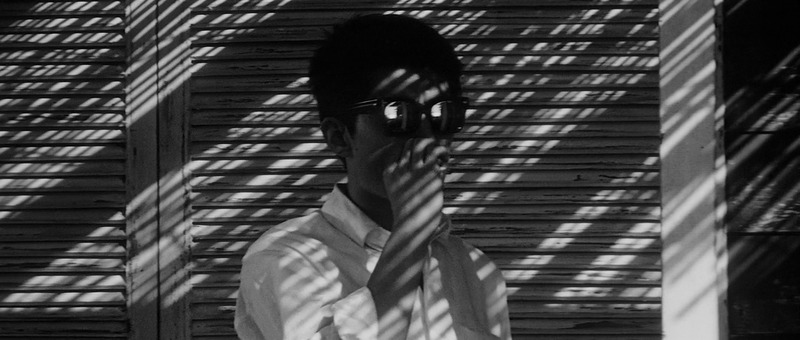
The photography was shared by two regular Kurosawa collaborators: Asakazu Nakai and Takao Saito. Nakai was already a veteran cinematographer in 1963, having photographed Kurosawa films including “Stray Dog” (1949), “Seven Samurai” (1954) and “Throne of Blood” (1957). He would later work on “Red Beard” (1965), “Dersu Uzala” (1975) and “Ran” (1985). Nakai came out of retirement for the latter and received an Academy Award nomination for Best Cinematography at the age of eighty-four.
Within Kurosawa’s collaborative production system, Saito also worked alongside Kurosawa and Nakai on “Red Beard”. He later photographed Kurosawa’s first feature made entirely in color, “Dodes’ka-den” (1970), and “Kagemusha” (1980). He reunited with Nakai on “Ran”, sharing the Academy Award nomination with Nakai and Masaharu Ueda.
Visual Style Analysis
As was common in Kurosawa’s work during this period, “High and Low” is photographed essentially in black and white — with the famous exception of the pink smoke — and in the Japanese TohoScope system. TohoScope belongs to the same family of 35mm 2x anamorphic widescreen systems as CinemaScope and Panavision anamorphic photography. One of Kurosawa’s defining habits at the time was an almost obsessive preference for long lenses, often extremely long ones. Judging from the perspective and angle of view, much of the film appears to have been photographed on anamorphic focal lengths longer than 100mm, sometimes perhaps 200mm, 300mm or more.
What makes the method unusual is that Kurosawa did not use those focal lengths mainly for close shots. He wanted wide compositions and substantial depth of field. To obtain both while working with long anamorphic lenses, the cameras had to be placed a considerable distance from the action, while Nakai and Saito had to work at very small apertures — probably around T11, quite possibly T16, and on some shots perhaps smaller still. The goal was not telephoto compression alone, but telephoto compression while keeping a broad section of the staged space readable.
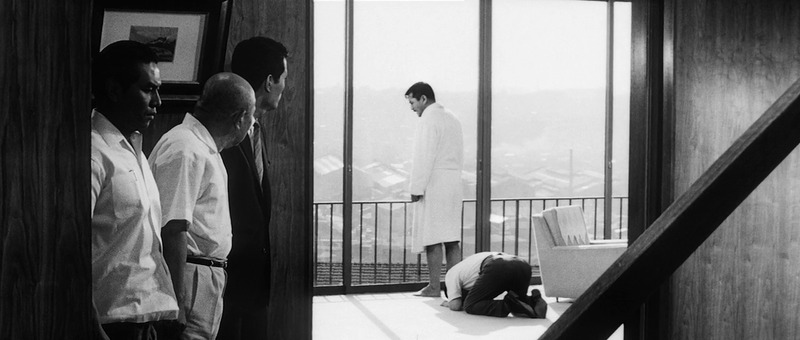
The clearest demonstration is the principal set, Gondo’s house. Behind the characters sits the city where the chauffeur’s son has been kidnapped, and keeping that city present has a specific narrative function. Gondo and the people around him know they are being observed by the kidnapper from somewhere below. The background is therefore not merely scenic information. It becomes part of the threat, and Kurosawa’s long-lens staging keeps that relationship between foreground and city constantly active.
The same combination of long lenses and small apertures is especially visible in the police interiors during the second half, when the investigators assemble and compare what they have learned. The film was most likely photographed on Kodak Double-X 5222, rated at EI 200 under tungsten light. At a conventional 24 fps and 180-degree shutter, working around T16 on that stock would require on the order of 1,600 foot-candles — roughly 17,000 lux — depending on meter calibration and laboratory practice. At those levels, some flattening of the light is hardly surprising. The more distinctive achievement is the geometry: compressed space, an unusual telephoto perspective and far more depth than we normally associate with such long focal lengths.
And then there is Kurosawa’s control of the widescreen frame itself. He uses the full width of the image to place multiple characters with remarkable precision, often allowing several planes of action to remain legible at once. The compositions are not simply balanced. They organize information, hierarchy and tension across the entire 2.35:1 frame.
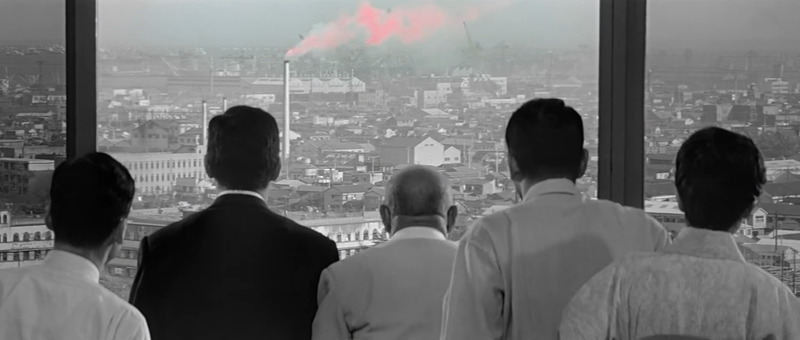
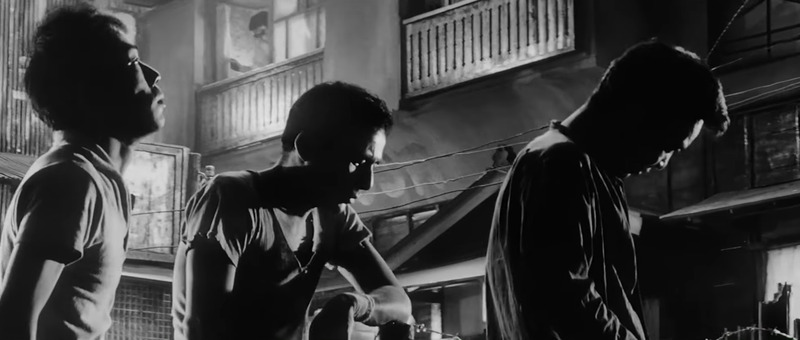
In some locations — the harbor, for example, and the night streets — that balance has to change. The apertures appear to open and the focal lengths sometimes become shorter, allowing Kurosawa, Nakai and Saito to preserve a reasonable amount of depth without maintaining strict deep focus at all costs. The visual principle remains, but the production adapts it to the available space and light.
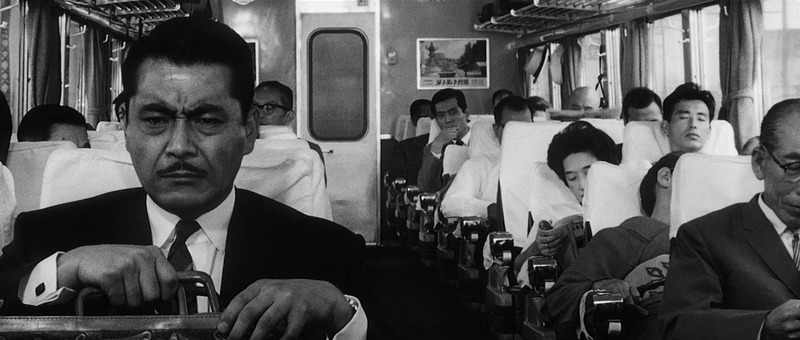
The train interiors and the material shot inside the car make the physical limitation even clearer. Extreme telephoto work becomes impractical because the camera simply cannot retreat far enough from the actors. Those shots appear closer to 75mm or 100mm anamorphic lenses, roughly equivalent in horizontal angle of view to about 35–40mm and 50mm spherical lenses respectively. Against the rest of the film, they can almost read as wide-angle images. They are not wide lenses, of course; the difference comes largely from the camera being forced closer to the action, which changes the spatial perspective that dominates most of the picture.
Conclusion
From a lighting standpoint, the film is less consistently interesting to me, largely because so much of the lighting is in service of this demanding optical strategy. But when the police begin closing in on the kidnapper — especially in the sequence that takes him into the crowded world of drug addicts — the image becomes much more contrasty, smoky and openly noir. In those passages, atmosphere takes priority over the deep-focus telephoto geometry, and the photography becomes more expressive in a conventional lighting sense.
Taken as a whole, “High and Low” is a model of mise-en-scène with a very strong visual identity. Its camera placement and widescreen composition remain memorable because they are structural rather than decorative: they organize information, pressure and social distance inside the frame.
ON FILM & DIGITAL
© Ignacio Aguilar, 2026.
This article is part of ON FILM & DIGITAL’s English-language cinematography reviews and essays.
These texts are not plot summaries or general film reviews, but cinematography-focused essays written from the perspective of a working cinematographer.
The Author
Ignacio Aguilar, AEC is a cinematographer / director of photography based in Madrid, Spain. His work spans feature films, television, commercials and technical writing on cinematography, with experience in digital cinema, 16mm and 35mm film, anamorphic lenses, large-format digital capture, lens testing and film-based workflows.
He is a member of the Spanish Society of Cinematographers (AEC) and the Spanish Academy of Cinema, a Sony I.C.E. Certified Expert and a Cooke SP3 ambassador. His writing has appeared in American Cinematographer and Camera & Light, and ON FILM & DIGITAL gathers his bilingual essays, technical guides and cinematography reviews.
For professional work, collaborations, lectures, workshops or cinematography consulting, visit his professional biography, selected works or contact page.
The Spanish-language archive is available at ON FILM & DIGITAL.