


Red Beard / Akahige (1965) – Cinematography by Asakazu Nakai and Takao Saito
“Red Beard” / “Akahige”
Spanish Title: Barbarroja
Year of Production: 1965
Director: Akira Kurosawa
Directors of Photography: Asakazu Nakai, JSC and Takao Saito, JSC
Format and Aspect Ratio: 35mm anamorphic (TohoScope), 2.35:1
Viewed on: Blu-ray
Black-and-white anamorphic photography, long-lens deep-focus staging and Akira Kurosawa’s millimetric mise-en-scène, photographed by Asakazu Nakai and Takao Saito.
The Film
“Red Beard” / “Akahige” is Akira Kurosawa’s adaptation of a collection of short stories by Shūgorō Yamamoto. Set in 19th-century Japan, the film is built around two doctors: the young and ambitious Yasumoto, played by Yūzō Kayama, and the older doctor known as Red Beard, played by Toshiro Mifune. Beneath his rough appearance and severe temper, Red Beard is a compassionate physician deeply committed to patients who have very little.
Through a series of interconnected stories, Red Beard gradually guides Yasumoto toward a different understanding of medicine, duty and human suffering. The film is very well acted and beautifully narrated, not only through the relationship between the two main characters, but also through the lives of the patients who pass through the clinic. Kurosawa interweaves those stories with great skill.
At the same time, the film’s virtues also shape its limitations. Kurosawa takes great care to observe his characters, to give them silence, duration and emotional weight. That humanism is central to the film, but it also produces a very slow rhythm, with long pauses between lines of dialogue, and a running time of 185 minutes. For that reason, “Red Beard” is not necessarily one of Kurosawa’s most accessible works.

The Cinematographers
The directors of photography were Asakazu Nakai [JSC] and Takao Saito [JSC], both long-term collaborators of Akira Kurosawa. Each of them later received an Academy Award nomination, together with a third cinematographer, Shoji Ueda, for their work with Kurosawa on “Ran” (1985).
Nakai collaborated with Kurosawa for 39 years, beginning with “No Regrets for Our Youth” (1946), and worked on twelve of his films. Those titles include “Ikiru” (1952), “Seven Samurai” (1954), “High and Low” (1963) and “Dersu Uzala” (1975).
Saito, who also worked on “High and Low,” became especially important in the second half of Kurosawa’s career, with films such as “Dodes’ka-den” (1970), “Kagemusha” (1980), “Dreams” (1990) and “Rhapsody in August” (1991).
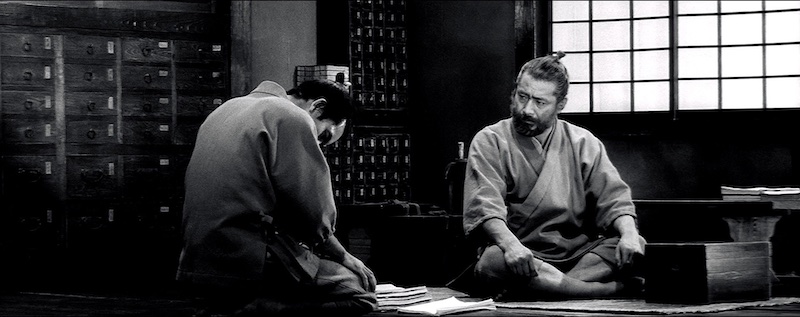
Visual Style Analysis
The key to the collaboration between Kurosawa and his cinematographers can be found in the July 1986 “American Cinematographer” article on the making of “Ran.” One cinematographer functioned as the principal cinematographer, but the others were capable of making autonomous decisions, and each operated one of the cameras that Kurosawa often used simultaneously.
On “Ran,” Saito was the principal cinematographer and the one who prepared the film for the longest period, partly because Nakai was already 75 years old. On “Red Beard,” the situation was probably the reverse, with Nakai likely acting as the supervising cinematographer. The production appears to have been very long, lasting more than a year, and Kurosawa had access to a large, highly detailed set. Even so, “Red Beard” is primarily a black-and-white interior film.
It was also Kurosawa’s last film to voluntarily renounce color photography, despite the fact that, given its scale and budget, he could presumably have used color without difficulty. As a consequence, it was also his final anamorphic widescreen film. Kurosawa had used that format from “The Hidden Fortress” (1958) through “Red Beard,” and he used it in a very personal way, defined by telephoto lenses and extremely long focal lengths.
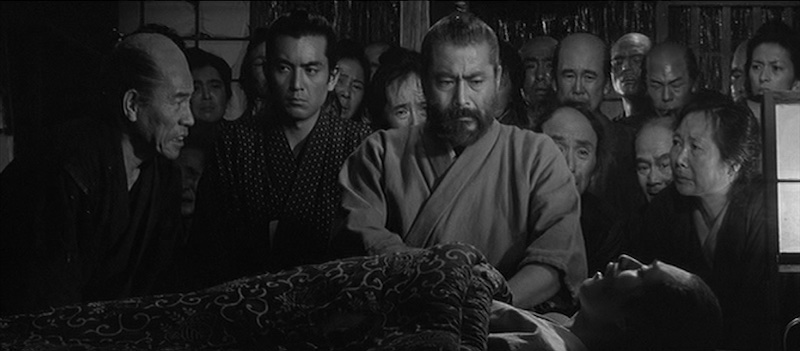
That style depends on two classic Kurosawa principles. The first is the use of long lenses. The focal lengths seem to range roughly from 100mm to 500mm in 2x anamorphic, equivalent in horizontal angle of view to approximately 50mm to 250mm in spherical terms. This compresses perspective enormously.
That does not mean Kurosawa only shot close or tight angles. On the contrary, his films are famous for their wide shots. But in order to achieve those wide compositions with telephoto lenses, he placed the cameras very far from the action. The result is unusual: general shots with compressed perspective, very different from the more conventional widescreen image built from wider lenses.
The second principle is closely related to the first. Despite the compressed perspective and the use of telephoto lenses, which greatly reduce depth of field, Kurosawa wanted characters and backgrounds to remain sharp whenever possible. That forced his cinematographers to illuminate interiors to levels that were almost unheard of. Speculatively, some shots may have required T11, T16 or even T22 when using a 500mm anamorphic lens.
Those levels were necessary to create Kurosawa’s unusual long-lens deep focus. This kind of depth often works better in black and white, where sharp backgrounds are less likely to distract than in color. It is also possible that the enormous quantities of light required for these interiors were better served by black-and-white photography. In color, the same approach might have looked much more artificial.
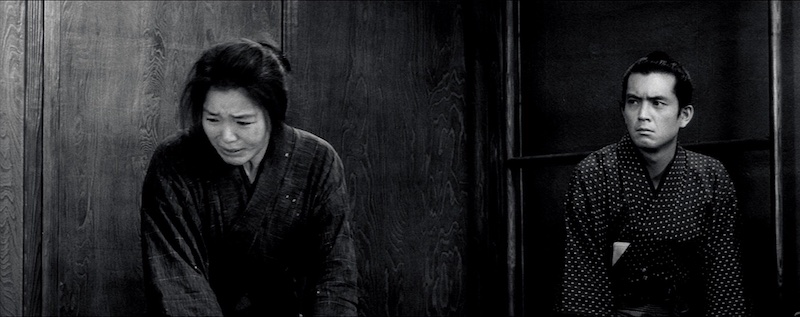
Through multicamera shooting, anamorphic telephoto lenses and very small apertures, Kurosawa achieves compositions that are often memorable. He can place three, four or five characters across the panoramic frame with absolute precision. In scenes with many more figures, the flattened perspective and unusually deep focus create effects that are almost pictorial. At times, they even recall religious altarpieces, with multiple characters arranged in dense, frontal layers.
The overall effect may not be as visually striking here as the same system in “Yojimbo” (1961), “High and Low” or “Ran.” Part of the reason is the nature of the main set. Although it is excellent, many scenes take place in austere interiors with plain walls, intended to evoke the reality of a 19th-century Japanese clinic. In those conditions, the deep-focus effect is less stylized and less immediately spectacular.
The image can also feel somewhat flat and low in contrast, probably because of the extreme illumination levels required. Some shadows on the walls appear more incidental than expressive, perhaps the inevitable consequence of using so many lighting units to reach those stops. This does not weaken the mise-en-scène, but it does make “Red Beard” a less visually seductive film than some of Kurosawa’s other widescreen work.
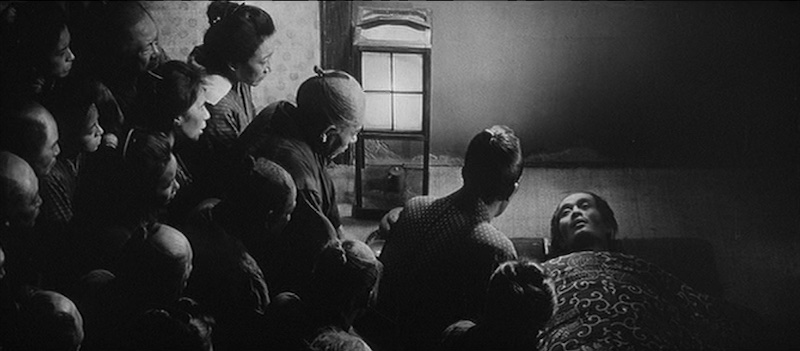
Conclusion
When Kurosawa moves outside the main clinic set and tells some of the stories that form the film’s broader moral universe, the photography rises to a more immediately expressive level. Those passages reveal more clearly the visual power associated with his other major works.
Even if “Red Beard” is not as aesthetically compelling as some other Kurosawa films, it contains one particularly extraordinary moment near the end. The camera looks down into a well, showing the water inside, the reflection of the people looking from above and a drop of water falling into the surface, breaking that reflection. It is one of those images that justifies the entire viewing experience by itself.
As a whole, “Red Beard” remains a fascinating cinematography case study. It shows Kurosawa pushing anamorphic black-and-white photography toward an unusual combination of long-lens compression, deep focus and multicamera staging. The results are sometimes austere, sometimes visually severe, but always controlled by a director thinking in terms of bodies, space, moral hierarchy and the exact placement of figures within the frame.
Viewed on Blu-ray
ON FILM & DIGITAL
© Ignacio Aguilar, 2026.
This article is part of ON FILM & DIGITAL in English, Ignacio Aguilar AEC’s archive of cinematography essays, technical guides, lens tests and film photography reviews.
The Author
Ignacio Aguilar, AEC is a cinematographer / director of photography based in Madrid, Spain. His work spans feature films, television, commercials and technical writing on cinematography, with experience in digital cinema, 16mm and 35mm film, anamorphic lenses, large-format digital capture, lens testing and film-based workflows.
He is a member of the Spanish Society of Cinematographers (AEC) and the Spanish Academy of Cinema, a Sony I.C.E. Certified Expert and a Cooke SP3 ambassador. His writing has appeared in American Cinematographer and Camera & Light, and ON FILM & DIGITAL gathers his bilingual essays, technical guides and cinematography reviews.
For professional work, collaborations, lectures, workshops or cinematography consulting, visit his professional biography, selected works or contact page.