


“Local Hero”
Spanish Title: Un Tipo Genial
Year of Production: 1983
Director: Bill Forsyth
Director of Photography: Chris Menges, ASC, BSC
Lenses: Zeiss T1.4 High Speed
Format and Aspect Ratio: 35mm spherical, 1.85:1
Awards: BAFTA nomination for Best Cinematography
Viewed on: Blu-ray
In “Local Hero,” Bill Forsyth turns a cultural collision into a luminous fable, while Chris Menges, ASC, BSC gives it an apparently simple but carefully controlled image: soft light, delicate texture and a Scottish magic hour that remains unforgettable.
The Film
“Local Hero” is a strange but very charming film, set in a small village on the northern coast of Scotland. Its protagonist is MacIntyre, played by Peter Riegert, an employee of an American oil company based in Houston. His boss, played by Burt Lancaster, sends him to Scotland to buy the village and surrounding land so the company can build a refinery there.
Once MacIntyre arrives on the Scottish coast and begins to live among the locals, things start to move in a very different direction from what everyone expects. The film is rare and quietly acidic, halfway between drama and comedy. It is full of eccentric characters and absurd situations, but it works because Bill Forsyth finds a tone that moves between the dreamlike and the absurd without losing sight of the human depth underneath.
That balance is the film’s main strength. Forsyth, who won the BAFTA Award for Best Direction for this film, never treats the village as a simple comic device or as an idealized postcard. Dennis Lawson, in a wonderful role, Peter Capaldi, Fulton Mackay and Jenny Seagrove complete the cast of a film produced by David Puttnam and shot in spectacular locations.
The Cinematographer
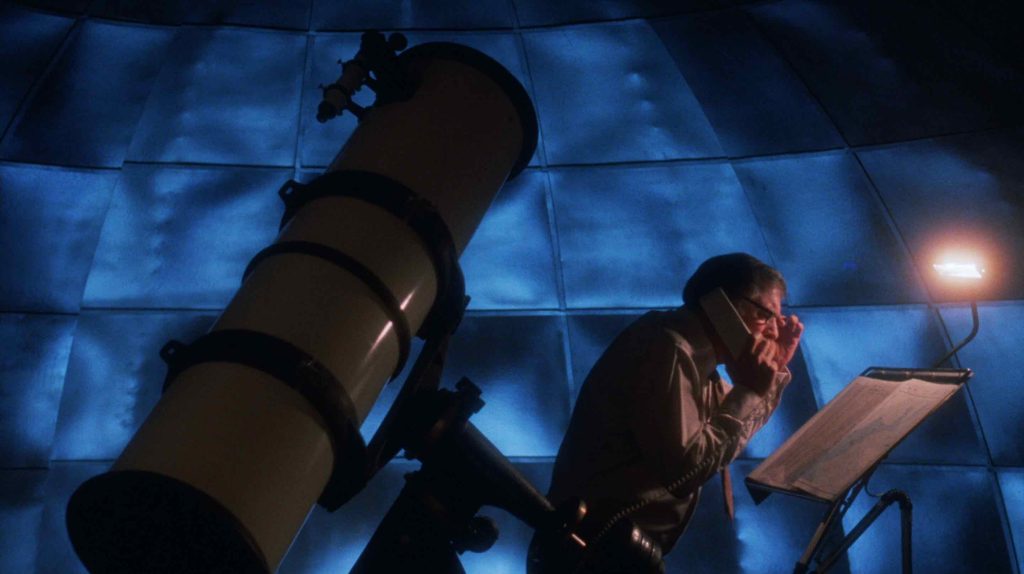
The cinematographer was Chris Menges [ASC, BSC], who would also collaborate with Bill Forsyth on “Comfort and Joy” (1984). In a sense, “Local Hero” closes the first stage of Menges’s career as a cinematographer. He had begun with documentaries and films such as “Kes” in the late 1960s, before moving almost immediately into the work that would make him internationally recognized.
Right after “Local Hero,” Menges won two Academy Awards in close succession, both for Roland Joffé films: “The Killing Fields” (1984) and “The Mission” (1986). Those films placed him at the highest level of the profession. Instead of using that position to pursue large studio productions, however, Menges devoted much of his energy to directing, beginning with the acclaimed “A World Apart” (1988).
After nine years away from cinematography, he returned strongly with “Michael Collins” (Neil Jordan, 1996), for which he received another Oscar nomination. He later photographed important films such as “The Boxer” (Jim Sheridan, 1997), “The Pledge” (Sean Penn, 2001), “North Country” (Niki Caro, 2005), “The Three Burials of Melquiades Estrada” (Tommy Lee Jones, 2005) and “The Reader” (Stephen Daldry, 2008), for which he received a final Oscar nomination, shared with Roger Deakins, whom he replaced after a production pause made Deakins unavailable.
Menges later worked again with Daldry on “Extremely Loud & Incredibly Close” (2011), when he was already over 70, and continued working at least until “Waiting for the Barbarians” (Ciro Guerra, 2019).
Visual Style Analysis
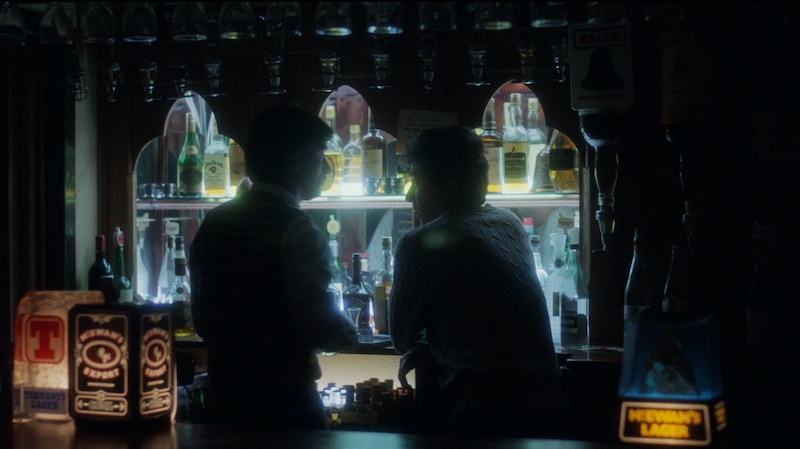
Chris Menges’s style is always recognizable: natural light, very low light levels and a strong command of both exterior and interior photography. His exteriors are often the images people remember first, and some of the exterior work in “Local Hero” is extraordinary. But Menges is also an exceptional cinematographer of interiors, perhaps even more than his reputation suggests.
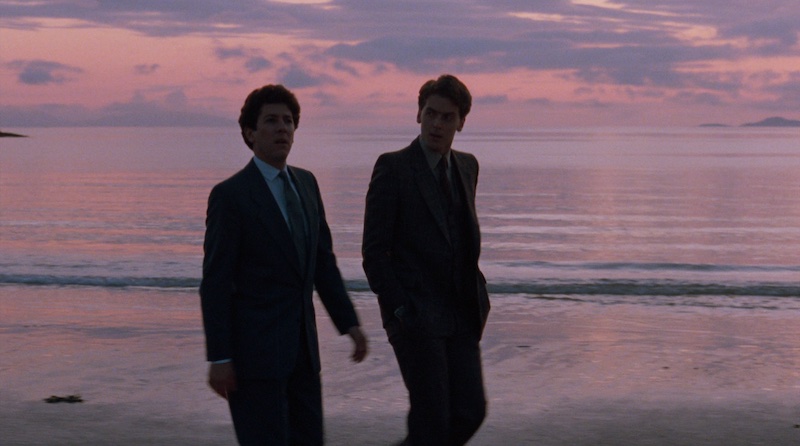
The magic-hour material in “Local Hero” is magnificent. Menges makes exceptional use of a west-facing beach in the far north of Scotland, where the magic hour may have lasted much longer than it would in lower latitudes, perhaps for hours during the early summer of 1982. Those conditions gave him time, but the images also show precision: pink and reddish skies, backlit figures, silhouettes that still retain detail and a delicate balance between exposure and atmosphere.
As in “The Killing Fields” and “The Mission,” however, the interiors are just as important. The film was made around the period when cinema moved from the older 100 ASA stocks toward the newer 250 ASA emulsions, first from Fuji and then from Kodak. It is likely that Menges did not yet have access to those faster stocks. What he did have was his own set of Zeiss High Speed T1.4 lenses, the so-called B Speeds, with their distinctive triangular iris. These lenses allowed him to shoot interiors at very wide apertures and to capture those glorious low-light exteriors.
The film begins with a series of scenes set in Houston. These are probably the least interesting part of Menges’s work. Curiously, he worked with Michael Coulter as camera operator, a situation that may have been somewhat delicate, since Coulter had already photographed two films for Bill Forsyth and would later work with him again as cinematographer after Forsyth’s two films with Menges.
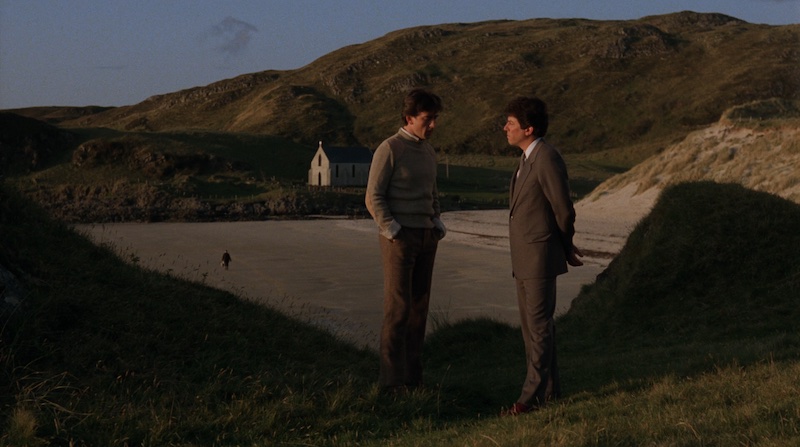
In the American scenes, the use of diffusion is very noticeable. This is not a major feature of Menges’s later work, and here it can feel intrusive. The filter seems to belong to the Low-Con, Fog or, more likely, Double Fog family. It becomes excessive when combined with stronger sunlight. This filtration remains present, to different degrees, through much of the film, except in exterior scenes shot at lower ambient light levels.
Most of the time, the filtration works. It gives the image a soft, delicate texture that fits well with Menges’s lighting. It only becomes problematic when direct sun pushes the effect too far. In day interiors, the light is usually justified by windows. In night interiors, Menges uses some diegetic sources, but very often relies on soft, heavily diffused overhead light to illuminate the actors without calling attention to the source.
This approach relates to John Alcott, David Watkin and Gordon Willis, and in more contemporary terms to Roger Deakins. It has not aged badly. Without the heavier filtration, and shot today on a digital camera such as an ARRI Alexa, the same visual philosophy would still feel entirely current. Its simplicity is part of its strength.
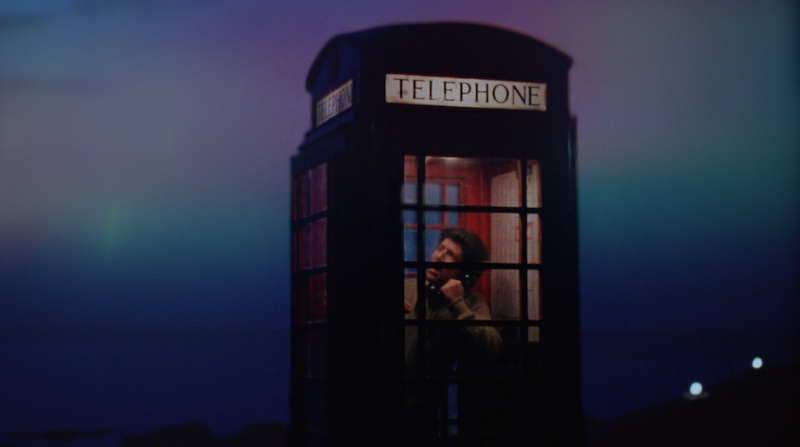
Even so, the images most viewers remember are probably the exteriors. Not so much the ordinary daytime scenes in the village under overcast skies, which are very natural, but the magic-hour scenes on the beaches and in the village itself, especially when the protagonist goes to make his telephone calls.
Menges’s handling of magic hour is exceptional. The latitude, the orientation of the coast and the extended northern twilight all work in his favor, but the results are not merely accidental. The skies are pink, red or blue; the characters are held against them in backlight, often close to silhouette but still readable. The moment in which the camera holds a wide shot during magic hour, and a light appears in the distance before gradually revealing itself as a real helicopter, is genuinely moving.
Conclusion
The results are very strong, although not completely even. The main reason is the occasional excess of in-camera diffusion. Seen from more than forty years after the film’s release, that is the element that has aged the most. It is almost the only one.
It is not surprising that Chris Menges received his first BAFTA nomination for this work. Nor is it surprising that, probably through producer David Puttnam, he soon photographed two of the most important productions of his period, “The Killing Fields” and “The Mission,” winning Academy Awards for both.
“Local Hero” may not be as widely celebrated as those later films, but it already contains almost all of Menges’s qualities as a cinematographer: his use of natural light, his patience with low levels, his delicate interiors, his ability to let faces live in soft but controlled illumination, and his extraordinary sensitivity to landscape and twilight.
The northern-lights visual effects sequences, credited among others to the British effects master Wally Veevers, add another memorable layer to the film. But the deepest impression still comes from the photography itself: the soft interiors, the filtered texture, the Scottish coast and the long magic hour that makes “Local Hero” feel both grounded and slightly enchanted.
Viewed on Blu-ray
ON FILM & DIGITAL
© Ignacio Aguilar, 2026.
This article is part of ON FILM & DIGITAL’s English-language cinematography reviews and essays.
The Author
Ignacio Aguilar, AEC is a Spanish cinematographer based in Madrid. His work spans feature films, television, commercials and technical writing on cinematography, with experience in digital cinema, 16mm and 35mm film, anamorphic lenses, large-format digital capture and practical lens testing.
Read more articles and reviews in Spanish at ON FILM & DIGITAL, or visit the main cinematography portfolio at ignacioaguilardop.com.