


The Ascent / Voskhozhdeniye (1977) – Cinematography by Vladimir Chukhnov and Pavel Lebeshev
“The Ascent / Voskhozhdeniye”
Spanish Title: La Ascensión
Year of Production: 1977
Director: Larisa Shepitko
Cinematographers: Vladimir Chukhnov, Pavel Lebeshev
Lenses: Zeiss T1.4 High Speed lenses (some sequences)
Format and Aspect Ratio: 35mm spherical, 1.37:1
Harsh black and white, hostile snow and a camera pressed close to the human face: Larisa Shepitko and cinematographers Vladimir Chukhnov and Pavel Lebeshev turn The Ascent into a physically punishing and morally severe war film.
The Film
The Ascent is adapted from a novel by Vasil Bykov and set in Belarus during the Second World War. It follows two Soviet partisans, played by Boris Plotnikov and Vladimir Gostyukhin, who leave their group in search of food and fall into German hands. From that point onward, the film develops a very precise reversal of character positions. One man initially appears weak, wounded and almost useless. The other seems stronger, more practical and more in control of the situation.
The film is clearly divided into two halves. In the first, Larisa Shepitko proposes an almost physical vision of war: bodies moving through snow, exhaustion, hunger, fear and exposure. In the second, the film becomes more interior and moral. The question is no longer only whether the characters will survive, but how they will choose to face the pressure placed upon them.
That shift gives the title its full meaning. The film begins as a story of resistance and survival, but gradually moves toward sacrifice, betrayal, faith and spiritual endurance. Anatoly Solonitsyn, so closely associated with the cinema of Andrei Tarkovsky, has an important supporting role as a Russian collaborator working with the Germans. His presence adds another layer of severity to a film already built around moral pressure.
The Cinematographers
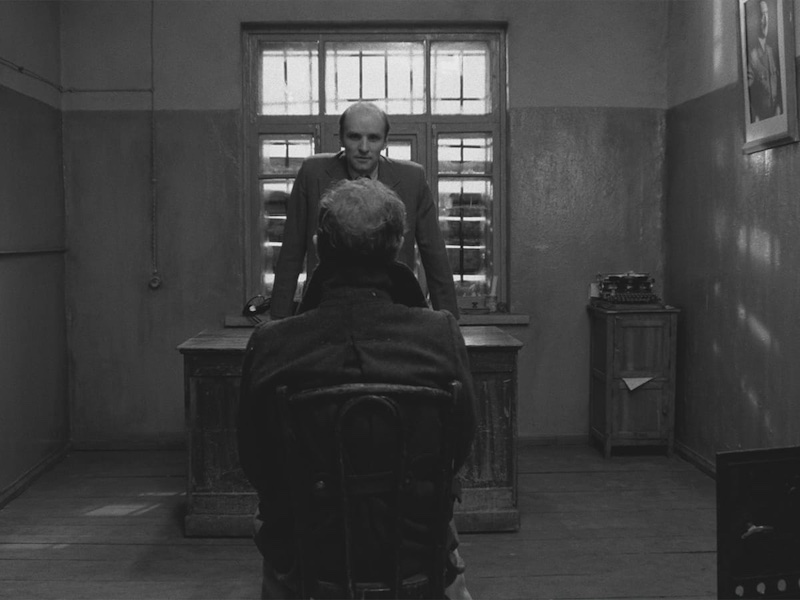
The cinematographers were Vladimir Chukhnov and Pavel Lebeshev, who apparently worked together throughout the production. Chukhnov’s career was tragically brief. He was one of the five people killed in the July 1979 car accident that also took the life of Larisa Shepitko, while they were scouting locations for what would become Farewell / Proshchanie (1983).
That film was later completed by Shepitko’s husband, Elem Klimov, whose own masterpiece, Come and See / Idi i Smotri (1985), would become one of the most devastating war films ever made. Pavel Lebeshev, by contrast, went on to have a much longer career, especially through his collaborations with Nikita Mikhalkov — brother of Andrei Konchalovsky — during the 1970s, 1980s and 1990s.
This dual credit is important because The Ascent does not feel like a film photographed from a single comfortable visual position. It is, at times, rough, urgent and physically strained. At other moments, especially in interiors, it becomes more static and less convincing. That irregularity is part of the interest of the film as cinematography: it is not immaculate, but its best passages have an extraordinary force.
Visual Style Analysis
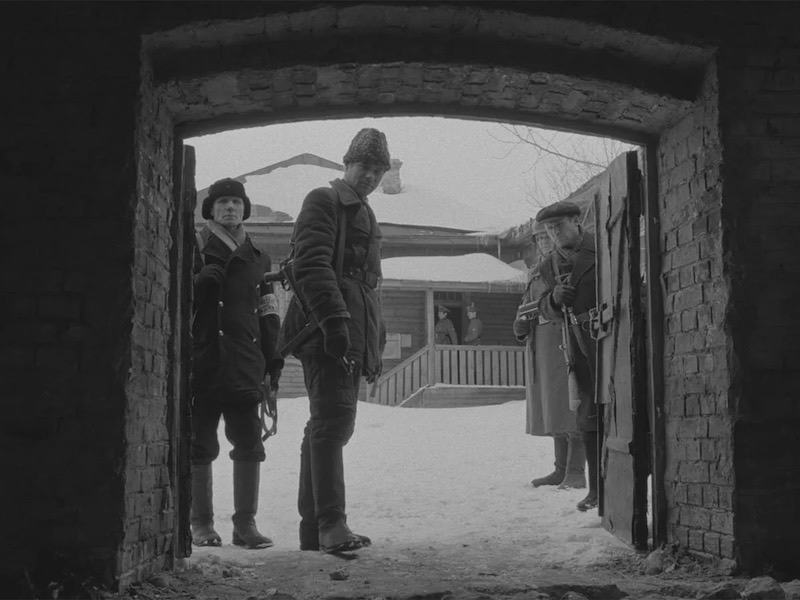
The black-and-white cinematography of The Ascent is also divided into two major movements. The first follows the two partisans as they move through the snow, with a few interiors placed between the exterior passages. The second begins after their capture. From that point on, the structure is almost reversed: the film becomes mostly interior, interrupted by some exterior scenes.
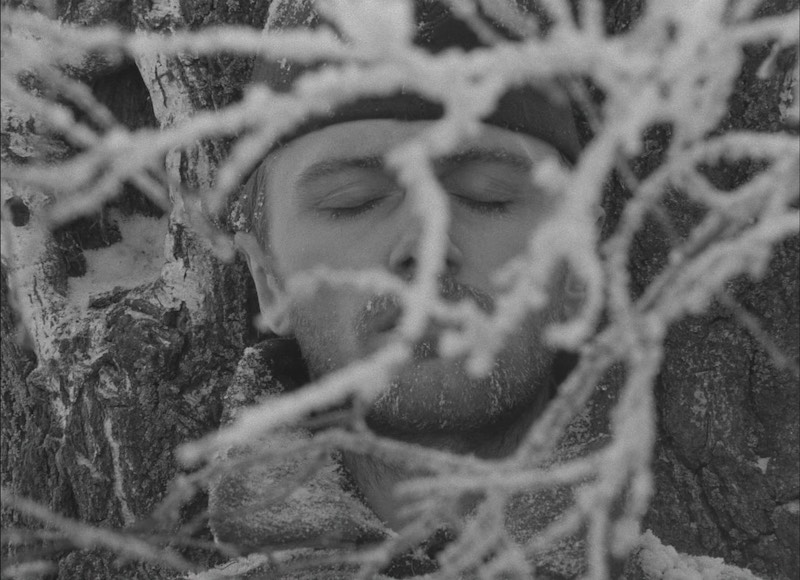
The first half must have been exceptionally difficult to shoot. Production reportedly began near Moscow in January 1974, in conditions that appear severe even on screen. These are not merely snowy landscapes used as background. There is often at least half a meter of snow, and the characters seem to fight the ground itself with every movement.
The photography is not high-contrast. If anything, it is relatively low in contrast, which makes sense given the circumstances. Snow acts as an enormous ambient source. It bounces light back into faces, reduces black levels and creates a broad, diffuse tonal field. The film does not fight that condition too much. Instead, it uses it to make the exterior world feel exposed, blank and physically hostile.
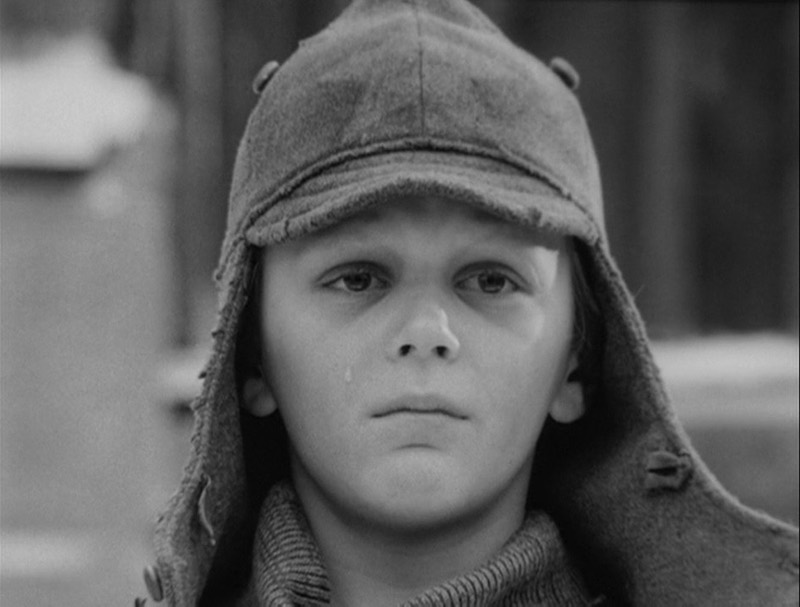
What stands out most in this section is Shepitko’s use of the camera. It is often handheld, frequently equipped with zoom lenses, and placed extremely close to the actors. Not close in a decorative way, but physically close: close enough to register breath, exhaustion, falling bodies, faces pushed into snow and hands struggling to keep moving.
That proximity gives the first half its real power. The image is not especially polished, nor does it try to turn the snow into lyrical landscape photography. It is more direct than that. The camera stays with the actors as they crawl, collapse, rise and continue. The frame becomes less a window onto war than a pressure placed against the body.
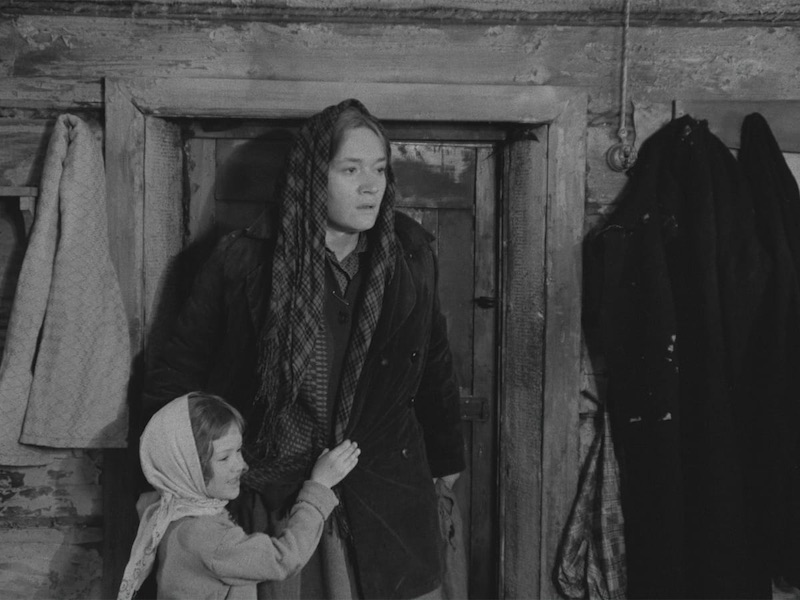
The interiors in this first half are less successful. The house of the German collaborator, and later the house with the three children, sometimes seem too evenly lit. A higher contrast ratio, or simply more areas allowed to fall into darkness, might have given those spaces greater dramatic weight. Instead, the lighting can become flat, as if the filmmakers had chosen legibility over atmosphere.
The same issue returns in the second half, starting with the interrogation. There are exceptions. When the prisoners are placed in a shed full of rats, the contrast becomes stronger and the space feels more oppressive. But across much of the second half — and in several interiors from the first — the film would benefit from greater spatial articulation.
The characters are often pressed against walls, furniture or one another, and the framing can become very tight for long stretches. This is partly expressive, because the film is about confinement and moral pressure. But from a staging and cinematography perspective, some scenes might have gained from wider shots, clearer geography and a more developed choreography of bodies within space.
That said, the film improves again once daylight returns and the characters are taken outside for the final sequence. The snow comes back, and with it the physical and symbolic clarity of the first half. One can still miss a more elaborate spatial construction in this section, but the force of what happens is strong enough to overcome some of those limitations.
Conclusion
Taken as a whole, the results are remarkable, even if the cinematography is uneven. The Ascent does not have the visual coherence and consistency that Elem Klimov would later achieve in Come and See, although Klimov’s film clearly inherits something from Shepitko’s work here. The most powerful part of The Ascent is, paradoxically, the part that must have been the most difficult to shoot: the opening movement in the snow, under conditions that look almost impossibly harsh.
The film’s roughness should not be dismissed too quickly. In its best moments, the image has a severity that a smoother, more elegant approach might have weakened. The low-contrast snow, the handheld camera, the zoom work, the faces in distress and the absence of visual comfort all serve the same dramatic purpose. The film does not beautify suffering. It makes the viewer feel the cold, the fatigue and the moral narrowing of the characters’ world.
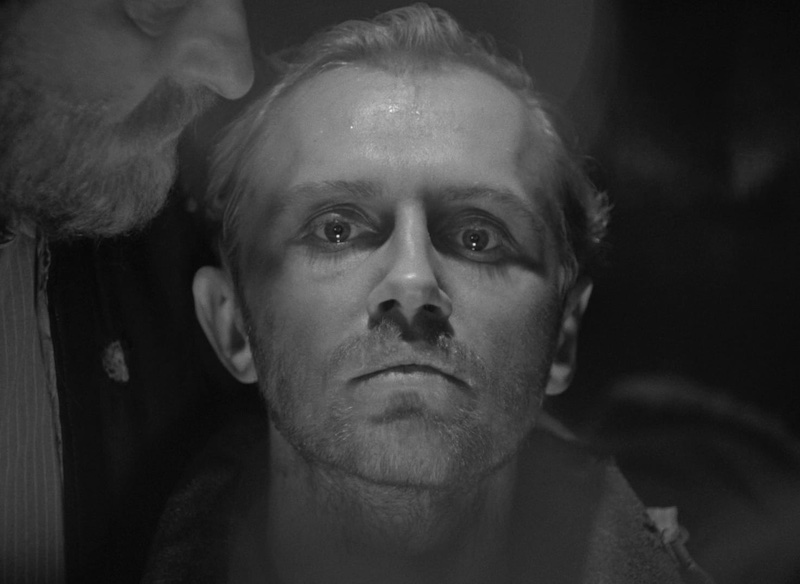
Finally, almost the entire film appears to have been shot with zoom lenses, whose performance is sometimes visibly limited. For that reason, the appearance of the famous triangular iris associated with the Zeiss T1.4 High Speed lenses — the so-called B-Speeds — is especially striking in some sequences around the middle of the film. If the production was indeed shot in 1974, this would place those images very close to the earliest years of that lens generation.
I would be cautious about over-specifying the exact origin of those lenses without further documentation. What can be stated from the image itself is that the triangular iris signature strongly suggests early Zeiss High Speed glass in at least part of the film. It is a small but fascinating technical trace inside a work whose visual power usually comes less from optical elegance than from physical endurance and moral gravity.
Viewed on Blu-ray
ON FILM & DIGITAL
© Ignacio Aguilar, 2026.
This article is part of ON FILM & DIGITAL’s English-language cinematography reviews and essays.
These texts are not plot summaries or general film reviews, but cinematography-focused essays written from the perspective of a working cinematographer.
The Author
Ignacio Aguilar is available for cinematography work, creative collaborations, lectures, workshops and international projects. He is a Sony Independent Certified Expert (ICE) and Cooke Optics Spanish Ambassador for Cooke SP3 lenses. Contact here.