

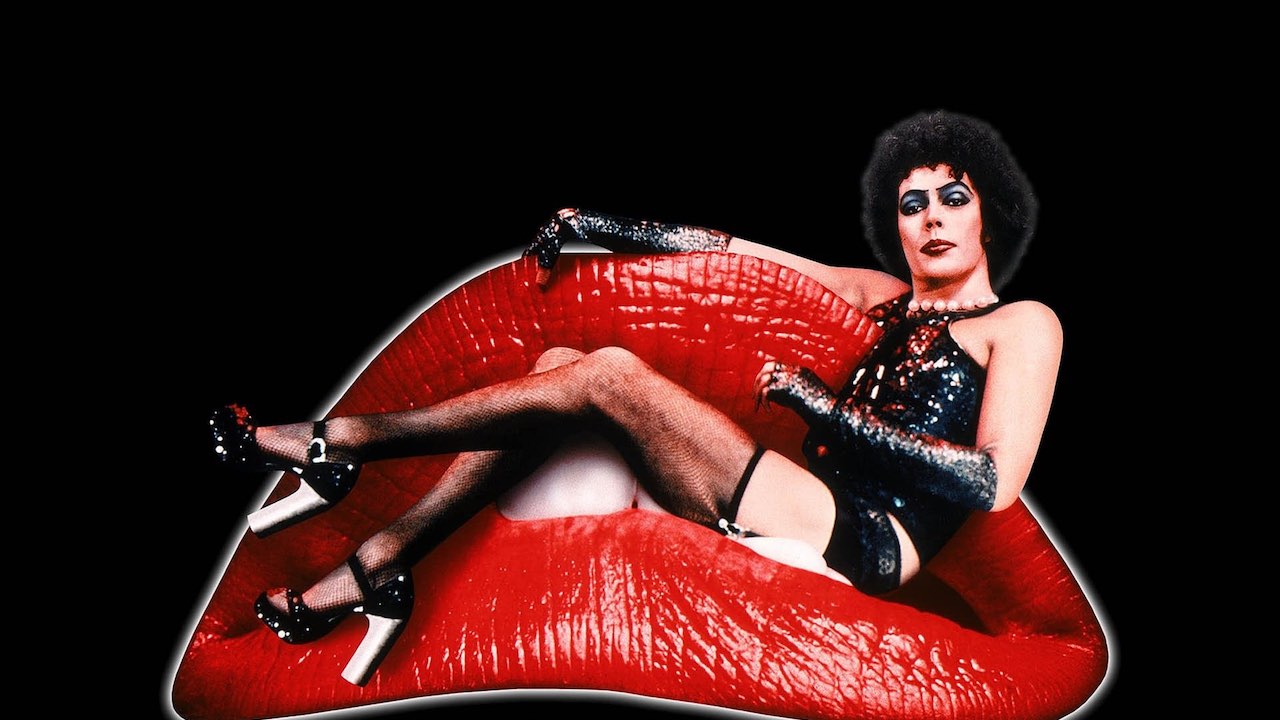
The Rocky Horror Picture Show (1975) – Cinematography by Peter Suschitzky, ASC, BSC
“The Rocky Horror Picture Show”
Spanish Title: The Rocky Horror Picture Show
Year of Production: 1975
Director: Jim Sharman
Director of Photography: Peter Suschitzky, ASC, BSC
Format and Aspect Ratio: 35mm spherical, 1.66:1
Viewed on: 4K HDR Blu-ray
Color, fast zooms, wide-angle lenses and expressive backlight drive Peter Suschitzky’s 35mm cinematography for Jim Sharman’s cult musical.
The Film
Adapted from Richard O’Brien’s stage musical, with a screenplay by O’Brien and director Jim Sharman, “The Rocky Horror Picture Show” has a premise almost as eccentric as the film itself. When Brad and Janet —Barry Bostwick and Susan Sarandon— suffer a breakdown on a deserted road late at night, they seek help at a nearby castle. There they meet Dr. Frank-N-Furter, a flamboyant cross-dressing scientist from outer space played by Tim Curry, who is preparing to unveil his latest creation.
The comic tone makes the film’s excess easy to accept, helped enormously by its songs and Graeme Clifford’s energetic editing. The second half is less focused and less consistently funny than the first, where most of the images, musical numbers and situations that define the film take shape. Richard O’Brien, Meat Loaf, Charles Gray and Peter Hinwood complete the principal cast.
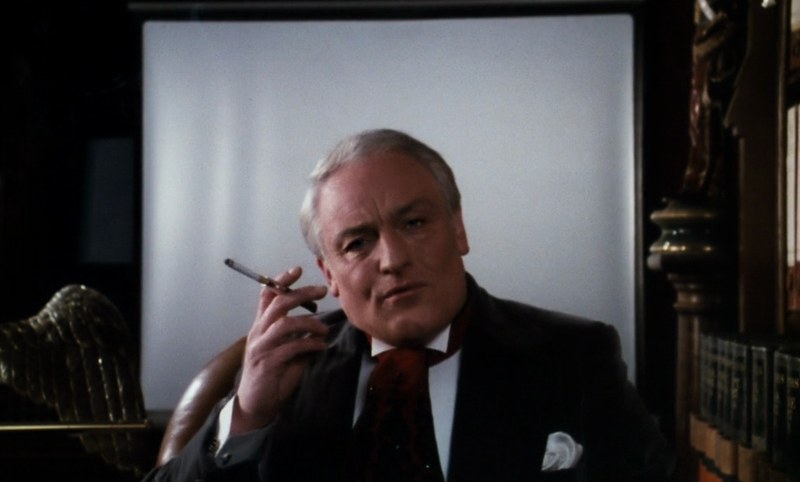
The Cinematographer
The film was photographed by British cinematographer Peter Suschitzky, ASC, BSC, and shot entirely in England, both on location and, above all, in studio interiors. Suschitzky’s father, Wolfgang, was also a cinematographer —“Get Carter” (1971)—. Peter Suschitzky is best known to general audiences for “The Empire Strikes Back” (Irvin Kershner, 1980), one of the most highly regarded films in the “Star Wars” universe, and for his long collaboration with British filmmaker David Cronenberg.
That collaboration began with “Dead Ringers” (1988) and continued through “Maps to the Stars” (2014), encompassing such celebrated films as “A History of Violence” (2005) and “Eastern Promises” (2007).
Across his broader career, Suschitzky worked twice with John Boorman —“Leo the Last” (1970) and “Where the Heart Is” (1990)— and twice with Ken Russell —“Lisztomania” (1975) and “Valentino” (1977)—. He was also the cinematographer of “Krull” (Peter Yates, 1983), “Mars Attacks!” (Tim Burton, 1996) and “After Earth” (M. Night Shyamalan, 2013).
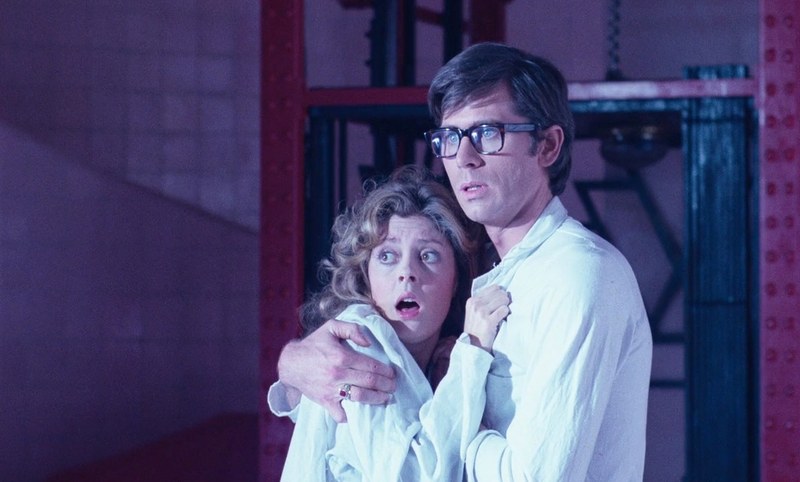
Visual Style Analysis
Suschitzky began working as a cinematographer unusually young, in the second half of the 1960s and well before turning thirty. By the time he received this assignment, he already had close to a decade of experience and a notably modern visual sensibility. He was also active in commercials, at a time when British commercials were among the most visually inventive in the world.
That background matters. “The Rocky Horror Picture Show” is visibly a modestly scaled production, yet its imagery remains lively, assured and surprisingly current. The film also owes something to the extravagant, expressive staging associated with Ken Russell, which makes it unsurprising that Russell began working with Suschitzky immediately afterward.
Sharman and Suschitzky use fast tracking shots, wide-angle lenses and a great many zooms. Here, the zoom is not merely a lens choice but a basic tool of staging: it opens or tightens the frame, redirects attention and establishes new points of emphasis within the shot.
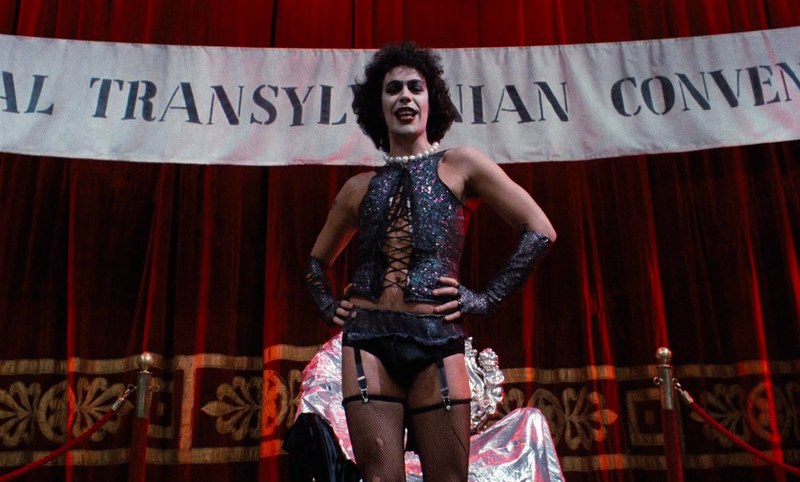
Suschitzky’s modernity is just as evident in the lighting. The film is not naturalistic —neither the story nor the sets invite realism— but the actors are generally handled with soft, bounced or diffused light, while the décor receives harder, more directional accents. This distinction keeps the faces attractive and readable while preserving the theatrical quality of the production design.
Suschitzky photographs faces with particular care, especially Sarandon’s and Curry’s. Colored light is used expressively, together with pronounced backlight that often gives the figures a heightened stage presence. Because the production relied on zoom lenses and a 100 ASA stock, during the industry’s transition from Eastman 5254 to 5247, the working light levels would have needed to be high. That practical requirement may help explain why some passages feel slightly flatter than others.
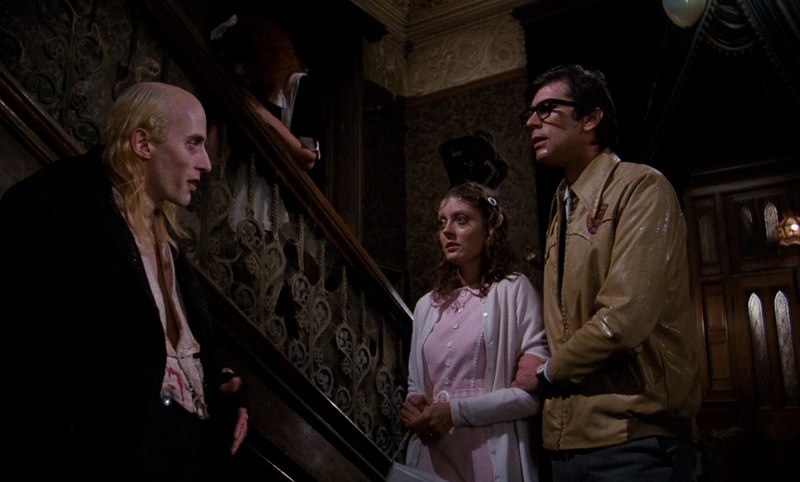
Even so, the overall impression is not flat. The color of the production design and costumes creates strong separation, while the songs, movement and performances keep the imagery buoyant. The film feels bright, energetic and visually generous.
Conclusion
The results are impressive. The zooms are the element that most clearly anchors the film to its period, placing it unmistakably within the visual grammar of the 1970s. Yet they also contribute to the picture’s speed and theatrical aggression, so they amount to more than a simple period mannerism.
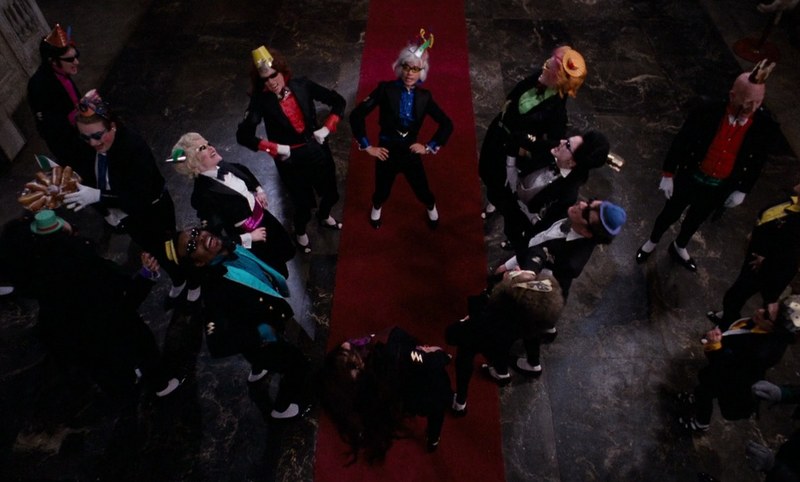
The 4K HDR Blu-ray reveals an exceptionally solid and detailed image, at times surprisingly sharp for a production photographed so extensively with zoom lenses. Grain is restrained, but the image retains a convincingly photochemical character. The optical transitions are the main exception, showing a clear loss of definition and density.
Apart from those passages, the 4K master derived from the original negative confirms the strength of Suschitzky’s technique. The image is dense, colorful and tonally rich, fully in keeping with the film’s playful, uninhibited character —especially in its stronger first half.
ON FILM & DIGITAL
© Ignacio Aguilar, 2026.
This article is part of ON FILM & DIGITAL’s English-language cinematography reviews and essays.
These texts are not plot summaries or general film reviews, but cinematography-focused essays written from the perspective of a working cinematographer.
The Author
Ignacio Aguilar, AEC is a cinematographer / director of photography based in Madrid, Spain. His work spans feature films, television, commercials and technical writing on cinematography, with experience in digital cinema, 16mm and 35mm film, anamorphic lenses, large-format digital capture, lens testing and film-based workflows. He is a member of the Spanish Society of Cinematographers (AEC) and the Spanish Academy of Cinema, a Sony I.C.E. Certified Expert and a Cooke SP3 ambassador. His writing has appeared in American Cinematographer and Camera & Light, and ON FILM & DIGITAL gathers his bilingual essays, technical guides and cinematography reviews.
For professional work, collaborations, lectures, workshops or cinematography consulting, visit his professional biography, selected works or contact page.
The Spanish-language archive is available at ON FILM & DIGITAL.