


“Train Dreams”
Spanish Title: Sueños de Trenes
Year of Production: 2025
Director: Clint Bentley
Director of Photography: Adolpho Veloso, ABC, AIP
Lenses: Kowa Cine Prominar TLS, Zeiss Super Speed T1.3, Angénieux Optimo 26-320mm T3.1
Format and Aspect Ratio: ARRI Alexa 35, ARRIRAW 4.6K, 1.50:1; RED Komodo for a few tree and airplane shots
Awards: Academy Award nomination for Best Cinematography; ASC and BAFTA nominations
Viewed on: HDTV
ARRI Alexa 35, vintage Kowa lenses and available light shape Adolpho Veloso’s intimate, elemental cinematography for Clint Bentley’s Train Dreams.
The Film
Train Dreams is a film adaptation of Denis Johnson’s novella, set in the American Northwest during the early decades of the twentieth century. It follows the life of Robert Grainier, played by Joel Edgerton in what may be the finest role of his career, from childhood to old age. The film pays particular attention to the central period of his life, when he works as a logger and, despite spending long stretches away from home, manages to build a family.
This is not a film built around great events. Its strength lies elsewhere. Train Dreams is minimal, direct and deeply honest, and it makes the thoughts and emotions of an anonymous man — his human bonds, his solitude and his relationship with nature — feel unexpectedly close. At its best, the film suggests a meeting point between Terrence Malick’s Days of Heaven and Andrei Tarkovsky’s Mirror, without imitating either in any simple way.
The result, in Clint Bentley’s second feature after Jockey (2021), is exceptionally strong. It may not become one of the most discussed titles during awards season, but it has the feeling of a film that will last. William H. Macy, Felicity Jones, Kerry Condon and Will Patton, as the third-person narrator, complete the cast.
The Cinematographer
The cinematographer is the clearly emerging Adolpho Veloso, ABC, AIP. Born in Brazil, he has worked in both cinema and music videos. His still relatively short filmography includes Tungstênio (Hector Dhalia, 2018), Mosquito (João Nuno Pinto, 2020), El Perfecto David (Felipe Gómez Aparicio, 2021) and Rodantes (Leandro Lara, 2021). He had already photographed Clint Bentley’s first feature, Jockey.
At the time of writing, Veloso’s upward trajectory is clear. He has several major projects awaiting release, including Queen at Sea (Lance Hammer), The Species (Justin Chadwick) and Remain, the new film by M. Night Shyamalan.
Visual Style Analysis
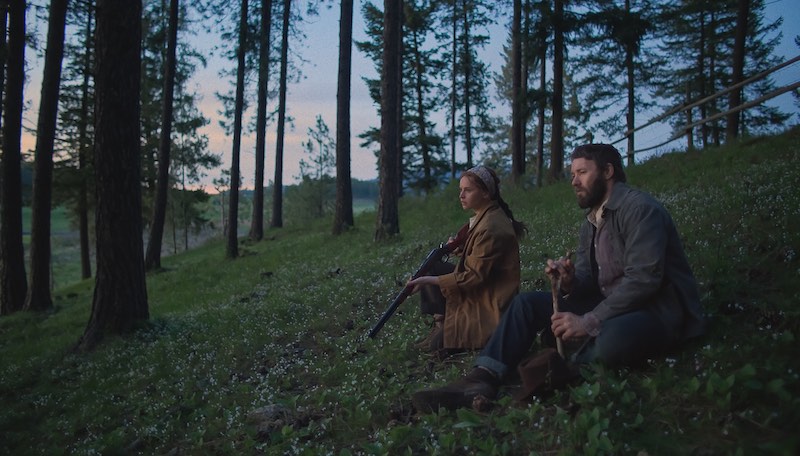
Visually, Train Dreams is built around a rare trust in natural light, vintage spherical lenses, 1.50:1 framing and a patient relationship with landscape, weather, faces and time.
Shot over a short period of twenty-nine days, the film was apparently conceived, at least initially, as a project that might have been photographed on celluloid. The tight schedule — and probably the budget — led the filmmakers instead to the ARRI Alexa 35, recorded in ARRIRAW 4.6K and paired mainly with Kowa Cine Prominar spherical lenses rehoused by TLS.
These Japanese lenses have a slightly cool, bluish tendency, but they also produce spectacular golden flares. Veloso used them for the daytime exteriors and day interiors. When he needed more speed than the Kowa lenses could reasonably offer — they are rated at T2.3, although their performance below T2.8 is probably less ideal — he turned to Zeiss Super Speed T1.3 lenses for both night exteriors and night interiors. The film also uses zooms at certain moments, and in a very visible way. In this case, the filmmakers chose a modern Angénieux Optimo rather than a vintage zoom that might have been closer in age to the Kowa lenses.
In any case, the combination of the Alexa 35 and the Kowa Cine Prominars looks beautiful. The images are sharp, but not as sharp as they would have been with more modern lenses, or even with the Zeiss Super Speeds used throughout. The bluish tendency of the Kowa glass has clearly been corrected in the grade. When the sun hits the lens directly, however, the classic Kowa flares and circular artifacts appear in full force.
Because these are older lenses, the backgrounds carry a little more distortion and the bokeh has a more unpredictable character. Even so, the performance is very strong, especially when these optics are combined with a modern digital camera. The contrast remains healthy, but the image has a subtle handmade quality that would have been harder to achieve with cleaner contemporary glass.
The 3:2 frame, or 1.50:1 aspect ratio, is essential to the film. Veloso and Bentley often leave a generous amount of vertical space above faces, allowing trees, skies and the surrounding landscape to enter the composition. The cinematography is not simply decorative here. It plays a fundamental narrative role.
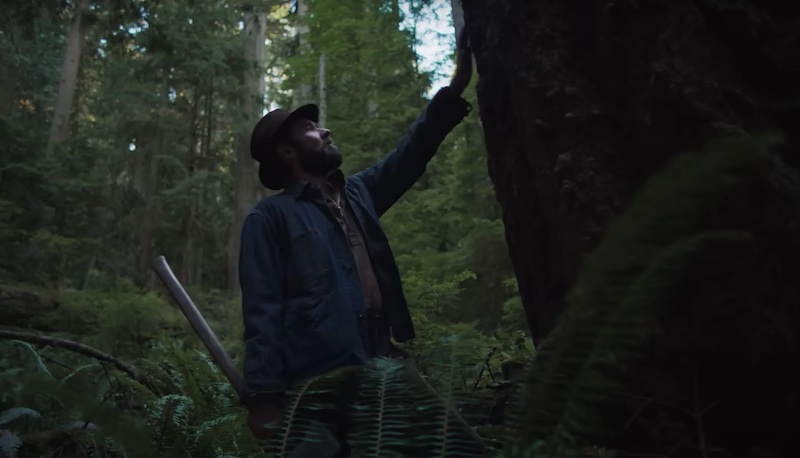
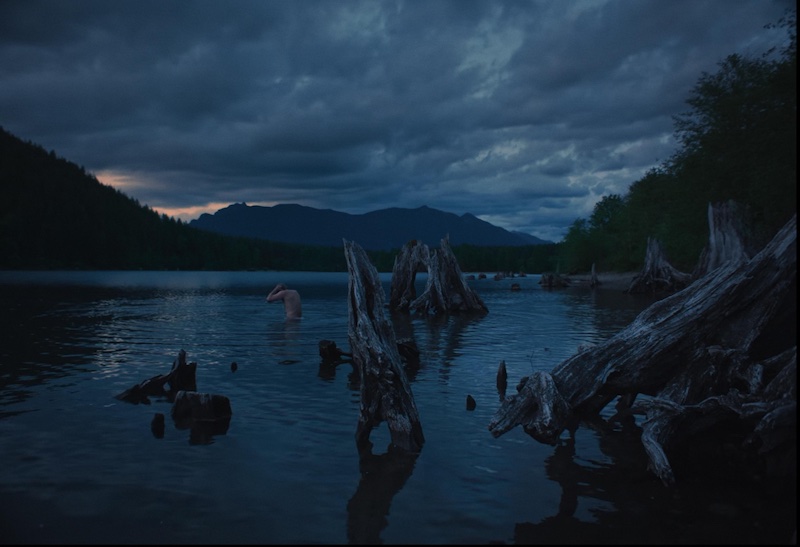
Because this is a film about a life connected to nature and to the passage of time, much of the photography depends on being in the right place at the right moment of the day. Low sun, dawn, dusk, late afternoon and the edges of night are not treated as occasional flourishes. They are part of the film’s structure. With the ARRI Alexa 35 and its wide dynamic range, those moments often look magnificent.
Nature is photographed with exceptional sensitivity. The filmmakers achieve a look that is natural but still intensely attractive, drawing the viewer into the early twentieth-century world of the story. The whole film feels direct, as if the filmmakers, echoing Days of Heaven, had subordinated the shoot to the available light and to the correct moment of the day. There is little sense of exterior lighting being added for its own sake.
That does not mean there was no control. One can imagine the occasional use of negative fill, overhead diffusion, light fabric, reflectors or carefully chosen angles and backgrounds. But the overall impression is that the crew is responding to the landscape rather than imposing a lighting scheme on it. In spring, in Washington State, just south of the Canadian border on the Pacific side of the country, the available conditions seem almost ideally suited to that approach.
Veloso has described this dependence on light in American Cinematographer. During the dialogue scene between Joel Edgerton and Kerry Condon, for example, the filmmakers reportedly abandoned what they had already shot and started again when only about an hour of sun remained. That meant the actors would have fewer takes, but the scene would gain the light it needed. That decision says a great deal about the priorities of the film.
Other moments, such as Edgerton with the little girl or with the dogs, feel almost improvised. In practice, the filmmakers seem to have planned a series of actions, then allowed the actors room to behave within them while the camera followed. The method gives the film a looseness that never feels careless.
The approach works partly because Train Dreams has very few extended dialogue scenes. Most of the film is built from short scenes, brief fragments or jump cuts, which allow the light to shift without creating a continuity problem. Time has passed; the moment has changed; the image is allowed to change with it.
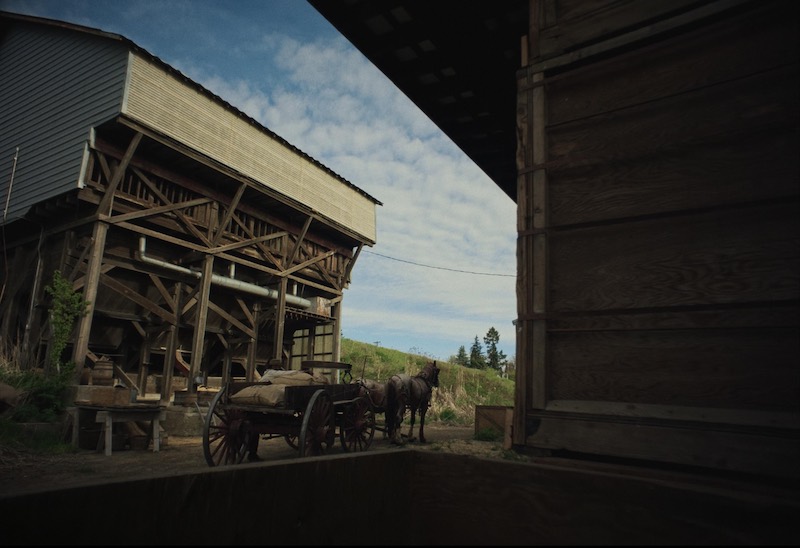
The same principle applies to the interiors. Some are highly contrasted, with only window light entering the room and no visible sense of artificial units being added inside. Because many of these scenes are short, Veloso can work with the available light, shaping, softening or redirecting it rather than locking the whole scene into a fixed lighting plan. This gives the interiors a directness that suits the film’s emotional tone.
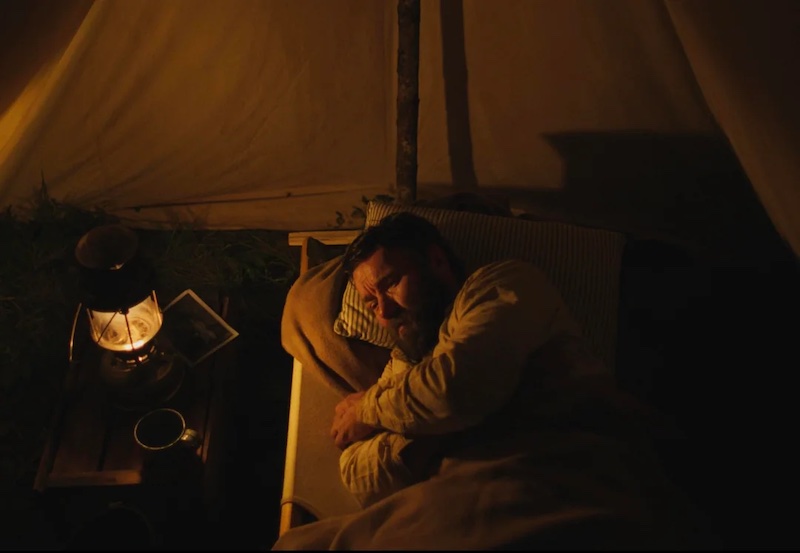
The night work is especially impressive. Many of the scenes appear to rely primarily on real fires or candles, shot at very wide apertures. At times the candles and lanterns seem to have been supplemented by additional candles and reflectors placed just outside the frame. The result is fragile but readable. It feels earned rather than illustrated.
Conclusion
The results are extraordinary. Train Dreams manages to evoke its period setting despite being shot digitally, and much of that success comes from the organic quality of the Kowa Cine Prominar lenses. The guiding philosophy seems clear: wait for the light rather than recreate it. That kind of method can constrain a production severely, but here it becomes one of the film’s essential strengths.
The visual effects are also integrated with unusual care, including the fire work in both exterior and interior scenes. One sequence was reportedly shot in an LED volume so that the characters and the fire could be photographed at different speeds. Although Veloso has not mentioned this specifically, at least as seen on Netflix, several static shots appear to use something close to a 90-degree shutter. That gives certain actions — falling trees, sawing, physical labor — a slightly quicker, more incisive quality inside the frame.
The camera work is another major part of the film’s success. It is often handheld and close to the actors, but without falling into extreme wide-angle distortion. The perspective is wide enough to remain physically present, yet restrained enough to preserve observation. There are dollies and even crane moves, but the central part of the film, when Robert Grainier lives through his adult life, is defined by a close, attentive camera that suits the material perfectly.
For all these reasons, Train Dreams is not only one of the cinematographic achievements of the year. It may well become one of the defining works of the decade in this field. It also places enormous expectations on Adolpho Veloso’s future career.
ON FILM & DIGITAL
© Ignacio Aguilar, 2026.
This article is part of ON FILM & DIGITAL’s English-language cinematography reviews and essays.
These texts are not plot summaries or general film reviews, but cinematography-focused essays written from the perspective of a working cinematographer.
The Author
Ignacio Aguilar is available for cinematography work, creative collaborations, lectures, workshops and international projects. He is a Sony Independent Certified Expert (ICE) and Cooke Optics Spanish Ambassador for Cooke SP3 lenses. Contact here.