

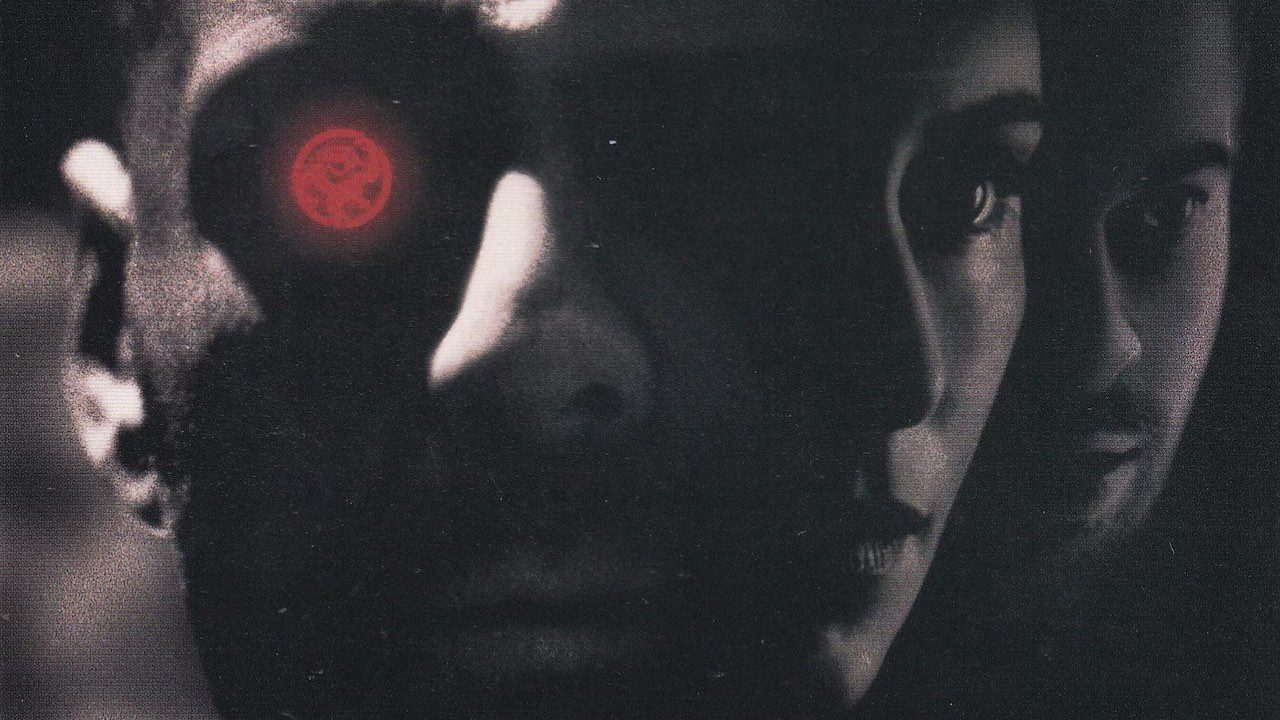
Spanish title: 12 Monos
Year of Production: 1995
Director: Terry Gilliam
Director of Photography: Roger Pratt, BSC
Lenses: Cooke S2/S3, Cooke Varotal 20-100mm T3.1
Film Stock: Kodak EXR 5298 (500T)
Format and Aspect Ratio: 35mm spherical, 1.85:1
Viewed on 35mm & 4K HDR Blu-ray
The 4K HDR Blu-ray confirms how Roger Pratt makes extreme wide angles, grain and optical flaws central to the narrative logic of Twelve Monkeys.
The Film
An adaptation of Chris Marker’s short film La Jetée (1962), written for the screen by David Peoples (Blade Runner, Leviathan, Unforgiven) and Janet Peoples, Twelve Monkeys follows James Cole (Bruce Willis), a prisoner living underground with what remains of humanity in an apparent 2035. Promised a pardon, Cole agrees to travel back to 1996 to gather information about the virus that destroyed the world, in the hope of finding a cure and allowing humanity to leave the subterranean refuge.
In the hands of British filmmaker Terry Gilliam (Brazil, The Fisher King), the material becomes a film with commercial scale but unusually strong artistic results. It retains a pronounced personality and a rare authorial presence for this kind of science-fiction thriller. Willis gives one of his finest performances and, with an excellent Madeleine Stowe, follows the clues of the coming catastrophe. The narrative’s flashbacks and continual shifts in time are intricate but never inert. Brad Pitt, nominated for the Academy Award for Best Supporting Actor, Christopher Plummer in a brief role, and David Morse complete a superb cast.
The Cinematographer
The cinematographer was the British Roger Pratt, BSC, who worked with Terry Gilliam through part of the director’s 1980s and 1990s filmography. The exception was The Adventures of Baron Munchausen, photographed by Giuseppe Rotunno in 1988, while Pratt, interestingly, handled the miniature unit. Pratt had already photographed Gilliam’s segment of The Meaning of Life (1983), as well as Brazil (1985) and The Fisher King (1991).
For some reason, Twelve Monkeys was their last collaboration. It is an odd endpoint, since Gilliam had backed Pratt early in his career, when he was still relatively unknown; Nicola Pecorini would photograph much of Gilliam’s subsequent work. Beyond Gilliam, Pratt, who died in 2024, shot Batman (Tim Burton, 1989), worked repeatedly with Richard Attenborough on films including Shadowlands (1993), In Love and War (1996), Grey Owl (1999) and Closing the Ring (2007), and photographed Mary Shelley’s Frankenstein (Kenneth Branagh, 1994), The End of the Affair (Neil Jordan, 1999), for which he received an Academy Award nomination, Chocolat (Lasse Hallström, 2000), Harry Potter and the Chamber of Secrets (Chris Columbus, 2002), Troy (Wolfgang Petersen, 2004) and Harry Potter and the Goblet of Fire (Mike Newell, 2005).
Analysis of the Visual Style
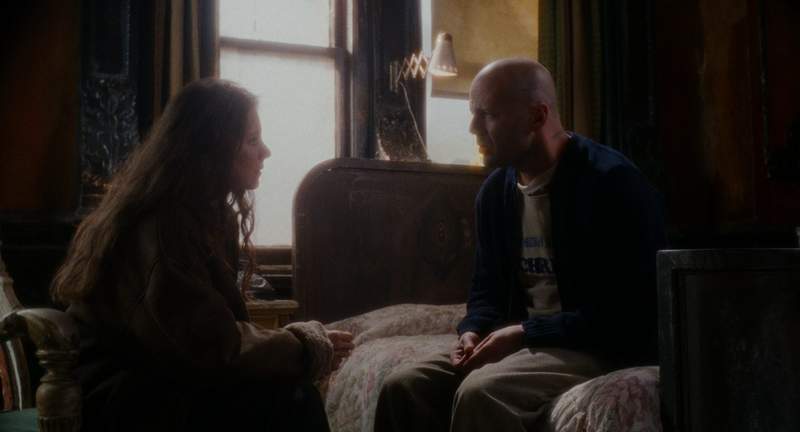
Shot in a mixture of locations—generally very decayed for the present-day material—in Baltimore and Philadelphia, with studio work for the future scenes, Twelve Monkeys rejects visual polish through Gilliam and Pratt’s shared choices. The film often works with extreme wide angles, between 10mm and 18mm. They are especially evident in the future sequences and in the 1990s scenes connected directly to the characters’ instability: the institution where Pitt’s character appears, the staircase shots, and the party sequence Cole enters. These passages are framed through Willis’s character’s distorted perception.
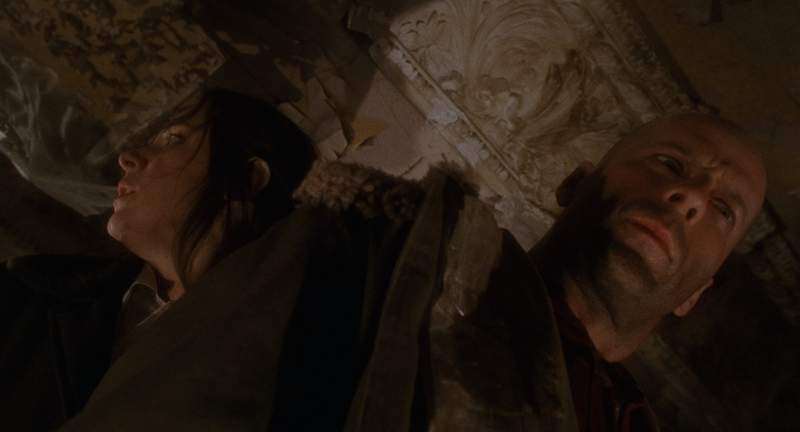
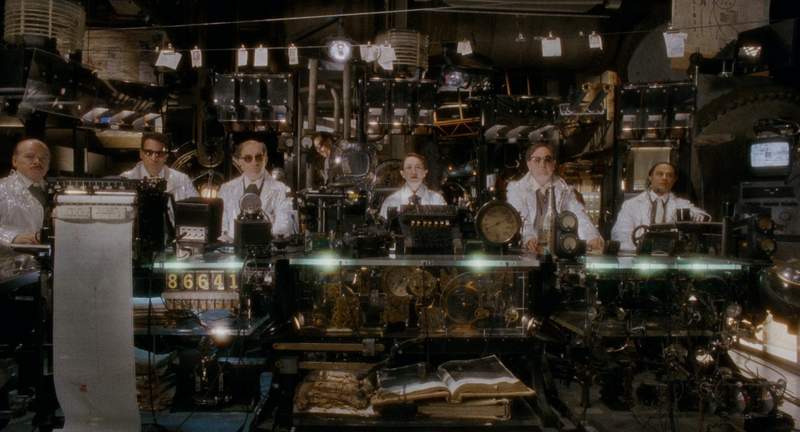
The filmmakers also tend to use handheld camera there. The movement, composing broadly across the frame but also vertically within the 1.85:1 ratio, supports Cole’s discomfort as he is mistaken for someone with mental-health problems. In the future scenes, where Cole is questioned by the scientists directing the mission, Gilliam and Pratt apply a related treatment, though in a more dreamlike register. The strange technology of the supposed underground world belongs to the same visual logic.
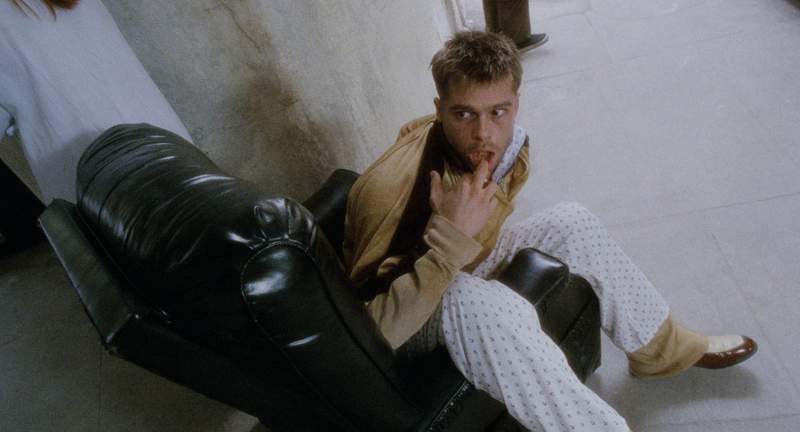
Technically, the filmmakers did not pursue a perfect image; frequently, and deliberately, they sought the opposite. Those extreme wides may have been Canon FD still-photography lenses adapted for cinema. In addition to its 14mm conversion, Optex made a 10mm from the same design, with scarcely any usable edge definition, and that character matches what appears in the future scenes. Although one can clearly see a wide-angle lens from the Zeiss High Speed T1.4 series in those passages—or possibly the Zeiss Standard Prime 20mm T2.1, with its distinctive triangular iris in defocus—the greater part of the film appears to have been shot with Cooke Speed Panchros, or S2/S3 lenses. They were already old lenses—manufacture had ceased in 1970—when Twelve Monkeys was made, though digital cinematography would make them fashionable again years later for their softness and imperfections. A Cooke 20-100mm zoom also appears occasionally.
Much of the film was also shot with a Christian Dior 10 stocking behind the lens, creating halation and softening the image further. Pratt then committed to one high-speed stock for the whole production, Kodak EXR 5298 (500T). Alongside the optical imperfections, it gives the film a pronounced grain texture, characteristic of those pre-Vision Kodak emulsions.
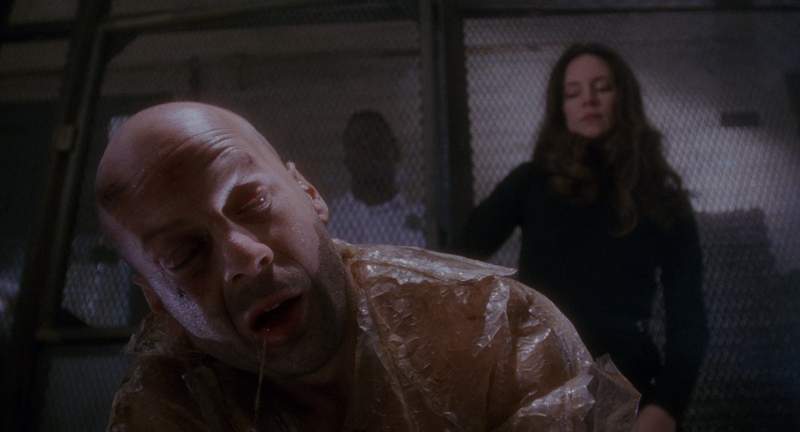
Under these conditions, it is no surprise that the image is not conventionally attractive. That seems precisely to be what Pratt was avoiding. Color is rarely vivid and can be distinctly muted. To keep the technical decisions from producing a merely flat image, he lights with large sources and frequent overexposure, at times allowing performers to move freely between light and shadow. This is especially evident in the institutional scenes. The first exteriors on the Earth’s surface have a pronounced bluish cast; together with the degraded locations and the technical choices, the film offers the viewer very little visual comfort.
Direct units sometimes enter through windows, as in the scenes where the doctors question Willis or when Willis and Stowe are attacked in the hotel, yet the overall result is not, and does not seek to be realistic. Shooting the car interiors on a stage adds another layer of artifice. There is some care in giving Madeleine Stowe an appealing look, but it is integrated into the general lighting and visual design. For the future scenes, Pratt explained the warm look as the consequence of low-voltage tungsten light being used by a precarious humanity; that accounts for their yellowish cast, alongside the emphatic use of wide lenses.
Final Thoughts
The results are compelling because the staging fits the narrative so closely. The visual language is not simply another contribution to an odd tone: it is an essential part of it, fully integrated with the story and the filmmakers’ way of telling it. Pratt’s choices keep the lighting and the film’s aesthetic, beyond the extreme wide angles, in a relatively low-key register, which may make the work seem less demonstrative. Within Gilliam’s particular sensibility, however, they are highly effective. The decayed, dirty, low-contrast and grainy appearance defines the environments in which the characters move before the release of the virus that will destroy humanity.
The slow-motion, heavily overexposed images in Bruce Willis’s dream remain especially memorable. Laboratory work was used to heighten the effect captured on set, and the sequence offers a beautiful homage to Vertigo (Alfred Hitchcock, 1958), one that is perfectly integrated into the plot of this science-fiction classic. The current 4K HDR Blu-ray represents the film’s original appearance very well: its 35mm prints and photochemical finish remain legible in the transfer.
This article is part of ON FILM & DIGITAL’s English-language cinematography reviews and essays.
Ignacio Aguilar, AEC is a cinematographer / director of photography based in Madrid, Spain. His work spans feature films, television, commercials and technical writing on cinematography, with experience in digital cinema, 16mm and 35mm film, anamorphic lenses, large-format digital capture, lens testing and film-based workflows.
He is a member of the Spanish Society of Cinematographers (AEC) and the Spanish Academy of Cinema, a Sony I.C.E. Certified Expert and a Cooke SP3 ambassador. His writing has appeared in American Cinematographer and Camera & Light, and ON FILM & DIGITAL gathers his bilingual essays, technical guides and cinematography reviews.
For professional work, collaborations, lectures, workshops or cinematography consulting, visit his professional biography, selected works or contact page.
The Spanish-language archive is available at ON FILM & DIGITAL.