
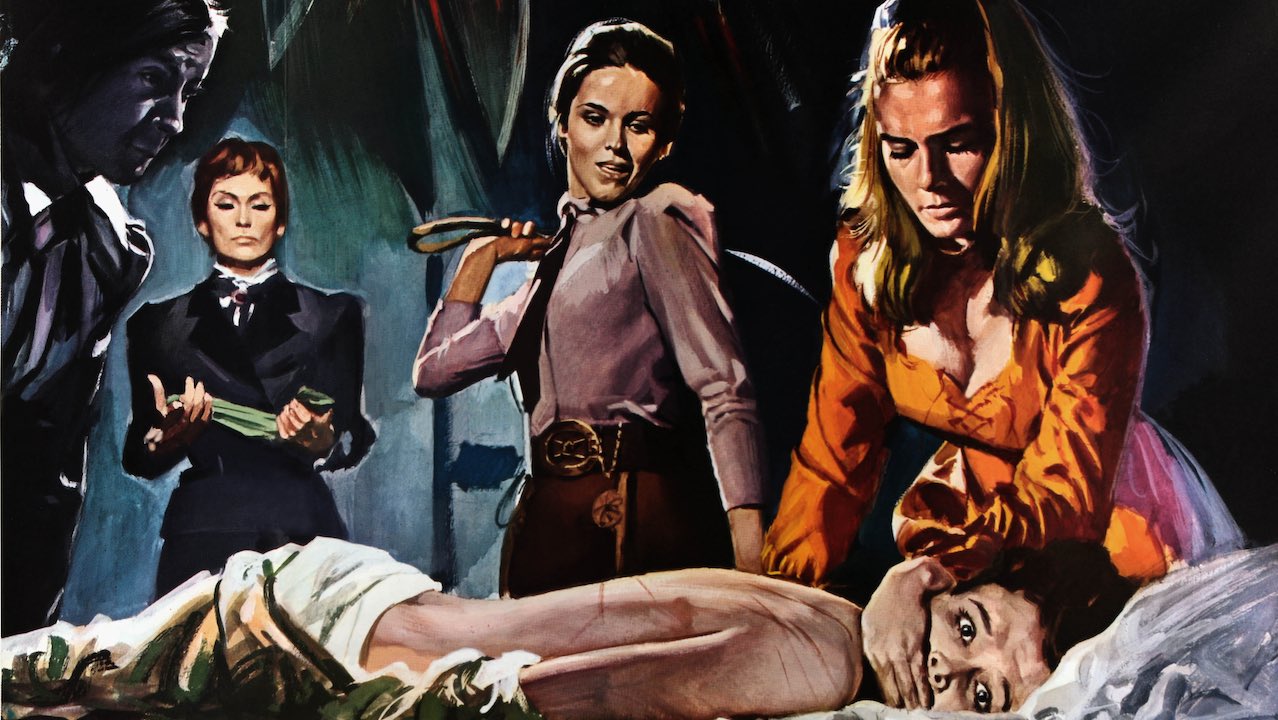
“The House That Screamed”
Original Spanish Title: “La Residencia”
Also Known As: “The Finishing School”
Year of Production: 1969
Director: Narciso Ibáñez Serrador
Cinematographer: Manuel Berenguer [ASC]
Optics / System: Franscope anamorphic
Film Stock: Kodak 5254 (100T)
Format and Aspect Ratio: 35mm anamorphic (Franscope), 2.35:1
Viewed on Blu-ray
Narciso Ibáñez Serrador’s Gothic debut remains one of the most formally accomplished Spanish horror films of the 1960s, built around Manuel Berenguer’s controlled anamorphic lighting and an unusually international sense of visual ambition.
The Film
“The House That Screamed” is one of the key works of Spanish horror cinema and the feature debut of writer-director Narciso “Chicho” Ibáñez Serrador. It adapts, rather freely, a short story by Juan Tébar. By that point, however, Serrador was already a major television figure in Spain, known for his game shows and for the anthology series “Historias para no dormir.”
It was also one of the first Spanish films — perhaps the first — conceived with a clearly international market in mind. That ambition explains the presence of foreign actors such as Lilli Palmer, excellent in the central role, as well as John Moulder-Brown and Mary Maude. It also explains the unusually substantial production values, including the impressive interior sets designed by Ramiro Gómez.
The screenplay is somewhat schematic, but the film is carried by Serrador’s direction and by the precision of its visual construction. Serrador would make only one more feature, the also remarkable “¿Quién Puede Matar a un Niño?” / “Who Can Kill a Child?” (1976). Waldo de los Ríos composed the score, and the cast also includes Cristina Galbó, Cándida Losada, Tomás Blanco, Víctor Israel and Teresa Hurtado.
The Cinematographer
The cinematographer was Manuel Berenguer [ASC], the first Spanish cinematographer to become a member of the American Society of Cinematographers. Trained in Germany, Berenguer photographed films such as “Bienvenido Mr. Marshall” (Luis García Berlanga, 1953), “El Lazarillo de Tormes” (César Ardavín, 1959) and “Un Rayo de Luz” (Luis Lucía, 1960). Yet his reputation is especially tied to the many international productions that came to Spain in the 1950s and 1960s.
He worked on second units for “Around the World in 80 Days” (1956) and “The Pride and the Passion” (1957), photographed “Thunderstorm” (John Guillermin, 1956), and later, during the 1960s, was promoted to first-unit work on “King of Kings” (Nicholas Ray, 1961) after Franz Planer became ill. The final cinematography credit on that film was shared by Planer, Milton Krasner and Berenguer.
He then continued to work on second units for “El Cid” (1961), “55 Days at Peking” (1963), “Circus World” (1964), and films such as “The Thin Red Line” (1964) and “Crack in the World” (1965), both for Andrew Marton. He was also associated with large-format international productions such as “Savage Pampas” (1966) and “Krakatoa: East of Java” (1969).
“Doctor Zhivago” (David Lean, 1965) is a special case. Berenguer was assigned to the second unit, but he also served as a bridge on first-unit photography for several weeks between the departure of Nicolas Roeg and the arrival of Freddie Young, shooting, for instance, material in Finland.
In the 1970s, already a veteran, Berenguer continued to work on international projects shot in Spain. The most important of these was probably “Nicholas & Alexandra” (Franklin J. Schaffner, 1971), again on second unit, along with a number of smaller international productions before his retirement at the end of the decade.
Visual Style Analysis
Berenguer, however, was not the original cinematographer on “The House That Screamed.” The film was initially assigned to Godofredo Pacheco. First-hand sources told me that Pacheco had difficulties with the anamorphic format and with the levels of darkness and contrast required by the film, with the dreaded risk of a thin negative with milky blacks. He was quickly replaced by Berenguer, and the finished film appears, for practical purposes, to have been visually resolved by Berenguer.
Sol Carnicero, who worked on the film, later attributed the incident to a stock or laboratory problem and described the dismissal as unfair. Whatever the exact cause, Berenguer’s solution was very classical and very practical. Shooting on film — most likely Kodak 5254, the 100T stock introduced in 1968 — he substantially increased the light levels, either by adding lamps or by replacing existing units with more powerful ones.
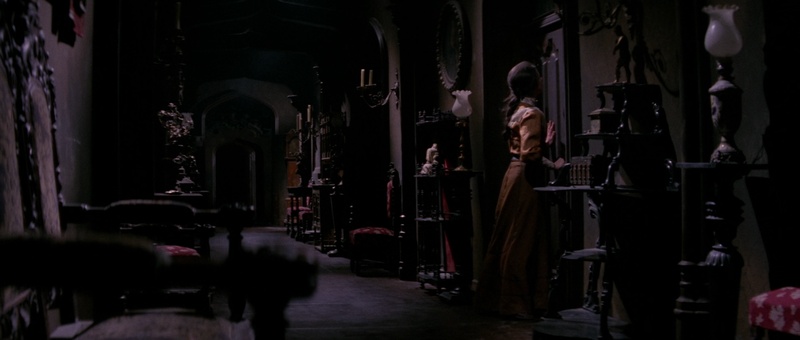
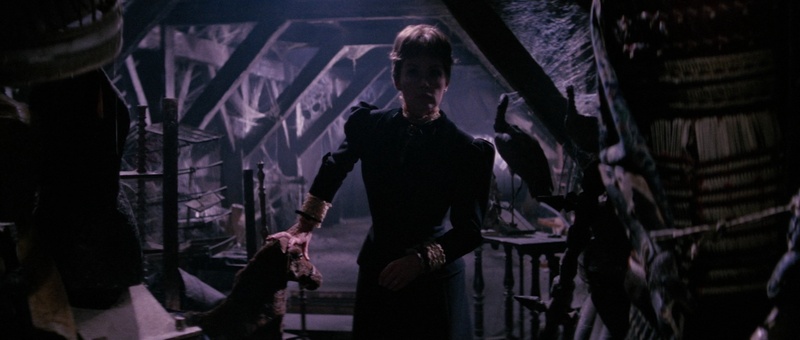
But he did not simply flood the sets with light. Working around T/4 ½ with the Franscope system, he generally seems to have concentrated a great deal of light in a limited number of areas, and then probably printed the image down. The properly exposed areas hold density and shape, while the unlit parts of the frame fall into real darkness. That gives the blacks more weight and keeps them cleaner than a softer, more general lighting approach would have done.
This is one reason why the lighting of “The House That Screamed” feels closer to “The Innocents” (Jack Clayton, 1961) than to almost any other reference. Serrador’s film is in color, of course, but it shares with Clayton’s film a highly controlled Gothic atmosphere, a sense of visual pressure, and a classical approach to the architecture of fear.
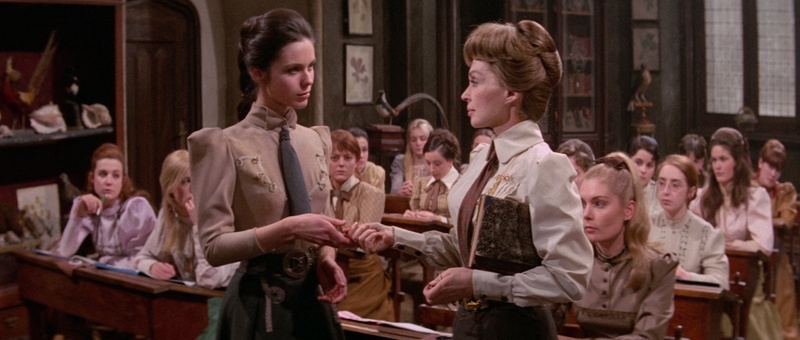
Berenguer’s light is usually hard and direct, aimed both at the actresses and at the sets. There are exceptions, especially the shower sequence and some of the kitchen scenes, where the light is softer. But much of the film uses a classical front-lighting strategy, almost in the Robert Krasker tradition, to photograph Lilli Palmer, Mary Maude or Cristina Galbó with a carefully shaped, flattering intensity.
What is technically impressive is the way Berenguer uses multiple sources on the actresses — in the classroom, in the dining room, or in the dormitory — without letting the shadows become chaotic or visibly overlap. He also manages to preserve that control during moving shots, which is considerably more difficult with this kind of lighting.
In the darker scenes, the system is based on large units creating continuous backlight. Not just one unit, but several, because the actresses move through the spaces. Other large sources pick out parts of the set or create highlights on the floor. The candle scenes are also clearly supported by off-camera lamps, probably controlled through resistance dimmers, the old practical solution for making candlelight effects photographable at the required stop.
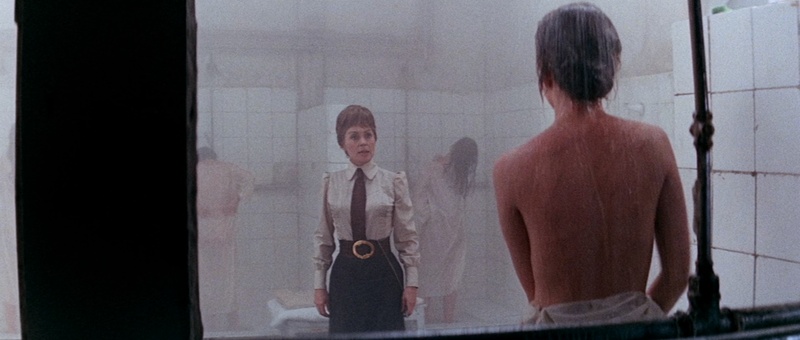
The result is a color genre film of unusual formal discipline, capable of standing beside far more established international models. The care with which Berenguer photographs Lilli Palmer is especially visible on the Arrow Blu-ray master, sourced from a 2K scan of the original negative. It suggests not only precise placement of light, but also the possible use of very light diffusion on the lens to soften the German actress’s close-ups even further.
This is cinematography of a very high level, not only by Spanish standards, but within 1960s genre cinema more broadly. Its only limitation, if one wants to call it that, is that the style is so classical that it would soon begin to feel historically displaced. The candle effects, for example, are created with large Fresnel support rather than through the more available-light sensibility that would become central to the New Wave and to many American films of the early 1970s. For a nineteenth-century Gothic setting, however, and for the dramatic intentions of the film, the approach is almost ideal.
And when the lighting already seems to be the film’s most impressive achievement, there is another essential element: the camera work in anamorphic widescreen.
Berenguer used the Franscope system, which in this context basically meant a front anamorphic attachment placed on an Angénieux 35-140mm zoom, as in films such as “Rapture” or “The Blue Max.” The system offered a broad focal range in anamorphic, from pronounced wide-angle views to telephoto compositions, as well as the ability to zoom. It also came with significant edge distortion and limited speed, around T/4.4. Its minimum focus, however, was very good for anamorphic photography.
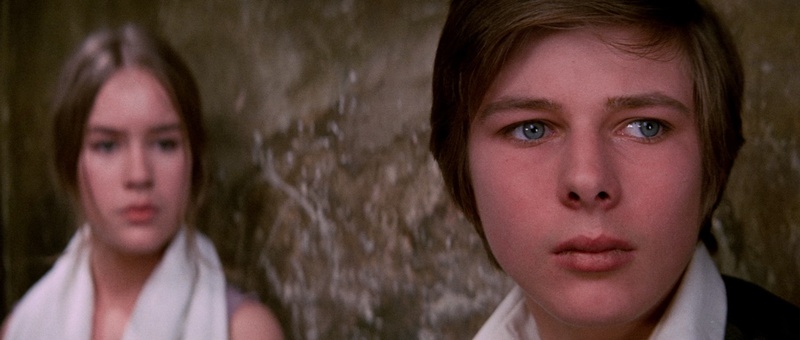
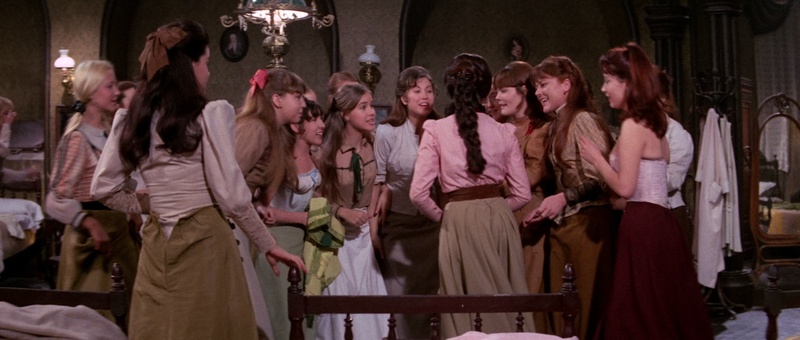
The filmmakers use that system with real skill. They build excellent compositions with many characters in the frame at the same time, placing the actresses with remarkable order and balance. The blocking creates depth and perspective lines, but it also reinforces the film’s idea of imposed discipline: bodies arranged in space as part of a repressive visual system.
The camera, operated by Salvador Gil, also moves among the actresses with remarkable precision, using tracks, dollies, cranes, wheeled platforms and other classical tools. These compositions and movements are even more impressive when one remembers the working conditions of the period: no video assist, no Steadicam, no stabilized heads, and no modern monitoring systems to correct the shot after the fact.

Conclusion
What remains is a superb visual achievement, and one that still seems under-discussed. The sets are often praised, and rightly so, but the way those sets are photographed is just as important as the production design itself.
By Spanish standards of the time, “The House That Screamed” was a major production — it reportedly cost around 30 million pesetas, a very large sum then. But the film does not stand out simply because money was spent on it. It stands out because that money was organized into a coherent visual system: lighting, décor, blocking, lenses and camera movement all working toward the same oppressive Gothic atmosphere.
It is a pity that the Arrow master still shows certain issues, including a slightly magenta bias and some sections that do not appear to come from the original negative, such as the optical effects, which were probably sourced from second- or third-generation elements. Even so, the improvement in image quality may help the film gain the wider international reassessment it deserves as one of the most memorable achievements in Spanish Gothic cinema.
ON FILM & DIGITAL
© Ignacio Aguilar, 2026.
This article is part of ON FILM & DIGITAL’s English-language cinematography reviews and essays.
These texts are not plot summaries or general film reviews, but cinematography-focused essays written from the perspective of a working cinematographer.
The Author
Ignacio Aguilar is available for cinematography work, creative collaborations, lectures, workshops and international projects. He is a Sony Independent Certified Expert (ICE) and Cooke Optics Spanish Ambassador for Cooke SP3 lenses. Contact here.