

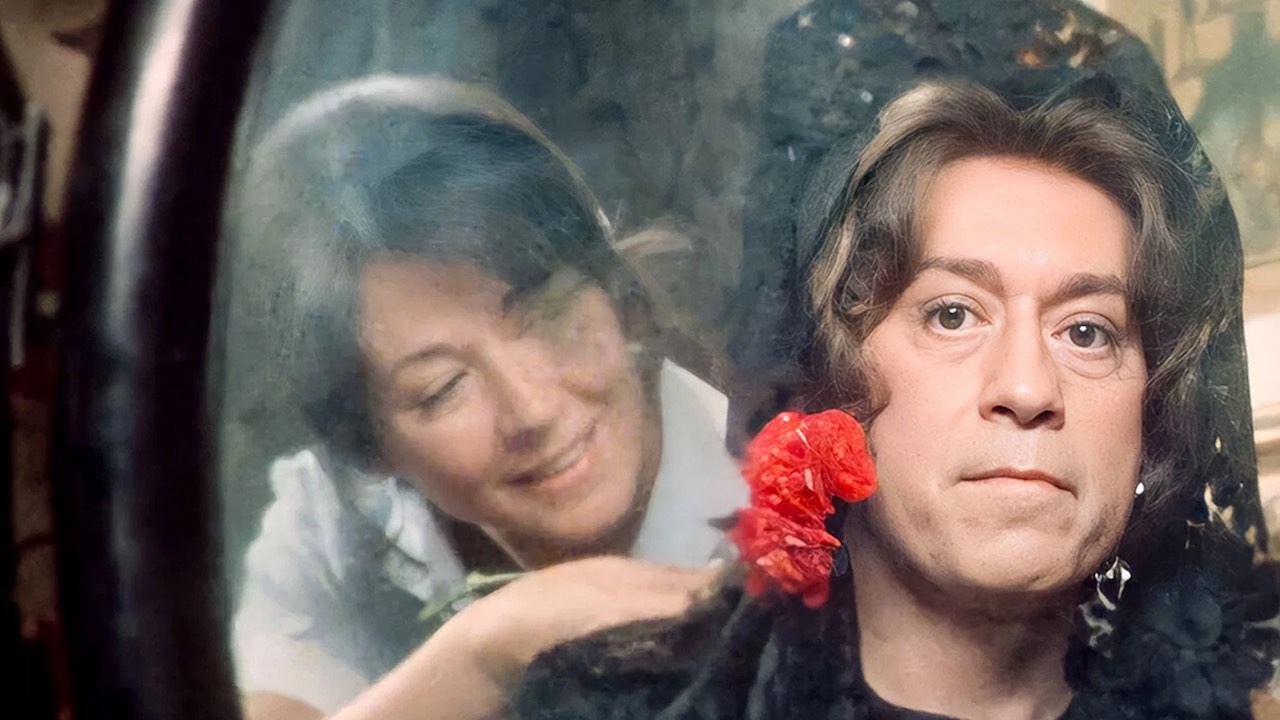
“My Dearest Senorita” / “Mi Querida Señorita”
Production Year: 1972
Director: Jaime de Armiñán
Director of Photography: Luis Cuadrado
Film Stock: Kodak 5254 (100T)
Format and Aspect Ratio: 35mm spherical, 1.66:1
Viewed on HDTV
Soft light, generous exposure and modern naturalism in one of Spanish cinema’s most unusual early-1970s films, photographed by Luis Cuadrado.
The Film
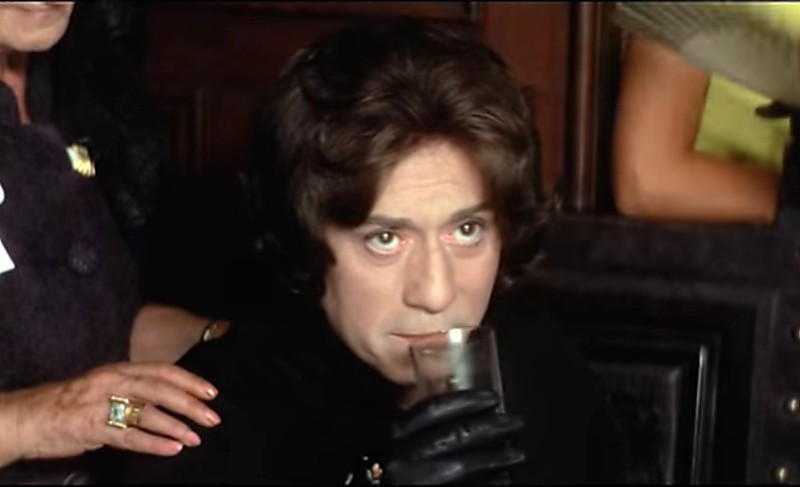
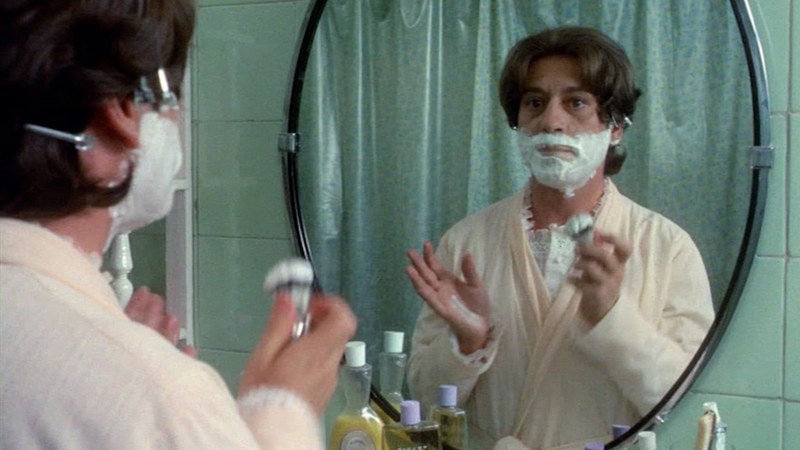
A classic of Spanish cinema, and a remarkably daring film for its time, “My Dearest Senorita” centers on a middle-aged woman, played by José Luis López Vázquez, who lives with her maid, played by Julieta Serrano, in a town in northern Spain. Her sheltered life begins to collapse when she receives a marriage proposal and, after following her own suspicions, is forced to confront a physical reality about her sex that completely alters the social identity under which she has lived until that point.
Shot and released under the conditions of repression and censorship that still defined Spain at the time, “My Dearest Senorita” is anchored above all by López Vázquez’s remarkable performance in the central role. Its premise and dramatic development may require a certain suspension of disbelief from a contemporary viewer. But in many other respects — its delicacy in treating sexuality, its supporting performances, and the way the film often suggests more than it explains — it remains exemplary and unexpectedly magnetic, especially when considered within its historical context.
Antonio Ferrandis, Mónica Randall, Lola Gaos, Chus Lampreave, co-screenwriter José Luis Borau, appearing as the doctor, and Luis Barbero complete the cast.
The Cinematographer
The cinematographer was Luis Cuadrado, who at the time was regarded as the cinematographer of the “New Spanish Cinema,” and perhaps the most important Spanish cinematographer of his generation. He would later work again with director Jaime de Armiñán on “El Amor del Capitán Brando” (1974).
Cuadrado was, of course, the cinematographer of “El Espíritu de la Colmena” / “The Spirit of the Beehive” (Víctor Erice, 1973), one of the major works of Spanish cinema. He also collaborated with Carlos Saura on “La Caza” (1965), “Peppermint Frappé” (1967), “Ana y los Lobos” (1973) and “La Prima Angélica” (1974). With José Luis Borau himself, he shot “Furtivos” (1975) and “Hay que matar a B.” (1975), as well as “Pascual Duarte” (1976) for Ricardo Franco.
His career, however, ended tragically. After vision problems that were diagnosed late in the early 1970s, he underwent unsuccessful surgery for a brain tumor, became blind, and had to retire from cinema prematurely. His final films were made with considerable help from his crew, led by his camera operator Teo Escamilla. Cuadrado died in 1980, at only 45 years of age.
Visual Style Analysis
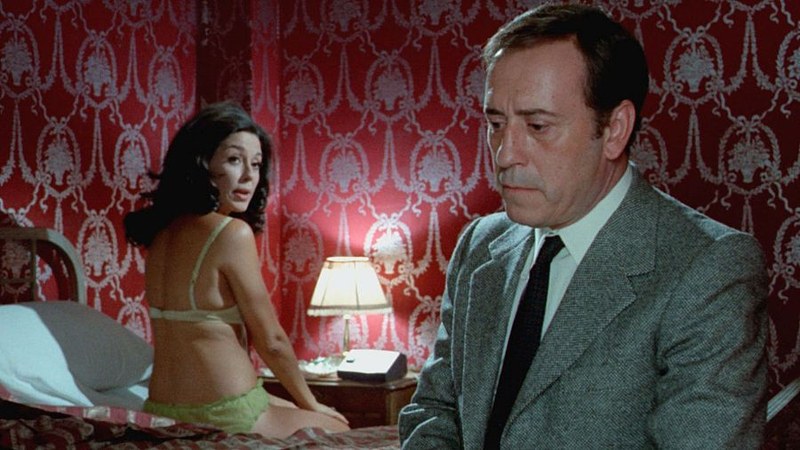
The cinematography of “My Dearest Senorita” is very characteristic of Luis Cuadrado. It is modern for its time, and very different from the more classical color cinematography that continued to dominate much of Spanish cinema almost until the 1980s. The work is built around soft light, practical locations and motivated sources.
Cuadrado believed strongly in that principle. If there was a window or a lamp within the set, the cinematographer’s task was to use it as the primary motivation for the lighting. This does not necessarily mean that the visible source was actually doing the work. More often, it served as a visual reference around which the cinematographer could build the scene, persuading the viewer that the source was truly illuminating the space.
In “My Dearest Senorita,” Cuadrado constructs many situations in precisely this way, especially day interiors. The rooms in Adela’s house and the interiors of the bank, for instance, have a convincing sense of being lit by the daylight entering through the windows.
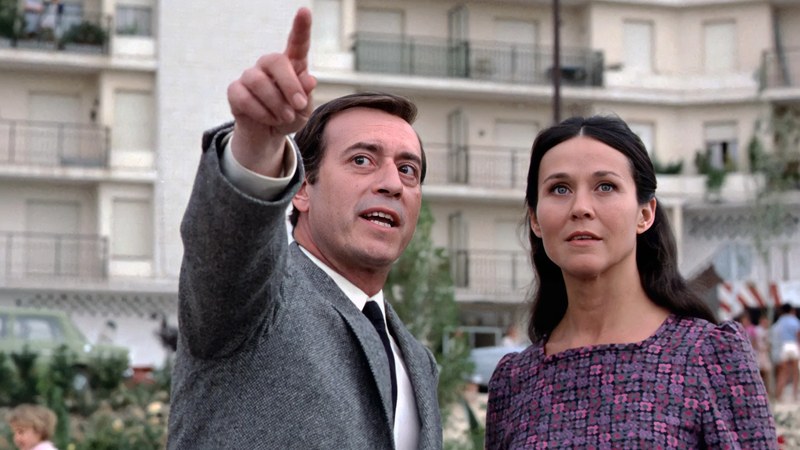
His work can perhaps be seen as a continuation of what Gianni Di Venanzo had represented in Italy, or Henri Decaë in France. At the same time, it also feels like a Spanish, much more modest equivalent of a line that in Britain could be associated with David Watkin. To soften the light, Cuadrado had to bounce it or diffuse it, which requires either large sources or a great deal of power from many smaller units. That becomes difficult on low-budget films shot in real locations.
For that reason, Cuadrado’s sources are not as large as Watkin’s. Watkin was working at a different level of production. But in smaller spaces, Cuadrado often reaches comparable results, only drier, harder and less painterly. He also shares something with Watkin in the way he exposes: giving the negative plenty of exposure during shooting, often protecting the shadows, and then controlling the highlights through processing and printing.
This gives the shadows a great deal of information and helps Cuadrado obtain a dense negative. The trade-off is that he often has to shoot wide open. At that point the lenses sometimes show focus problems at the edges, or a very visible spherical aberration, producing a slightly milky softness. It is possible that he was using Schneider or Zeiss lenses rather than Cooke Speed Panchros, precisely because this kind of lateral focus loss, or this specific aberration, is not usually associated with Cooke glass, even at maximum aperture.
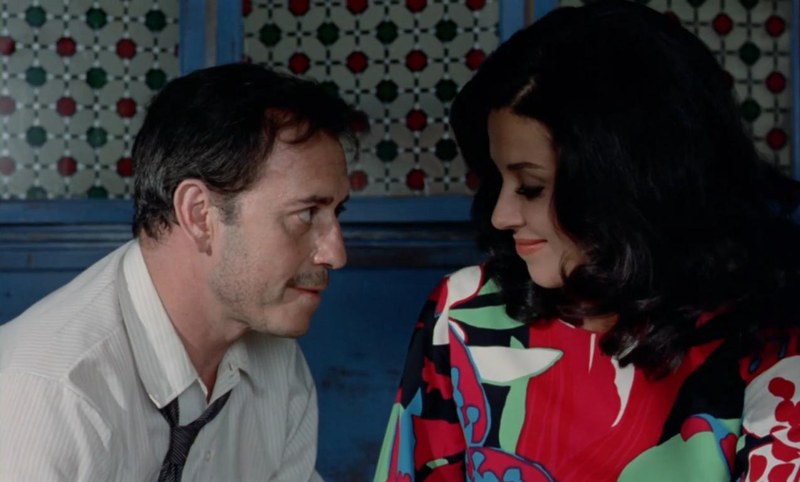
In exteriors, Cuadrado follows the direction of the sun and chooses the right hours of the day, but above all he shoots backlit whenever possible. Combined with his generous exposure, this allows him to avoid artificial light in many exterior scenes and still obtain very good, natural-looking results.
Within this approach, some scenes work better than others. In the night scenes, Cuadrado tends to use more direct, harder and more focused light on the actors, probably out of necessity and logistics rather than preference. But even within those limitations, and despite the modernity of the overall approach, the treatment of faces is extremely interesting. This applies not only to López Vázquez, for obvious dramatic reasons, but also to Julieta Serrano and Mónica Randall, who are photographed very well.
Conclusion
For all these reasons, despite its limitations and its small scale, “My Dearest Senorita” looks very good. It clearly competes with European productions of the period and absorbs visual tendencies that were already being applied in higher-budget cinema. Cuadrado was unquestionably at the forefront of that movement in Spain, which makes his early fate all the more tragic.
Viewed on HDTV.
ON FILM & DIGITAL
© Ignacio Aguilar, 2026.
This article is part of ON FILM & DIGITAL’s English-language cinematography reviews and essays.
These texts are not plot summaries or general film reviews, but cinematography-focused essays written from the perspective of a working cinematographer.
The Author
Ignacio Aguilar is available for cinematography work, creative collaborations, lectures, workshops and international projects. He is a Sony Independent Certified Expert (ICE) and Cooke Optics Spanish Ambassador for Cooke SP3 lenses. Contact here.