


“Autumn Sonata”
Spanish Title: Sonata de Otoño
Year of Production: 1978
Director: Ingmar Bergman
Director of Photography: Sven Nykvist, ASC
Lenses: Cooke 20-100mm T3.1
Film Stock: Kodak 5247 (100T)
Format and Aspect Ratio: 35mm spherical, 1.66:1
Viewed on: Blu-ray
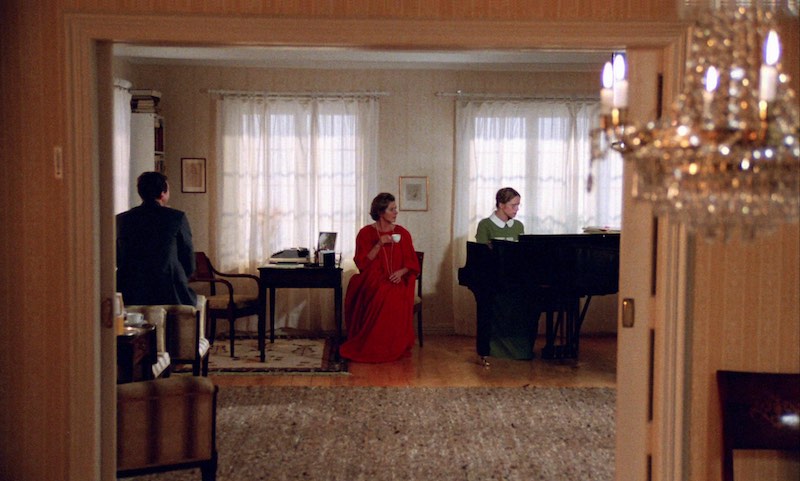
Nordic window light, controlled faces and a discreet zoom-based camera language: Ingmar Bergman and Sven Nykvist turn “Autumn Sonata” into an almost surgical chamber duel.
The Film
An Ingmar Bergman production starring Ingrid Bergman — in her final theatrical feature — and Liv Ullmann, “Autumn Sonata” brings together a mother and daughter who meet again at the daughter’s home after seven years apart. Eva lives there with her husband and with her younger sister, Helena, who suffers from a severe illness. She is also marked by the loss of her own son years earlier.
Charlotte’s return soon reopens a relationship built on love, resentment and emotional abandonment. Her long absence from family life was the consequence of a career as an elite concert pianist, and the film gradually turns that absence into the central dramatic wound. This is classic Bergman material: intense relationships, psychological depth and characters whose contradictions are treated with unusual precision. Above all, the film is an extraordinary acting duel between Ingrid Bergman and Liv Ullmann.
The film was shot in Norway and produced through Bergman’s German company, during the period when he was dealing with tax problems in Sweden. In emotional severity, it is not far from the celebrated “Cries and Whispers” (1972), with which it shares several dramatic and formal concerns.
The Cinematographer
The cinematographer was Sven Nykvist [ASC], Bergman’s most important collaborator in this field. Their work together includes approximately thirty titles across cinema, television, documentary and projects in which Bergman was only credited as writer. The collaboration extended from 1953 to 1984 and includes two Academy Awards for Best Cinematography: the first for “Cries and Whispers” and the second, ten years later, for “Fanny & Alexander” (1982).
Their shared filmography includes “Jungfrukällan” (“The Virgin Spring”, 1960), “Persona” (1966) and “Scener ur ett äktenskap” (“Scenes from a Marriage”, 1974). But Nykvist was never only Bergman’s cinematographer. He also built an exceptional international career, working with filmmakers such as Richard Fleischer (“The Last Run”, 1971), Volker Schlöndorff (“Strohfeuer”, 1972), Roman Polanski (“Le Locataire / The Tenant”, 1976), Louis Malle (“Pretty Baby”, 1978), Jan Troell (“The Hurricane”, 1979), Bob Rafelson (“The Postman Always Rings Twice”, 1981), Norman Jewison (“Agnes of God”, 1985), Andrei Tarkovsky (“The Sacrifice”, 1986), Philip Kaufman (“The Unbearable Lightness of Being”, 1988, for which he was nominated for an Oscar), Woody Allen (“Crimes and Misdemeanors”, 1989), Richard Attenborough (“Chaplin”, 1992, also Oscar-nominated), Nora Ephron (“Sleepless in Seattle”, 1993) and Lasse Hallström (“What’s Eating Gilbert Grape”, 1993), among others.
Visual Style Analysis
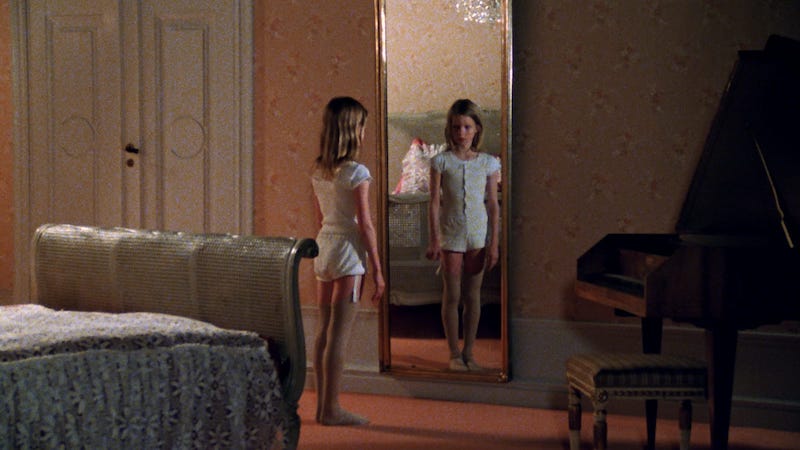
If “Autumn Sonata” is recognizably an Ingmar Bergman film, the same can be said of Sven Nykvist’s cinematography and of the way the film is staged for the camera. It is not especially surprising that Nykvist relied largely on a zoom lens. The zoom — probably the Cooke 20-100mm T3.1 — is not used simply as a variable focal length to avoid changing primes. Throughout the film, there are many small reframings performed with the zoom, almost always discreetly.
At times, the zoom seems to replace the need for tracks or dollies. It allows the camera to collect or follow the characters when their distance from the lens changes, without turning that adjustment into an overt camera move.
At other moments, it may have been a way to work faster, or more quietly, on set without disturbing the actresses, who are clearly the central consideration in a film like this. “Autumn Sonata” is also built around a large number of close-ups. In that context, adjusting the frame with a zoom makes practical sense. Its slightly softer rendering, compared with harder or sharper primes, may also have been gentler on faces.
In any case, the zoom is always present. At times it reveals spherical, chromatic and even geometric aberrations. But Nykvist and Bergman clearly trusted the instrument. Its neutral, observational character suits their position as storytellers: close enough to register the damage between the characters, but not so expressive that the photography overtakes the scene.
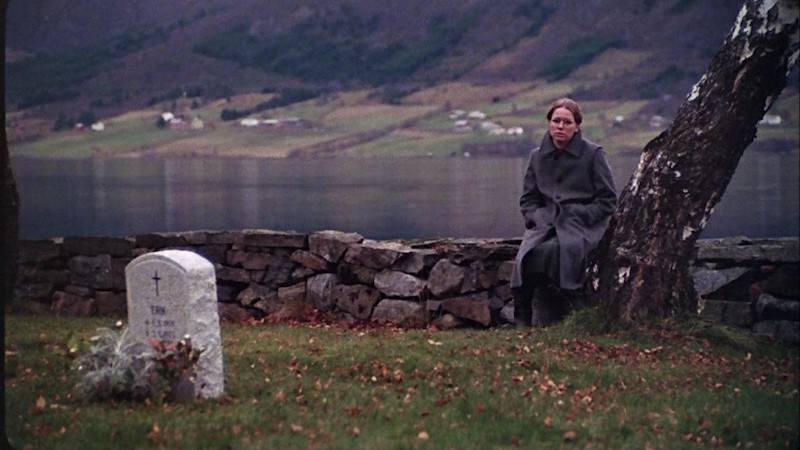
In terms of lighting, “Autumn Sonata” is one of the clearer examples of what is usually understood as northern light. Nykvist’s light is generally soft, window-motivated and low in intensity. Except for a few moments that imitate sunlight entering through the windows, the effect is closer to an overcast sky filtering into an interior: soft, even, restrained and emotionally desaturated. That sadness is one of the film’s defining aesthetic qualities.
Here, Nykvist works in close alignment with the production and costume design, both of which are organized around ocher and autumnal tones that almost justify the title by themselves. There is also a considerable amount of night material. In those scenes, Nykvist tries to preserve a degree of realism while also presenting Ingrid Bergman with a sophisticated and carefully shaped appearance. The actress was over 60 at the time of the shoot, and the cinematography is clearly attentive to that fact.
The light remains low in level, with many practical sources integrated into the frame. But there is also a visible effort to surround Ingrid Bergman with soft bounced or diffused light, so that the contrast on her face remains controlled even when it is present. The same effort is not applied as consistently to Liv Ullmann. She appears under more varied conditions, and not always the most flattering ones. That may also serve the drama, making her character seem more exposed and vulnerable in relation to her mother.
Conclusion
This is not a film in which the image carries the main dramatic weight. Nor is it the kind of film that depends heavily on cinematography to tell the story. Beyond its melancholy atmosphere, “Autumn Sonata” would probably remain dramatically legible with a less refined visual treatment. But Nykvist gives it something crucial: the image surrounds the characters without calling attention to itself, quietly shading their personalities and their different emotional positions.
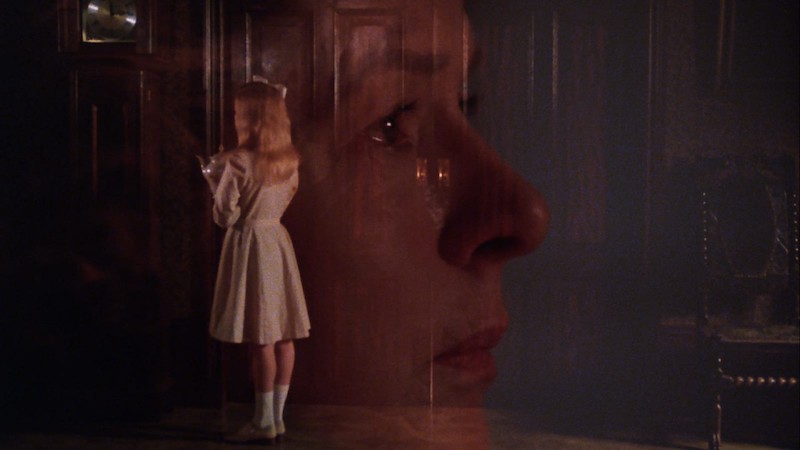
The film includes Bergman’s familiar break of the fourth wall almost from the beginning. It also contains flashbacks that, within an otherwise direct narrative, are clearly separated from the rest of the film by their distance and slightly warmer tone.
From a cinematographic point of view, this is a very strong example of invisible craft. There are aspects one can question: some focus issues, the heavier grain of the night scenes — which were probably pushed in order to continue working with the zoom — and a few small localized lights used by Nykvist to reinforce practical sources, which are slightly more visible than ideal. Even so, the film shows an exceptional stylistic understanding between director and cinematographer. Its visual style is invisible enough not to announce itself, but present enough to give “Autumn Sonata” the unmistakable distinction of Bergman and Nykvist.
Viewed on Blu-ray
ON FILM & DIGITAL
© Ignacio Aguilar, 2026.
This article is part of ON FILM & DIGITAL’s English-language cinematography reviews and essays.
The Author
Ignacio Aguilar, AEC is a Spanish cinematographer based in Madrid. His work spans feature films, television, commercials and technical writing on cinematography, with experience in digital cinema, 16mm and 35mm film, anamorphic lenses, large-format digital capture and practical lens testing.
Read more articles and reviews in Spanish at ON FILM & DIGITAL, or visit the main cinematography portfolio at ignacioaguilardop.com.