

“Jackie Brown”
Spanish Title: Jackie Brown
Year of Production: 1997
Director: Quentin Tarantino
Director of Photography: Guillermo Navarro, ASC, AMC
Lenses: Zeiss Super Speed T1.3
Film Stock: Kodak 5279 (500T)
Format and Aspect Ratio: 35mm spherical, 1.85:1
Viewed on: 4K HDR Blu-ray
Guillermo Navarro, ASC, AMC photographs Quentin Tarantino’s most restrained film: 35mm in 1.85:1, realistic Los Angeles locations, Kodak 5279 and touches of modern noir without losing the director’s rhythm.
The Film
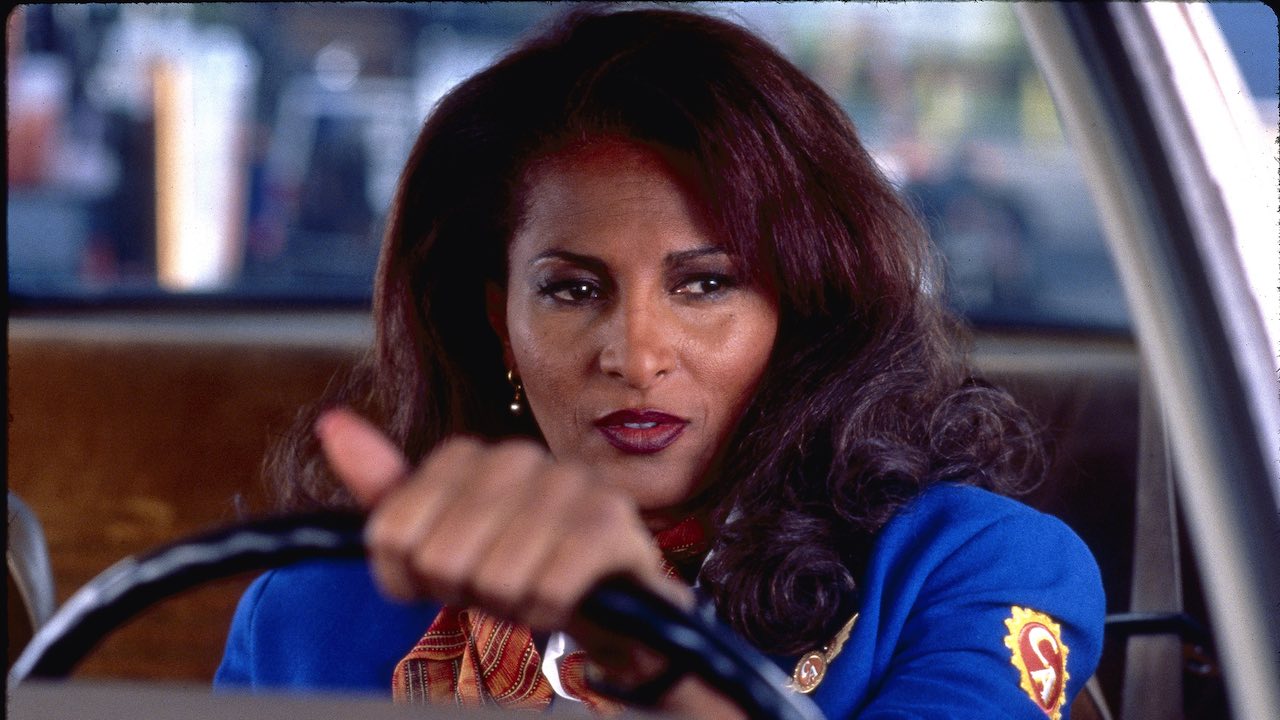
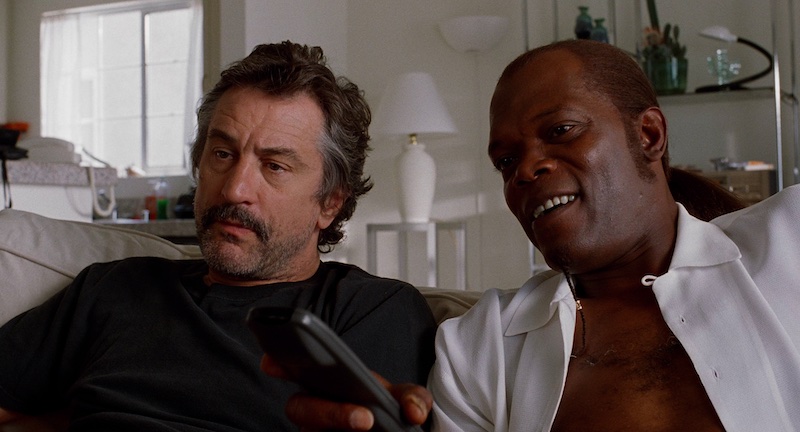
“Jackie Brown” is Quentin Tarantino’s film adaptation of Elmore Leonard’s novel “Rum Punch,” and remains the only adaptation in the director’s feature-film career. Its central character, Jackie Brown, played by Pam Grier, is a flight attendant who also works as a money courier for Ordell Robbie, a small-time arms dealer played by Samuel L. Jackson.
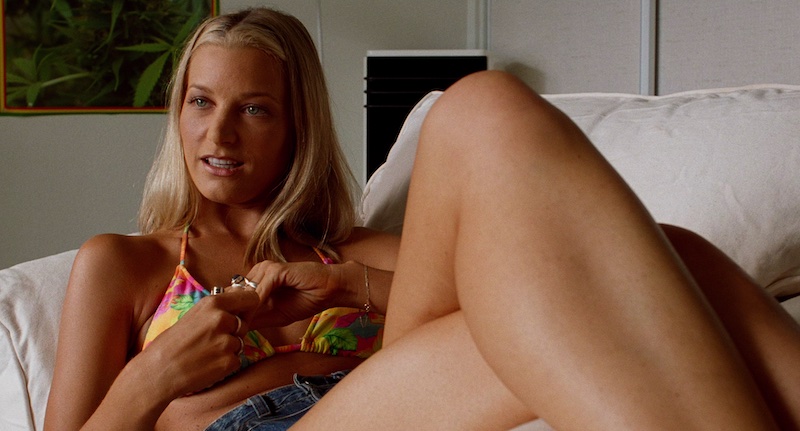
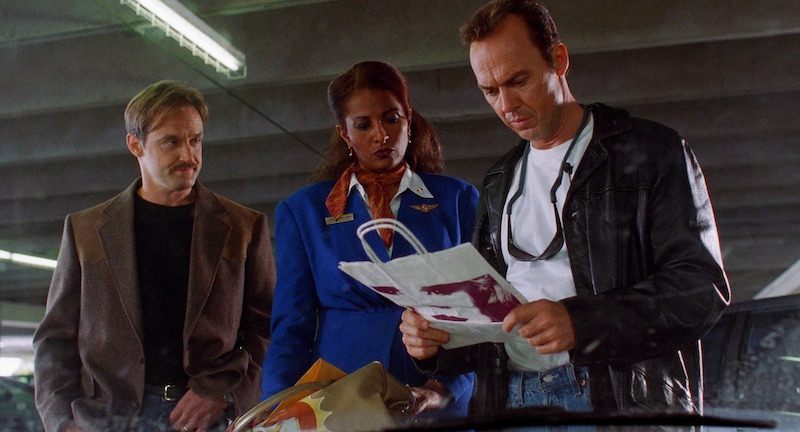
Ordell’s world includes Louis Gara, played by Robert De Niro, an old prison acquaintance, and Melanie, played by Bridget Fonda, a young woman who spends most of her time getting high at home. When Jackie is intercepted by two law-enforcement agents, played by Michael Keaton and Michael Bowen, she is forced into a difficult position: help them take down Ordell or face prison herself. With the help of bail bondsman Max Cherry, played by Robert Forster, she begins to imagine another option.
“Jackie Brown” was not the cultural explosion that “Pulp Fiction” (1994) had been, nor did it retroactively turn into the same kind of phenomenon as “Reservoir Dogs” (1992). That may be because it is a lower-profile film than Tarantino’s first two features. It is also narrated mostly in linear fashion, unlike the temporal disruptions that had made the earlier films so recognizable. None of that makes “Jackie Brown” a lesser work. It has rhythm, tension, character and a very clear authorial voice, but its energy is more controlled.
The Cinematographer
The cinematographer was the Mexican director of photography Guillermo Navarro [ASC, AMC]. Quentin Tarantino had met him through Robert Rodriguez, after appearing as an actor in two Rodriguez films photographed by Navarro: “Desperado” (1995) and “From Dusk Till Dawn” (1996). They had also crossed paths on the anthology film “Four Rooms” (1995), although Tarantino’s segment was still photographed by Andrzej Sekula, the cinematographer of “Reservoir Dogs” and “Pulp Fiction,” with whom Tarantino did not work again.
Navarro won the Academy Award in 2006 for “Pan’s Labyrinth / El Laberinto del Fauno,” directed by his compatriot Guillermo del Toro. His collaboration with del Toro includes some of his best-known films: “Cronos” (1993), “The Devil’s Backbone” (2001), “Hellboy” (2004), “Hellboy II: The Golden Army” (2008) and “Pacific Rim” (2013). In recent years, Navarro has focused largely on directing television.
Outside his work with del Toro, Navarro also photographed “The Long Kiss Goodnight” (Renny Harlin, 1996), “Spy Kids” (Robert Rodriguez, 2001), “Night at the Museum” (Shawn Levy, 2006) and “The Twilight Saga: Breaking Dawn” (Bill Condon, 2011), among other films, many of them involving action, fantasy or complex visual effects.
Visual Style Analysis
The cinematography of “Jackie Brown” is very different from the films Tarantino made before and after it. “Reservoir Dogs” and “Pulp Fiction” had been photographed on Kodak 5245 (50D), often with hard lighting, which immediately gave them a more stylized image. Both also used wider formats, and “Pulp Fiction” was photographed in 35mm anamorphic.
“Jackie Brown” is the opposite in many ways. Along with Tarantino’s episode of “Four Rooms,” it is one of the very few works he has shot for the conventional 1.85:1 aspect ratio. Perhaps because the director wanted a lower-profile film, the filmmakers also moved toward a more realistic visual approach.
As Navarro explained in “American Cinematographer,” Tarantino wanted a more realistic look. Navarro also noted that shooting a contemporary story in Los Angeles almost pushed them in that direction, even if Andrzej Sekula had already shown that Los Angeles could also be treated in a more overtly stylized way.
That intention helps explain several technical choices: Zeiss Super Speed T1.3 primes, some zoom work — possibly with Zeiss Variable Primes, which Navarro used on other films and which would have matched his prime set well — and Kodak Vision 5279 (500T). Compared with the earlier Kodak EXR 5298 (500T), 5279 offered higher contrast, strong saturation and finer grain. For Tarantino, moving from Sekula’s 50 ASA stock to Navarro’s 500T must have opened up a very different working method.
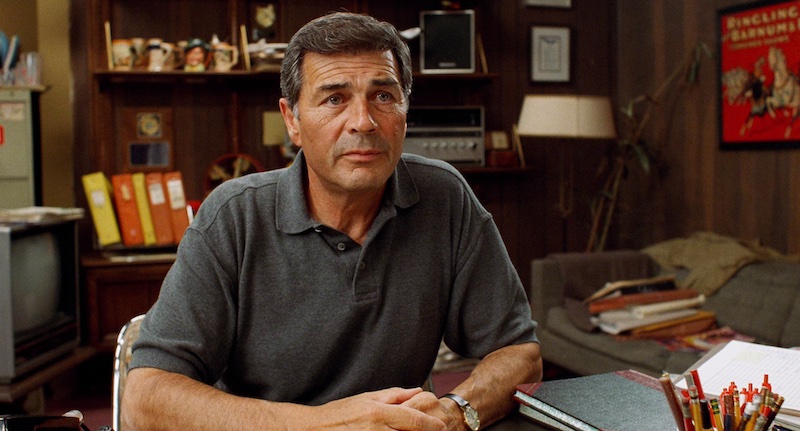
Many of the ordinary locations in the film — Max Cherry’s office, the beach apartment, the police facilities, the shopping mall, the airport parking lot — have the soft, realistic appearance Navarro was seeking. That does not mean they were simply recorded without intervention. The beach house, for example, appears to have required considerable lighting work. But these spaces are far removed from the hard, direct HMI style used on actors in parts of “Reservoir Dogs” and “Pulp Fiction.”
The night work, however, is more stylized. In exterior scenes, Navarro uses very large backlight sources to cover broad spaces with a single-shadow logic and a relatively neutral color. The film avoids the classic blue Hollywood night look. Its darkness is shaped, but it does not feel conventionally romanticized.
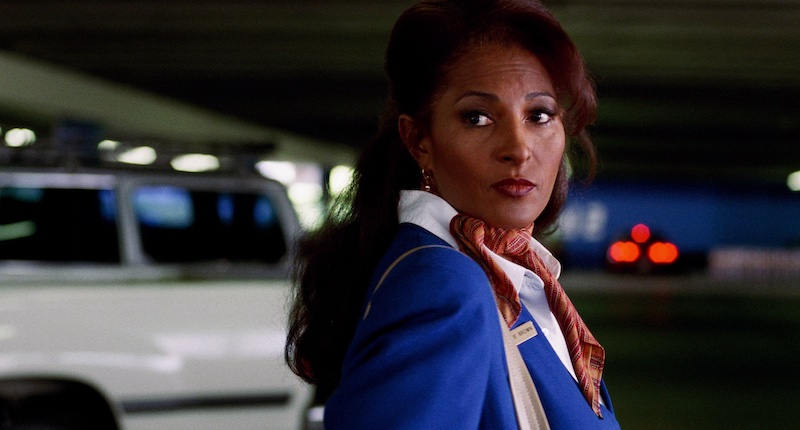
Some interiors and specific dramatic moments are more openly noir-inflected. The night encounter between Ordell and Jackie begins with only a glint in Samuel L. Jackson’s eyes inside a car. When the two characters meet inside the apartment, they are almost reduced to silhouettes against the window. The scene is simple, but it carries a precise sense of threat.
There are many close-ups in the film, and Navarro handles the actors with a good balance between realism and stylization. He makes them look attractive without breaking the ordinary quality of the locations. The light seems especially attentive to Pam Grier and Robert Forster. Forster is often photographed with a soft, enveloping light, usually with some bright element near the camera to create a clean eye light.
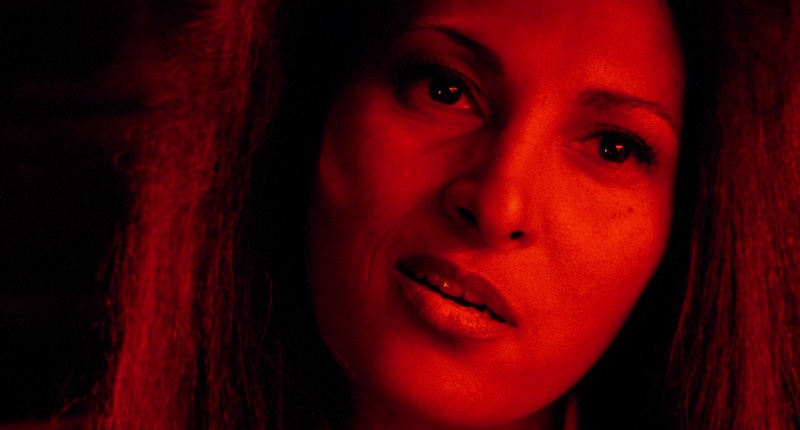
There is also a particularly interesting scene between Grier and Forster lit only with red light. In that situation, Navarro reduces the visible difference between their skin tones, producing a striking and unusual effect that still remains integrated into the film’s emotional tone.
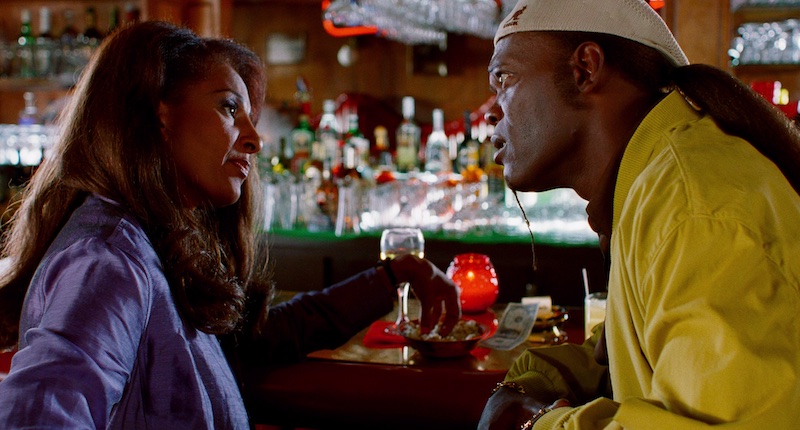
In terms of camera, perhaps because of the conscious move away from widescreen anamorphic, Tarantino sometimes tries to compose horizontally by separating the actors across the frame. It is as if he were looking for a Scope-like compositional logic inside a less wide format.
There is also extensive Steadicam work, ranging from subtle movement to more aggressive moments, such as Pam Grier’s run through the shopping mall, with several 360-degree moves around the actress. Even so, “Jackie Brown” is not an especially stylized film in terms of camera. This time, Tarantino seems more focused on the story and on telling it clearly, without allowing visual flourishes to dominate or complicate the narrative.
There are, however, several shots using Swing Shift lenses. These allow the focal plane to be curved or tilted in order to create the illusion that characters inside cars, or at different distances from the camera, remain in focus at the same time. The effect is related, in practical terms, to the old split-diopter illusion, but achieved through a different optical tool.
Conclusion
The results are very strong cinematically. Even within this lower-profile approach, Tarantino shows himself to be both a powerful storyteller and a very precise director of actors. Aesthetically, however, “Jackie Brown” can feel somewhat muted when compared with the rest of his filmography.
His two previous features had a strong visual identity and very noticeable camera work. His later films, with the exception of “Death Proof,” would be photographed by Robert Richardson, one of the most visually forceful American cinematographers of the last forty years. That collaboration began with the “Kill Bill” diptych (2003 and 2004), and continued through “Inglourious Basterds” (2009), “Django Unchained” (2012), “The Hateful Eight” (2015) and, for now, “Once Upon a Time in Hollywood” (2019).
Richardson is precisely the kind of cinematographer whose visual personality leaves a sophisticated and unmistakable mark on the image. By comparison, “Jackie Brown” may appear less immediately distinctive. But that does not mean it is below the level of Tarantino’s other work. It is simply a rare oasis of realism inside a filmography that, almost everywhere else, has favored much stronger stylization.
That restraint is part of the film’s value. Navarro gives Tarantino a different visual register: softer, more observational, more tied to real Los Angeles locations, but still capable of noir detail when the story needs it. “Jackie Brown” may be the least visually flamboyant Tarantino film, but it is also one of the clearest examples of how a subdued photographic approach can protect performance, rhythm and narrative pleasure.
Viewed on 4K HDR Blu-ray
ON FILM & DIGITAL
© Ignacio Aguilar, 2026.
This article is part of ON FILM & DIGITAL’s English-language cinematography reviews and essays.
The Author
Ignacio Aguilar, AEC is a Spanish cinematographer based in Madrid. His work spans feature films, television, commercials and technical writing on cinematography, with experience in digital cinema, 16mm and 35mm film, anamorphic lenses, large-format digital capture and practical lens testing.
Read more articles and reviews in Spanish at ON FILM & DIGITAL, or visit the main cinematography portfolio at ignacioaguilardop.com.