

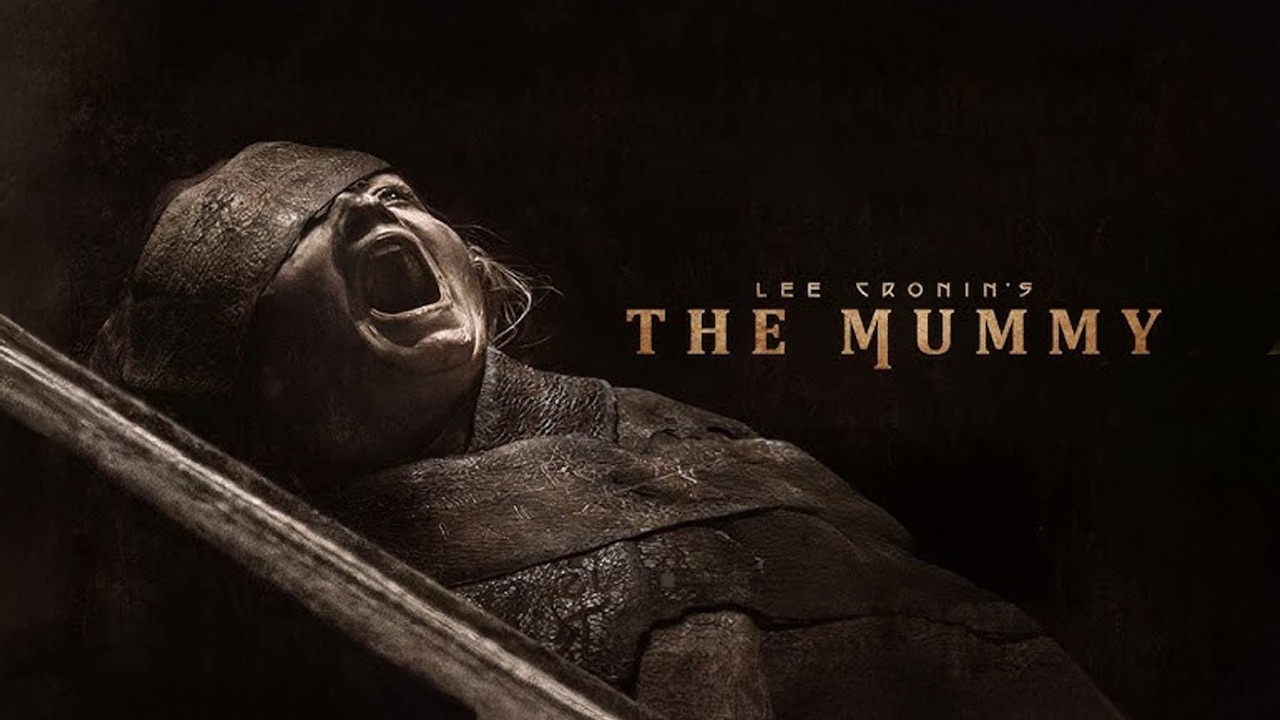
“Lee Cronin’s The Mummy”
Spanish Title: La momia de Lee Cronin
Year of Production: 2026
Director: Lee Cronin
Director of Photography: Dave Garbett, NZCS
Lenses: Panavision Ultra Vista
Format and Aspect Ratio: Sony VENICE 2 (X-OCN), 2.4:1
Other: 4K Digital Intermediate
Viewed on: Blu-ray
Dave Garbett, NZCS, uses the Sony VENICE 2, Panavision Ultra Vista anamorphics and a sickly green interior palette to shape Lee Cronin’s body horror.
The Film
This is the third feature from Irish filmmaker Lee Cronin, who made his debut with The Hole in the Ground (2019). Produced by James Wan and Jason Blum, the film offers a new variation on the classic Mummy story. The daughter of an American couple living in Egypt is abducted and declared missing. Years later, after the family has moved to New Mexico, she returns alive but in a devastating physical and psychological state. They bring her home in the hope that she can recover, only for a series of increasingly disturbing events to begin.
What distinguishes Lee Cronin’s The Mummy is how seriously Cronin takes the material. It is a thoroughly modern horror film with a relentless pace, fully committed to being intense, violent and grotesque. It is also highly calculated, but effective: for the most part, it achieves exactly what it sets out to do. Cronin updates the myth without severing its roots and reframes it for a contemporary audience.
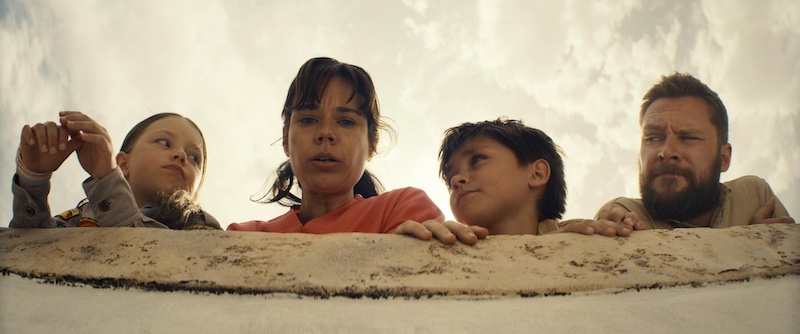
Laia Costa and Jack Reynor play the married couple at the center of a film that feels like a cross between The Exorcist (William Friedkin, 1973) and Hereditary (Ari Aster, 2018) played at fast-forward speed. May Calamawy, Natalie Grace and Verónica Falcón complete the principal cast.
The Cinematographer
The cinematographer is Dave Garbett, NZCS, working with Lee Cronin for the second time after photographing Evil Dead Rise (2023). Garbett had also worked on the Sam Raimi-produced series Ash vs Evil Dead (2015), so the connection between the two filmmakers may well have come through that franchise.
He also has Insidious: Out of the Further arriving in 2026, suggesting that his feature career may continue to gravitate toward horror. Before this recent run, however, Garbett was closely associated with television, shooting episodes of series such as Spartacus (2010), Sweet Tooth (2021) and, more recently, Spartacus: House of Ashur (2025).
Visual Style Analysis
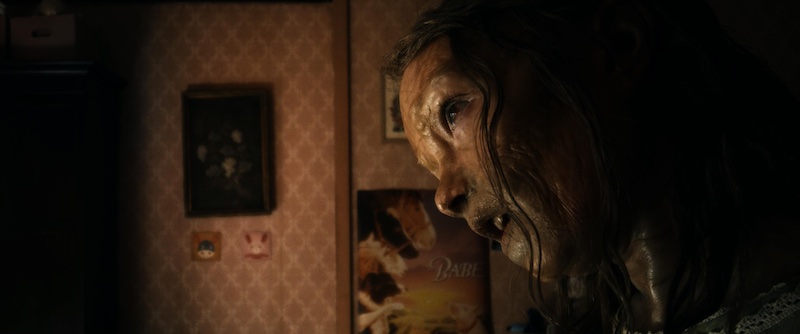
Despite its Egyptian and New Mexican settings, the film was shot largely on stages in Ireland, with several sequences filmed in Almería, Spain, doubling for both Cairo and New Mexico. Its tone is overtly contemporary, and the camera and lighting follow the same logic. The opening exteriors in Egypt are warm and colorful. New Mexico is also rendered warmly, but with a more restrained palette.
Cronin could shoot most of the film in his home country because the story unfolds largely indoors. The police-station scenes lean toward cyan, creating a colder and more distant atmosphere. By contrast, the family’s New Mexico house is suffused with a green cast that permeates almost the entire image.
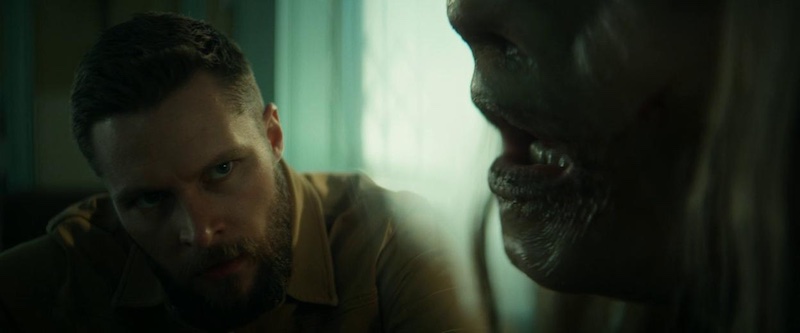
The green does not read as though it comes clearly from individual sources. Instead, it functions less as motivated light than as an associative color. Green is often used to suggest illness, contamination or a world in which something is fundamentally wrong, and that is precisely the condition of this film. Its use here is therefore entirely coherent.
In practical terms, Garbett frequently lights through windows or places motivated sources within the frame. Those sources contribute a substantial part of the exposure, but the ambient interior level — the light that makes the space readable and models the actors — is itself contaminated by green, giving the film much of its visual identity.
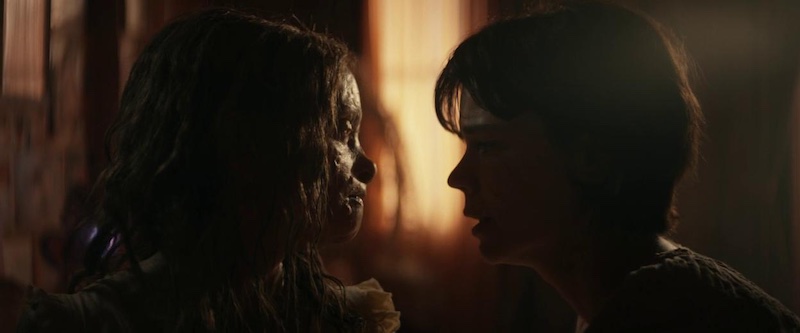
The film was photographed on the Sony VENICE 2 with Panavision Ultra Vista lenses, which were also used on The Mandalorian. These are full-frame anamorphics with a 1.6x squeeze and a typical maximum aperture of T2.5. Here they appear to have been used wide open or close to it. Combined with the VENICE 2’s dual-base ISO of 800/3200, that makes extremely low light levels practical.
Full Frame, Lens Coverage and Depth of Field
The combination of the Sony VENICE 2 and Panavision Ultra Vista lenses places Lee Cronin’s The Mummy within a Full Frame or Large Format workflow. The larger sensor affects lens coverage, focal-length choices, angle of view, camera distance and decisions about depth of field. These practical considerations are examined in Full-Frame Cinema: Lens Coverage, Crop Factor and the Large Format Look.
That is broadly Garbett’s approach throughout the film: window light, practical sources built into the sets and a small amount of green fill introduced where needed, sometimes replaced by pale blue in the night scenes. Because the lenses are used near maximum aperture, depth of field is generally shallow. More unusually, the image sometimes appears to fall out of focus toward the edges of the frame under these conditions. The effect becomes slightly distracting in some of the early Cairo scenes.
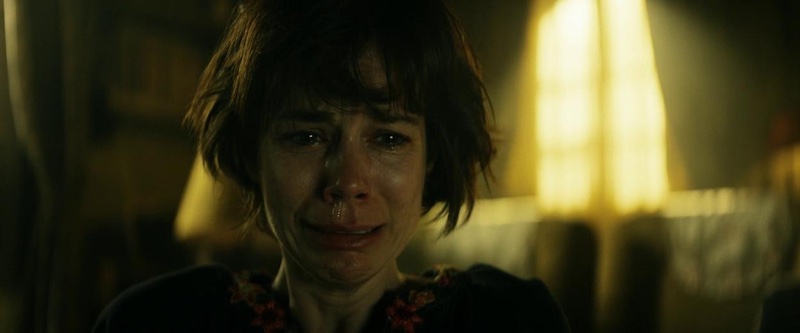
Cronin’s camera is rarely still. The result is a sustained barrage of movement and assertive angles: overhead shots, macro work, low angles, cranes and canted frames. Most striking is the repeated use of split diopters, which hold a foreground character or object in focus at the same time as another character positioned deep in the background.
Everything happens very quickly. The editing often breaks actions into syncopated fragments and rarely allows a shot to breathe. Together with the elaborate prosthetic makeup, the real priority is accumulation: a great deal of gore, shocks reinforced by changes in shutter speed and an overwhelming soundtrack.
Conclusion
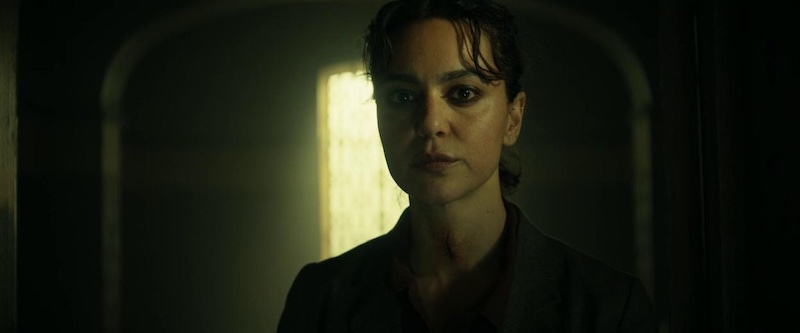
If all of this succeeds in holding the audience’s attention — and, more significantly, in attracting younger viewers — it is probably fair to call the strategy successful. The film has personality despite its reliance on calculated effects. It is not trying to be classical; it is trying to break with the classical model, and on those terms it succeeds. That does not make the result any less deliberately nasty and repellent, perhaps to excess.
ON FILM & DIGITAL
© Ignacio Aguilar, 2026.
This article is part of ON FILM & DIGITAL’s English-language cinematography reviews and essays.
These texts are not plot summaries or general film reviews, but cinematography-focused essays written from the perspective of a working cinematographer.
The Author
Ignacio Aguilar, AEC is a cinematographer / director of photography based in Madrid, Spain. His work spans feature films, television, commercials and technical writing on cinematography, with experience in digital cinema, 16mm and 35mm film, anamorphic lenses, large-format digital capture, lens testing and film-based workflows.
He is a member of the Spanish Society of Cinematographers (AEC) and the Spanish Academy of Cinema, a Sony I.C.E. Certified Expert and a Cooke SP3 ambassador. His writing has appeared in American Cinematographer and Camera & Light, and ON FILM & DIGITAL gathers his bilingual essays, technical guides and cinematography reviews.
For professional work, collaborations, lectures, workshops or cinematography consulting, visit his professional biography, selected works or contact page.
The Spanish-language archive is available at ON FILM & DIGITAL.