

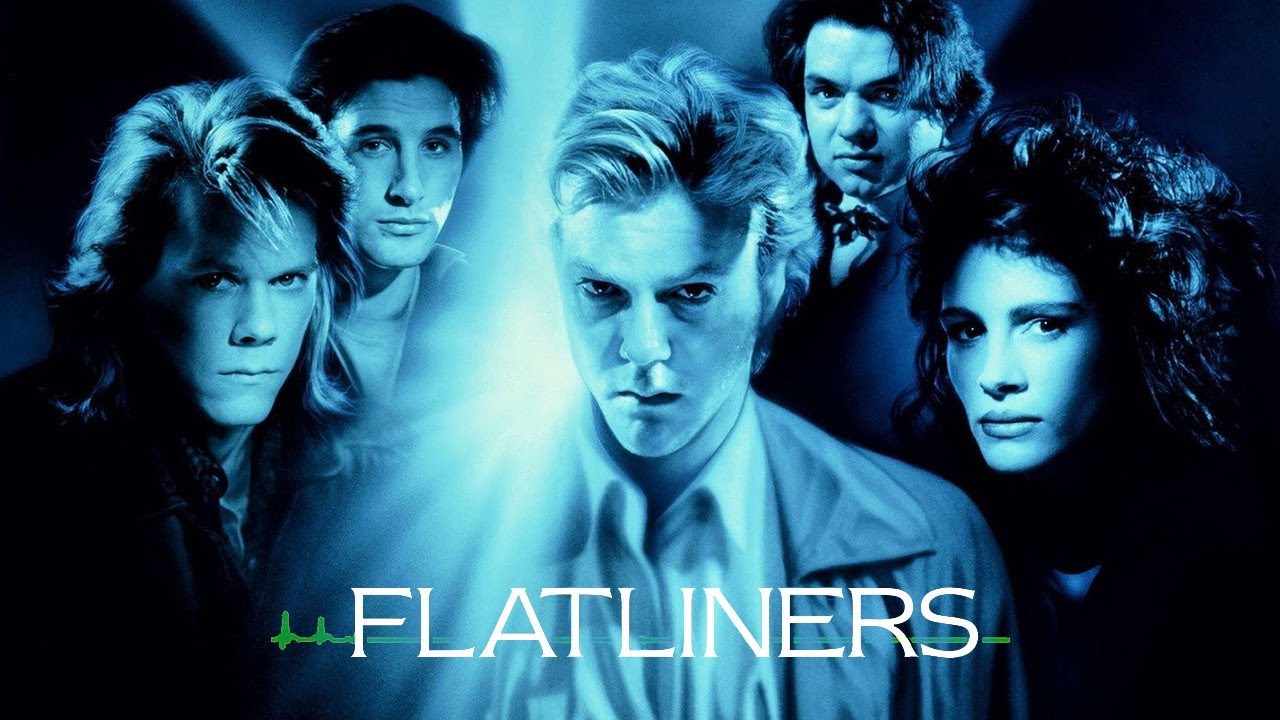
“Flatliners”
Spanish Title: Línea mortal
Year of Production: 1990
Director: Joel Schumacher
Director of Photography: Jan de Bont, ASC
Lenses: Panavision Primo Anamorphic, E Series, Cooke Varotal
Format and Aspect Ratio: 35mm anamorphic Panavision, 2.39:1
Viewed on: 4K UHD Blu-ray (HDR)
Jan de Bont pushes Panavision anamorphic toward a highly stylized, color-driven, low-light aesthetic, although the film’s low-contrast texture ultimately shapes much of the result.
The Film
Produced by Michael Douglas, “Flatliners” has since become something of a minor classic of early-1990s American supernatural cinema. Its premise remains a strong one: five medical students decide to explore the boundary between life and death by deliberately stopping their vital functions and then being revived after spending several minutes clinically dead. Kiefer Sutherland, Julia Roberts, Kevin Bacon, William Baldwin and Oliver Platt play the group, whose experiment gradually turns into a competition to see who can remain on the other side the longest.
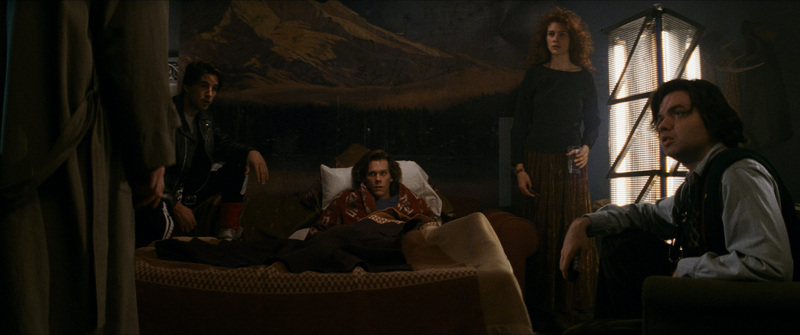
The trouble begins when those experiences start returning images, memories and figures connected to traumatic events from their own lives. In Joel Schumacher’s hands, the premise quickly develops into a highly visual and deliberately expressionistic fantasy in which architecture, lighting, Eugenio Zanetti’s production design and James Newton Howard’s score carry almost as much weight as the narrative itself. That approach gives the film a very distinctive identity, although some of the dreamlike passages have aged less gracefully than the central idea, and the repetition of the same dramatic mechanism gradually reduces its impact.
The Cinematographer
The cinematographer was Dutch director of photography Jan de Bont, ASC, who was approaching the end of his career behind the camera before moving permanently into directing with “Speed” (1994). His European work had been closely associated with Paul Verhoeven, including “Turks Fruit” (1973), “Keetje Tippel” (1975), “De Vierde Man” (1983) and “Flesh + Blood” (1985).
Once established in the United States, De Bont increasingly specialized in large-scale action and suspense films. He photographed “Die Hard” (John McTiernan, 1988), part of “Black Rain” (Ridley Scott, 1989), “The Hunt for Red October” (John McTiernan, 1990), “Basic Instinct” (Paul Verhoeven, 1992), “Lethal Weapon 3” (Richard Donner, 1992) and “Shining Through” (David Seltzer, 1992). “Flatliners” therefore belongs to a very specific phase of his career, when anamorphic photography, mobile camerawork and increasingly aggressive use of colored light had become central elements of his visual language.
Visual Style Analysis
The cinematography of “Flatliners” is highly representative of Jan de Bont’s American work. The film was shot in 35mm anamorphic and combines several Panavision lens families: Primo Anamorphics, E Series lenses and anamorphized Cooke Varotal zooms. That mixture does not produce a completely uniform image in terms of contrast, resolution or optical behavior, although the widescreen format and the overall treatment of the print give the film a sufficiently coherent visual identity.
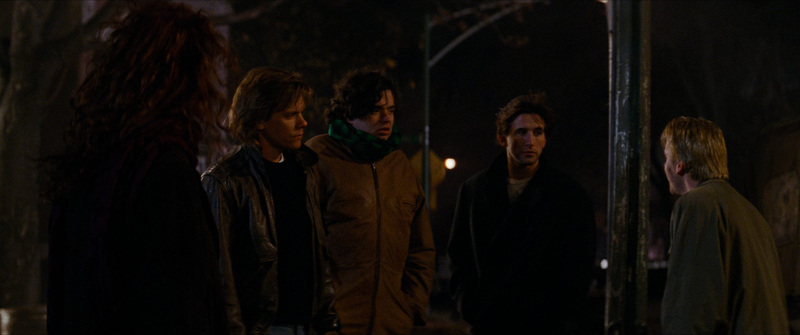
The Primos appear to make up most of the prime-lens work, supplemented by E Series lenses for the longer focal lengths, particularly the 135mm and 180mm, which recur throughout the close-ups. The zooms are more evident in exteriors and in certain camera moves that combine crane work, tracking and focal-length changes. De Bont therefore uses anamorphic not simply for the width of the frame, but also for compression, reduced depth of field and the optical texture it introduces into the backgrounds.
The characteristic that most strongly shapes the image, in my view, is its relatively low contrast. The blacks rarely achieve truly deep density, and much of the material has a slightly lifted, muted quality. The same tendency can be found elsewhere in De Bont’s work, although it is less extreme here than in “Flesh + Blood”. My reading remains that this texture may be related to a comparatively thin negative that was then printed up photochemically, which would help explain both the reduced black density and the increase in visible grain in some scenes.
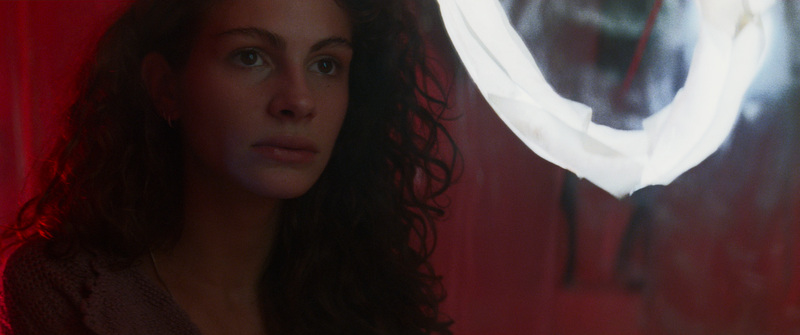
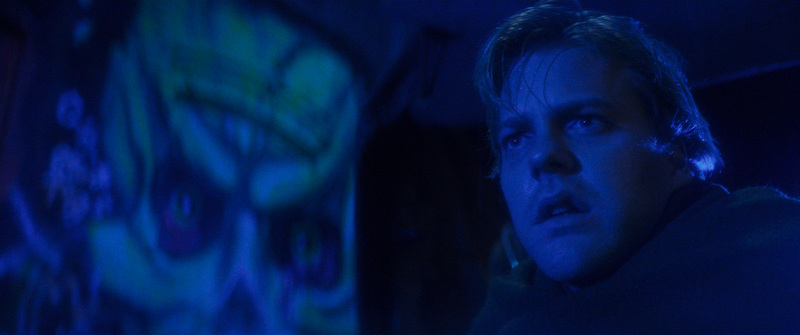
Paradoxically, the lighting feels considerably more modern than the final texture of the image. De Bont makes extensive use of colored light, particularly saturated blues and reds during the characters’ experiments and visions. There are even transitions within individual sequences from an apparently normal color balance into these more expressionistic states. In 1989, long before today’s multicolor LED fixtures, achieving such changes required a much more complex combination of conventional units, gels, dimmer cues and electrical control.
There are also many warm interiors and exteriors, along with color effects introduced through camera filtration or on the sources themselves. The difficulty is that this chromatic richness coexists with an exposure strategy that often seems more concerned with protecting highlights than with maintaining sufficient density in the shadows. As a result, scenes that could have been far more powerful through design, color and direction of light sometimes end up feeling comparatively weak in the blacks and overall contrast.
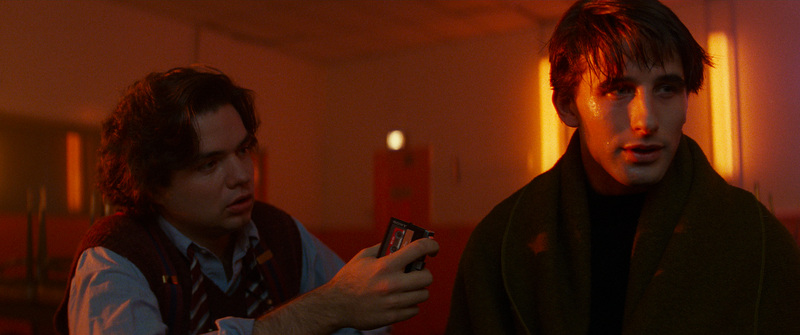
The strongest passages are those in which stylization and exposure are working in the same direction. The final cemetery sequences, with strong backlighting, smoke and hard sources, produce a much more solid image. The childhood memory among the trees is also especially effective, while some effects resembling light filtered through water anticipate techniques De Bont would use more extensively in “Basic Instinct”. In these scenes, the combination of Zanetti’s production design, anamorphic photography and lighting finally achieves the Gothic, slightly excessive quality Schumacher appears to be seeking throughout the film.
The treatment of the actors is perhaps less consistent than one might expect from a production built around some of the most prominent young stars of the period. Julia Roberts, in particular, moves through very different lighting and filtration treatments. Schumacher and De Bont frequently use relatively frontal sources on the performers in studio interiors, even when the space might have allowed a more lateral or motivated direction of light. Some close-ups work effectively, while others are considerably less refined. Again, the issue is not a lack of intention, but that the degree of stylization is not always matched by equally precise execution.
Conclusion
“Flatliners” has a very clear visual identity and could hardly be described as unambitious cinematography. Anamorphic lenses, colored light, backlight, smoke, long focal lengths and production design are constantly used to create a world removed from realism. Some of those decisions have also aged better than might be expected, anticipating visual devices that would become much more common in mainstream filmmaking during the 1990s.
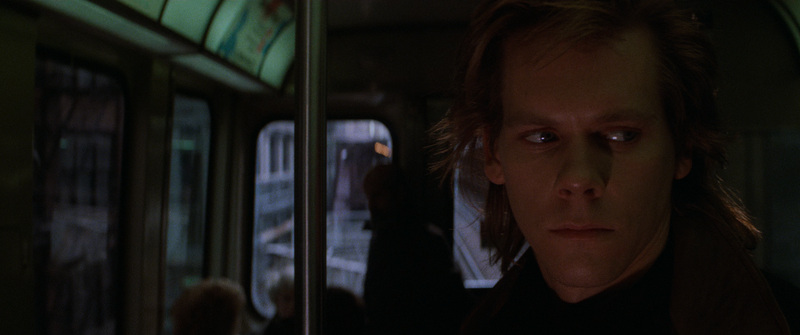
I still find, however, that the overall texture places a significant limit on the result. Reduced contrast, blacks that lack density and an exposure that often feels too thin take strength away from an approach that contains many interesting ideas on paper. At its best, De Bont demonstrates a remarkable command of colored light and anamorphic photography; elsewhere, the stylization is more convincing than the image quality supporting it. It is recognizable, ambitious and technically interesting cinematography, but also an uneven piece of work.
ON FILM & DIGITAL
© Ignacio Aguilar, 2026.
This article is part of ON FILM & DIGITAL’s English-language cinematography reviews and essays.
These texts are not plot summaries or general film reviews, but cinematography-focused essays written from the perspective of a working cinematographer.
The Author
Ignacio Aguilar, AEC is a cinematographer / director of photography based in Madrid, Spain. His work spans feature films, television, commercials and technical writing on cinematography, with experience in digital cinema, 16mm and 35mm film, anamorphic lenses, large-format digital capture, lens testing and film-based workflows.
He is a member of the Spanish Society of Cinematographers (AEC) and the Spanish Academy of Cinema, a Sony I.C.E. Certified Expert and a Cooke SP3 ambassador. His writing has appeared in American Cinematographer and Camera & Light, and ON FILM & DIGITAL gathers his bilingual essays, technical guides and cinematography reviews.
For professional work, collaborations, lectures, workshops or cinematography consulting, visit his professional biography, selected works or contact page.