

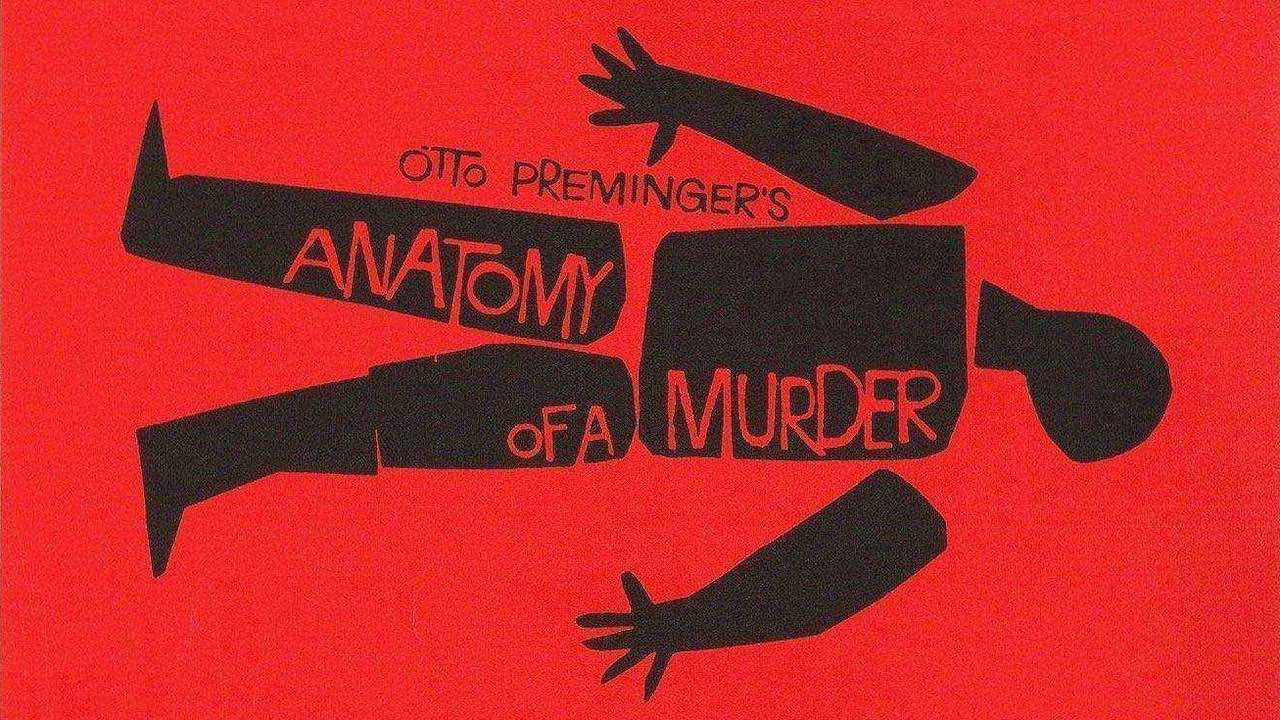
“Anatomy of a Murder”
Spanish Title: Anatomía de un asesinato
Year of Production: 1959
Director: Otto Preminger
Director of Photography: Sam Leavitt, ASC
Lenses: Bausch & Lomb Baltar
Format and Aspect Ratio: 35mm spherical, 1.85:1
Awards: Academy Award nomination for Best Cinematography (Black-and-White)
Viewed on: Blu-ray
Sam Leavitt, ASC turns the physical constraints of a real Michigan courthouse into a framework for Otto Preminger’s unusually fluid camerawork.
The Film
Adapted from the novel by Robert Traver — the pen name of Michigan Supreme Court Justice John D. Voelker — “Anatomy of a Murder” follows Paul Biegler, a Michigan lawyer and former prosecutor played by James Stewart. Biegler agrees to defend a U.S. Army lieutenant (Ben Gazzara) accused of shooting and killing a tavern owner after his wife (Lee Remick) says the man raped her. He needs the money, but the case troubles him from the outset. The defendant has a violent temper, while the circumstances surrounding his wife’s account leave Biegler with questions he must somehow turn into a viable defense.
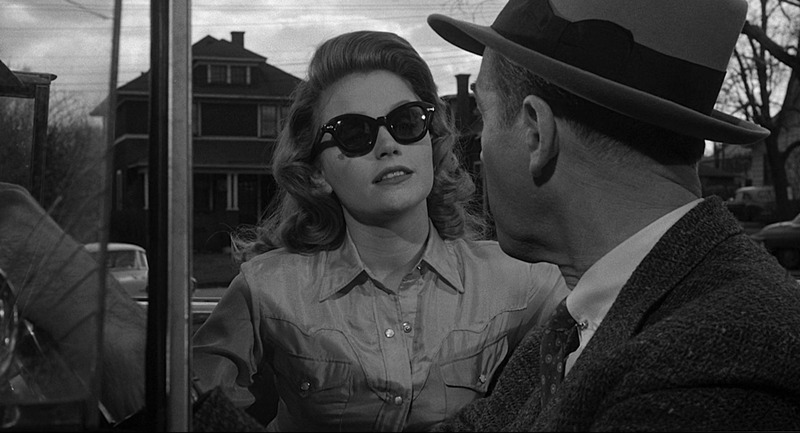
The film is unmistakably Preminger: Saul Bass provides the celebrated title design, Duke Ellington the score, and the drama is built around argument, performance and ambiguity rather than conventional suspense. Its center of gravity is Stewart’s defense attorney, especially once he faces the formidable prosecutor played by George C. Scott. The results are strong and at times excellent, even if the film runs long and some of its attitudes toward sex and gender now feel distinctly dated. Seen in the context of 1959, however, it remains a remarkably assured courtroom drama, supported by Arthur O’Connell, Eve Arden, Kathryn Grant and Murray Hamilton. The judge is played by noted attorney Joseph N. Welch in his only film role.
The Cinematographer
The cinematographer was Sam Leavitt, ASC, a veteran of classical Hollywood. The previous year he had won the Academy Award for black-and-white cinematography for “The Defiant Ones” (Stanley Kramer, 1958), and “Anatomy of a Murder” brought him another nomination. He received a third nomination the following awards season for “Exodus” (Otto Preminger, 1960), photographed in 5-perf 65mm using the Super Panavision 70 system.
His best-known credits include “A Star Is Born” (George Cukor, 1954), “The Man with the Golden Arm” (Otto Preminger, 1955), “Cape Fear” (J. Lee Thompson, 1962), “Advise & Consent” (Otto Preminger, 1962) and “Guess Who’s Coming to Dinner” (Stanley Kramer, 1967). “Anatomy of a Murder” therefore belongs to the period in which Leavitt received his greatest awards recognition, positioned directly between his Oscar for “The Defiant Ones” and his later nomination for “Exodus”.
Visual Style Analysis
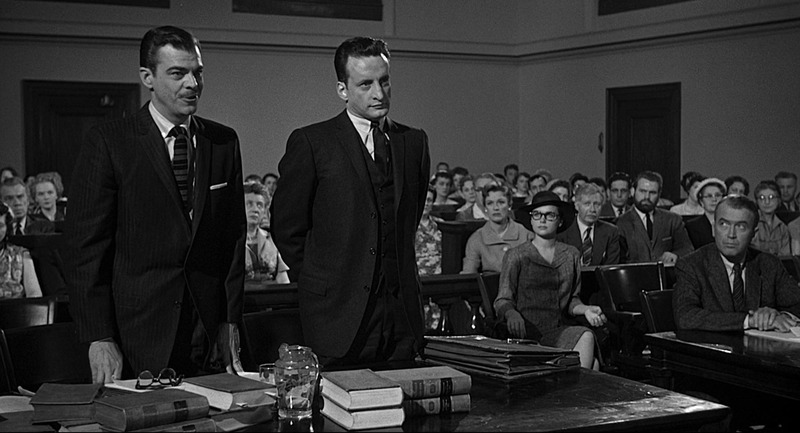
A crucial production fact changes the way Sam Leavitt’s black-and-white cinematography reads: much of “Anatomy of a Murder” was not photographed on comfortable Hollywood stages, but on real locations in Michigan’s Upper Peninsula. Leavitt himself explained in American Cinematographer that the courtroom was the actual Marquette County courthouse, a space measuring only about 40 by 50 feet, with thick, immovable walls, dark wood and a large stained-glass dome. Lighting could not be rigged in the normal studio manner, while the limited floor area also had to accommodate the principal actors, roughly two hundred extras, the camera, a crane and the lighting crew.
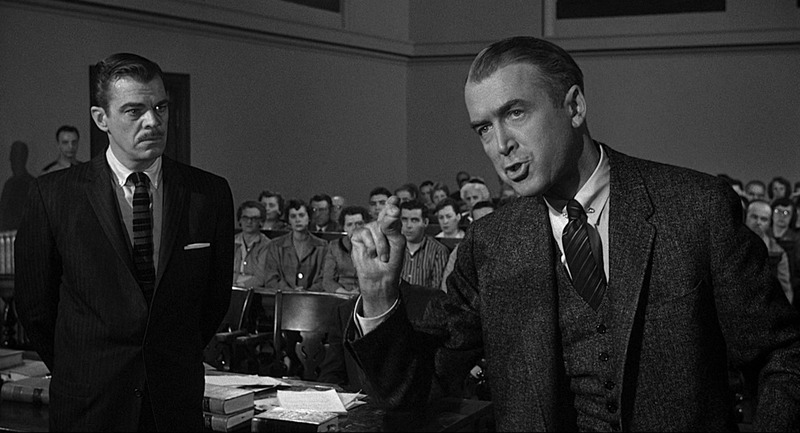
Under those conditions, the courtroom settles into a comparatively even lighting scheme, with fairly high levels and moderate contrast. Leavitt could place units in the balcony for medium shots and close-ups, but the physical restrictions of the room prevented the same kind of cross-lighting on the wide shots. The image therefore lacks the dramatic blacks and stronger chiaroscuro found in some of his other work. What it gains is spatial clarity. The depth of field keeps a large part of the courtroom readable at once, allowing Preminger to distribute numerous characters across the frame without losing visual information.
That is where the film becomes especially interesting cinematographically. Preminger was committed to a fluid camera, and here he repeatedly moves forward and backward, tracks laterally, reverses the field and, at times, swings through as much as 180 degrees inside the courtroom. Leavitt recalled that one setup required fifteen separate camera moves within a single shot. In this respect, “Anatomy of a Murder” is more compelling than a reading based on lighting alone would suggest. Even so, I still find the compositions and camera work in “Witness for the Prosecution” (Billy Wilder, 1957) more refined as courtroom filmmaking, as are, many years later, some of the angles in “The Verdict” (Sidney Lumet, 1982).
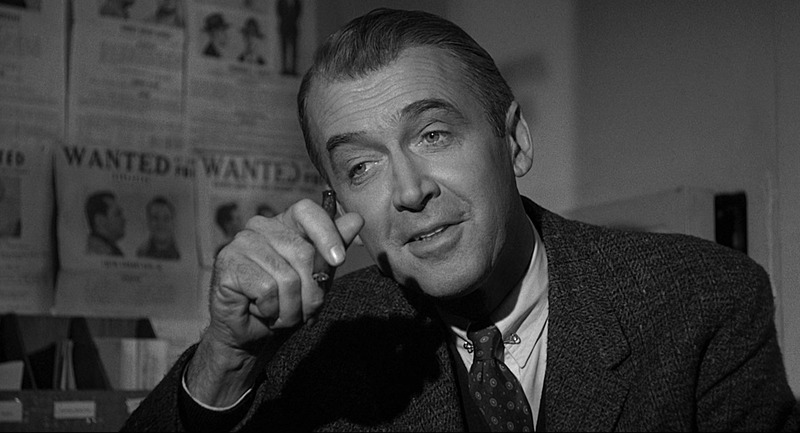
Outside the courtroom, Leavitt works in a more conventional classical black-and-white mode, using hard sources, clear separation and a structure close to traditional three-point lighting. Contrast remains relatively restrained, and the photography rarely attempts to impose itself on the performances or the dialogue. Even the treatment of Lee Remick is carefully controlled without pushing her into a separate visual register as a conventional star portrait. In that sense, the film is far less expressive than Leavitt’s work three years later on “Cape Fear”, where hard light, deep blacks and pronounced chiaroscuro become an essential part of the threat.
There are nevertheless several visible technical irregularities. In some shots involving large pans or extensive camera movement through the locations, the shadow of part of the camera equipment or matte box can be seen crossing an actor or a wall. Seen in isolation, these read as straightforward technical lapses. In context, they are easier to understand. Non-removable walls, very confined spaces, restricted lighting positions and camera moves approaching 180 degrees made it unusually difficult to keep every part of the shooting apparatus — and its shadows — out of the photographed space.
Conclusion
None of this makes “Anatomy of a Murder” one of Sam Leavitt’s most expressive achievements. The lighting remains primarily functional, subordinated to narrative clarity, dialogue and performance. But the actual production conditions make the work considerably more interesting than it first appears. Leavitt had to photograph highly restrictive real spaces while preserving the freedom of movement Preminger demanded from the camera.
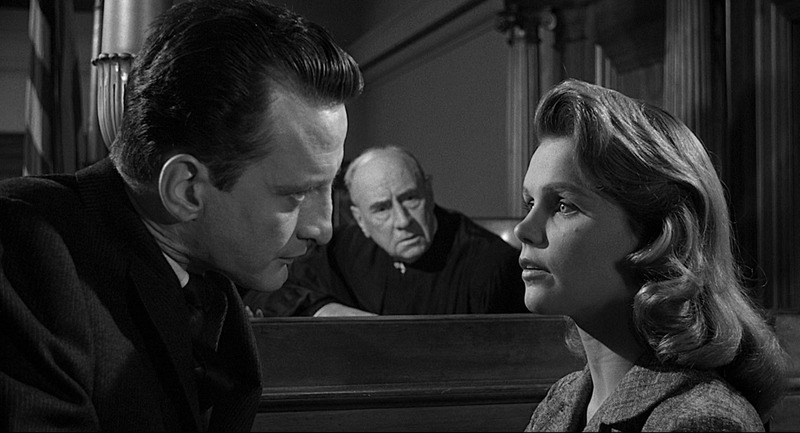
Ultimately, the cinematography of “Anatomy of a Murder” is more interesting for its combination of real locations, deep focus, spatial clarity and camera movement than for an especially personal lighting style. It is sober and effective work, with a few visible technical irregularities, but also far more carefully engineered — and far more constrained by the realities of production — than a first viewing of its images might suggest.
ON FILM & DIGITAL
© Ignacio Aguilar, 2026.
This article is part of ON FILM & DIGITAL’s English-language cinematography reviews and essays.
These texts are not plot summaries or general film reviews, but cinematography-focused essays written from the perspective of a working cinematographer.
The Author
Ignacio Aguilar, AEC is a cinematographer / director of photography based in Madrid, Spain. His work spans feature films, television, commercials and technical writing on cinematography, with experience in digital cinema, 16mm and 35mm film, anamorphic lenses, large-format digital capture, lens testing and film-based workflows.
He is a member of the Spanish Society of Cinematographers (AEC) and the Spanish Academy of Cinema, a Sony I.C.E. Certified Expert and a Cooke SP3 ambassador. His writing has appeared in American Cinematographer and Camera & Light, and ON FILM & DIGITAL gathers his bilingual essays, technical guides and cinematography reviews.
For professional work, collaborations, lectures, workshops or cinematography consulting, visit his professional biography, selected works or contact page.
The Spanish-language archive is available at ON FILM & DIGITAL.