

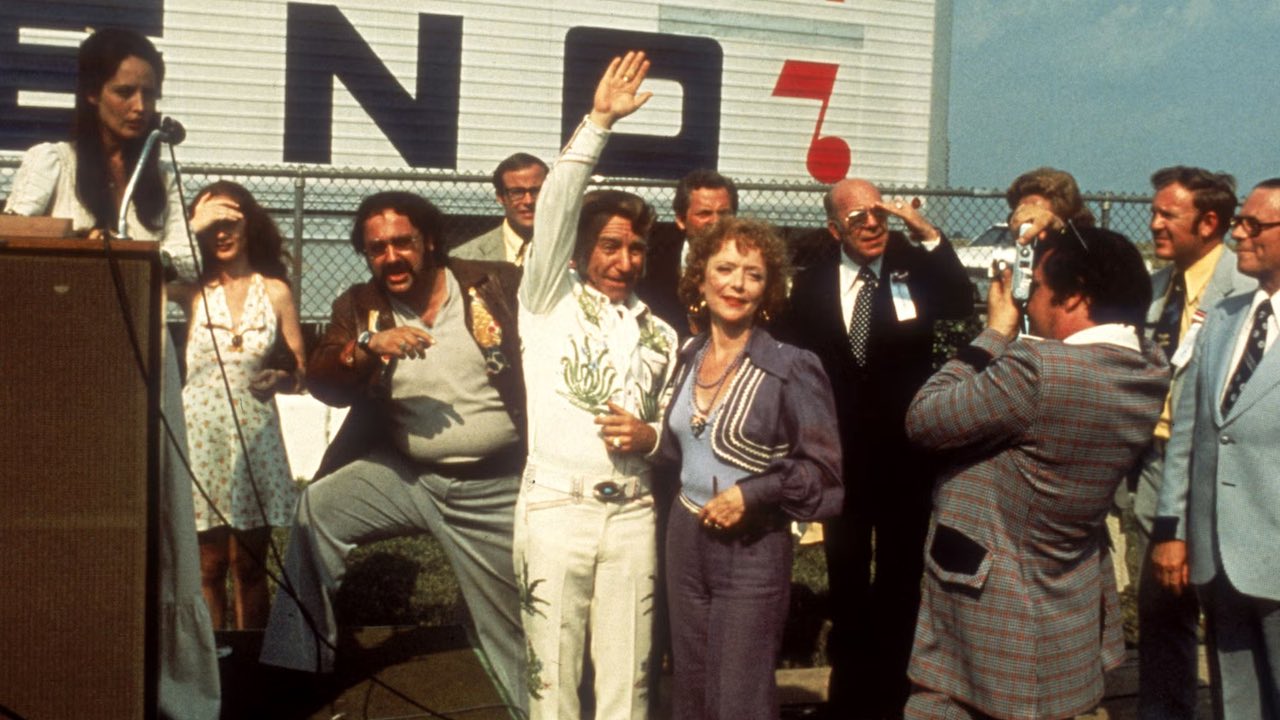
“Nashville”
Spanish Title: Nashville
Year of Production: 1975
Director: Robert Altman
Director of Photography: Paul Lohmann
Lenses: Super Panazoom Cooke zooms, Panavision C Series
Film Stock: Kodak 5254 100T
Format and Aspect Ratio: 35mm anamorphic Panavision, 2.40:1
Viewed on: Blu-ray
Paul Lohmann photographs “Nashville” with anamorphized zooms, Chem-Tone processing and location lighting adapted to Robert Altman’s observational method.
The Film
Set in Nashville, Robert Altman’s film follows a large group of characters connected to the music industry during the days leading up to a political convention. Rather than building a conventional dramatic arc, Altman is primarily interested in how these people interact. He also devotes substantial screen time to complete concerts and musical performances, with the actors singing live and performing songs they wrote themselves.
Although the film was successful and has many admirers — Paul Thomas Anderson among them — Nashville is very long and, for me, often feels closer to a self-indulgent docudrama than to conventional fiction. As in many of his films, Altman seems less interested in telling a story than in improvisation, overlapping dialogue and what happens behind the scenes. A recognizable dramatic progression emerges only very late, perhaps too late for viewers who do not respond to the film’s method from the outset. Karen Black, Ned Beatty, Michael Murphy, Henry Gibson, Shelley Duvall, Keenan Wynn, Geraldine Chaplin, Keith Carradine, Cristina Raines, Ronee Blakley, Lily Tomlin, Gwen Welles and Scott Glenn, among others, make up the ensemble cast.
The Cinematographer
The cinematographer was Paul Lohmann, who worked across a wide range of projects throughout the 1970s and into the early 1980s. Lohmann collaborated with Robert Altman on three films: California Split (1974), Nashville and Buffalo Bill and the Indians (1976). He then began working with Mel Brooks on Silent Movie (1976) and High Anxiety (1977).
He later photographed one of Steve McQueen’s final films, An Enemy of the People (George Schaefer, 1978), as well as one of the last entries in the disaster-film cycle, the deeply flawed Meteor (Ronald Neame, 1979). Neame, himself a former cinematographer, spoke highly of Lohmann, although the two never worked together again. After Looker (Michael Crichton, 1981), Lohmann moved mainly into television, where he continued working until his retirement in the early 1990s.
Visual Style Analysis
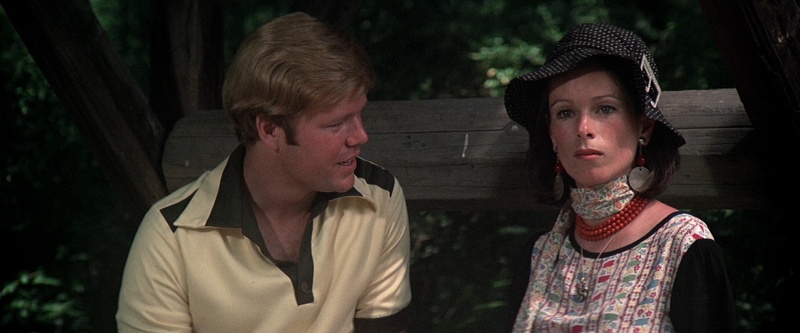
The cinematography of Nashville is highly characteristic of 1970s American cinema, but it is just as characteristic of Robert Altman. During his earlier collaboration with Vilmos Zsigmond on McCabe and Mrs. Miller (1971), Images (1972) and The Long Goodbye (1973), Altman had already begun shooting most of his footage with zoom lenses converted for anamorphic use. At the time, this generally meant modifying a conventional spherical zoom — probably one of the Cooke Varotal designs introduced from 1971 onward — with a rear converter that anamorphized the horizontal axis.
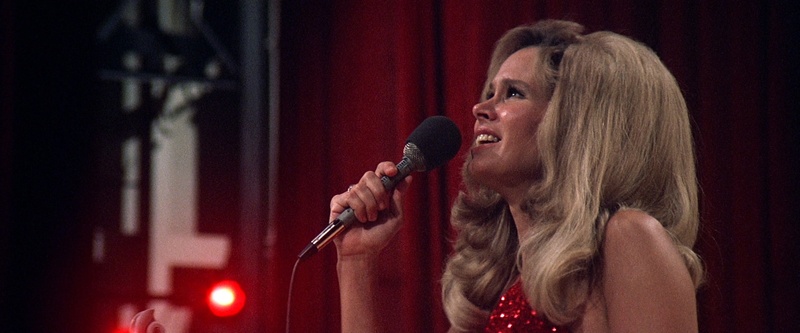
Because the anamorphizing element sits behind the nodal point of the taking lens, the system does not produce the familiar artifacts of a front anamorphic attachment: no strong blue horizontal streaks and no conspicuously stretched oval bokeh. It is essentially a practical way of adapting zoom lenses to anamorphic photography. The disadvantages were considerable. A 20–100mm T3.1 became a 40–200mm T4.5, while a 25–250mm T4 became a 50–500mm T5.6, losing roughly one stop on lenses that were not especially fast to begin with. These anamorphized zooms also came nowhere near the optical performance of contemporary primes. Apart from two or three shots that appear to have been photographed with fixed focal lengths, virtually all of Nashville displays the behavior of these zooms, which became the central stylistic device in Altman’s staging.
A large part of the film takes place in clubs, bars and concert venues with no natural source of illumination. Lohmann almost certainly had to push the negative by at least one stop, perhaps two. Even with the stock effectively rated at 200 or 400 ASA, working at approximately T4.5 or T5.6 required a great deal of light. Yet because the film operates, in some respects, as a docudrama, Lohmann could not impose heavily shaped lighting without losing the character of the locations. It is the classic location approach: raise the existing illumination just enough to make motion-picture exposure possible.
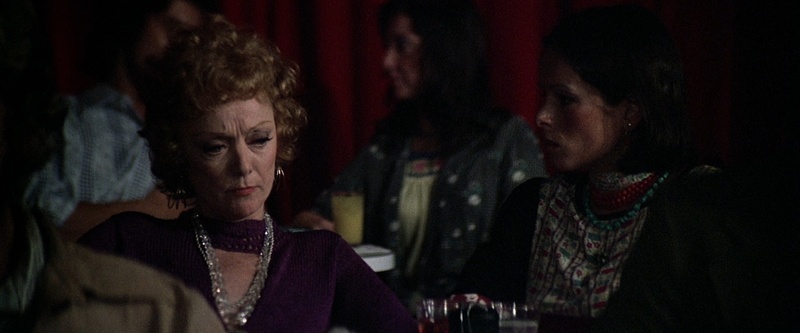
Because he still needed such a high light level simply to expose the negative, Lohmann’s usual solution was to place a relatively hard, direct source on the principal actors while allowing the rest of the frame to fall back into the existing ambience, often underexposed. To compensate, the filmmakers used TVC Laboratories’ Chem-Tone process, a form of flashing applied during development — whereas Zsigmond had flashed his Altman films in camera. As with conventional flashing, the process opened the shadows slightly and created the impression of more information by reducing contrast. Nashville contains very few significant highlights, and most of the image information sits between middle gray and the toe of the curve. A process of this kind therefore made practical sense.
Chem-Tone, Flashing and Laboratory Processes
In Nashville, the restrained contrast, color reproduction and distinctive texture do not result solely from the negative and the anamorphized zoom lenses. The Chem-Tone process — a form of laboratory flashing introduced during development — also contributed to the material construction of the image. For a broader explanation of how flashing, processing, printing and other special laboratory techniques could alter the negative or the release print, see The Motion Picture Negative (IV): Processing, Printing and Laboratory Processes.
A typical scene in Nashville consequently feels barely lit or shaped, almost as though the crew had walked into a club and simply started shooting. At the same time, the images often have little visual appeal and, under these constraints, feel technically marginal. This is not because Lohmann lacked command of his craft, as his other work demonstrates. He was operating within a method dictated almost entirely by Altman: the zoom repeatedly moves from a wide shot to a close-up within the same take, turning the camera into an observational way of watching the characters.
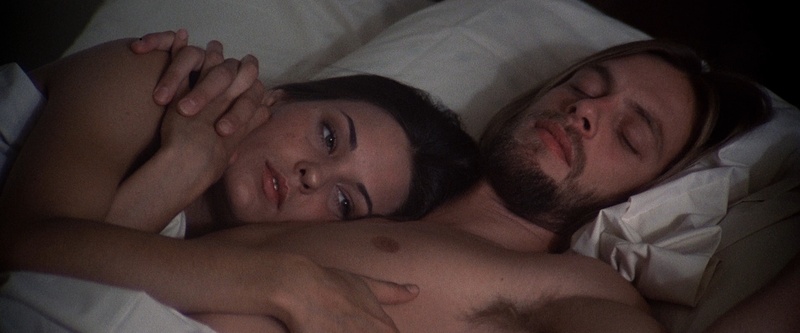
That method prevents the cinematographer from moving sources closer for the close-ups or relighting the actors as the framing changes. The light designed for the wide shot must also serve the close-up. Under comparable conditions, Vilmos Zsigmond achieved more convincing results with Altman, perhaps because, at an earlier stage in the director’s career, he was able to impose a tighter photographic framework.
Conclusion
Aside from the image’s strong 1970s character, the results are very limited. The intention is clearly to make a film that rejects convention, including the aesthetic conventions Altman had been challenging for years. But the conscious surrender of even a basic level of technical rigor makes large sections of Nashville visually unappealing. Nor is there a sufficiently strong visual design to make that technical imperfection feel purposeful.
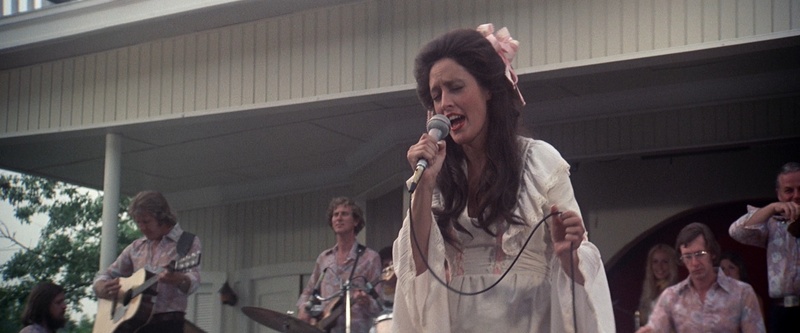
Many major works by Vilmos Zsigmond, László Kovacs, Owen Roizman, Conrad Hall or Gordon Willis pursue a form of naturalism related to what Altman was seeking here. In those films, however, a coherent visual design either makes the apparent roughness expressive or supports the naturalism with technique that is itself highly refined. Although it is a very different film, Roizman’s The Taking of Pelham One Two Three offers a clear example of the latter approach.
Lohmann never achieved the same standing as those cinematographers, and the constraints imposed by Robert Altman were exceptionally severe. For all these reasons, the cinematography of Nashville may serve the film’s docudramatic, observational approach to a large ensemble of characters. In strictly aesthetic and photographic terms, however, it does not live up to the film’s reputation.
ON FILM & DIGITAL
© Ignacio Aguilar, 2026.
This article is part of ON FILM & DIGITAL’s English-language cinematography reviews and essays.
These texts are not plot summaries or general film reviews, but cinematography-focused essays written from the perspective of a working cinematographer.
The Author
Ignacio Aguilar, AEC is a cinematographer / director of photography based in Madrid, Spain. His work spans feature films, television, commercials and technical writing on cinematography, with experience in digital cinema, 16mm and 35mm film, anamorphic lenses, large-format digital capture, lens testing and film-based workflows.
He is a member of the Spanish Society of Cinematographers (AEC) and the Spanish Academy of Cinema, a Sony I.C.E. Certified Expert and a Cooke SP3 ambassador. His writing has appeared in American Cinematographer and Camera & Light, and ON FILM & DIGITAL gathers his bilingual essays, technical guides and cinematography reviews.
For professional work, collaborations, lectures, workshops or cinematography consulting, visit his professional biography, selected works or contact page.
The Spanish-language archive is available at ON FILM & DIGITAL.