


“Network”
Spanish Title: Network, Un Mundo Implacable
Year of Production: 1976
Director: Sidney Lumet
Director of Photography: Owen Roizman, ASC
Lenses: Panavision Ultra Speed MK2
Film Stock: Kodak 5254 (100T)
Format and Aspect Ratio: 35mm spherical, 1.85:1
Awards: Academy Award nomination for Best Cinematography
Viewed on: Blu-ray
Dirty 1970s New York realism, ultra-fast spherical lenses, grain and low-contrast available-light photography in Owen Roizman’s cinematography for Sidney Lumet’s “Network.”
The Film
“Network” is an extraordinary satire about television, built around a group of characters who work inside the same broadcast system. Howard Beale, played by Peter Finch, is a news anchor who suffers a nervous breakdown during his program. Instead of being removed from the air, he becomes a kind of media prophet. His ratings rise, and the network immediately understands the commercial value of his collapse.
That decision triggers a chain reaction involving his friend and news-division president Max Schumacher, played by William Holden; Max’s wife, played by Beatrice Straight; the ambitious programming executive Diana Christensen, played by Faye Dunaway; the network executive Frank Hackett, played by Robert Duvall; and even the corporate chairman Arthur Jensen, played by Ned Beatty. The film becomes an increasingly tangled struggle for power, audience share and control of the image.
In the hands of another director, Paddy Chayefsky’s screenplay might easily have become exaggeration, melodrama or broad satire. Sidney Lumet finds the exact temperature for the material. He allows each scene to be satirical without asking the actors to play it as comedy. That seriousness is essential. It gives the film its plausibility and allows the ensemble to perform at an exceptional level. Unfortunately, “Network” also anticipated a large part of what television would later become.
The Cinematographer
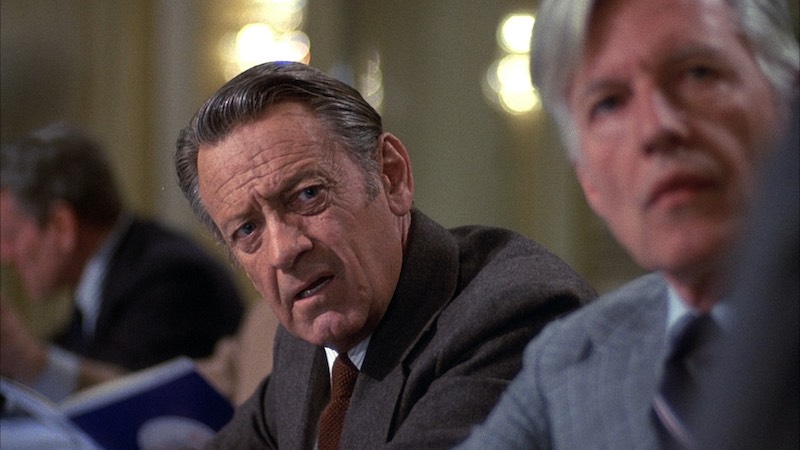
The cinematographer was Owen Roizman [ASC], one of the major American cinematographers associated with East Coast filmmaking, even if he later moved to California, unlike Gordon Willis. On paper, Roizman seemed almost ideally matched with Sidney Lumet, a director strongly identified with New York stories. For whatever reason, however, they collaborated only on this harsh portrait of television culture.
“Network” brought Roizman his third Academy Award nomination for Best Cinematography. By that point, he was already known as a cinematographer with a particular command of realistic material. His work for William Friedkin on “The French Connection” (1971) and “The Exorcist” (1973) had earned him his first two Oscar nominations and helped define his reputation.
Between those films and “Network,” Roizman also photographed “Play It Again, Sam” (Herbert Ross, 1972), the emblematic New York thriller “The Taking of Pelham One Two Three” (Joseph Sargent, 1974) and “Three Days of the Condor” (Sydney Pollack, 1975). Later in his career, he photographed “Tootsie” (Sydney Pollack, 1982) and “Wyatt Earp” (Lawrence Kasdan, 1994), which brought him his fourth and fifth Oscar nominations. In 2017, he received an Honorary Academy Award, becoming only the third cinematographer to receive one.
Visual Style Analysis
The cinematography of “Network” is almost a summary of 1970s American film aesthetics. During that decade, cinematographers such as Owen Roizman, Conrad Hall, Gordon Willis, Jordan Cronenweth and Vilmos Zsigmond definitively moved away from the older studio look: hard color lighting, high levels and techniques inherited from black-and-white cinematography. “Network” belongs fully to that break. Its image is direct, realistic and physically tied to the spaces in which the characters operate.
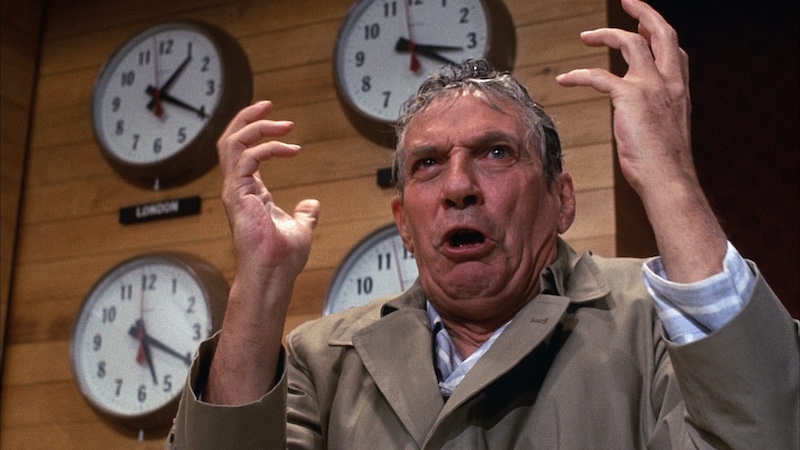
Roizman used ultra-fast Panavision lenses, and, as he explained in “American Cinematographer,” he photographed much of the film around T1.8. He apparently never stopped down beyond approximately T2.3, and at times used some focal lengths fully open at T1.1. The opening sequence with Peter Finch and William Holden is a strong example. It is shot almost entirely with available light on a New York street. The depth of field is extremely shallow, but the effect is remarkable because Roizman captures the real light of the city.
That is the visual philosophy of the film. Whether in streets, apartments, offices or television studios, the image tries to remain truthful and direct. Roizman uses little light, or balances interiors against exterior light, often with neutral-density gels installed on office windows. Compared with some of his earlier work, he seems to have relied less on push processing. The new Panavision lenses probably allowed him to work at similar light levels to those he had previously achieved by pushing the negative to around 200 ASA, since the Ultra Speeds were roughly one stop faster than earlier lens sets.
Even so, the image is still slightly grainy, partly because of underexposure. It is also low in contrast and carries a certain dirtiness, although it is cleaner if compared directly with “The French Connection” or “The Taking of Pelham One Two Three.” That balance is important. “Network” needs realism, but not the documentary roughness of Roizman’s most aggressive street work.
At the same time, Roizman makes a visible effort to give the relationship between William Holden and Faye Dunaway a more controlled photographic treatment. There is some in-camera diffusion to soften the image and improve the actors’ appearance, and they are generally surrounded by the softest light the situation can plausibly allow.
The night scene in which Dunaway seduces Holden in his office was, according to Roizman, one of the most difficult scenes in the film. Lumet and Roizman wanted the city to remain visible through the office windows, which were smoked glass. That forced the cinematographer to work at extremely low levels. Any light placed inside the room reflected in the glass, and the actors still had to be photographed attractively. Roizman solved the scene with small 25-watt bulbs, carefully hidden in the location.
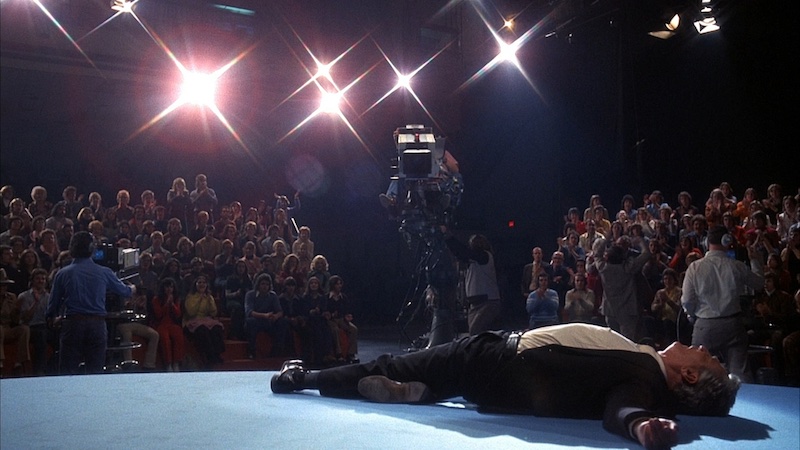
In general, his lighting is soft and built from low-power sources. That principle is broken only when the drama requires a more theatrical or symbolic intervention. The scenes with Peter Finch in the television studio are one example. Another is the famous sequence in which Beale calls on viewers to go to their windows and shout. Lumet and Roizman choreograph a striking night scene in which the buildings are lit by lightning from a storm, along with the isolated light of several windows.
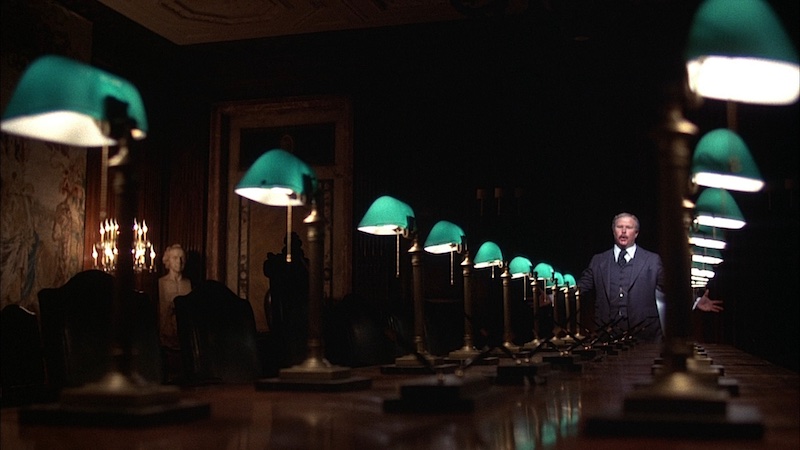
The boardroom scene with Ned Beatty is equally memorable. The green lamps, the long table and the direct beam of light falling on Beatty turn the corporate space into something almost religious. It is one of the few moments in the film where the photography openly departs from everyday realism, but the departure is dramatically precise: Jensen is not just an executive in that scene. He becomes the voice of the system itself.
Conclusion
The strength of Roizman’s work in “Network” does not come primarily from pictorial beauty. It comes from sobriety. He follows the same visual discipline from beginning to end, across every kind of location, and gives the film a look that is consistent with what it says and with how Lumet says it.
That may be one of the reasons the film works as well as it does. Chayefsky’s screenplay needed a visual envelope of reality and common sense. Without that, the increasingly absurd behavior of the characters might have seemed implausible. The photography makes the world feel solid enough for the satire to become believable.
The same is true of Lumet’s direction of the actors. He does not ask them to play “Network” as the black comedy it ultimately is. He asks them to play it with the seriousness of a drama. Roizman’s cinematography supports that decision at every level: low light, shallow focus, soft practical solutions, grain, restrained diffusion and a New York image that feels lived-in rather than designed.
For that reason, “Network” remains one of the essential examples of 1970s American realism in color cinematography. It is not as visually dirty as “The French Connection,” nor as aggressively raw as some of the decade’s street films. But its restraint is exactly what makes it effective. The image never competes with Chayefsky’s writing or Lumet’s actors. It gives them the credible world they need in order to become terrifyingly prophetic.
ON FILM & DIGITAL
© Ignacio Aguilar, 2026.
This article is part of ON FILM & DIGITAL’s English-language cinematography reviews and essays.
The Author
Ignacio Aguilar, AEC is a Spanish cinematographer based in Madrid. His work spans feature films, television, commercials and technical writing on cinematography, with experience in digital cinema, 16mm and 35mm film, anamorphic lenses, large-format digital capture and practical lens testing.
Read more articles and reviews in Spanish at ON FILM & DIGITAL, or visit the main cinematography portfolio at ignacioaguilardop.com.