

“The Last Showgirl”
Spanish Review: The Last Showgirl
Year of Production: 2024
Director: Gia Coppola
Director of Photography: Autumn Durald Arkapaw, ASC
Camera: ARRIFLEX 416
Lenses: Panavision custom anamorphic lenses for Super 16mm / Panavision 16mm bespoke Auto Panatars
Film Stock: Kodak Vision3 500T 7219, pulled one stop at FotoKem
Format and Aspect Ratio: Super 16mm anamorphic, 2.4:1
Other: 4K Digital Intermediate
Viewed on: Blu-ray
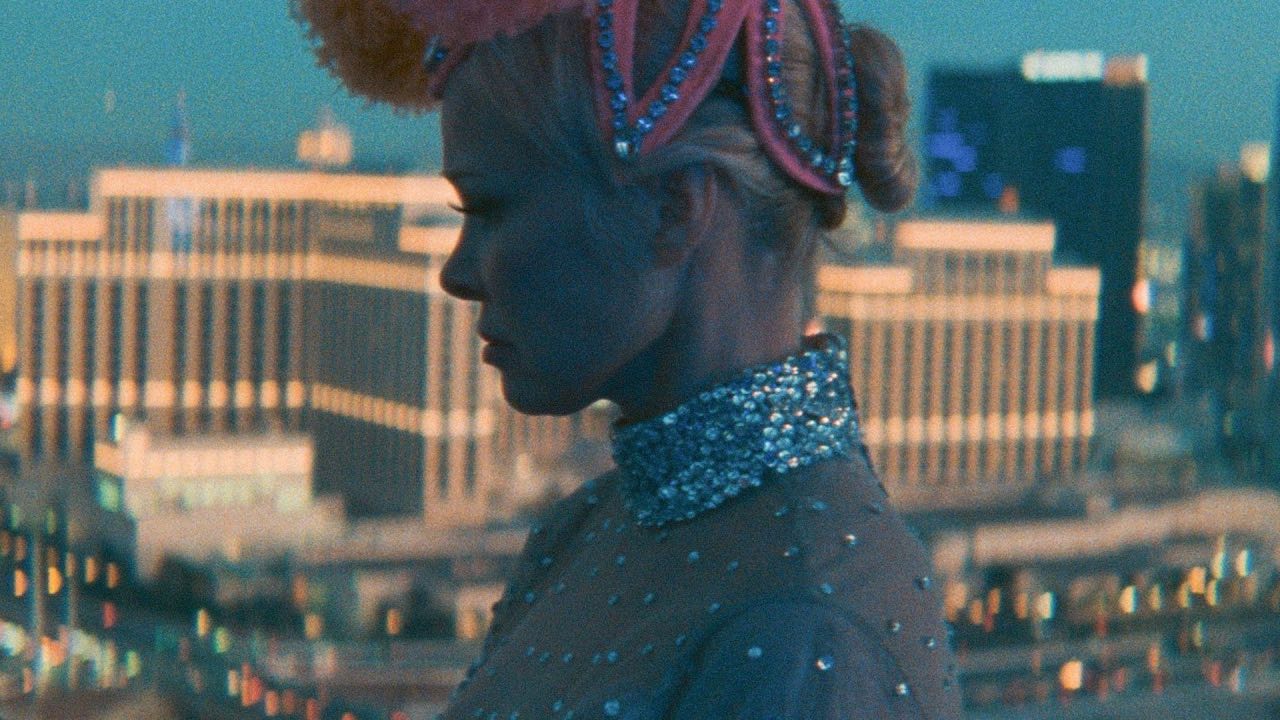
Super 16mm, Panavision anamorphic glass and Kodak 500T shape Autumn Durald Arkapaw’s fragile, textured image for Gia Coppola’s intimate Las Vegas drama.
The Film
A small independent production directed by Gia Coppola, “The Last Showgirl” tells the story of Shelly, a Las Vegas dancer played by Pamela Anderson, who has spent more than thirty years performing in the same long-running revue. When the show is about to close, she is forced to confront what might come next and how little of her life exists outside the stage.
That crisis also brings back her daughter, with whom she has only a distant relationship. Shelly chose her career when the girl was young, and the film treats that decision less as melodrama than as a wound that has never entirely closed. It is a modest, intimate picture, carried above all by Anderson’s performance in a register very different from the one that made her famous decades earlier.
Gia Coppola approaches the material with restraint. Even with obvious budget limitations, she does not try to turn the film into a spectacle about Las Vegas performance. The focus remains on the private drama of the central character. Jamie Lee Curtis and Dave Bautista complete the main cast.
The Cinematographer
The cinematographer was Autumn Durald Arkapaw, ASC, best known now for becoming the first woman to win the Academy Award for Best Cinematography for “Sinners” (Ryan Coogler, 2025), which she photographed immediately after this film.
Before that, her career included “Black Panther: Wakanda Forever” (Ryan Coogler, 2022), following earlier work on “Guadalupe the Virgin / La Virgen de Guadalupe” (Victoria Giordana, 2011), “Palo Alto” (Gia Coppola, 2013), “One and Two” (Andrew Droz Palermo, 2015) and “Teen Spirit” (Max Minghella, 2018). She has also worked in television, including the series “Loki” (2021).
Visual Style Analysis
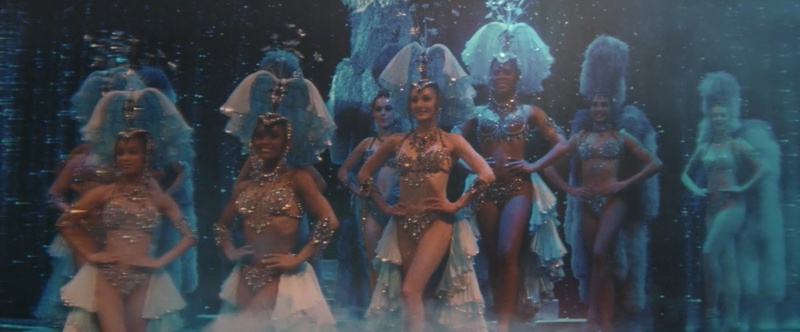
Shot in only eighteen days, “The Last Showgirl” is a film strongly defined, for better and for worse, by its technical choices. It is not a movie about Las Vegas performances as spectacle. It is more interested in what happens backstage, in corridors, dressing rooms, apartments and quiet spaces after the show. For that reason, one should not expect an especially glossy or spectacular image.
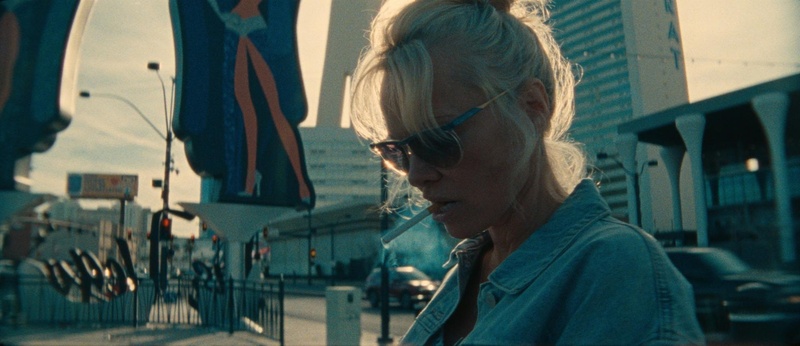
The main aesthetic decision was to shoot the film on Super 16mm. That alone gives the movie a very specific identity. Texture, sharpness and the overall photographic behavior are radically different from what the same material might have looked like on a conventional ARRI Alexa Mini. The 16mm image gives “The Last Showgirl” a slightly old, vintage and decaying quality that fits the story for obvious reasons.
At the same time, the film was shot with Panavision anamorphic lenses adapted or customized for Super 16mm, close to the kind of solution used on “Red Rocket” (2021). This gives the picture a widescreen frame, but the optical performance — edge sharpness, contrast, focus behavior and field consistency — moves deliberately into an area of strong imperfection. It is the kind of image David Watkin might perhaps have described as an “optical disaster.”
The look can be interesting, and it works in several scenes. But when the viewer can hardly settle the eye anywhere because focus is unstable, or because the edges of the frame are heavily broken, the gain can become smaller than the cost. The effect starts calling attention to itself. These kinds of flaws often work better when they are absorbed into the narrative more quietly, almost subliminally, rather than placed so close to the surface of the image.
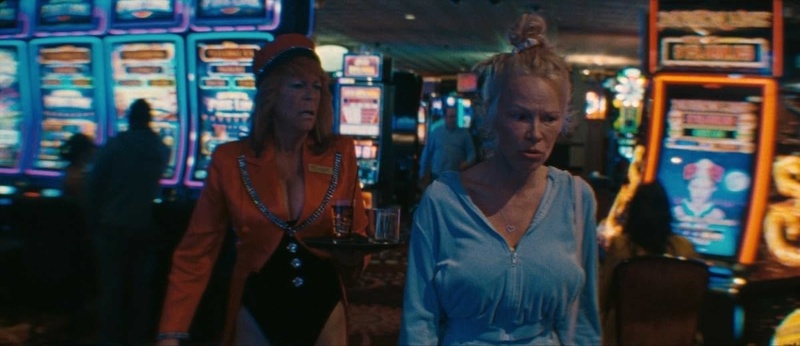
The visual approach is direct. Not exactly documentary, but certainly drawn toward a realistic surface. Whenever possible, Autumn Durald Arkapaw uses the light already built into the locations and sets to make those spaces illuminate themselves. This is especially clear in the dressing rooms, corridors, backstage areas and even in the domestic scenes.
The method is to accept practical sources as active lighting elements, even when they become heavily overexposed. Rather than domesticating them completely, the cinematographer lets them do real work in the scene. By opening the lens, she can capture more of that light and preserve the immediacy of the locations. In exteriors, she often seems to avoid additional lighting altogether. Some moments are particularly interesting, such as the rooftop scene at dusk, almost at magic hour, with the city lights working in the background.
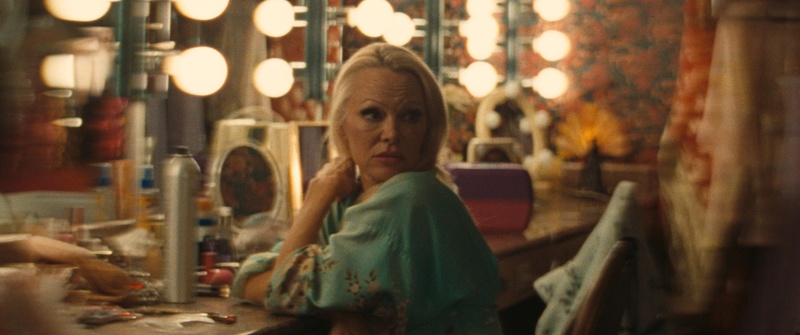
The difficulty appears when two of the film’s main decisions fully overlap: intentionally imperfect lenses and practical or existing light with very little additional shaping. Optical weakness, critical focus and low edge definition can then meet an image with limited separation, little refinement and a very raw surface. This is visible, for example, in the dinner-preparation sequence at Pamela Anderson’s house.
The low contrast in that scene, and in others, does not always help the lenses or the small negative. With this technical combination, stronger blacks and clearer tonal separation would often give the image more support. Super 16mm anamorphic, especially with lenses that already have strong falloff and a limited field of sharpness, tends to need some density in order to hold together.
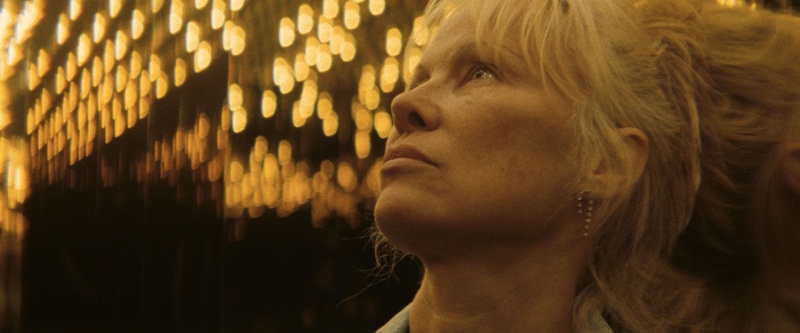
That makes the lab strategy especially interesting. Kodak states that the film was pulled one stop at FotoKem, meaning that the negative was exposed and processed to reduce contrast and saturation, with a smoother grain structure. In theory, that choice could help tame 500T on 16mm. In practice, it does not always seem to favor a combination that was already delicate: Super 16mm, anamorphic glass, strong falloff and extensive practical lighting. At times, the image might have benefited from denser blacks, firmer tonal separation and a slightly less unprotected negative.
Conclusion
In that embrace of imperfection, which clearly does not seem to worry the filmmakers very much, “The Last Showgirl” shows many of the virtues of Super 16mm. It has prominent texture, a strong photochemical acquisition quality and a surface that feels physically different from contemporary digital cinema.
It also shows the risks of the format when it is pushed in this direction: focus can become fragile, spatial separation can suffer, and the overall technical reserve is much more limited than in 35mm. The cinematography is therefore technically uneven. Yet, despite those problems, it works reasonably well at a narrative level.
A slightly more polished approach might have been useful, preserving the same texture and realism while preventing the optics and the way they are used from drawing quite so much attention to themselves. Given the story and the type of filmmaking Coppola is pursuing, the image perhaps needed to remain fragile, but a little less exposed to its own fragility.
ON FILM & DIGITAL
© Ignacio Aguilar, 2026.
This article is part of ON FILM & DIGITAL’s English-language cinematography reviews and essays.
These texts are not plot summaries or general film reviews, but cinematography-focused essays written from the perspective of a working cinematographer.
The Author
Ignacio Aguilar, AEC is a Spanish cinematographer based in Madrid. His work spans feature films, television, commercials and technical writing on cinematography, with experience in digital cinema, 16mm and 35mm film, anamorphic lenses, large-format digital capture and practical lens testing.
Read more articles and reviews in Spanish at ON FILM & DIGITAL, or visit the main cinematography portfolio at ignacioaguilardop.com.