


“Sinners”
Spanish Title: Los Pecadores
Year of Production: 2025
Director: Ryan Coogler
Director of Photography: Autumn Durald Arkapaw, ASC
Lenses: Panavision Ultra Panatar, Panavision Sphero 65
Film Stock: Kodak Vision3 5219 500T, Kodak Ektachrome 100D 5294
Format and Aspect Ratio: 5-perf 65mm anamorphic Ultra Panavision, 2.76:1 + 15-perf 65mm IMAX, 1.43:1
Other: 4K Digital Intermediate
Viewed on: 4K HDR Blu-ray
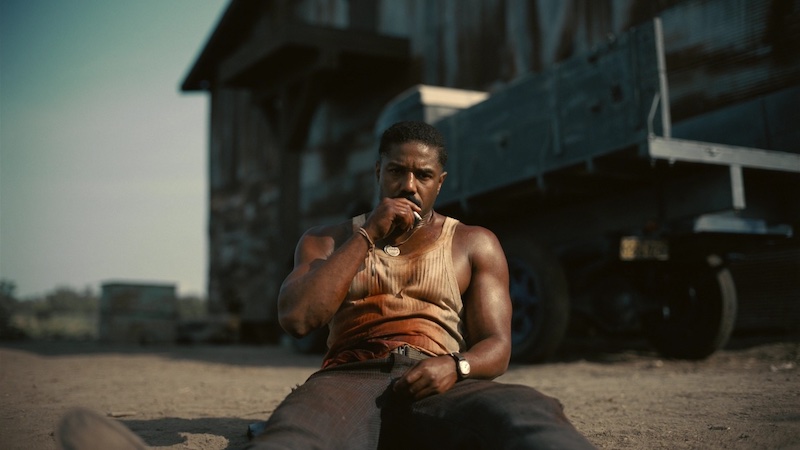
Large-format ambition, 65mm texture, IMAX spectacle and a deliberately underexposed image in Autumn Durald Arkapaw’s cinematography for Ryan Coogler’s Sinners.
The Film
Sinners is a period horror-action film set in the American South in the early 1930s. Its protagonists are twin brothers, both played by Michael B. Jordan, who return from Chicago after years apparently spent in the criminal underworld. Their plan is to buy an old sawmill and turn it into a nightspot for Black customers, with blues music, alcohol and the promise of one night of freedom. As the evening develops, a supernatural threat begins to close in.
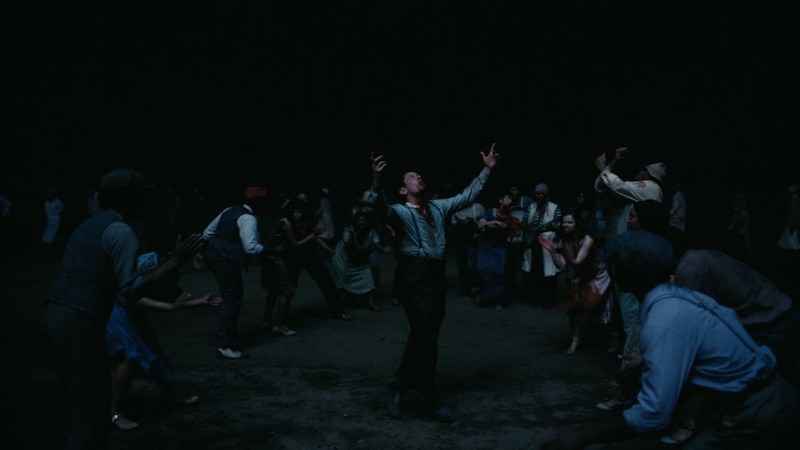
The film was one of the major popular successes of 2025. Its period setting, its music and its large-format presentation all helped turn it into a genuine theatrical event. The most impressive passage is probably the musical sequence near the beginning of the night section, staged as a long, fluid movement and given the scale of IMAX. There, the film briefly finds a strong connection between music, history, performance and format.
As drama and horror, however, Sinners is less persuasive. The film takes a long time to gather force, and once the supernatural element takes over, it draws very openly from earlier genre models. The influence of The Thing (John Carpenter, 1982) is clear, and the basic dramatic structure also recalls From Dusk Till Dawn (Robert Rodriguez, 1996). Coogler relocates those references into a Black Southern historical context, which gives the material a different cultural charge. But the mechanics of the genre do not always feel newly imagined.
The result is ambitious, expansive and occasionally powerful, but also frustrating. The film has scale, cast and concept, yet it is less effective as suspense and rarely convincing as horror. Its best moments suggest a richer and stranger film than the one that finally emerges. Hailee Steinfeld, Miles Caton, Jack O’Connell, Wunmi Mosaku, Jayme Lawson, Omar Benson Miller, Delroy Lindo and Li Jun Li complete the cast.
The Cinematographer
The director of photography is Autumn Durald Arkapaw, ASC. Her career has moved between smaller, more personal films and large-scale studio work. She photographed Gia Coppola’s Palo Alto (2013), Mainstream (2020) and The Last Showgirl (2024), while also working with Ryan Coogler on Black Panther: Wakanda Forever (2022).
Coogler has often worked with women cinematographers. Creed (2015) was photographed by Maryse Alberti, while Black Panther (2018) was shot by Rachel Morrison. With Sinners, Arkapaw became the first woman to photograph both 65mm and IMAX for theatrical release. That fact gives the production an undeniable industrial importance, regardless of the questions one may raise about the final use of those formats.
Visual Style Analysis
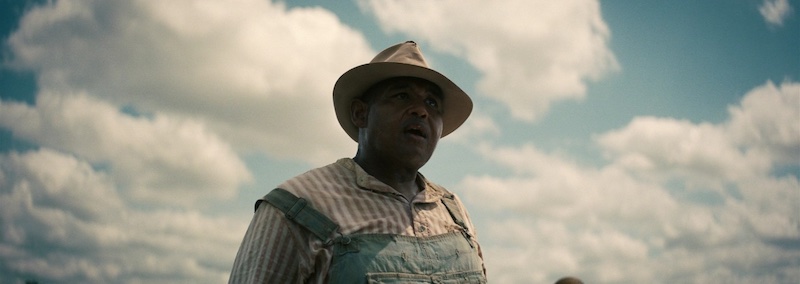
Visually, Sinners is defined by the tension between large-format ambition and a deliberately dark, low-density lighting strategy, raising questions about exposure, format choice and the dramatic necessity of 65mm and IMAX.
The central issue in Sinners cinematography is not simply that the film was shot in large format. It is why these particular formats were used, and how well the film integrates them into its visual language. Coogler initially wanted to shoot in 16mm, a choice that Arkapaw reportedly found appealing. She was shooting The Last Showgirl on that format when the proposal arrived. Because the film required extensive visual effects to duplicate Michael B. Jordan in both leading roles, the filmmakers moved first toward 35mm. A smaller negative would have created additional difficulties for compositing and image stability.
Warner Bros. then encouraged the filmmakers to consider large format, partly to turn the film into an event for theatrical exhibition. The result is an unusual combination. Most of the film was photographed in 5-perf 65mm anamorphic Ultra Panavision, the format associated with Ben-Hur, Mutiny on the Bounty, Battle of the Bulge and The Hateful Eight. Selected sequences were photographed in 15-perf 65mm IMAX.
Mixing IMAX with other formats is not new. Even mixing IMAX with 65mm is no longer unusual. What makes Sinners distinctive is the pairing of IMAX 1.43:1 with 5-perf 65mm anamorphic at 2.76:1, the widest commercial theatrical ratio. In 15/70 IMAX projection, the film alternates between 1.43:1 and 2.76:1. In digital IMAX, that becomes 1.90:1 and 2.76:1. On the 4K Blu-ray, the same contrast is preserved. In conventional digital projection, the entire film is presented at 2.76:1.
That strategy is bold, but it is also questionable. The shift from 1.43:1 to 2.76:1 is more dramatic than the more familiar transition between IMAX and 5-perf spherical 65mm at 2.20:1 or 2.21:1. In theatrical exhibition, the Ultra Panavision material can also leave a great deal of screen height unused. More importantly, the film often gives the impression that these formats were chosen because the production had access to them, not because the story or the staging truly needed them. The decision has event value. Its visual necessity is much less convincing.
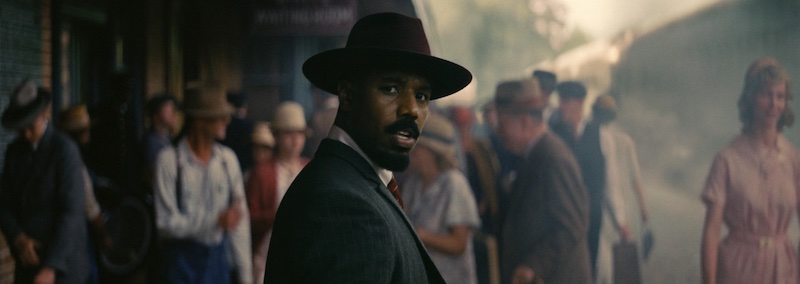
The film does not always take full advantage of the negative area it uses. Much of Sinners is built around a deliberately low exposure level. That choice can work in digital cinematography, where modern sensors often hold shadow information with great flexibility. On negative, however, the relationship is different. Film generally rewards a healthier exposure, especially if one wants density, color separation and robust blacks. It also tends to respond beautifully when protected, or even slightly overexposed, in the highlights.
Here, the image often feels as if it has been exposed with a digital instinct rather than a photochemical one. The shadows are not always dense; they can become gray, thin and somewhat compressed. The blacks do not consistently have the weight one might expect from 65mm origination. Some of that may come from the exposure strategy. Some of it may come from the optical character of the Panavision Ultra Panatars, modern descendants of the APO Panatars designed for 1.3x anamorphic photography. Their contrast can feel relatively soft, especially when most of the information is placed near the lower part of the curve.
This becomes more visible when the film cuts to IMAX material. The IMAX sections, photographed with spherical lenses, often appear brighter and more open in the shadows. Part of that difference may simply be the larger negative area. Part may be the lenses. But because Sinners was finished through a Digital Intermediate, unlike Christopher Nolan’s photochemical large-format workflows, it is difficult to isolate the exact cause. The result seems to come from a combination of underexposure, optical contrast and digital grading choices.
This is also why the film is curious in relation to Arkapaw’s stated concern, in interviews, for strong blacks. The intention may well have been there. On screen, however, the blacks often feel weaker than expected. The image is dark, but darkness and density are not the same thing. That distinction is central to the problem.
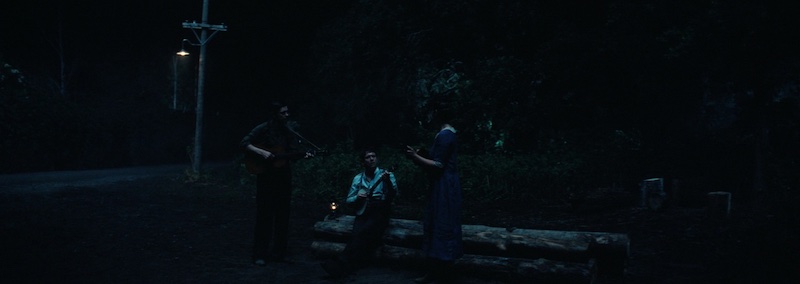
The general lighting approach is modern and often built around significant underexposure, perhaps around two stops in some scenes. One can imagine this strategy working more naturally on a large-format digital camera such as the Alexa 65. On film, it produces a more ambiguous result. It gives the image mood, but it also limits the richness that 65mm could otherwise provide.
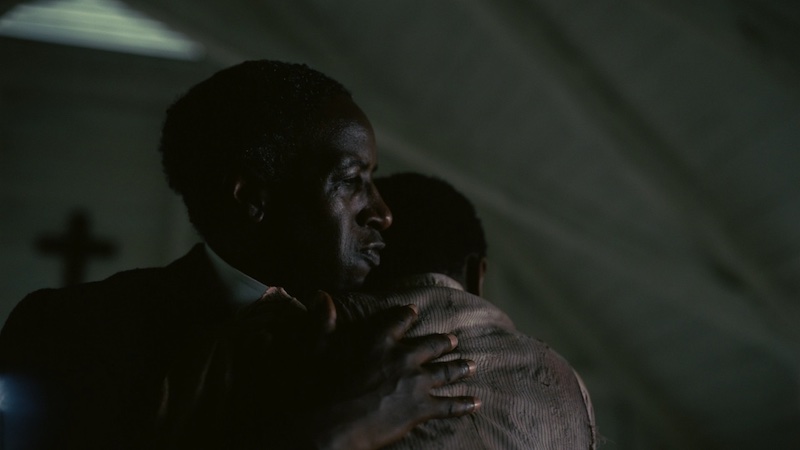
In the first part of the film, Arkapaw often lights from outside rooms or structures, such as the chapel and the store. The light is soft and diffuse, designed to keep some continuity between exterior and interior levels. She also introduces soft daylight from above to keep faces readable. The method is understandable, especially with dark skin tones and a low-exposure strategy. Without those soft sources and the skin response they create, the actors could easily disappear into the lower values.
The difficulty is that the LED sources inside these spaces can feel too visible. They are not always convincingly motivated by the architecture or by practical sources. The faces remain readable, but the image often reveals too clearly how that readability has been achieved. This is a difficult problem, but the film does not always solve it with much elegance or invention.
The strongest interior work comes inside the nightclub. There, the top-light approach is more integrated, because the set itself contains visible practicals. The light can come from above without feeling arbitrary. In many shots, the real sources are probably soft units — Chinese lanterns, heavily diffused lamps or CTO-warmed rigs — placed above the action. They shape the actors, hold warmth and allow a degree of contrast.
Even in the club, however, the heavy reliance on overhead light has a cost. At times, the actors could use slightly more modelling from their own level, rather than so much information coming from above. Because the negative is held low, a great deal of image detail sits close to black. The result has atmosphere, but not always dimensionality.
The weakest part of the cinematography is the night exterior work. The club is a stage set, and the exterior extensions appear to be resolved through visual effects. The integration itself is not the main problem. The issue is the lighting language chosen for those exteriors.
Arkapaw uses large crane-mounted LED sources to create broad, soft, blue overhead ambience. The idea seems to be to separate the cooler exterior world from the warmer foregrounds of the club. As a basic strategy, that is functional. But it remains too blunt. The light covers space rather than shaping it. It produces low contrast, limited depth and very little sense of direction.
For a film with the resources to shoot Ultra Panavision and IMAX, the night exteriors feel surprisingly ordinary. Large soft sources can be useful for very wide areas, or as a base ambience on difficult nights. But here they often become the dominant idea. The film rarely finds the harder edges, backlight, pockets of darkness, motivated sources or layered contrast that could have made those spaces more dramatic.
This is where the cinematography raises its largest question. The tools are extraordinary, but the night exterior language is not. The image has scale, yet it often lacks shape. It has exposure, but not enough dramatic tension in the light. It has format, but not enough visual pressure.
Conclusion
The most successful passage remains the musical sequence at the beginning of the night section. Shot in IMAX, it uses scale, movement and musical time in a way that feels genuinely connected to the film’s ambitions. Some of the club compositions also make good use of the 2.76:1 frame, especially when two or three characters are held across the width of the image in medium or tighter shots.
But the broader approach is much less convincing. The mixture of formats is technically impressive, but not fully integrated. The underexposure strategy limits much of what 65mm can offer. The Ultra Panavision material often lacks the density and richness one might expect, while the night exteriors rely too heavily on broad, soft overhead ambience. These are not minor reservations. They affect how the film handles space, depth, contrast and dramatic tension.
For that reason, Sinners is difficult to accept as one of the year’s strongest cinematographic achievements. It is ambitious, certainly, and important as a production milestone. It also contains individual passages of real interest. But the large-format choice is not enough by itself. When judged as cinematography — not as event, not as format publicity, and not as industrial achievement — the film feels considerably more uneven than its reputation suggests.
The achievement is real, but the limitations are just as visible. Sinners shows what access to 65mm and IMAX can make possible, but it also shows that format alone does not create visual necessity. In this case, the strongest ideas are intermittent. The weaker ones reveal how much large-format photography still depends on exposure discipline, lighting strategy and a precise sense of why the image needs to be that large in the first place.
ON FILM & DIGITAL
© Ignacio Aguilar, 2026.
This article is part of ON FILM & DIGITAL’s English-language cinematography reviews and essays.
These texts are not plot summaries or general film reviews, but cinematography-focused essays written from the perspective of a working cinematographer.
The Author
Ignacio Aguilar is available for cinematography work, creative collaborations, lectures, workshops and international projects. He is a Sony Independent Certified Expert (ICE) and Cooke Optics Spanish Ambassador for Cooke SP3 lenses. Contact here.