

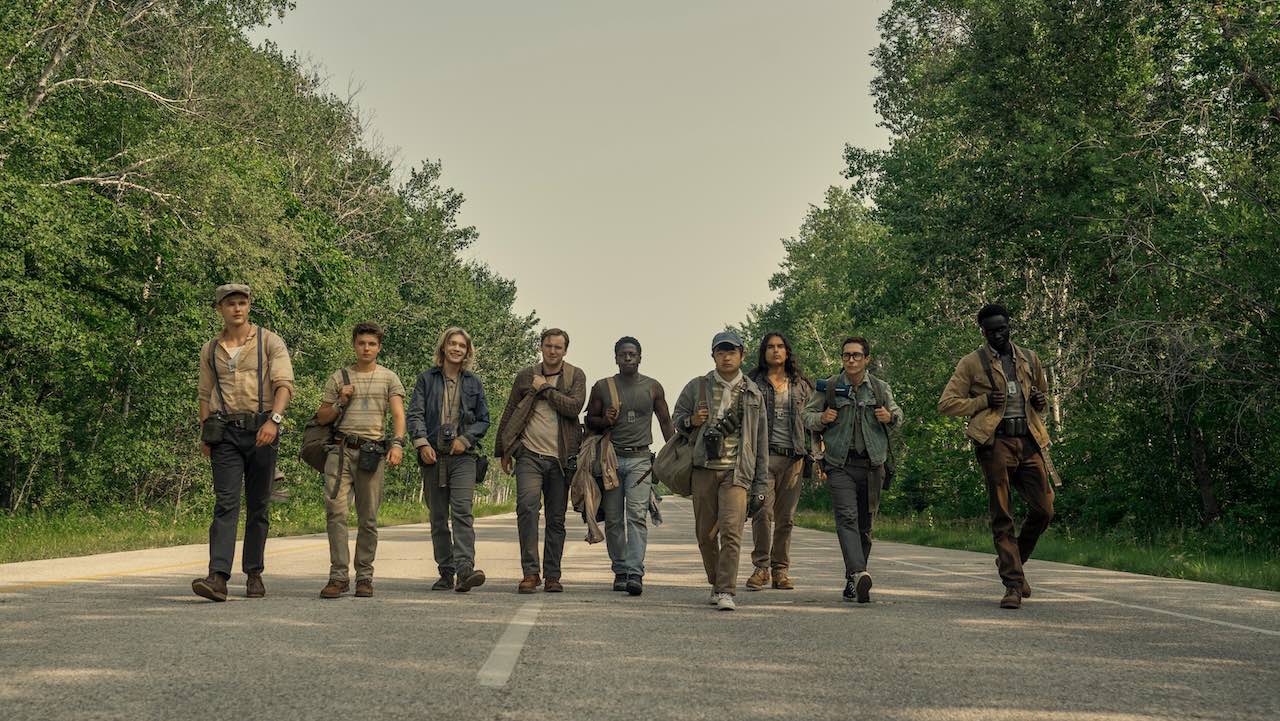
“The Long Walk”
Spanish Title: La Larga Marcha
Year of Production: 2025
Director: Francis Lawrence
Director of Photography: Jo Willems, ASC, SBC
Lenses: Panavision T Series anamorphic, ALZ10, AWZ2.3 and ATZ zooms
Format and Aspect Ratio: ARRI Alexa 35 (ARRIRAW 4.6K), 2.39:1 / 2.40:1
Other: 4K Digital Intermediate
Viewed on: Blu-ray
A march without rest, natural light and Panavision anamorphic lenses: Jo Willems turns the physical exhaustion of “The Long Walk” into the film’s main visual strategy.
The Film
The Long Walk is an adaptation of Stephen King’s novel about a group of young men who enter a peculiar contest. They must keep walking without rest, maintaining a certain speed at all times. If they slow down, stop or leave the route, they are shot and killed.
Directed by Francis Lawrence (The Hunger Games, Red Sparrow), and starring Cooper Hoffman, David Jonsson and Mark Hamill, the film begins from a visually interesting premise: an image that is almost always in motion, built around long stretches of dialogue with the camera either in front of or behind the participants in this strange endurance test.
The problem is that the device exhausts itself quite quickly. What the characters say is not as compelling as the film seems to need, and what happens on screen is not enough to sustain its 108 minutes. The road walked by the characters ends up feeling almost as long for the viewer, and even the resolution is not especially satisfying.
The Cinematographer
The cinematographer is Belgian director of photography Jo Willems, ASC, SBC, who has maintained a productive association with director Francis Lawrence for many years. They appear to have first worked together in music videos, before Lawrence later brought Willems onto television work.
Since then, they have collaborated on several films in The Hunger Games series from 2013 onward, including Catching Fire, Mockingjay – Part 1, Mockingjay – Part 2 and The Ballad of Songbirds and Snakes, as well as Red Sparrow (2018), Slumberland (2022) and the Apple series See (2019). Willems was also the cinematographer of Hard Candy (2005) and 30 Days of Night (2007), both directed by David Slade, as well as Limitless (Neil Burger, 2011).
Visual Style Analysis
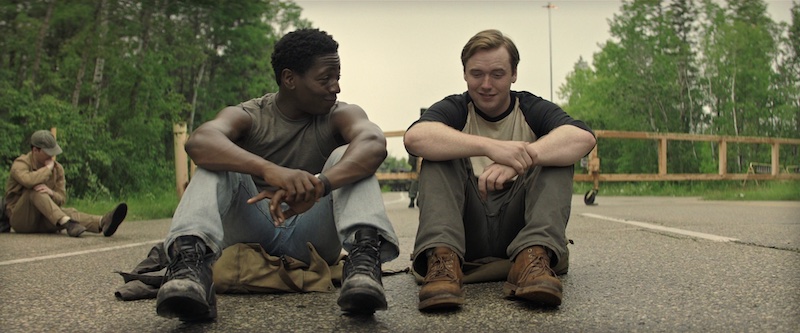
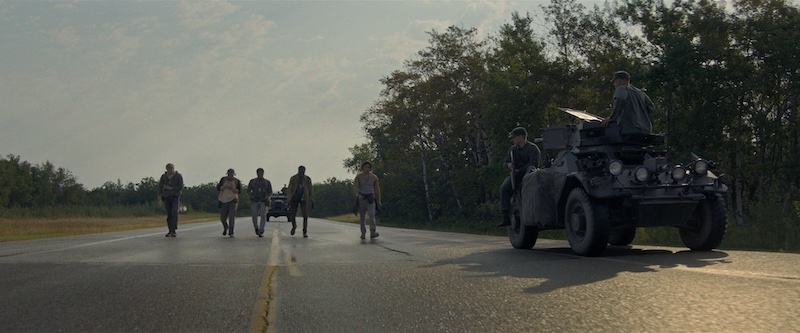
Most of The Long Walk consists of daytime exteriors shot on Canadian locations, mainly roads and paths. The look of the film is direct, because Willems makes the most logical decision for this kind of material: since the film follows people walking for most of its running time, he shoots as much as possible against the light. That choice seems to have been prepared from the location stage, selecting east-west roads that would allow the sun to be placed behind the actors at the right moments of the day.
In the morning, the filmmakers seem to shoot toward the east, with the sun behind the performers. Around midday, the approach shifts toward tighter shots, profiles and wider views that can tolerate the less favorable overhead light. In the afternoon, the direction is probably reversed, allowing the actors to be photographed again in backlight as they walk in the opposite direction from the morning setup.
The result is a very natural image, and the presence of the cinematographer is not felt in an obvious way. Most of the intervention has taken place before the camera rolls: in choosing the locations, deciding the direction of travel, and determining which side of the road can be photographed at each hour. The film does use selected moments of magic hour at sunrise or sunset, but these more conventionally beautiful images are relatively limited. The narrative does not really have much room for them.
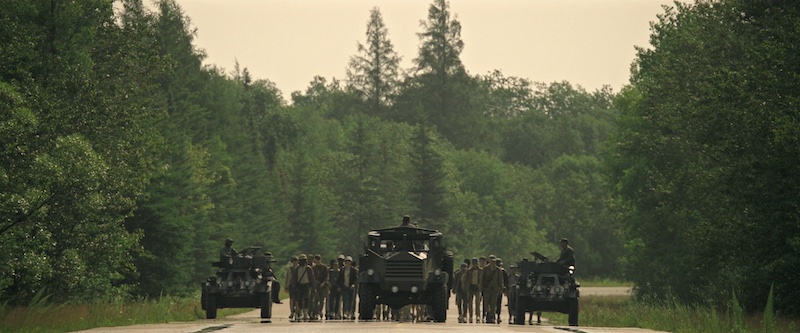
In the comparatively few night scenes, Willems appears to follow the simplest and most coherent path available. The escort vehicles carry large integrated lamps, and he generally uses them as backlight while also leaving them visible as practical sources. This produces numerous flares and highlights across the frame, which suit both the anamorphic lenses and the harsh functional logic of the story.
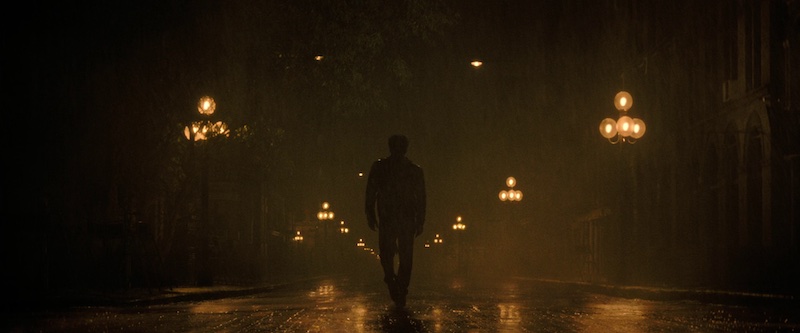
A crane with a light is even used in this way and is occasionally visible on screen. Only near the final resolution, in a more urban environment, do the filmmakers move toward a more classical cinematic lighting scheme. Even then, the yellowish tone remains close to the earlier night sequences and to some of the flashbacks involving the protagonist and his mother.
These night scenes look good, but the film’s limited stylistic variation — and the very long wait before those sequences arrive — may make them feel less interesting than they actually are. They are probably the passages that best exploit the strong look of the Panavision T Series anamorphic lenses, used here with the ARRI Alexa 35.
What is curious is that neither Willems nor Lawrence seem to overcomplicate a story in which dialogue takes priority and in which many shots are, by necessity, variations on the same setup. The film appears to have been shot from the rear of a vehicle moving in front of the actors, and also with telescopic cranes and stabilized heads. But the filmmakers remain classical in their camera angles: frontal views, rear views, some lateral shots and over-the-shoulder framings. They do not try to create rhythm through constant changes in shot size or through aggressive visual variation.
In fact, there are many wide, long and carefully composed anamorphic shots, often with five, six or more actors sharing the frame and occupying its horizontal width. This leads, surprisingly, to a relatively old-fashioned use of directional dialogue. The staging often lets the viewer know who is speaking because the actors are placed and held clearly within the frame, rather than fragmented through coverage.
Conclusion
The main problem is that what The Long Walk tells is not compelling enough to support its own structure. The concept is clear, and the visual approach is disciplined, but the dramatic progression is too flat. As a short film, the same idea might have worked better. In a feature-length form, the repetition becomes the subject, but not always in a productive way.
If everything between the appearance of the title card, around minute twenty-two, and the final scene had been compressed into a dissolve, the film might have lost less than it should. That is revealing. It suggests that the central body of the film, however carefully staged and photographed, often feels more procedural than essential.
From a cinematography standpoint, however, Willems’ work is coherent and intelligent. The image accepts the conceptual limitations of the film and turns them into a method: backlight, roads, bodies in motion, practical night sources and restrained anamorphic compositions. The photography is not the problem. If anything, it is one of the elements that most consistently understands what the film is trying to be.
ON FILM & DIGITAL
© Ignacio Aguilar, 2026.
This article is part of ON FILM & DIGITAL’s English-language cinematography reviews and essays.
These texts are not plot summaries or general film reviews, but cinematography-focused essays written from the perspective of a working cinematographer.
The Author
Ignacio Aguilar, AEC is a Spanish cinematographer based in Madrid. His work spans feature films, television, commercials and technical writing on cinematography, with experience in digital cinema, 16mm and 35mm film, anamorphic lenses, large-format digital capture and practical lens testing.
Read more articles and reviews in Spanish at ON FILM & DIGITAL, or visit the main cinematography portfolio at ignacioaguilardop.com.