

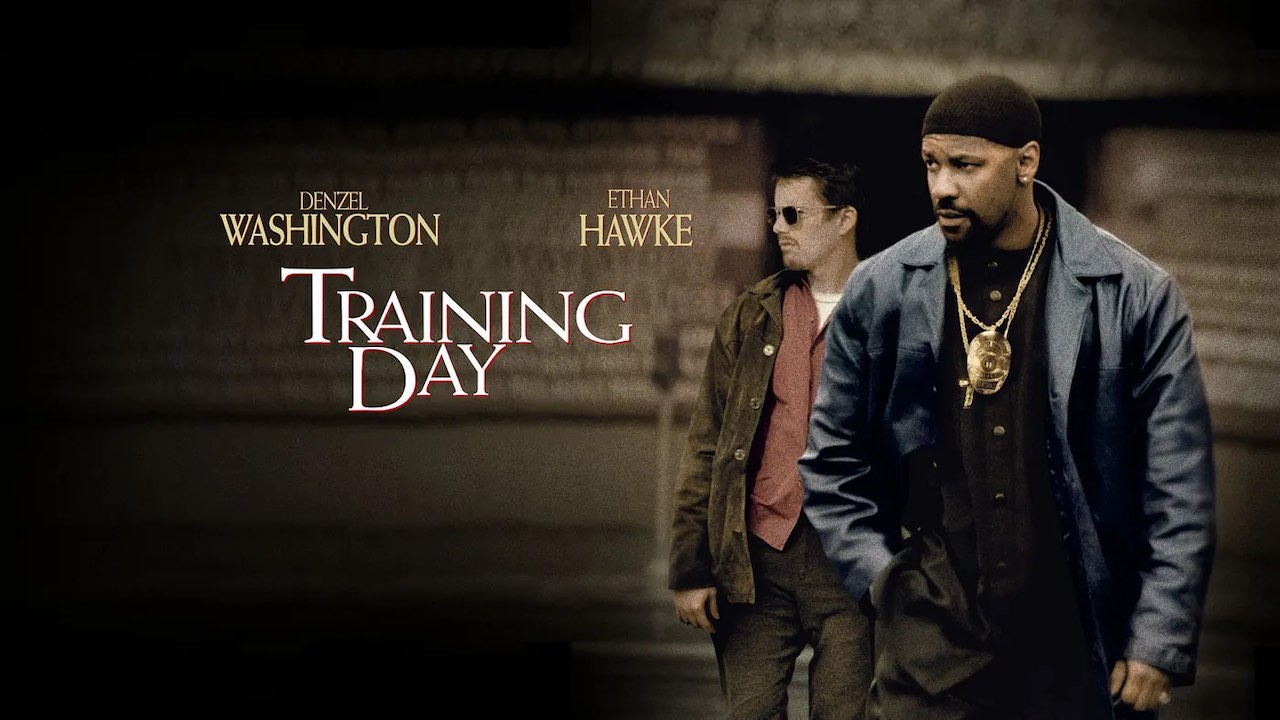
“Training Day”
Spanish Title: Training Day (Día de Entrenamiento)
Year of Production: 2001
Director: Antoine Fuqua
Director of Photography: Mauro Fiore, ASC
Lenses: Hawk C-Series
Format and Aspect Ratio: 35mm anamorphic (Hawk Scope), 2.4:1
Viewed on: 4K HDR Blu-ray
Hawk anamorphic lenses, fierce contrast and an aggressive urban image in Mauro Fiore’s cinematography for Antoine Fuqua’s “Training Day.”
The Film
“Training Day” is a police thriller written by David Ayer and set in Los Angeles. Its protagonists are Alonzo Harris, a veteran narcotics detective played by Denzel Washington, and Jake Hoyt, a rookie officer played by Ethan Hawke, who wants to become a detective himself. To earn that position, he must spend a full day with Alonzo, who tests him constantly, first through intimidation and later by placing him in serious danger through actions far outside the law.
The film stands out for Antoine Fuqua’s direction of actors and for Denzel Washington’s magnetic performance as a corrupt detective. His Academy Award for Best Actor may feel somewhat excessive, especially since Ethan Hawke, who has as much or even more screen time, was nominated as supporting actor. Even so, Washington gives the film much of its force. The action scenes are also staged with control and energy, which helps explain why “Training Day” became both a critical and commercial success on release.
Scott Glenn, Eva Mendes, Tom Berenger and Harris Yulin complete the cast in smaller roles, giving the film a broader texture of Los Angeles corruption, bureaucracy and street-level danger.
The Cinematographer
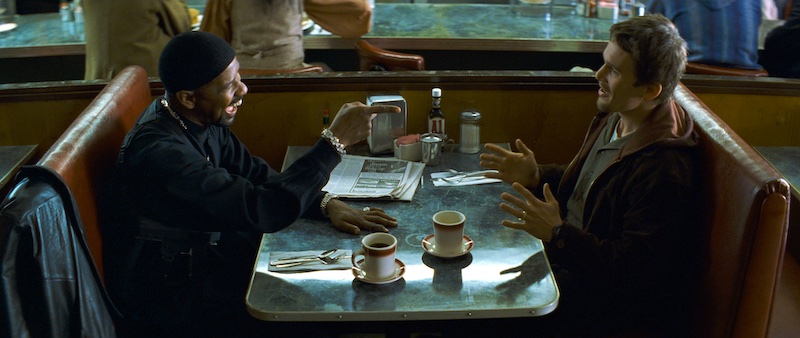
The cinematographer was Mauro Fiore [ASC], who has photographed seven films for Antoine Fuqua to date, including this one. The others are “Tears of the Sun” (2003), “The Equalizer” (2014), “Southpaw” (2015), “The Magnificent Seven” (2016), “The Equalizer 2” (2018) and “Infinite” (2021). In recent years, Fuqua has also worked with Robert Richardson.
Early in his career, Fiore was known above all for his connection with Janusz Kaminski. He was Kaminski’s gaffer on “Schindler’s List” (Steven Spielberg, 1993), and when Kaminski directed “Lost Souls” (2000), Fiore photographed the film. From that point onward, Fiore’s career became closely linked to action cinema, with films such as “Driven” (Renny Harlin, 2001), “The Island” (Michael Bay, 2005), “Smokin’ Aces” (Joe Carnahan, 2006), “The Kingdom” (Peter Berg, 2007) and “The A-Team” (Joe Carnahan, 2010).
Fiore is also widely known as the Academy Award-winning cinematographer of “Avatar” (James Cameron, 2009), a controversial case because Cameron’s film contained relatively little live-action footage in the traditional sense. Fiore was not brought back for “Avatar: The Way of Water” (2022) or “Avatar: Fire and Ash” (2025), both photographed by Russell Carpenter, a longtime Cameron collaborator.
Visual Style Analysis
I had never seen “Training Day,” despite its reputation, until the release of the 4K Blu-ray. That matters, because the new disc strongly suggests a serious case of later revisionism, or at least a significant alteration of the film’s original image. That impression is also supported by comparison videos between the new disc and the original 2006 Blu-ray.
In 2001, when the film was released, very few features were still being finished through a full Digital Intermediate. Photochemical processing and timing remained the more common workflow. In the following two or three years, that situation would change substantially; by 2005 or 2006, most Hollywood studio films were being finished digitally. “Training Day” was finished photochemically. Since, in a photochemical workflow, color decisions are applied to the interpositive, returning to the original camera negative requires a new color grade.
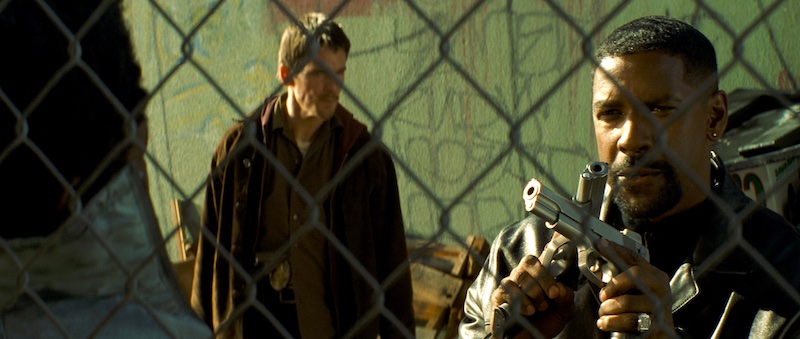
The 4K Blu-ray appears to come from a scan of the original 35mm negative, followed by a new color grade. The problem is that this new grade seems not to preserve, or perhaps not to prioritize, the original color. The result is very evident: strong green casts in daylight exteriors, extremely high contrast and very deep blacks. This does not quite correspond to what one would expect from a 2001 photochemical finish, especially with some of the equipment involved, including the lenses. What may once have been a relatively conventional urban thriller now has visual echoes of “Se7en” (David Fincher, 1995).

What can be judged directly, however, is an attractive image. Shot in 35mm anamorphic, “Training Day” is interesting because Fiore used Hawk C-Series lenses rather than the Panavision equipment more typical of this kind of American production. Their performance is generally strong, and it is difficult to imagine the final result being radically different had the film been shot, for instance, with classic Panavision C Series anamorphics.
In its current 4K incarnation, the film shows very high contrast and, above all, a teal-green cast typical of the digital color grades that would become common only a few years later. That makes the daylight section of the film — roughly two thirds of the running time, or slightly more — feel much more aestheticized than naturalistic.
During this daylight section, the filmmakers do not pursue an especially textured image. The negatives appear well exposed, clean and sharply defined, probably because the lenses were used around their optimal aperture range. Even the many car interiors are handled well and do not become visually repetitive, which is not simple in anamorphic. Anamorphic lenses usually have a longer minimum focus distance than conventional spherical lenses, making cramped car work more difficult.
There are clearly some inserts made with close-up lenses, others probably made with macro lenses, and some longer-lens shots that may have used an anamorphic zoom, such as the classic Angenieux HR 25-250mm T3.5, commonly adapted or used in anamorphic workflows of that period.
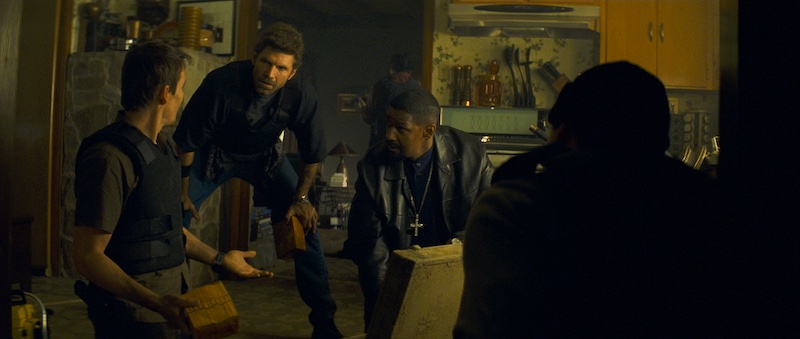
When night falls, the visual strategy changes. Fiore appears to work at wider apertures and allows more imperfection into the image. It is difficult to know exactly what was present in the original color timing, but the current version shows a strong combination of green and yellow, almost amber tones. That is somewhat unusual for a film of this period. Not because it was technically impossible, but because the more fashionable approach for night exteriors was often large blue sources, or sometimes a mercury-vapor look.
Here, Fiore seems to take a lower-profile route, closer to the idea of streetlight. The grade may be as intrusive and revisionist at night as it is during the day, but the effect is less immediately obvious to viewers who do not know the film’s original color.

Conclusion
The result is very solid cinematography, especially if one sets aside the possible controversy around the new color grade. I do not know first-hand exactly how the original color of “Training Day” looked in 2001. What appears in the 4K HDR presentation, however, is visually interesting and belongs clearly to the action cinema of its period. It has affinities with Paul Cameron’s work on “Gone in Sixty Seconds” (Dominic Sena, 2000) and “Swordfish” (Dominic Sena, 2001).
What is most interesting is the transition. The film moves from an aggressive, highly aestheticized daylight look, far from realism, to a night look that remains strong but becomes dirtier, darker and more dangerous. Whether that contrast comes from the original timing or from the new grade, it serves the story well.
The narrative itself follows Jake Hoyt’s loss of innocence. In the first half, he is still inexperienced, observing and reacting to Alonzo’s world. In the second half, once he understands the real nature of his situation, the film becomes harder and more immediately about survival. The image follows that descent effectively.
In any case, “Training Day” is well made, and it is easy to understand why it helped establish Mauro Fiore’s Hollywood career and why he and Antoine Fuqua continued to collaborate successfully afterward.
Viewed on 4K HDR Blu-ray
ON FILM & DIGITAL
© Ignacio Aguilar, 2026.
This article is part of ON FILM & DIGITAL’s English-language cinematography reviews and essays.
The Author
Ignacio Aguilar, AEC is a Spanish cinematographer based in Madrid. His work spans feature films, television, commercials and technical writing on cinematography, with experience in digital cinema, 16mm and 35mm film, anamorphic lenses, large-format digital capture and practical lens testing.
Read more articles and reviews in Spanish at ON FILM & DIGITAL, or visit the main cinematography portfolio at ignacioaguilardop.com.