

“Weapons”
Spanish Title: Weapons
Year of Production: 2025
Director: Zach Cregger
Director of Photography: Larkin Seiple
Lenses: ARRI/Zeiss Master Anamorphic, Zeiss Master Primes, Canon K35, Laowa Probe
Format and Aspect Ratio: ARRI Alexa 35 (ARRIRAW 4.6K), 2.39:1
Other: 4K Digital Intermediate
Viewed on: HDTV 4K HDR
Fragmented suspense, restrained anamorphic texture and low-light night work: Zach Cregger and Larkin Seiple build Weapons as a very controlled piece of visual horror.
The Film
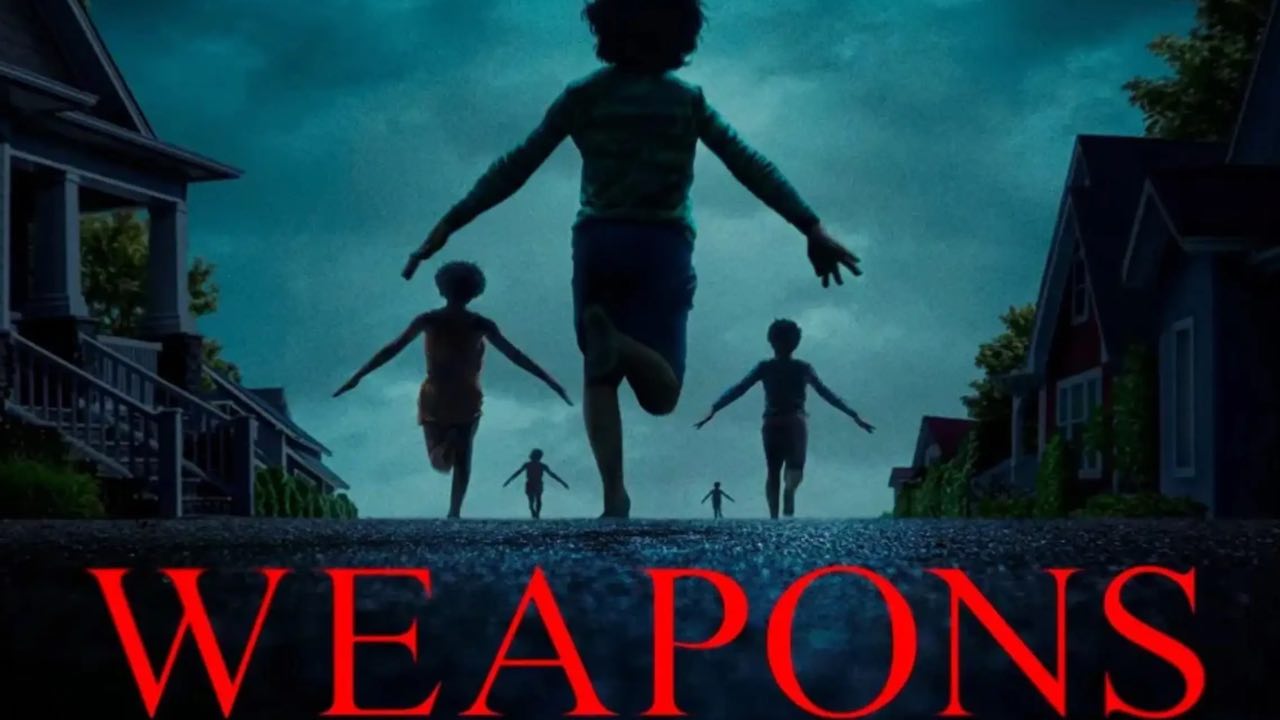
Zach Cregger’s second feature after “Barbarian” is another film built inside the territory of fantasy and horror. Its premise is simple and effective: seventeen children from the same classroom disappear from a small community. All but one leave their houses at exactly the same time, running in a straight line through the night.
The novelty is not only the mystery itself. Cregger has openly pointed to Paul Thomas Anderson’s “Magnolia” (1999) as an influence, and the film uses that idea of fragmentation to follow different characters in relation to the same event. At the same time, rather than simply offering alternate consequences or points of view, it keeps moving the plot forward with a tone that also has something in common with Denis Villeneuve’s “Prisoners” (2013).
The results are very strong. Weapons is an interesting and very well-directed film, capable of producing effective scares and building toward a climax that will likely satisfy many horror viewers. Julia Garner, Josh Brolin, Alden Ehrenreich, Austin Abrams and Amy Madigan — in the film’s most striking role — lead the cast.

The Cinematographer
The cinematographer was Larkin Seiple, best known for his work on the surprise multi-Oscar winner “Everything Everywhere All at Once” (Daniel Kwan & Daniel Scheinert, 2022). Seiple began his career in the lighting department, working as an electrician and gaffer before moving into cinematography through music videos, a field in which he has been very active over the last fifteen years.
His feature work includes “Cop Car” (Jon Watts, 2015, shared credit), “Swiss Army Man” (Daniel Kwan & Daniel Scheinert, 2016), “Bleed for This” (Ben Younger, 2016) and “Wolfs” (Jon Watts, 2024), starring George Clooney and Brad Pitt. He has also photographed episodes of series such as “Gaslit” (2022) and “Beef” (2023).

Visual Style Analysis
Weapons is a sober and, by all appearances, carefully prepared piece of work. Among its references, it seems closer to “Prisoners” — perhaps Roger Deakins’ finest work — than to “Magnolia.” What it takes from Anderson’s film is, above all, the widescreen anamorphic frame. Here, however, that format is created digitally with the ARRI Alexa 35 and ARRI/Zeiss Master Anamorphic lenses.
Within the wide range of anamorphic lenses currently available, the Master Anamorphics are probably among the most controlled. Their “anamorphic look” is present but never aggressive. They breathe very little, flare very little and show almost no visible distortion. That makes them a logical choice for a film that wants width and tension without allowing the optics to dominate the image.
Even so, not everything in the film appears to be anamorphic. Some isolated shots are spherical, especially the numerous zoom shots used throughout the movie. One specific section, centered on James (Austin Abrams), was also shot in spherical format with Canon K35 lenses, in addition to other brief moments using Zeiss Master Primes.
The change is relatively subtle and does not seem to announce a precise narrative rule. But it is not especially surprising, considering that “Everything Everywhere All at Once” changed lenses almost from scene to scene. Here, thanks to very strong color and postproduction work, the shifts are largely minimized. The tone, contrast and sharpness remain within the same visual family, so the integration feels almost invisible.

Perhaps the strongest aspect of Weapons is the way Cregger directs it. The film is a lesson in how to generate suspense and fear through staging: long takes, point-of-view shots, carefully held frames and a strong sense of visual coherence. It even opens with a number of slow-motion shots, all of them well judged. Elsewhere, the film uses zooms, tracking shots and other movements with a very precise sense of timing.
Seiple’s lighting does not exactly resemble “Prisoners,” which is even darker and more deeply fused with the emotional state of its characters. But Weapons does share some of that film’s solemnity. It is clearly a low-key photographic approach, making strong use of the speed of the Master Anamorphics (T1.9) and of the ARRI Alexa 35’s Enhanced Sensitivity modes.
The whole film seems to have been shot at very low light levels, with a degree of realism. Yet, on closer inspection, much of that soft light justified through windows, or those exposures held toward the outside while interiors remain dark, are the result of deliberate cinematographic control. Seiple generally avoids obvious artifice and lets the lighting feel motivated by the spaces.

The color palette is relatively muted, which again connects the film to Villeneuve’s movie, and the night scenes are especially notable. In the exterior streets where the children run away, the image is built from small accents of light placed here and there, sometimes supported by a larger backlight from a crane. In the interiors, the work often relies on practical sources.
The house of Julia Garner’s character is a good example. So are the wall lights at the entrance of Alex’s house, the only child in the class who does not disappear. These scenes show the extraordinary performance of the Alexa 35 under almost insignificant light levels.
In the day interiors, the image is relatively contrasty, at least in terms of lighting. But the grade appears to lift the black level slightly, giving it a more grayish quality. Perhaps this connects to the fact that the filmmakers considered shooting on 35mm and even made tests with actors. In any case, that lifted black level softens the contrast and gives the image a more cinematic, almost filmic quality on the big screen.

Final Thoughts
What is more debatable is that some of the blue, very soft night scenes move in the opposite direction. They are much less contrasty, with the black level pushed even higher. Within an otherwise very convincing visual design, those moments are the ones that raise the most questions.
Still, the results are very good. From the staging — this is one of those films where nearly every directorial choice seems to have a clear purpose — to the lighting, Weapons is a very accomplished piece of visual work. Even if the climax contains a few moments that feel slightly less controlled, the film creates a first-rate look: modern, visually attractive and, when required, genuinely frightening.
ON FILM & DIGITAL
© Ignacio Aguilar, 2025. Revised in 2026.
This article is part of ON FILM & DIGITAL’s English-language cinematography reviews and essays.
The Author
Ignacio Aguilar is available for cinematography work, creative collaborations, lectures, workshops and international projects. He is a Sony Independent Certified Expert (ICE) and Cooke Optics Spanish Ambassador for Cooke SP3 lenses. Contact here.