


“Gladiator II”
Spanish Title: Gladiator II
Year of Production: 2024
Director: Ridley Scott
Director of Photography: John Mathieson, BSC
Lenses: Angenieux EZ, Panaspeed, Optica Elite
Format and Aspect Ratio: ARRI Alexa Mini LF, ARRIRAW 4.5K, 2.4:1
Other: 4K Digital Intermediate
John Mathieson’s cinematography for Gladiator II still shows flashes of craft, but it is constantly pushed against Ridley Scott’s multicamera method, a heavy digital finish and a spectacle increasingly built around CGI rather than physical staging.
The Film
Gladiator II is a direct sequel to Gladiator (Ridley Scott, 2000), continuing the story more than a decade after the events of the original film. A man named Lucius (Paul Mescal) is enslaved in North Africa after watching the Roman army invade and destroy his city. He is taken to Rome and forced to fight as a gladiator, initially driven by revenge against the Roman general who led the assault, Marcus Acacius (Pedro Pascal).
That premise soon becomes entangled with the legacy of the first film. Lucius is revealed to be the son of Lucilla (Connie Nielsen), daughter of Emperor Marcus Aurelius, and his personal desire for revenge is folded into a larger political conflict against the corrupt young emperors Geta and Caracalla (Joseph Quinn and Fred Hechinger). The most alert presence in the film is Denzel Washington as Macrinus, an ambitious gladiator trainer who seems to understand the tone of the movie more clearly than anyone else on screen.
The result is a deeply disappointing sequel. It misses Russell Crowe’s gravity and Hans Zimmer’s musical force, but the larger problem is structural. David Scarpa’s screenplay and Scott’s direction rarely give the material the dramatic weight, narrative focus or physical conviction that the original film had, even with all its own weaknesses. Gladiator II is not merely less moving than its predecessor. It often feels less believed in by the people making it.

The Cinematographer
The cinematographer was once again the British director of photography John Mathieson, BSC. Mathieson made his major breakthrough with Ridley Scott on the first Gladiator, and later worked with him again on Hannibal (2001), Matchstick Men (2003), Kingdom of Heaven (2005) and Robin Hood (2010). After that, Scott’s feature work became almost entirely associated with Dariusz Wolski, who had previously photographed Crimson Tide and The Fan for Tony Scott.
Mathieson’s work on the original Gladiator made him one of the major cinematographers of that awards season, and he later received another Oscar nomination for The Phantom of the Opera (Joel Schumacher, 2004). His later career has been more uneven, but rarely without craft. He has often worked on commercial films of considerable technical complexity, including X-Men: First Class (Matthew Vaughn, 2011), 47 Ronin (Carl Erik Rinsch, 2013), The Man from U.N.C.L.E. (Guy Ritchie, 2015), King Arthur: Legend of the Sword (Guy Ritchie, 2017), Logan (James Mangold, 2017), Doctor Strange in the Multiverse of Madness (Sam Raimi, 2022) and Jurassic World: Rebirth (Gareth Edwards, 2025).
That makes his return to Scott especially interesting. On paper, Gladiator II reconnects Mathieson with the film that defined his international reputation. In practice, however, it also places him inside a very different production culture: large-format digital capture, extensive multicamera coverage, a very fast directorial method and a much heavier dependence on visual effects.
Visual Style Analysis
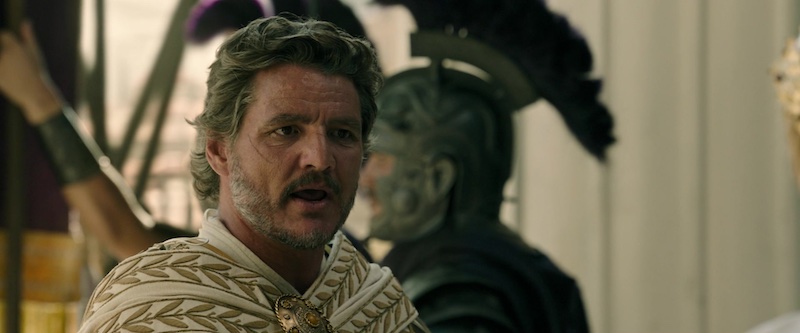
Since moving into digital cinematography with Prometheus (2012), his first feature with Dariusz Wolski, Ridley Scott has not returned to photochemical capture. The reasons are easy to understand. Digital cameras give him speed, immediate feedback and a more flexible way of working with multiple cameras. Scott has always liked multicamera shooting, even from his earliest films, but in his later digital period that method has become more dominant.
The problem is that multicamera coverage now often seems to replace traditional shot design. Instead of building a scene around a precise sequence of chosen angles, Scott appears to choreograph the action in front of three, four or five cameras and then let the coverage accumulate. This can create energy. It can also create a sense that the scene is being captured rather than truly staged.
The method has direct consequences for cinematography. A scene can only be lit ideally from one principal angle. Once several cameras are shooting at the same time, every additional angle becomes a compromise. The key light, the backlight, the direction of the practicals, the negative fill, the shape of the faces and even the exposure strategy all have to serve more than one camera position. That does not automatically make the photography bad, but it changes its nature. It becomes less sculptural and more managerial.
That seems to be one of the central issues in Gladiator II. The film often feels as if it has been organized in real time, almost like a broadcast of large-scale action, rather than constructed from a controlled visual plan. The lighting carries the same burden. Mathieson can still shape individual moments, but the overall image is repeatedly conditioned by simultaneous coverage, zoom work, visual effects and the need to keep the production moving.
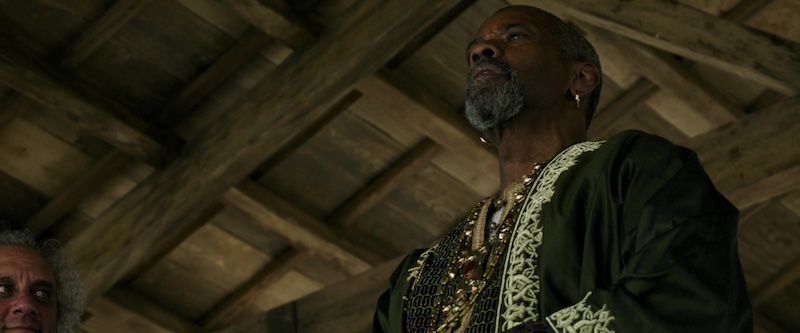
The other major difference from the first film is the amount and nature of the digital imagery. The visual effects in Gladiator were not flawless, but they were usually used with some restraint: wide views of Rome, extensions of the Colosseum, crowd multiplication, removals and additions. In Gladiator II, the digital layer is far more pervasive. More importantly, it frequently replaces the physical action, choreography and staging that gave the first film its more tactile quality.
The opening battle is a good example. Instead of the forest battle that opened the first film, Scott stages a naval assault against a walled coastal city. In theory, the idea is ambitious. In practice, much of the image appears to be built in post-production, with the actors inserted into environments that rarely feel physically present. The sequence announces the film’s largest visual problem very early: scale is everywhere, but weight is often missing.
That impression continues through the arena material, whether the film is dealing with monkeys, a rhinoceros or the Colosseum naumachia with sharks. The issue is not simply that the film was shot digitally. A photochemical texture might have helped counter the cleanliness and hardness of the digital finish, but the deeper problem is the constant sensation that the action and the world around the actors are being generated rather than staged. Compared with this sequel, even the weakest digital moments of the original Gladiator now feel comparatively artisanal.

None of this means that Mathieson has forgotten how to light. The better passages in Gladiator II make the opposite clear. What happens is that his work is heavily subordinated to Scott’s shooting method and to the visual-effects pipeline. That dependence seems to extend even to faces. Connie Nielsen, for example, sometimes appears digitally softened or retouched, and sometimes does not. The inconsistency is distracting because it turns the human face itself into part of the post-production surface.
In the Colosseum, Mathieson clearly tries to echo the look of the first film. In exteriors, he shoots backlit whenever possible, searching for the same kind of separation, dust and sculptural edge that made the original feel more physical. But he is often at the mercy of digital armies, digital backgrounds and sometimes even digital light. The final sequence is especially revealing in that sense: it has the scale of spectacle, but very little of the material conviction that would allow that spectacle to land.
The cinematography works best in interiors, where Mathieson can still impose shape on the space. Some Roman interiors use large hard sources to project shafts of sunlight, giving the architecture weight and depth. Other interiors, especially those shot in Malta, use a combination of torchlight and moonlight that recalls the first Gladiator more successfully. In these scenes, one can still see the cinematographer’s hand: hard light, atmosphere, modeled faces, warm practical fire and cooler ambient separation.
But there is not enough of that control across the film. The zooms, the simultaneous camera positions and the constant replacement of physical elements by digital ones dilute the cinematography. At its best, it is competent and occasionally handsome. At its weakest, it feels like a reduced version of Mathieson’s earlier work with Scott, filtered through a production method that gives him limited authority over the final image.
The flashbacks do not help. They are aggressively desaturated and offer little visual nuance beyond their obvious function as memory. The day-for-night material is also unconvincing, often looking more like underexposed or graded daylight than actual night. These passages contribute to the impression that Mathieson had limited control over the final look, especially once the image passed through visual effects, grading and the broader machinery of a very large production.
Conclusion
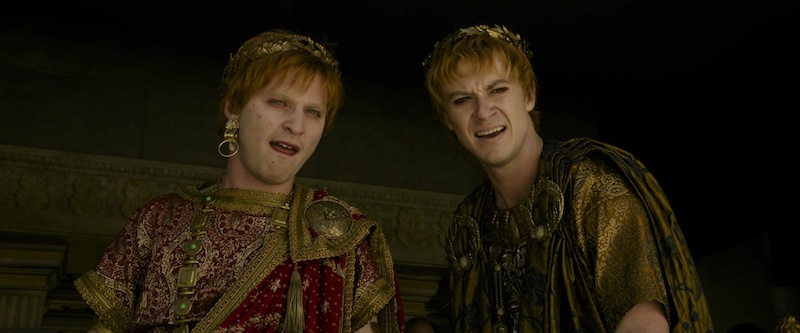
Gladiator II spends an enormous amount of money on a story that rarely feels dramatically inevitable. It is directed by a filmmaker who, at eighty-seven at the time of the film’s release, remains a remarkable figure in film history, but who here seems far removed not only from the masterpieces that built his reputation — The Duellists, Alien, Blade Runner, Thelma & Louise — but also from the more uneven films in which his visual imagination still gave entire worlds a strong and specific presence.
Here, the dominant impression is different. The film often seems driven by the act of shooting itself: shoot quickly, shoot from many angles, accumulate coverage, build the rest later. That can be a valid industrial method, but in this case it produces a strange paradox. Gladiator II is larger than the original in scale, yet smaller in physical conviction. It has more digital spectacle, but less visual authority.
For John Mathieson, the film is therefore a compromised return. There are still passages where his craft is visible, especially in interiors and in the attempts to recover the backlit atmosphere of the first Gladiator. But the cinematography is finally trapped between multicamera pragmatism and CGI expansion. The result is not without professional moments, but it rarely feels fully authored. It is a big film with an oddly unstable image, and that instability is one of the clearest symptoms of the sequel’s failure.
Viewed on 4K HDR Blu-ray
ON FILM & DIGITAL
© Ignacio Aguilar, 2026.
This article is part of ON FILM & DIGITAL’s English-language cinematography reviews and essays.
These texts are not plot summaries or general film reviews, but cinematography-focused essays written from the perspective of a working cinematographer.
The Author
Ignacio Aguilar is available for cinematography work, creative collaborations, lectures, workshops and international projects. He is a Sony Independent Certified Expert (ICE) and Cooke Optics Spanish Ambassador for Cooke SP3 lenses. Contact here.