


“Prisoners”
Spanish Title: Prisioneros
Year of Production: 2013
Director: Denis Villeneuve
Director of Photography: Roger Deakins, ASC, BSC
Cameras: Arri Alexa Studio, Arri Alexa Plus
Lenses: Arri/Zeiss Master Primes
Capture: ArriRaw 2.8K (2880 × 1620)
Format and Aspect Ratio: Digital spherical, 1.85:1
Awards: Academy Award for Best Cinematography (nomination), American Society of Cinematographers Award (nomination)
Viewed on: DCP
A story this harrowing demanded an image that was cold, austere and naturalistic. Roger Deakins answers with cinematography of extraordinary precision, pushing darkness to the edge while remaining completely at the service of the drama.
The Film
Prisoners begins with the disappearance of two young girls on Thanksgiving. Their families — Hugh Jackman, Maria Bello, Terrence Howard and Viola Davis — watch helplessly as the police, and the detective assigned to the case, played by Jake Gyllenhaal, fail to obtain a confession from the principal suspect, played by Paul Dano: a man with an intellectual disability who lives under the care of his aunt, played by Melissa Leo.
The situation develops into a spiral of morally questionable decisions and an increasingly uncertain outcome. Working from an exceptionally solid screenplay by Aaron Guzikowski, Canadian director Denis Villeneuve makes a memorable American debut, draws excellent performances from the cast and handles an extremely harsh and violent story with exemplary control, without giving in to the excess or mannerism that the material could easily have invited.
The result is outstanding. Apart from a few isolated details or narrative turns, Prisoners is an extraordinarily complete film, the kind that remains in the viewer’s memory long after it ends.
The Cinematographer
Villeneuve may have been making his first American feature, but he did so in the best possible company: British cinematographer Roger Deakins, ASC, BSC, who had already been based in North America for more than two decades. By the time of Prisoners, Deakins was widely regarded as one of the leading cinematographers of his generation. He had accumulated ten Academy Award nominations and three competitive awards from the American Society of Cinematographers, as well as the Society’s Lifetime Achievement Award, among many other honors.
In addition to photographing almost every Coen brothers feature since 1991, Deakins had worked with many of the most prominent filmmakers in North America, including Frank Darabont, Martin Scorsese, Ron Howard, M. Night Shyamalan, Paul Haggis, Norman Jewison and Sam Mendes. One striking feature of his career is how consistently strong the material has been: Deakins’ filmography repeatedly places his cinematography inside films that are already dramatically and formally ambitious.
Visual Style Analysis
Prisoners was Deakins’ third feature photographed digitally with the Arri Alexa, after In Time (2011) and Skyfall (2012). He used Alexa Studio and Alexa Plus cameras with Arri/Zeiss Master Primes, recording ArriRaw at 2880 × 1620. The Master Primes were particularly important because the film repeatedly enters extremely low-light territory. Deakins generally rated the Alexa at EI 800, moved to around 1250 for most night exteriors and used EI 1600 for the darkest sequences.
Technically, the image is superb: crisp and highly resolved, with ample latitude, deep blacks and strong contrast while remaining remarkably clean even in the many night scenes and interiors photographed at very low light levels. The digital format never becomes the subject of the photography; it simply gives Deakins the exposure range and monitoring confidence required to work at levels that would once have involved a much greater degree of uncertainty.
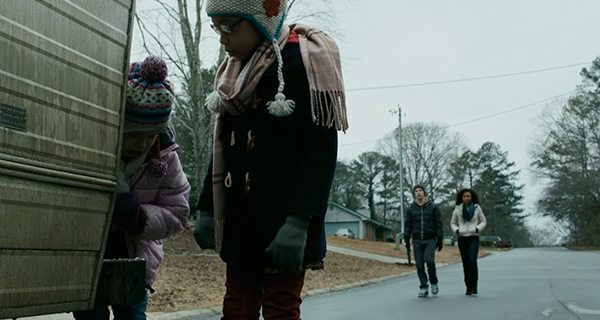
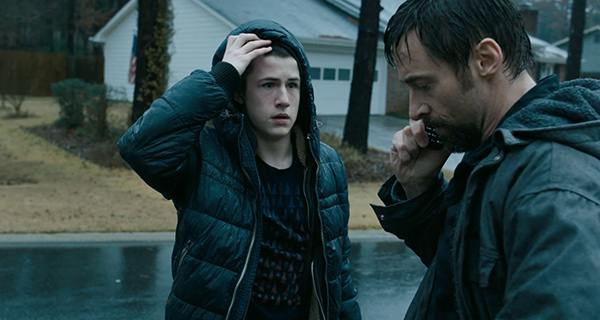
As usual, Deakins approaches the story from a minimalist, simple and naturalistic foundation. A narrative as painful as Guzikowski’s demanded a cold visual treatment, and Villeneuve and Deakins repeatedly place the characters beneath overcast, bluish skies, often in rain and occasionally in snow. The atmosphere recalls some of the restraint of Fargo (1996), another of Deakins’ great achievements, although here the emotional weight is considerably darker.
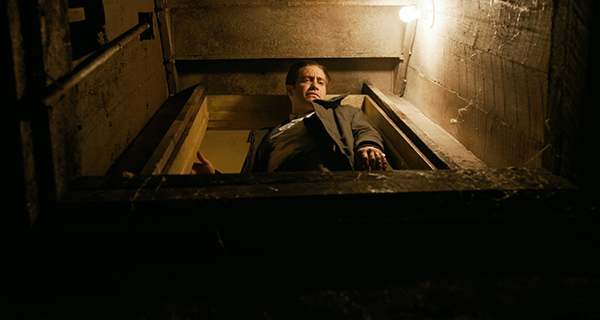
The strength of the cinematography does not lie primarily in how beautiful or impressive the images are — although they frequently are both — but in the economy of means Deakins applies whenever he actually has to light a space. The photography rarely announces its technique. Instead, the lighting is designed to feel as though it belongs naturally to the locations and to the emotional pressure of the scene.
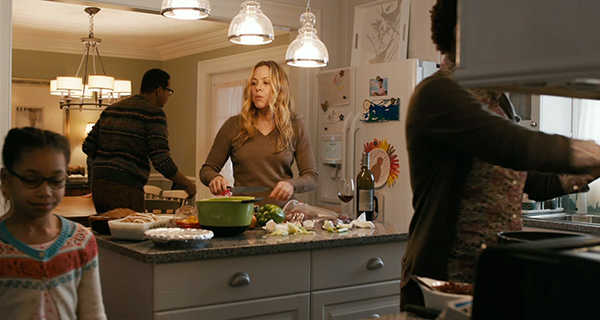
The day interiors are consistently motivated through the windows. On wider shots, Deakins can use very large sources outside the location; as the camera moves closer, softer units can be brought close to the actors, sometimes just outside the frame, while preserving the same apparent direction of light. The result is high contrast that feels inherent to the photographed space rather than imposed later as a stylistic layer.
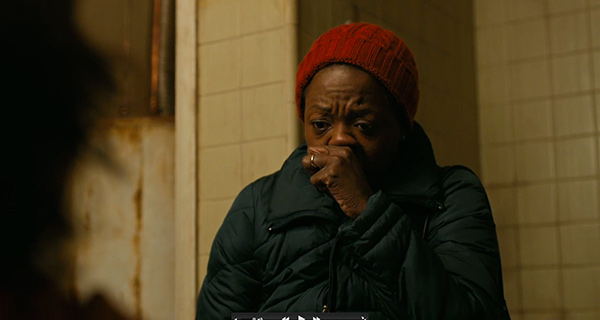
Warm artificial sources occasionally enter through table lamps or wall fixtures, not to imitate daylight but to complement it. In the police-station material, the integrated fluorescent fixtures naturally become the dominant source. The image may be less immediately seductive there, but the approach is entirely consistent with Deakins’ refusal to introduce a more flattering or conspicuously cinematic light when the location itself provides the correct visual logic.
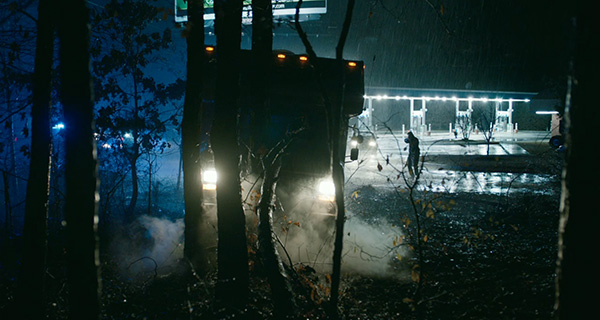
The night work is where Deakins pushes the approach furthest. Interiors are often built around a single practical source — a table lamp, wall fixture or flashlight — while the exteriors operate at extremely low levels and are usually anchored by a believable source within the environment. The sequence around the RV is a perfect example. Rather than inventing conventional moonlight, Deakins chose a gas-station location that could provide a bright practical island inside a much larger field of darkness, then extended that logic with carefully concealed additions.
The candlelight vigil takes the same principle even further. Deakins rated the Alexa at EI 1600 and allowed the candles to remain the principal visual source, supplementing them discreetly with hidden practical-level fixtures. The result is not merely technically impressive. It feels credible, fragile and oppressive, because the lighting never seems to arrive from outside the world of the scene.
Across these sequences, the combination of strong contrast, limited depth of field and extremely low illumination remains exceptionally controlled. Focus is precise, the image stays clean and the darkness is allowed to occupy real portions of the frame rather than being filled simply to preserve information. Two moments stand out in particular: the candlelit night exterior and the near-final sequence with Jake Gyllenhaal driving desperately through the rain, where technique, exposure and dramatic intensity become almost inseparable.

Villeneuve’s camera is frequently static and remains restrained even in scenes of action or suspense. Deakins, who continued to operate the camera himself, and Villeneuve deliberately avoided using camera movement to manufacture tension that was already present in the writing and performances. The film generally favors medium focal lengths, around 35 to 50mm, creating a consistent perspective and a point of view that feels observational rather than distorted or emphatic.
Conclusion
The film therefore displays the technical refinement that has characterized Deakins’ work for decades, but more importantly, that technique is perfectly aligned with the story. The cinematography shades and intensifies the drama when necessary while remaining grounded in a simple, naturalistic language that never tries to become intrusive, decorative or self-consciously beautiful.
What makes Prisoners especially striking is the extent to which the strength of the script, Villeneuve’s direction and the performances seem to encourage Deakins to push his usual restraint even further. Digital monitoring and the Alexa’s low-light capability gave him the confidence to let significant areas of the frame fall into darkness, but the risk is never technological for its own sake: the darkness becomes part of the film’s moral and emotional architecture.
Prisoners is not simply the work of one of the most accomplished cinematographers of modern cinema; it is one of the strongest demonstrations of Deakins’ ability to make technical sophistication disappear into a film. The images are precise, austere and often beautiful, yet their real achievement is how completely they serve the tension, ambiguity and emotional violence of the story. The film went on to earn Deakins another Academy Award nomination for cinematography.
ON FILM & DIGITAL
© Ignacio Aguilar, 2013. Revised in 2026.
This article is part of ON FILM & DIGITAL’s English-language cinematography reviews and essays.
These texts are not plot summaries or general film reviews, but cinematography-focused essays written from the perspective of a working cinematographer.
The Author
Ignacio Aguilar, AEC is a cinematographer / director of photography based in Madrid, Spain. His work spans feature films, television, commercials and technical writing on cinematography, with experience in digital cinema, 16mm and 35mm film, anamorphic lenses, large-format digital capture, lens testing and film-based workflows.
He is a member of the Spanish Society of Cinematographers (AEC) and the Spanish Academy of Cinema, a Sony I.C.E. Certified Expert and a Cooke SP3 ambassador. His writing has appeared in American Cinematographer and Camera & Light, and ON FILM & DIGITAL gathers his bilingual essays, technical guides and cinematography reviews.
For professional work, collaborations, lectures, workshops or cinematography consulting, visit his professional biography, selected works or contact page.
The Spanish-language archive is available at ON FILM & DIGITAL.