


“The Good Shepherd”
Spanish Title: El buen pastor
Year of Production: 2006
Director: Robert De Niro
Director of Photography: Robert Richardson, ASC
Lenses: Panavision Primo and Ultra Speed MkII
Film Stocks: Kodak VISION2 5212 (100T), 5217 (200T) and 5218 (500T)
Format and Aspect Ratio: 3-perf Super 35, 2.40:1
Post-production: Digital Intermediate
Awards: ASC Award (nomination)
Viewed on: 35mm & Blu-ray
Robert Richardson turns a chilly espionage drama into one of his richest, most sophisticated and most personal works.
The Film
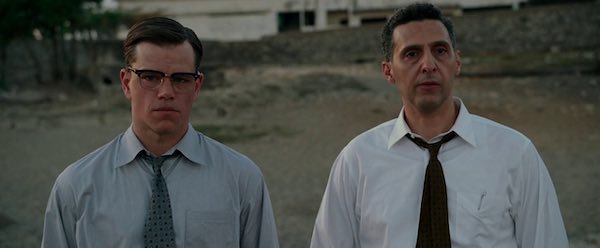
In his second feature as director, Robert De Niro takes a small supporting role and traces two periods in the life of Edward Wilson (Matt Damon). In the 1940s, he is recruited for covert wartime operations; in the later timeline, he is an established CIA officer dealing with the aftermath of the failed Bay of Pigs invasion. The film moves between these stages of his career to trace the agency’s early history and the compromises demanded by a life in intelligence.
“The Good Shepherd” is almost as cold and remote as its protagonist, a man more at ease on a clandestine assignment than at home with his wife (Angelina Jolie) and son (Eddie Redmayne). Yet for all the plot’s complexity, the storytelling flows remarkably well. Its scale and production resources help make that early CIA world convincing. Alec Baldwin, William Hurt, Tammy Blanchard, Keir Dullea, Billy Crudup, Joe Pesci, Michael Gambon, Timothy Hutton and John Turturro populate a world of spies, shifting loyalties and betrayal.
The Cinematographer
With a substantial budget and relatively little experience directing, De Niro made a natural choice in Robert Richardson, ASC. De Niro’s strengths seemed more likely to lie in working with actors than in visual staging; Richardson brought formidable experience with Martin Scorsese and Oliver Stone. De Niro also knew his work firsthand from “Casino” (1995).
If Richardson has a particular specialty, it is finding a visual language for America’s recent past. He had already done so brilliantly for Stone on “Born on the Fourth of July” (1989) and “JFK” (1991), the latter bringing him his first Oscar. His second came for Scorsese’s “The Aviator” (2004), made shortly before “The Good Shepherd.” He would later revisit period filmmaking in the psychological thriller “Shutter Island” (2010), then win a third Oscar for “Hugo” (2011). His collaborations with Quentin Tarantino, from “Kill Bill: Vol. 1” (2003) onward, form another major part of his career: “Kill Bill: Vol. 2,” “Inglourious Basterds,” “Django Unchained,” “The Hateful Eight” and “Once Upon a Time… in Hollywood” all bear his unmistakable stamp.
Visual Style Analysis
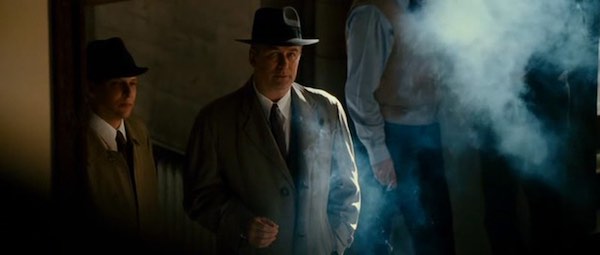
As on “The Aviator,” Richardson chose Super 35 rather than anamorphic photography, using spherical Panavision Primos alongside the older Ultra Speed MkII series. Those faster lenses seem a likely choice for the initiation sequences, which are shot at very low light levels.
Richardson was then exploring what a Digital Intermediate could offer. Beyond its flexibility in shaping color, the process allowed Super 35 footage to reach anamorphic release prints without a conventional optical blow-up. That mattered because, for a widescreen image, Super 35 uses substantially less negative area than anamorphic 35mm. An optical enlargement made the grain more conspicuous; scanning, grading and recording back to film offered a different route to the theatrical print.
The 35mm prints I saw, however, had conspicuous artifacts that looked like digital noise reduction, as if the grain had been deliberately suppressed in post. Those issues were far less obvious in HD. I had noticed similar problems in other Technicolor DIs of the period, although I cannot say exactly what caused them. Richardson’s earlier use of 100-speed stocks, on several films in the late 1980s and early 1990s, is worth remembering here: grain was not always something he wanted to emphasize.
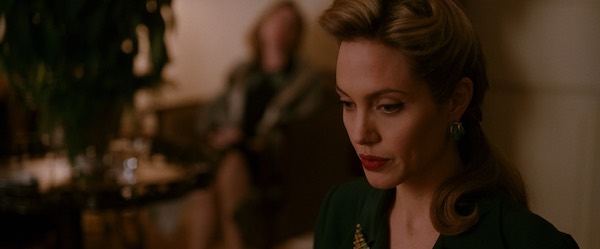
For all those reservations about the finish, this is one of Richardson’s most interesting and richly conceived films. Perhaps De Niro gave him considerable creative freedom; whatever the working arrangement, the images bring together his strengths, preferences and even his excesses. Some of those supposed excesses are better understood as the marks of a highly individual sensibility.
The staging is methodical and the compositions carefully worked out. Richardson’s contribution is especially tangible in the framing: whenever possible, he operates the camera himself. The lighting, meanwhile, frequently departs from strict realism. Backlight, rim light and his celebrated overexposed pools of top light, falling across tables and other surfaces, build a far more elaborate image than straightforward naturalism would require.
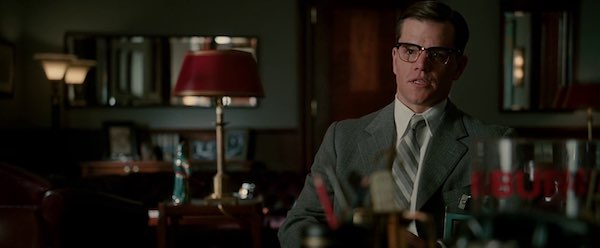
These off-camera sources interact with numerous practical lamps, which also contribute to the illumination within the frame. The result is intricate and sophisticated, but never merely decorative. Combined with the handling of sunlight in the exteriors and the careful choice of time of day, the lighting makes the film a superb example of period cinematography: images that transport us into the past through a distinctive visual sensibility and, in many scenes, a palpable sense of nostalgia.
Spherical lenses, lens speed and texture
For more on lens characteristics and the use of different lens families, see the Cinema Lenses Guide: Spherical, Anamorphic and Full Frame.
Conclusion
Richardson draws on other familiar tools for period filmmaking, too: Pro-Mist-type diffusion that gives highlights a halo and softens the image, and glorious backlighting in the wartime European night scenes. The result is one of his finest achievements. In a career as distinguished as his, that is saying a great deal. “The Good Shepherd” is essential viewing for its cinematography.
The taste, detail and assurance of the images are remarkable in a film by a director with so few features behind him. It is tempting to see this as Richardson working with unusual freedom, but that remains a hypothesis, not a documented account of De Niro’s instructions. What is beyond doubt is the talent and personality on display, shaped to serve the film and its director.
The film’s mixed critical reception may have cost Richardson another Oscar nomination. His peers at the ASC did recognize the achievement, nominating him for the feature-film award. Whatever the awards record, this is a major work in a career already full of them.
ON FILM & DIGITAL
© Ignacio Aguilar, 2021. Revised in 2026.
This article is part of ON FILM & DIGITAL’s English-language cinematography reviews and essays.
These texts are not plot summaries or general film reviews, but cinematography-focused essays written from the perspective of a working cinematographer.
The Author
Ignacio Aguilar, AEC is a cinematographer / director of photography based in Madrid, Spain. His work spans feature films, television, commercials and technical writing on cinematography, with experience in digital cinema, 16mm and 35mm film, anamorphic lenses, large-format digital capture, lens testing and film-based workflows.
He is a member of the Spanish Society of Cinematographers (AEC) and the Spanish Academy of Cinema, a Sony I.C.E. Certified Expert and a Cooke SP3 ambassador. His writing has appeared in American Cinematographer and Camera & Light, and ON FILM & DIGITAL gathers his bilingual essays, technical guides and cinematography reviews.
For professional work, collaborations, lectures, workshops or cinematography consulting, visit his professional biography, selected works or contact page.
The Spanish-language archive is available at ON FILM & DIGITAL.