

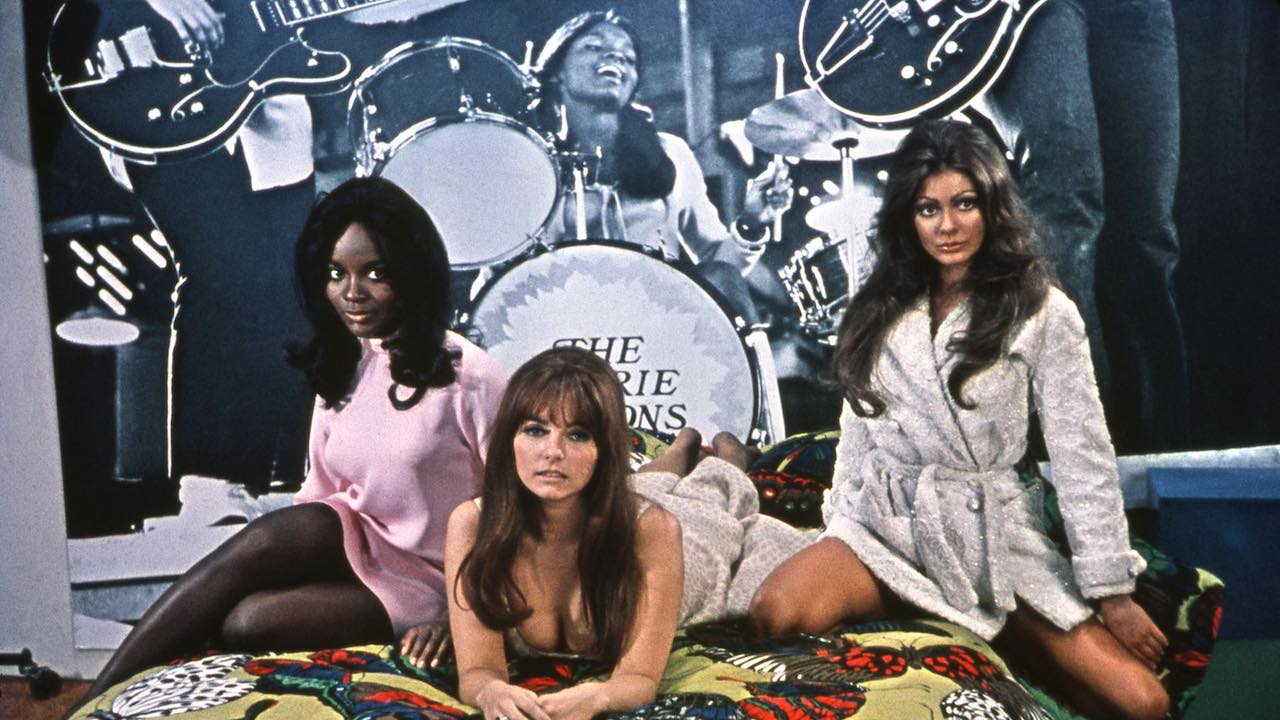
Beyond the Valley of the Dolls (1970) – Cinematography by Fred Koenekamp, ASC
“Beyond the Valley of the Dolls”
Spanish Title: El Valle de los Placeres
Year of Production: 1970
Director: Russ Meyer
Director of Photography: Fred J. Koenekamp, ASC
Lenses: Panavision C Series, Angénieux zoom
Film Stock: Kodak 5254 100T
Format and Aspect Ratio: 35mm anamorphic Panavision, 2.35:1
Viewed on: Blu-ray
Fierce satire, studio sets and artificial glamour: Fred J. Koenekamp turns Russ Meyer’s film into a glossy visual simulation of old Hollywood.
The Film
An unusual 20th Century Fox production, Beyond the Valley of the Dolls placed erotic filmmaker Russ Meyer in charge of what was, in effect, a more explicit and more deranged variation on Valley of the Dolls (Mark Robson, 1967). This time, the story follows three young women — played by Dolly Read, Cynthia Myers and Marcia McBroom — who arrive in Hollywood looking for fame. What they find instead is a path of drugs, sex, betrayal and violence.
The plot is as stiff and melodramatic as the original. Meyer and screenwriter Roger Ebert — the future celebrated film critic — approach it as satire, almost mocking the very model the film is supposed to extend. The results are often entertaining, sometimes sharp, and inevitably uneven. Its erotic content has always been part of its reputation. But the violence is just as striking, and in some ways more aggressive. The film was a major success despite its original X rating. Its controversy, however, made it difficult for Fox, or any other major studio, to continue in that direction.
The Cinematographer
The cinematographer was Fred J. Koenekamp, ASC, one of the most visible American directors of photography of the 1970s. Much of his reputation came through his association with Franklin J. Schaffner. For him, Koenekamp photographed Patton (1970), Papillon (1973) and Islands in the Stream (1977). He received Oscar nominations for Patton and Islands in the Stream, and won for The Towering Inferno (1974), sharing the credit with Joseph Biroc. On that film, Koenekamp photographed the main unit directed by John Guillermin.
He also worked again for producer Irwin Allen on the much less successful The Swarm (1978) and When Time Ran Out… (1980). Koenekamp was a highly versatile professional. He could photograph a melodrama such as The Champ (Franco Zeffirelli, 1979), a horror film like The Amityville Horror (Stuart Rosenberg, 1979), or a cult fantasy such as The Adventures of Buckaroo Banzai Across the 8th Dimension (W.D. Richter, 1984). He was equally at home on a military action film like Flight of the Intruder (John Milius, 1991). But his visual language remained essentially classical. That was both his strength and, later, his limitation.
By the 1980s, Koenekamp’s style had begun to look dated. He had emerged from television, and in the final phase of his career he largely returned to it. His cinema work became only occasional. He remained attached to hard light, controlled faces, clean separation and a fully lit image, long after Hollywood cinematography had moved toward softer, more motivated and more naturalistic approaches. In a sense, he did not evolve with the visual revolution of the 1970s. He continued to photograph as if movies should look unmistakably like movies.
Visual Style Analysis
That is precisely why Beyond the Valley of the Dolls works so well visually. In 1970, Koenekamp was still relatively young — forty-eight at the time — but his style already belonged to an earlier tradition of color cinematography. He seemed to be extending the methods of the 1950s and 1960s into a new decade. For many films, that would soon become a problem. Here, it becomes part of the joke.
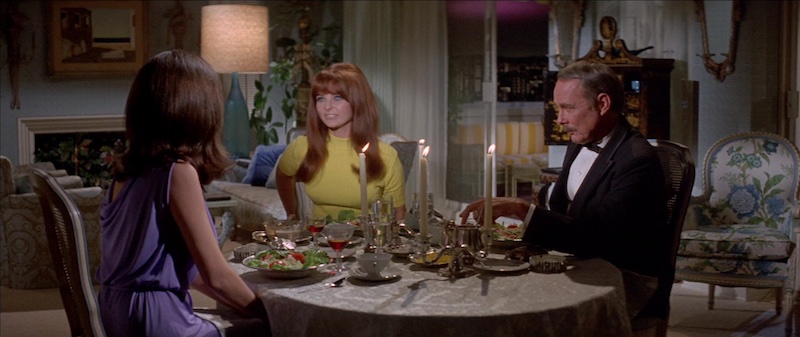
Koenekamp’s philosophy is the opposite of naturalism. He does not try to hide the lighting. Nor does he try to imitate available light with documentary restraint. His images are arranged, lit and presented. The light is hard, directed and often unapologetically artificial. The faces are cleanly modeled. The backgrounds are readable. The colors are strong. The whole frame announces that it has been manufactured.
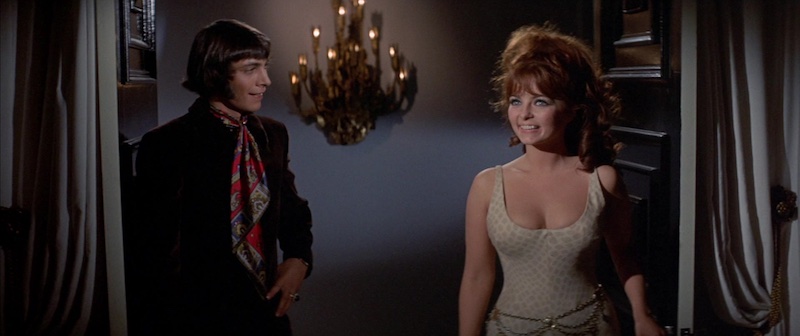
That artificiality suits Meyer’s film. Beyond the Valley of the Dolls is not interested in a credible Hollywood. It is interested in a vulgar, heightened, studio-made Hollywood: a place of sets, backings, saturated costumes, theatrical makeup, bright flesh, exaggerated close-ups and sexual melodrama. Koenekamp’s old-fashioned lighting does not contradict the film’s satire. It helps create it.
This is a film where high-key lighting, strong color and three-point portraiture become part of the surface. Many of the close-ups, especially of the actresses, are beautifully and carefully lit. The lighting is not subtle, but it is effective. It gives the faces polish, shine and definition. It also gives the film a kind of commercial gloss. That gloss collides nicely with the absurdity and violence of the material.
The format helps. Shot in 35mm anamorphic Panavision, the film has the width and production value of a studio picture, even when what it shows is deliberately garish. Koenekamp appears to have used Panavision C Series lenses, with occasional Angénieux zoom work. The zoom is not a dominant visual strategy here, except in certain obvious moments. For the most part, the anamorphic frame is treated in a fairly classical way. Bodies, faces and décor are arranged across the width, while the light does much of the expressive work.
Koenekamp used hard, directed light and relatively generous levels. As a result, shooting anamorphic would not have required the kind of wide-open exposure that later became central to much anamorphic work. The image is often sharp, bright and controlled. There is little sense of fighting for exposure. This is not a cinematographer trying to discover the scene through available light. It is a cinematographer imposing order on it.
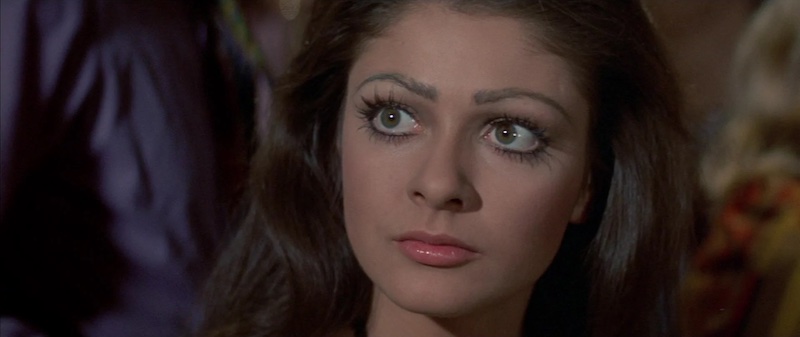
That order is, at times, almost absurdly visible. Studio sets look like studio sets. Backings look false. Night streets and alleys rarely escape the feeling of being built or dressed. Even when the film moves into spaces that should feel more dangerous or nocturnal, the image retains its prefabricated quality. But this may be exactly right. Beyond the Valley of the Dolls is, in a way, a studio film parodying the look of studio films.
This makes the question of intention difficult, and interesting. It is hard to know where homage ends and parody begins. It is equally hard to know whether Koenekamp was fully participating in Meyer and Ebert’s satire, or simply photographing the film according to his own beliefs about what a studio picture should look like. But that uncertainty does not weaken the result. If anything, it makes it more fascinating. The film benefits from a cinematographer whose taste may have been absolutely sincere, even when the material around him was anything but.
Russ Meyer had photographed many of his own films, and his visual instincts were clearly important to his cinema. But in Beyond the Valley of the Dolls, what appears on screen feels unmistakably Koenekamp. The polished faces, the hard sources, the saturated color, the lack of naturalistic hesitation and the theatrical clarity of the image all belong to his method. Whether this was an earnest application of old-school craft or a knowing contribution to the satire, it is difficult to deny his authorship.
There are also weaknesses. The day-for-night work is not always convincing, which is surprising given that Koenekamp later photographed one of the more interesting examples of that technique in Islands in the Stream. Here, the day-for-night passages often feel blunt and artificial. The continuity between locations and studio interiors can also be very rough. This is especially visible near the end. The exterior of the house is treated as day-for-night, while the interiors are clearly studio-shot. The transition is not especially defensible in realistic terms.
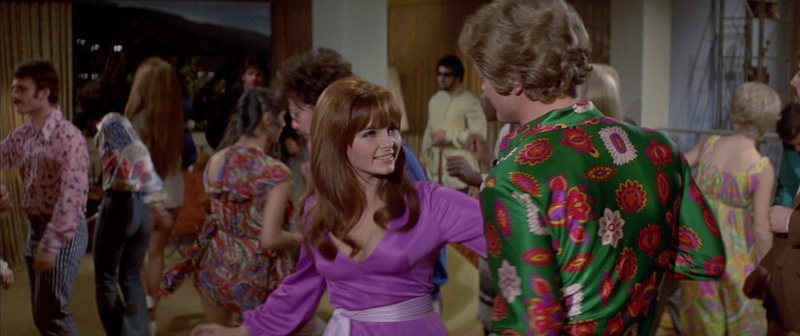
But again, the film has a strange way of absorbing these faults. Its falseness is so large, so deliberate-looking, and sometimes so vulgar, that conventional criticism becomes difficult. A more naturalistic cinematographer might have fought against the material. Koenekamp does the opposite. He gives it polish, shape and frontal theatricality. He lights the film as if its world deserved full studio treatment. That makes the exaggeration even stronger.
Conclusion
In that sense, Beyond the Valley of the Dolls is one of the rare cases in which an outdated visual language becomes dramatically useful. Koenekamp’s refusal — or inability — to move toward the softer naturalism of the period becomes part of the film’s identity. His cinematography is classical, artificial, overlit, decorative and often blatantly unreal. For this particular film, those qualities are not simply defects. They are the visual equivalent of Meyer and Ebert’s satire: loud, stiff, glossy, excessive and impossible to take entirely straight.
ON FILM & DIGITAL
© Ignacio Aguilar, 2026.
The Author
Ignacio Aguilar is available for cinematography work, creative collaborations, lectures, workshops and international projects. He is a Sony Independent Certified Expert (ICE) and Cooke Optics Spanish Ambassador for Cooke SP3 lenses. Contact here.