

English version of the Spanish article Historia del 35 mm, del cine mudo al sonoro.
This article is part of the Film Formats series. For the complete guide —35mm, CinemaScope, Panavision, VistaVision, 70mm, Technirama, Techniscope and IMAX— see the Film Formats Guide.
Film formats are the technical systems through which filmmakers bring image and sound to the cinema screen.
They are not limited to the cameras used on set. A format also includes the film stock or digital sensor that records the image, the lenses placed in front of it, the camera accessories that make capture possible and, finally, the projection systems used in theaters. Sound follows a similar logic. Its history moves from monophonic reproduction to stereophonic presentations and later digital multichannel systems, each of them changing the way films physically reach an audience.
Before widescreen, anamorphic photography and large-format exhibition transformed cinema in the 1950s, the basic language of theatrical presentation had already been shaped by 35mm film, silent-era framing, optical sound, Academy ratio and three-strip Technicolor.
This article explains how the 35mm film format became the foundation of motion picture cinematography, from silent cinema and the arrival of sound to Technicolor and early widescreen practices.
In motion-picture terminology, 35mm film is not just a strip width. It is the industrial basis of classical cinema: a film gauge, a camera and projector transport system, a negative and release-print workflow, and a family of aspect ratios shaped by silent projection, optical sound and later widescreen practices.
The silent 35mm frame was broadly 1.33:1. The arrival of optical sound reduced the usable picture area and led to the 1.37:1 Academy ratio. Three-strip Technicolor then added a complex color workflow to that same industrial base, using three black-and-white records to create a saturated color image.
- Silent-era cinema established 35mm film and the 1.33:1 frame as the basis of theatrical presentation.
- The arrival of optical sound reduced the image area and led to the standardized 1.37:1 Academy ratio.
- Early cinematography depended heavily on Bausch & Lomb Baltar and Cooke Speed Panchro lenses, whose lower contrast and gentler definition remain visually relevant today.
- Three-strip Technicolor created a saturated color image by exposing three black-and-white records simultaneously.
- Television’s adoption of the 4:3 frame helped push Hollywood toward widescreen formats, stereophonic sound and anamorphic photography.
| Format / system | Period | Key idea |
|---|---|---|
| Silent 35mm | 1890s–late 1920s | Full silent aperture, broadly associated with the 1.33:1 frame. |
| Sound 35mm | Late 1920s onward | Optical soundtrack reduced the available picture area and changed framing. |
| Academy ratio | 1930s onward | Standardized the sound-era theatrical frame at approximately 1.37:1. |
| Three-strip Technicolor | 1930s–1950s | Created color images through three separate black-and-white records. |
Introduction
This article follows the evolution of image and sound formats from the birth of motion pictures in the late nineteenth century to the arrival of television. The original piece was published by Zonadvd around 2002. This revised version, updated by its author, is exclusive to this website and incorporates both a refinement of the original text and later developments in the field.
As always, this survey is not intended to be exhaustive. There are books, specialist websites and historical studies devoted entirely to these subjects. The opinions expressed here are strictly those of the author. The images have been selected from material circulating online, with no intention of infringing third-party rights.
The Silent-Era 35mm Format
In the first years of cinema, during the silent era, 35mm film was already established as the standard motion-picture format.
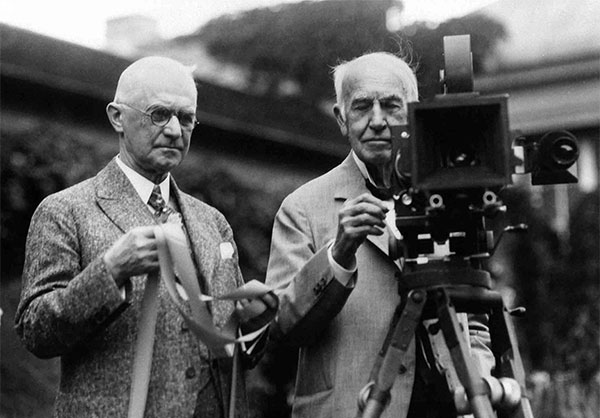
The relationship between image width and height — the aspect ratio — was broadly 1.33:1. That said, pioneers such as Edison and the Lumière brothers were not using precisely the same film configuration. Lumière film used a single round perforation per frame, while Edison film used four rectangular perforations on each side of the image. These perforations are the holes that allow the film to be pulled through the camera or projector. In practical terms, the greater the number of perforations used for each frame, the larger the negative area and the higher the potential image quality.
In 1909, at an international conference, the Edison film format was selected as the standard. It was already very close to the 35mm film we know today, with an image area of approximately 24 mm by 18 mm and an aspect ratio of 1.33:1. Lumière’s image was similar in shape, slightly larger, and used a somewhat more stable transport mechanism.

A silent-era 4-perf 35mm negative, with the image occupying the full frame height.
As for the lenses used by cinematographers of the period, Bausch & Lomb’s Baltar lenses became one of the important reference points in American production. Their maximum apertures were around f/2.3, but their optical design was far removed from modern standards, and they generally needed to be stopped down for more controlled results. Even then, films from the period often reveal a degree of softness, aberration and distortion that is now part of the visual memory of early cinema.
The most widely used American camera of the period was the Mitchell, with its BNC mount in later versions. Through successive redesigns and improvements, Mitchell cameras remained in regular professional use well into the 1980s and 1990s. The original Rank Taylor Hobson designs for the Cooke Speed Panchro Series I also belong to this era, although their use was always more widespread in Europe than in the United States. In Europe, Arnold & Richter — ARRI — began presenting motion-picture cameras in 1924.
Except for a few color experiments, which will be discussed later, cinema in this period was produced in black and white. Panchromatic film stock — sensitive to the full color spectrum — was not standardized until 1926. Before that, orthochromatic film was still common, and it was not sensitive to certain wavelengths of light.
The Sound-Era 35mm Format
The arrival of sound cinema in 1927 changed the motion-picture format itself. The lateral optical soundtrack, printed on release prints, quickly prevailed over synchronized disc systems. Because this soundtrack reduced the available image width by roughly 2.5 mm, its introduction initially produced an almost square image, around 1.25:1.
This transitional format can be seen in films such as Sous les toits de Paris (René Clair, 1930) and Marius (Alexander Korda, 1931).
Between 1927 and 1931, several formats coexisted with different aspect ratios. Fritz Lang’s M (1931), for example, varies between approximately 1.17:1 and 1.19:1. Silent films also continued to be made in 1.33:1 for several years, partly because some filmmakers, including Charles Chaplin, remained reluctant to embrace sound. The major studios did not reach a final agreement on the standard sound aspect ratio until 1931. From that point on, theatrical films were standardized at 1.37:1.
The height of the image was reduced, with the frame finally set at approximately 21 mm by 15.3 mm. This 1.37:1 format — often informally called 1.33 by analogy with the silent-era frame — became the universal cinema format for more than twenty years. Known as the Academy aperture, or Academy ratio, it was used for both shooting and projection at 24 frames per second until the arrival of widescreen formats.

This diagram shows how the image was initially reduced by the inclusion of the optical soundtrack, visible on the right between the perforations and the picture area.

A 35mm negative in the form still familiar today, with the image height reduced in relation to the earliest sound format.
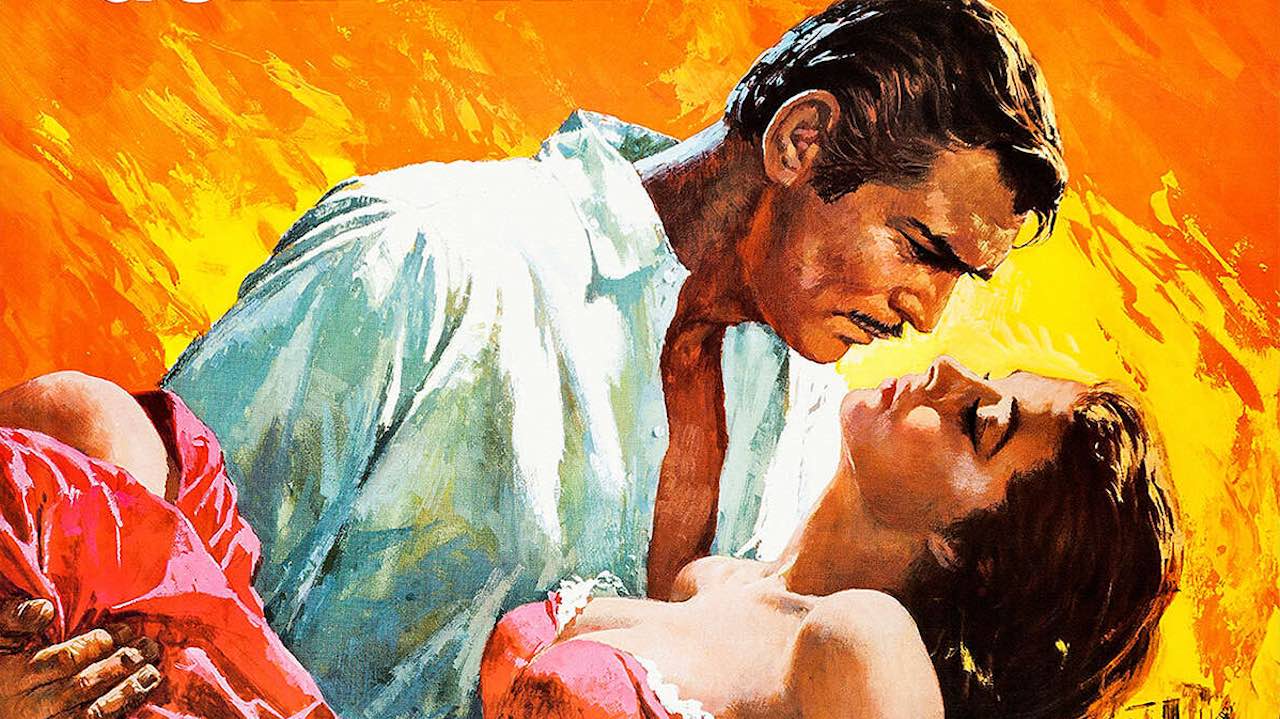
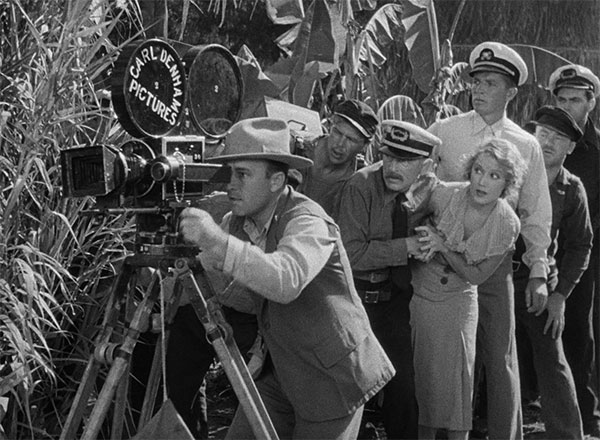
This new format, virtually the only standard in use until 1952, became the reference for theatrical films around the world. It was used in classics such as King Kong (Ernest B. Schoedsack and Merian C. Cooper, 1933), Gone with the Wind (Victor Fleming, 1939), Citizen Kane (Orson Welles, 1941) and Casablanca (Michael Curtiz, 1942), to cite only a few representative titles.
At the same time that this format was being standardized by the Academy of Motion Picture Arts and Sciences, the major studios also experimented with larger gauges, especially 56, 63 and 70 mm. The Great Depression prevented those systems from being developed on a broad industrial scale. Any new format required major changes to theater projection equipment, and the cost was extremely high. The best-known of these short-lived systems was Fox’s Grandeur, a 70mm format that anticipated later large-format processes discussed in greater depth in Film Formats (III).
One of the two versions of The Big Trail (Raoul Walsh, 1930) was shot in Grandeur, while the other was filmed simultaneously in the standard Academy format precisely because of Grandeur’s exhibition incompatibility.
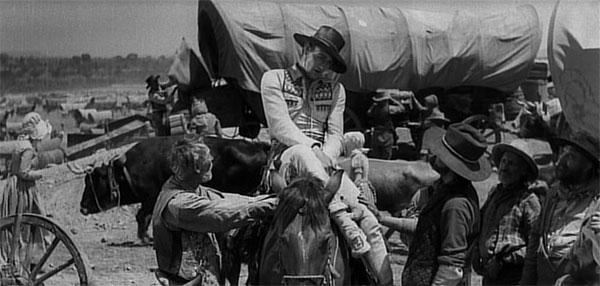
John Wayne in The Big Trail, photographed in Grandeur.
In lens design, 1930 saw the arrival of the second series of Cooke Speed Panchro lenses, with focal lengths ranging from 18 mm to 75 mm. Later, in the 1960s, the 18 mm and 25 mm were replaced by new Series III designs, while the rest of the focal lengths remained unchanged. This explains why many surviving Cooke Speed Panchro sets today include Series III wide lenses, while the focal lengths up to 75 mm are usually Series II. Cooke also developed the Deep Field Panchro 100 mm and the Telepanchro series, including 152, 203, 318, 406 and 558 mm lenses.
The major films of this period were therefore photographed either with Bausch & Lomb Baltars or with Cooke Speed Panchros. The lasting appeal of those lenses is easy to understand from a cinematographer’s point of view. Their image quality is strong, but their lower contrast and gentler definition can temper the excessive sharpness and hardness often associated with digital capture.
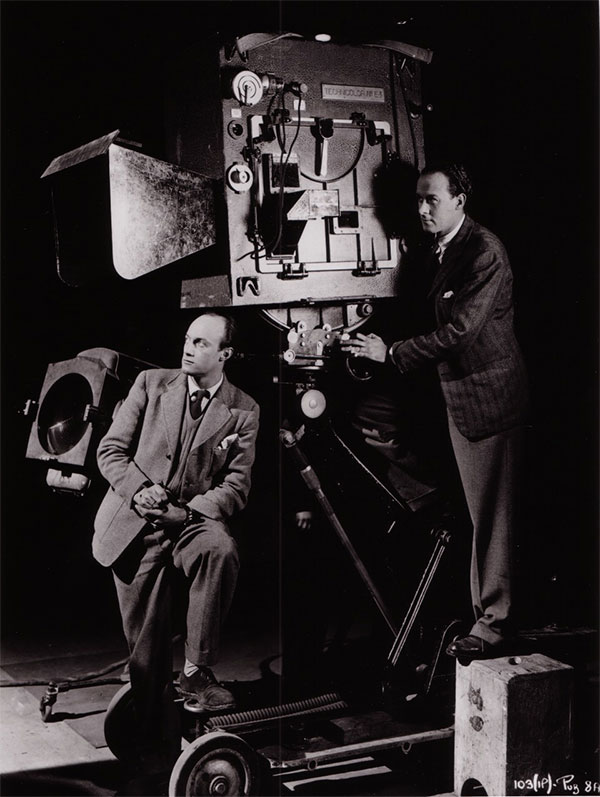
Jack Cardiff, left, and Geoffrey Unsworth, right, with one of the Technicolor cameras.
Three-Strip Technicolor
Another decisive invention of the 1930s was three-strip Technicolor. During the 1910s and 1920s, several color processes had already been tested, but the results were never fully satisfactory. Most were limited to red and green records, with variations on that basic principle.
Three-strip Technicolor changed that by offering a complete color experience. The process exposed three black-and-white negatives simultaneously: one through a green filter, blocking red and blue light; another through a magenta filter, blocking green; and a third record dedicated to blue light.
When the three records, or matrices, were combined into a single release print, the result was vivid, saturated and capable of a wide chromatic range. That is the origin of the almost colloquial expression “a Technicolor movie,” used even for films not necessarily photographed in the original three-strip process, whenever the image has strong, saturated color.
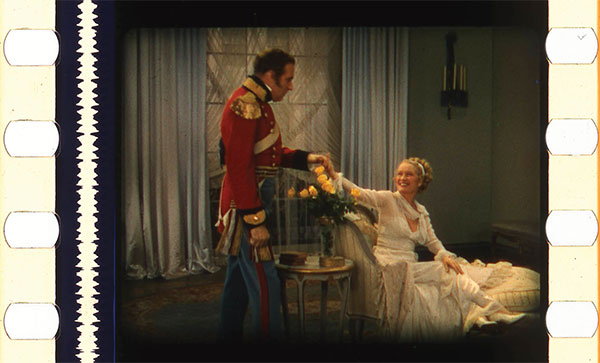
Becky Sharp (1935).
The drawback was exposure. The process, introduced with Becky Sharp (Rouben Mamoulian, 1935) and later used in classics such as The Adventures of Robin Hood (Michael Curtiz and William Keighley, 1938), had very low sensitivity: around 5 ASA, balanced for daylight. It required carbon-arc lighting and extremely high light levels. The three negatives, together with the need for Mitchell cameras specially modified for the process, also made it expensive. By the early 1950s, three-strip Technicolor was replaced by Eastmancolor and Kodak 5247, which allowed color photography on a single negative with higher sensitivity — around 16 ASA in daylight — although with less color stability and durability in release prints.
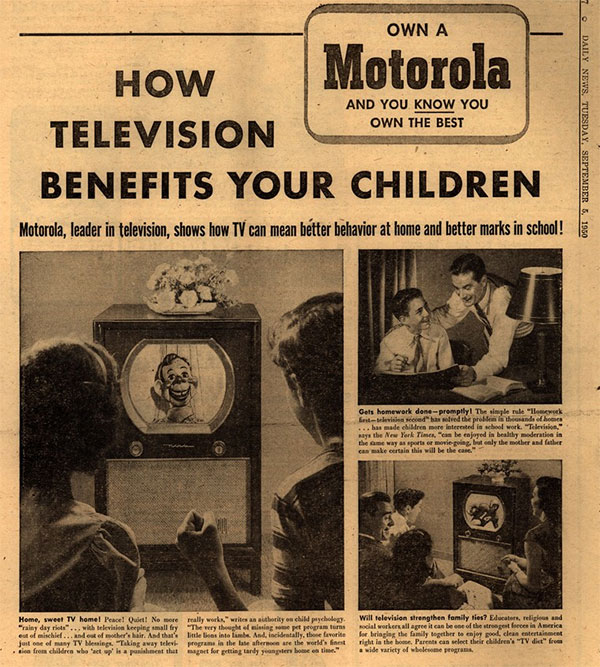
At the beginning of the 1950s, another invention appeared, this time domestic rather than theatrical: television. It allowed spectators to watch audiovisual content without leaving home. Television had adopted an aspect ratio close to cinema’s older 4:3 or 1.33:1 frame, and it threatened both the theatrical business and, at least in the eyes of the studios, the film industry itself. Hollywood’s response was immediate. Widescreen formats arrived, stereophonic sound followed, and soon afterward the industry developed the anamorphic format on a large commercial scale.
Continue the Film Formats Series
The evolution of widescreen formats and large-format exhibition systems continues in CinemaScope vs Panavision: Cinerama and anamorphic 35mm explained.
Film Formats Series
This page belongs to the ON FILM & DIGITAL series devoted to motion-picture film formats. The complete guide traces the evolution from silent 35mm and Academy ratio to CinemaScope, Panavision, VistaVision, 70mm, Technirama, Techniscope and IMAX.
Read the complete Film Formats Guide
Next part: Film Formats (II): Cinerama, CinemaScope and Panavision
Cinematography, education and technical partnerships
ON FILM & DIGITAL combines film analysis, technical history and professional cinematography experience. For cinematography work, lectures, workshops, technical presentations, brand collaborations or projects involving cameras, lenses, film stocks and cinematic workflows, contact Ignacio Aguilar AEC directly.
For a broader view of the series and related reading, see also:
- Film Formats Guide: 35mm, CinemaScope, VistaVision, 70mm and IMAX
- Film Formats (II): Cinerama, CinemaScope and Panavision widescreen formats
- Film Formats (III): Academy Ratio, VistaVision and 70mm explained
- Film Formats (IV): Technirama, Techniscope and IMAX film formats
- A Guide to Cinema Lenses (III): Cooke Speed Panchro and classic cinema lenses
- The Anamorphic Format in Cinema: A Complete Guide
ON FILM & DIGITAL
© Ignacio Aguilar, 2002, 2015. Revised in 2026.
More English-language cinematography essays, reviews and technical articles are available in the ON FILM & DIGITAL English index.
The Author
Ignacio Aguilar is available for cinematography work, creative collaborations, lectures, workshops and international projects. He is a Sony Independent Certified Expert (ICE) and Cooke Optics Spanish Ambassador for Cooke SP3 lenses. Contact here.
Sources:
Widescreen Museum
American Cinematographer Manual, 10th Edition
Motion Picture Lens Database, Richard Bradbury
Film Style and Technology: History and Analysis, Barry Salt
Cooke Optics
Kodak
2026 update note: this version has been revised to improve search intent, heading structure, readability, internal links and image ALT text, while preserving the article’s original content and authorial approach.