

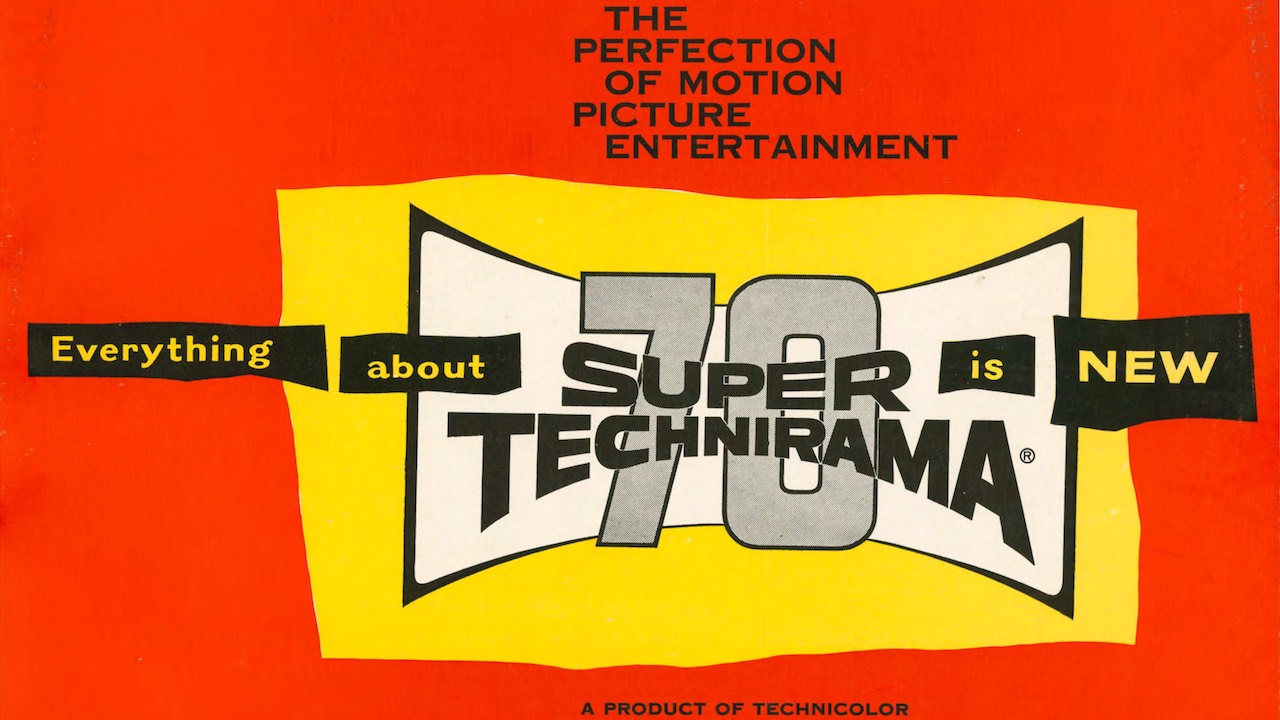
English version of the Spanish article Technirama, Techniscope and IMAX.
This article concludes the Film Formats series begun in Film Formats (I): 35mm, Silent Cinema, Sound and Technicolor, continued in Film Formats (II): Cinerama, CinemaScope and Panavision and expanded through VistaVision, Todd-AO and 70mm systems in Film Formats (III): Academy Ratio, VistaVision and 70mm.
This article is part of the Film Formats series. For the complete guide —35mm, CinemaScope, Panavision, VistaVision, 70mm, Technirama, Techniscope and IMAX— see the Film Formats Guide.
The final stage of this journey moves through some of the most interesting hybrid and transitional systems of photochemical cinema: Technirama, Techniscope, 70mm blow-ups, IMAX, lightweight cameras, Steadicam, fast lenses and the high-speed film stocks that reshaped cinematography in the 1970s and 1980s.
This article explains the difference between Technirama, Techniscope and IMAX, how 70mm blow-ups extended large-format exhibition, and why cameras, lenses and faster film stocks changed cinematography as much as new film formats did.
Key technical points:
- Technirama combined horizontal 8-perf 35mm photography with a 1.5x anamorphic squeeze, producing a 2.25:1 widescreen image.
- Super Technirama 70 referred to 70mm exhibition prints made from Technirama negatives, not to original 65mm photography.
- Techniscope used 2-perf 35mm spherical photography to obtain a 2.35:1 widescreen image at roughly half the negative cost.
- 70mm blow-ups allowed 35mm productions to benefit from large-format exhibition and six-track magnetic sound.
- IMAX 15/70 used a much larger 65mm negative area than 5-perf 70mm, creating a 1.43:1 large-format image rather than a conventional widescreen frame.
- The Panaflex, Steadicam, high-speed lenses and faster film stocks changed cinematography less through new formats than through new working methods.
Quick answer: Technirama vs Techniscope vs IMAX
Technirama, Techniscope and IMAX are very different film formats. Technirama was a high-quality 8-perf horizontal 35mm format with a 1.5x anamorphic squeeze, designed to produce widescreen images for either 35mm or 70mm exhibition. Techniscope was almost the opposite: a 2-perf spherical 35mm format created to reduce negative cost while still producing a 2.35:1 widescreen release image. IMAX 15/70 used a much larger 65mm negative area, running horizontally with fifteen perforations per frame, to create a very large 1.43:1 image for special venues.
70mm blow-ups were different again. Many films advertised or remembered as 70mm presentations were not photographed on 65mm negative. They were shot on 35mm and optically enlarged to 70mm prints, often to obtain larger-screen exhibition and six-track magnetic sound rather than true large-format origination.
| Format / system | Capture method | Main idea |
|---|---|---|
| Technirama | Horizontal 8-perf 35mm with a 1.5x anamorphic squeeze | Higher-quality widescreen 35mm source, often used for 70mm presentation |
| Techniscope | Vertical 2-perf 35mm spherical photography | Lower-cost widescreen photography with half the usual 35mm negative height |
| 70mm blow-up | 35mm original enlarged to 70mm release prints | Large-format exhibition and six-track sound without 65mm origination |
| IMAX 15/70 | Horizontal 65mm negative with 15 perforations per frame | Very large-format image for immersive special-venue exhibition |
Introduction
In this fourth and final chapter of the survey, we move away from the pure format revolutions of the 1950s and into a more complex territory. Some systems tried to extract more quality from 35mm. Others reduced costs while preserving a widescreen image. Later, 70mm blow-ups and IMAX changed the meaning of large-format exhibition, while cameras, lenses and emulsions transformed the practical conditions under which cinematographers could work.
Technirama: horizontal 8-perf 35mm anamorphic
Technicolor did not want to remain outside the new-format race. In 1957, it introduced Technirama as a direct competitor to both CinemaScope and Todd-AO. The format had unusual characteristics because it was built on Paramount’s VistaVision principle. In effect, Technirama was an anamorphic version of VistaVision.
It used the same negative layout: 35mm film running horizontally, with eight perforations per frame. This doubled the negative area available in conventional 4-perf 35mm CinemaScope.
Technirama abandoned VistaVision’s variable aspect-ratio philosophy and used a specific anamorphic system. Its lenses applied a 1.5x squeeze, less aggressive than the 2x anamorphic compression used by CinemaScope, Panavision and the many systems derived from them.
As a result, the native 1.50:1 image area of horizontal 8-perf 35mm became a true widescreen format with an aspect ratio of approximately 2.25:1. It sat between the 2.35:1 frame of CinemaScope and the 2.21:1 frame of 65/70mm spherical systems.
The anamorphic effect was produced by a front adapter called Delrama, placed in front of conventional spherical lenses. In some productions, such as Spartacus (Stanley Kubrick, 1960), those lenses were the familiar Cooke Speed Panchros.

Technirama was usually exhibited in two ways. The first was to reduce the 35mm 8-perf negative optically to standard 35mm 4-perf prints, fully compatible with CinemaScope projection but with higher apparent image quality because the source negative was twice as large. These prints could also carry the same four-track magnetic Magoptical sound used by CinemaScope.

The second form of exhibition was the 70mm blow-up. Many Technirama films were enlarged to 70mm rather than reduced to 35mm for release.
The image quality could not exactly match that of films originated on 65mm negative. A true 65mm frame offered roughly two and a half times the area of conventional 35mm, while Technirama offered twice the area and still required an optical enlargement step. Even so, 70mm prints from Technirama negatives produced better image quality than standard CinemaScope prints and could be projected in theaters equipped for Todd-AO or Super Panavision, including six-track magnetic sound.
This exhibition process was known as Super Technirama 70. It did not differ from Technirama during photography; the name referred to 70mm presentation. Many spectators therefore associated films such as Sleeping Beauty, El Cid and King of Kings with 70mm, even though they had been originated on 35mm 8-perf negative.

Technirama also had one practical advantage over true 65mm formats. Like VistaVision, it used standard 35mm negative stock. No special 65mm film orders or specialized laboratories were required. Technirama material could be processed in any motion-picture laboratory. Its drawback, of course, was that it consumed twice as much negative per frame as conventional 35mm.
Techniscope: 2-perf 35mm widescreen
If increasing the frame from four to eight perforations doubled negative consumption, as in VistaVision and Technirama, reducing the frame to two perforations could cut it in half.
At the beginning of the 1960s, many filmmakers with smaller budgets also wanted to use widescreen composition. That need gave rise to Techniscope, sometimes called “Poor Man’s CinemaScope,” developed at Technicolor’s Rome laboratory in 1961.


The Techniscope negative, with two perforations per frame, and the 35mm 4-perf anamorphic release print made from it.
The idea was simple: reduce the height of the traditional 35mm 4-perf frame to only two perforations, exactly half the usual height.
Once prepared for standard theatrical release, the format produced a 2.35:1 widescreen image, compatible with CinemaScope-style exhibition. The original photography was spherical, not anamorphic, but the final 35mm release prints were enlarged and anamorphically printed to 4-perf. Technicolor could also use its prestigious dye-transfer printing process, which helped the release image retain density and color richness.
The negative area was only half that of a 35mm anamorphic production and also smaller than the image area used for standard 1.85:1 projection. The result was inevitably grainier and less detailed. But Techniscope still delivered a widescreen frame while dramatically reducing negative costs.
The main virtue of the system was therefore economy. It saved not only on film stock, but also on camera equipment. Modifying a conventional 35mm camera for 2-perf photography was easier and cheaper than using a full anamorphic camera and lens package.
Sergio Leone used Techniscope in his celebrated Dollars Trilogy, as well as in Once Upon a Time in the West and Duck, You Sucker. These films also show another classic advantage of the format: the ability to combine a wide screen with the depth of field of spherical lenses. Under the harsh summer light of Almería, often stopped down to at least T16, Leone and his cinematographers could create emblematic deep-focus compositions with foreground, midground and background all held sharply in the same image.
Techniscope declined around 1975, when Technicolor stopped producing dye-transfer prints. It would briefly return in the 2000s, helped by digital methods for enlarging and finishing smaller formats.
70mm blow-ups and the decline of large-format production
Just as 35mm 8-perf Technirama films could be blown up to 70mm and receive a specific exhibition name — Super Technirama 70 — someone eventually applied the same idea to films photographed in 35mm 4-perf anamorphic, and later even to spherical 35mm films. Otto Preminger’s The Cardinal (1963) was the first title to receive this treatment, although it was not the film that popularized the practice.
That distinction belongs to Doctor Zhivago (1965). For this Metro-Goldwyn-Mayer superproduction shot in Spain, David Lean had wanted to use the same Super Panavision 70 format he had used on Lawrence of Arabia (1962).
Even the film’s large budget could not support that choice. The production was therefore photographed in traditional 35mm 4-perf anamorphic with Panavision lenses and equipment, at a lower cost.

For commercial release, however, 70mm blow-up prints were prepared with six-track magnetic sound.
The projected image was not as good as it would have been from a true 65mm negative, but the sound was part of the exhibition format and therefore matched genuine 70mm presentations. This initiated a new wave of productions photographed in 35mm and blown up to 70mm for major theatrical release, a trend that lasted into the early 1990s. In many cases, the main attraction was not only the larger print but the spectacular six-track magnetic soundtrack.
Popular titles such as The Poseidon Adventure, Earthquake, Star Wars, Close Encounters of the Third Kind, Days of Heaven, Superman, Alien, Apocalypse Now, Raiders of the Lost Ark, Blade Runner, Back to the Future, The Abyss, Terminator 2 and even Titanic belong to the long list of films that benefited from 70mm exhibition prints. Many viewers believed they were watching films actually photographed in 70mm, although most had originated in Panavision 35mm or even Academy Standard Flat.
The website in70mm.com maintains an extensive compilation of titles blown up for 70mm release.

At the same time, films photographed in 70mm formats began to be shown on curved Cinerama screens under the name Super Cinerama. Examples include It’s a Mad, Mad, Mad, Mad World, 2001: A Space Odyssey and Krakatoa: East of Java. The edges of the frame were optically modified to adapt the image to the curvature of the screen.

There are many reasons for the decline of large-format production and exhibition, but almost all are connected to cost, especially in comparison with traditional 35mm spherical or anamorphic photography.
Other causes were indirect. Large single-screen theaters gradually disappeared, first in the United States and later elsewhere, often divided into multiplexes. At the same time, the success of 70mm blow-ups changed the role of large-format exhibition. Until the arrival of digital sound formats, 70mm was often valued less for image quality than for its superior six-track magnetic sound.

For many years, Ryan’s Daughter (1970) and Airport (1970) were the last features photographed entirely in 5-perf 65mm.
After that, as discussed earlier in the series, some productions used large formats to avoid optical degradation in photochemical visual-effects sequences. But it was not until the early 1980s that Tron (Steven Lisberger, 1982) and Brainstorm (Douglas Trumbull, 1983) again photographed long sections in 65mm.
In 1992, Ron Howard released Far and Away, the same year Ron Fricke returned Todd-AO to the large screen with Baraka.
Kenneth Branagh had Alex Thomson photograph his massive Hamlet (1996) in 65mm, but no feature would again use the large negative extensively until Ron Fricke’s Samsara (2011) and Paul Thomas Anderson’s The Master (2012). Even The Master contains a significant amount of spherical 35mm material and does not use the full widescreen potential of 65mm, instead framing for the standard 1.85:1 ratio.
IMAX 15/70: the largest photochemical film format
Paradoxically, in the same year that continuous 65mm feature production came to an end, another large format appeared: IMAX. Perhaps the largest of all commercial film formats, IMAX also uses 65mm negative, but with fifteen perforations per frame instead of the five used by Todd-AO, Super Panavision or Ultra Panavision.
IMAX was conceived for special venues, with screens roughly twice as tall as those designed for 35mm anamorphic or standard 70mm exhibition. The spectator in an IMAX theater does not so much perceive a wider image as become absorbed by a screen of enormous proportions. The aspect ratio is not conventionally panoramic, but close to silent and classical cinema before CinemaScope: 1.43:1.
The original sound system used six magnetic tracks, later replaced by digital sound formats in the early 1990s.

For many years, IMAX was perceived less as a narrative film format than as a format for theme parks, science museums and technological demonstrations. Despite experiments such as Jean-Jacques Annaud’s medium-length film Wings of Courage (1995), IMAX remained largely confined to documentaries and high-end institutional films until Christopher Nolan used it for selected sequences in The Dark Knight (2008), intercutting IMAX footage with the main 35mm anamorphic material.
That decision created a contemporary large-format trend. Nolan continued it in The Dark Knight Rises (2012) and Interstellar (2014). It was also followed, in different ways, by Michael Bay in Transformers: Revenge of the Fallen (2009), Brad Bird in Mission: Impossible – Ghost Protocol (2011), and J. J. Abrams in Star Trek Into Darkness (2013) and Star Wars: The Force Awakens (2015), films that combine IMAX footage with material photographed in 35mm 4-perf.

Original IMAX, projected on 15-perf 70mm film, offered an extremely rich, contrasty and highly defined image. Its use in feature films became, for a time, one of the clearest ways to recover the spectacle of large-format photochemical exhibition in contemporary cinema.
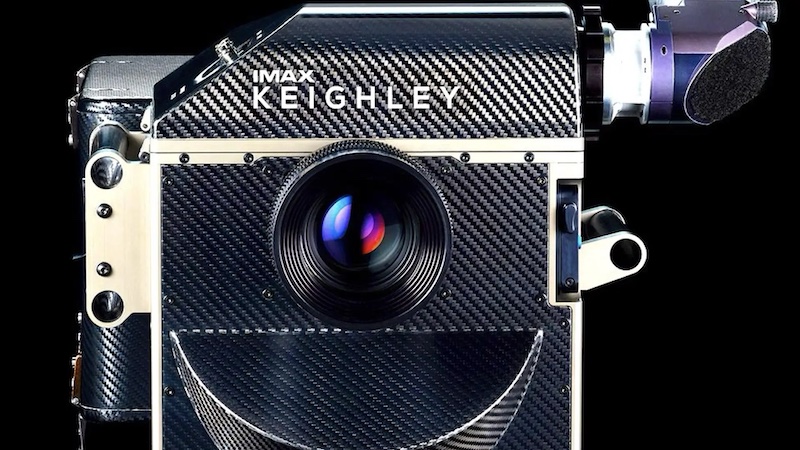
In 2026, for The Odyssey, the first soundproofed IMAX camera was built, enabling dialogue scenes to be filmed with direct sound (in previous films, both Christopher Nolan and other filmmakers used conventional 35mm cameras or 5-perf 65mm cameras to shoot dialogue scenes, intercutting footage from one format with the other). This camera, named Keightley, has allowed The Odyssey to be shot entirely in IMAX.
The bottleneck remains at the distribution level: there are only approximately 40 theaters worldwide capable of projecting IMAX in 15-perf 70mm. As a result, most of these installations (as is the case in Spain) are IMAX-configured auditoriums but with digital projection. Even so, it is still possible to create conventional 70mm photochemical prints (which typically feature the central 2.20:1 extraction from the original 1.43:1 frame), 35mm (2.39:1) or to also screen the film digitally and in conventional cinemas in Flat (approx. 1.90:1) or Scope (2.39:1) versions, depending on the theater. NOTE: Specific specifications may vary depending on the exact film.
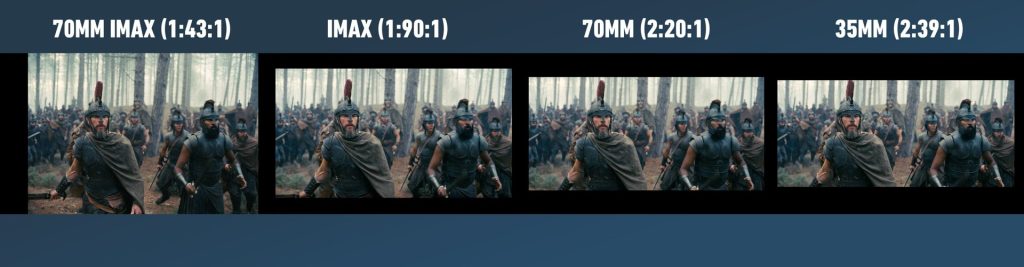
Currently, IMAX productions take into account a multi-format exhibition: full frame of «The Odyssey» for projections in 70mm 15-perf (the original IMAX, 1.43:1), 1.90:1 for digital IMAX, 2.20:1 for a 70mm 5-perf extraction, and 2.39:1 for «Scope» copies in 35mm. Source: IGN.
Shooting in the dark: Panaflex, Steadicam, fast lenses and high-speed film stocks
The 1970s and early 1980s were not nearly as prolific as the previous decades in terms of new formats. Instead, the industry consolidated around two principal forms of capture: standard spherical 35mm, usually 1.66:1 in Europe and 1.85:1 in the United States, and 35mm anamorphic.
Sound generally remained monophonic, except for major productions planned for 70mm release, which were mixed in stereo for six or four tracks, with five or three channels behind the screen and a monophonic surround or effects channel.
Universal’s Sensurround, a system based on very powerful low frequencies, did not become widely established. It was used only on Earthquake (1974), Midway (1976), Rollercoaster (1977) and the theatrical release of the pilot for Battlestar Galactica (1978).

Promotional poster for Earthquake in a Cinerama theater in Brazil, with a warning about its sound system.
The 1970s did, however, bring two important practical inventions: the lightweight Panaflex camera and the Steadicam. The Panaflex was first used either on Papillon (1973) or on The Sugarland Express (1974). Their cinematographers, Fred Koenekamp and Vilmos Zsigmond, both claimed to have been the first to use it.
In any case, the Panaflex was a revolutionary Panavision camera. For the first time in professional cinema, a relatively small and light camera could record sync sound, even handheld or on the shoulder, without requiring the heavy blimps used with earlier cameras.

The Steadicam was invented by camera operator Garrett Brown. Using a system of stabilization, counterweights and body-mounted support, Brown found a way to move the camera through space without the need for a dolly and tracks.
The first film to use it was Bound for Glory (1976), for which cinematographer Haskell Wexler won an Academy Award. It was followed by Rocky (1976), whose famous training sequence on the Philadelphia steps used Brown’s invention, and by Marathon Man (1976).
In 1978, Stanley Kubrick saw Brown’s demonstration reel through Ed Di Giulio of Cinema Products. Kubrick then designed sets and shot much of his next film, The Shining (1980), around Steadicam movement. The long tracking shots following the child on his tricycle and the sequences inside the maze remain among the clearest demonstrations of what the system made possible.

In lenses, the Zeiss High Speeds, Canon K35s and Panavision Ultra Speeds — the latter forming the basis for Panavision’s own High Speed anamorphic series — were major developments of the period.
Each manufacturer received a special Academy Award in 1977 for this innovation. Unlike Kubrick’s use of only two f/0.7 lenses on Barry Lyndon, these were complete lens series with very wide maximum apertures. They allowed cinematographers to shoot at light levels that had previously been impractical.
These lenses appeared around 1975–76, following the development of still-photography lenses with apertures between f/1.0 and f/1.4. Together with push processing, which was very fashionable at the time, they made it possible to shoot at light levels between roughly 8 and 15 foot-candles, instead of the 100 foot-candles often required with 100 ASA negative and lenses such as Cooke Speed Panchros or Super Baltars — especially when zoom lenses were used.
Wide open, these lenses often produced a soft, milky, lower-contrast image and were prone to flare. That behavior, once a technical compromise, is part of why they remain highly desirable today on digital sensors. They take the edge off excessive sharpness and give the image a more tactile optical personality.

As discussed in the section on Todd-AO, a 35mm variant called Todd-AO 35 appeared in 1971. It was essentially a CinemaScope/Panavision clone designed to compete directly with anamorphic 35mm formats. In 1976, another European clone appeared through Henryk Chroscicki: Technovision.
At the same time, Technovision adapted Cooke Varotal zooms — the 20-100 mm and 25-250 mm, introduced in 1971 — for both anamorphic and spherical use, improving their performance and speed and marketing them as Techno-Cooke lenses. In later years, Technovision also adapted Zeiss High Speed 1.4 and Zeiss Standard 2.1 lenses for anamorphic photography, giving cinematographers a broader range of tools.

In England, Joe Dunton, through J-D-C, also made his own anamorphic conversions. Dunton had handled the Todd-AO 35 lens business in Europe, and his conversions of Cooke Speed Panchro, Zeiss High Speed and Canon K35 lenses were known as Cooke Xtal Express, Zeiss Xtal Express and Canon Xtal Express. On screen, they were credited as J-D-C Scope.
Both Technovision and J-D-C probably also used still-photography elements from Zeiss Contax, Canon FD and Nikon, along with Japanese Shiga anamorphic front elements.
Films such as Poltergeist (1982), the first film credited in J-D-C Scope; Return of the Jedi (1983); The Mission (1986); and more recent productions such as Great Expectations (2012) and The Immigrant (2014) were photographed with Joe Dunton lenses.
Technovision and J-D-C lenses, which have been part of Panavision’s international catalogue since 2004, have a softened classical anamorphic character, with pronounced aberrations and barrel distortion. That kind of optical personality is precisely what many cinematographers now seek when working with digital sensors.

In 1974, Kodak introduced a new and improved color negative stock, 5247, rated at 100 ASA. It did not improve on 5254 in speed, but it had finer grain and therefore made push processing — usually to 200 ASA — more practical when cinematographers needed additional sensitivity.
After being used for the first time in the effects sequences of The Towering Inferno, 5247 was withdrawn for improvements and reintroduced in 1976, effectively making 5254 obsolete. Until Fuji introduced the first high-speed color negative stock on the market, 8518 at 250 ASA, in 1981, Kodak 5247 was the dominant color negative reference worldwide.
Fuji’s launch changed the situation dramatically. The 8518 was quickly used by cinematographers such as Jost Vacano on Das Boot, William Fraker on Sharky’s Machine and John Alcott on Vice Squad. It also helped change the perception of Fuji as a second-tier material, especially in the United States.
Kodak had to react quickly and introduced its own high-speed stock, 5293, also rated at 250 ASA. John A. Alonzo used it for parts of Blue Thunder (1982) and then throughout Scarface (1983). Miroslav Ondříček also used the stock on Amadeus (1984), for which he received an Academy Award nomination.
Both the Fuji and Kodak high-speed stocks were still grainy and had limited shadow detail. In 1984, Kodak replaced 5293 with the new 5294, rated at 400 ASA, which improved the results somewhat. It remained in use until the late 1980s, when it was replaced by 5295 and 5296, both rated at 500 ASA.

During this period, it remained common to combine high-speed stocks with the more traditional Kodak 5247 100 ASA, since 5247 produced cleaner results whenever light levels were sufficient.
Since the 1990s, Kodak has continued to concentrate on improving its motion-picture emulsions and maintaining a broad, solid range. As of 2026, its active camera-negative catalogue includes VISION3 50D, 250D, 200T and 500T, available across motion-picture gauges, along with EASTMAN DOUBLE-X black-and-white negative film. In April 2026, Kodak also introduced KODAK VERITA 200D 5206/7206, a new medium-speed, daylight-balanced color negative stock offered in 65mm, 35mm and 16mm. Developed in close collaboration with writer-director Sam Levinson and cinematographer Marcell Rév, HCA, ASC, and commercialized for the third season of Euphoria, VERITA 200D offers a more saturated, higher-contrast alternative to the VISION3 line, with detailed highlights, deep blacks and warm, natural skin tones.
Over time, Agfa left the market and Fujifilm stopped competing in camera negative for feature-film production. Kodak therefore remains the major industrial reference for motion-picture film stock. Today, it maintains an active catalogue of camera films, while Fujifilm’s motion-picture activity is no longer centered on camera negative for theatrical production.
Complete Film Formats Series
With this fourth part, the survey of classical and modern film formats comes to an end: from silent-era 35mm to widescreen, 65/70mm, IMAX, lightweight cameras, high-speed lenses and the emulsions that shaped the transition toward contemporary cinematography.
Film Formats Series
This page concludes the ON FILM & DIGITAL series devoted to motion-picture film formats. The complete guide traces the evolution from silent 35mm and Academy ratio to CinemaScope, Panavision, VistaVision, 70mm, Technirama, Techniscope and IMAX.
Read the complete Film Formats Guide
Previous part: Film Formats (III): Academy Ratio, VistaVision and 70mm
Cinematography, education and technical partnerships
ON FILM & DIGITAL combines film analysis, technical history and professional cinematography experience. For cinematography work, lectures, workshops, technical presentations, brand collaborations or projects involving cameras, lenses, film stocks and cinematic workflows, contact Ignacio Aguilar AEC directly.
For a broader view of the complete series and related reading, see also:
- Film Formats Guide: 35mm, CinemaScope, VistaVision, 70mm and IMAX
- Film Formats (I): 35mm film, silent cinema, sound and Technicolor explained
- Film Formats (II): CinemaScope vs Panavision and Cinerama explained
- Film Formats (III): VistaVision, 70mm and Academy Ratio explained
- A Guide to Cinema Lenses (III): Cooke Speed Panchro, Super Baltar and classic cinema lenses
- The Anamorphic Format in Cinema: a guide to 2x anamorphic lenses
- The Motion Picture Negative (I): film camera, film stock and color
- The Motion Picture Negative (II): format, film speed and grain
ON FILM & DIGITAL
© Ignacio Aguilar, 2015. Revised in 2026.
More English-language cinematography essays, reviews and technical articles are available in the ON FILM & DIGITAL English index.
The Author
Ignacio Aguilar is available for cinematography work, creative collaborations, lectures, workshops and international projects. He is a Sony Independent Certified Expert (ICE) and Cooke Optics Spanish Ambassador for Cooke SP3 lenses. Contact here.
Sources:
Widescreen Museum
in70mm.com, Thomas Hauerslev
American Cinematographer Manual, 10th Edition
Motion Picture Lens Database, Richard Bradbury
Film Style and Technology: History and Analysis, Barry Salt
Panavision
Kodak Motion Picture Film
2026 update note: this version has been revised to improve search intent, heading structure, readability, internal links and image ALT text, while preserving the article’s original content and approach.
Ignacio Aguilar AEC — Cinematographer / Director of Photography, Madrid, Spain · Professional bio · Selected works · Contact