


“Euphoria Season 3”
Spanish Title: Euphoria, Season 3
Year of Production: 2026
Director: Sam Levinson
Cinematographer: Marcell Rév, ASC, HSC
Lenses: ARRI 765, custom ARRI 65mm lenses, Panavision E-Series, Panavision C-Series, Panavision Macro Panatar, Panavision Primo Zoom (48-550mm T4)
Film Stocks: Kodak VERITA 5206 (200D) and Kodak VISION3 5219 (500T)
Format and Aspect Ratio: 5-perf 65mm (ARRI 765) + 35mm anamorphic (Panavision), 2.20:1
Other: 4K Digital Intermediate
Marcell Rév pushes “Euphoria Season 3” into 65mm, 35mm anamorphic and Kodak’s new VERITA negative stock.
The Season
The third and final season of the series created by Sam Levinson, originally launched in 2019, arrives after turning most of its young cast into major names: Zendaya, Hunter Schafer, Jacob Elordi, Alexa Demie, Maude Apatow and Sydney Sweeney, among others. Set five years after the second season, this final installment presents the characters as young adults. Rue works as a drug mule, bringing narcotics from Mexico. Jules is a painter living in her sugar daddy’s apartment. Nate now runs his father’s heavily indebted construction company and is engaged to Cassie, who wants to open an OnlyFans account with Maddie’s help.
It is possible that the freshness of the first season, of which something still remained in the second, has been gradually lost along the way. This third season is a more conventional closing chapter, with a great deal of visual and sonic style — the music is by Hans Zimmer — but also something hollower and less substantial than the beginning of the series. Even so, the scale of HBO’s investment and the talent involved are such that a more schematic screenplay does not prevent frequent flashes of brilliance, although the whole feels less and less credible. Sharon Stone, Colman Domingo, Rosalía, Darrell Britt-Gibson and Adewale Akinnuoye-Agbaje, among others, complete the cast.
The Cinematographer
The cinematographer for the entire season is Hungarian director of photography Marcell Rév, ASC, HSC, who had already been the principal cinematographer on the previous seasons. He was therefore responsible for defining the look of each installment, always with exceptional resources thanks to an extremely lavish production. For the first season, the filmmakers used the ARRI ALEXA 65 in order to obtain exceptional clarity, detail and image quality, despite the fact that this was not a show intended for the big screen. For the second, they revived Ektachrome, shooting it almost entirely on reversal stock.
That produced an unusual phenomenon. A series about young people, watched by many viewers of that same age, led a new audience to become interested in film stocks and their particular appearance, especially in contrast with the cleanliness of digital capture. Not only as spectators, but also as young filmmakers. Rév therefore occupies a leading position today and creates trends through his style, also because of his innovative use of new lighting tools, which imply a different way of working. He is also particularly active in music videos, shooting for artists as popular as Lady Gaga, Bad Bunny or Miley Cyrus.
Visual Style Analysis
For this final season, and as a result of the filmmakers’ previous relationship with Kodak, they jointly developed a new motion-picture film stock, the first from the Rochester manufacturer in nearly two decades. It is a line separate from the current VISION3 family: Kodak VERITA 5206, a daylight-balanced stock with a medium speed of 200D.
Why was it necessary, according to Rév? The current VISION3 range evolved from previous Kodak emulsions, but it was already designed for the hybrid photochemical workflow of the mid-2000s: shooting on film, scanning, digital color and effects manipulation — the Digital Intermediate — and the creation of a digital master. In other words, VISION3 was conceived to capture as much information as possible for scanning. For that reason, these stocks are perhaps less saturated and less contrasty than earlier Kodak families, which were designed for the traditional photochemical process, from negative to print.
VERITA is closer, in my opinion, to older stocks such as the EXR series — 5245 50D or 5293 200T — or even the famous VISION 5279 (500T). The contrast is higher, the saturation is stronger, and the dynamic range is lower than that of current stocks, especially in the shadows, according to Marcell Rév. But it offers a very rich image, with more force and greater vividness. In a sense, it feels closer to slide film or Ektachrome than to a modern negative. It also appears to be less forgiving of underexposure.
Because VERITA is a 200D stock, the filmmakers had to complement it with the traditional 5219 (500T), then match the look either digitally or through tools such as push processing, which increases contrast and saturation. Rév has not detailed that part of the process. What is known is that 500T was used for interiors and night exteriors.
Related reading in ON FILM & DIGITAL
For additional technical context on motion-picture negative, film stocks, sensitivity, grain, exposure, latitude and laboratory processes, this review connects directly with the technical series devoted to motion-picture negative:
And because the budget of the series is enormous, the filmmakers were not only able to use a new negative stock, which will be available by special order in 16mm, 35mm and 65mm, but also to work with a mixture of formats. Season 3 combines 5-perf 65mm — like the classic Super Panavision 70 or Todd-AO systems, in my opinion the best formats ever created — with 35mm anamorphic Panavision. In theory, 65mm is used for the most intense, dramatic or central moments of the series, while 35mm anamorphic is reserved for secondary scenes.
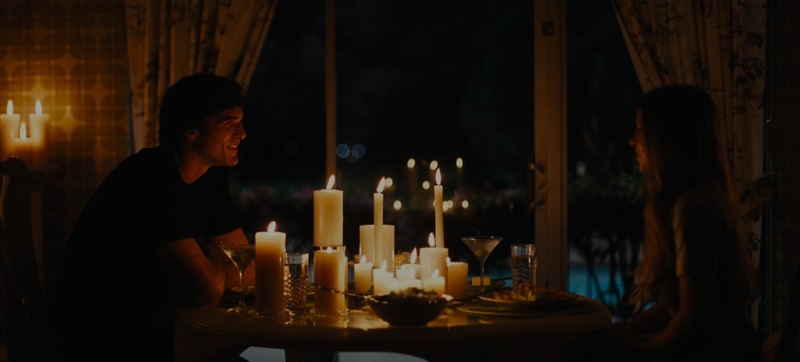
In practice, however, perhaps sixty percent of the season is 65mm and forty percent is 35mm anamorphic, always framed in 2.20:1. Sometimes the difference is organized by scene. At other times it appears within the same scene, depending on shots, camera angles or specific moments. This naturally produces differences in texture — more detailed in 65mm — in grain — more visible in 35mm — and even in the apparent sharpness, black level and three-dimensionality of the image, where the larger format is unbeatable. The candlelit scene between Jacob Elordi and Sydney Sweeney is a good example of shots and reverse shots mixing formats.
The immersive quality of 65mm, viewed in 4K on a large domestic laser-projection screen, is superlative, although the Panavision lenses used for the 35mm material — the E-Series and C-Series, along with a Macro Panatar and a Primo Zoom — also work beautifully. Interestingly, the 65mm material uses one of the only, or one of the very few, ARRI 765 camera bodies available on the market. These cameras have sometimes served as backups on films shot in Panavision 65mm. Here they were used with the classic ARRI 765 lens set and a new custom 65mm set developed by the company.
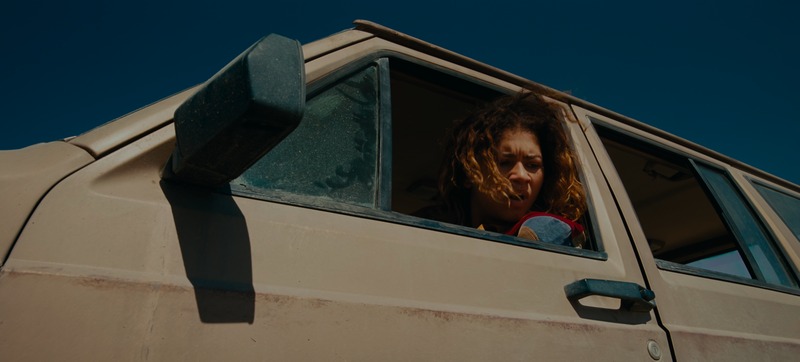
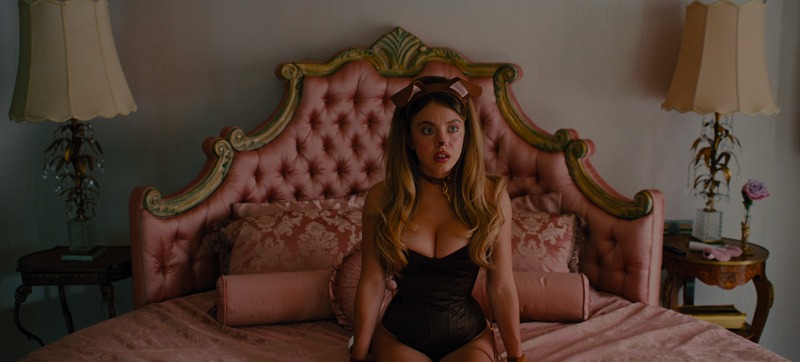
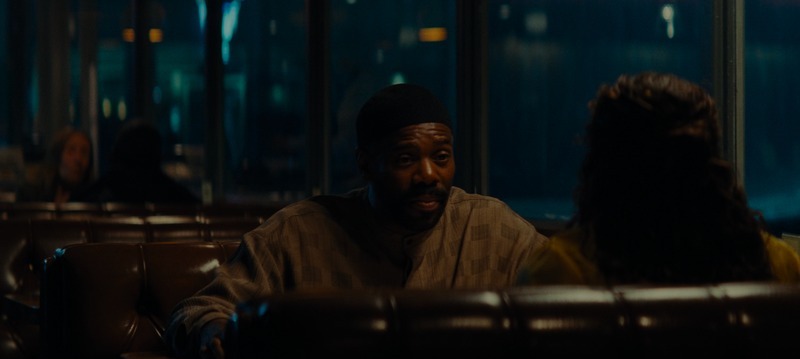
What, then, is the result of using resources usually reserved for major studio productions? In broad terms, it is superb. But not simply because of the scale of those resources. Sam Levinson’s staging and Marcell Rév’s lighting are as strong as in the previous two seasons: from the desert exteriors that open the first episode, with Rue (Zendaya) trying to drive over the fence, to the nightclub interiors in which a large part of the story unfolds, the image is vivid, saturated and extremely attractive. Mixed color temperatures are also frequent in the interiors: warm sources on the actors, with a broad range of tones from blue to green, passing through cyan, in the backgrounds. This clearly connects the season to the RGB LED look of the earlier installments.
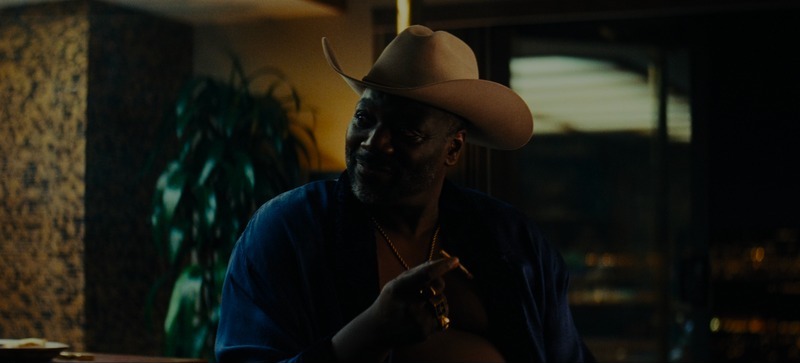
The contrast is extremely high, often using overhead sources on the actors and cutting the light so that it does not reach the walls. In this sense, it may be significant that, as Rév says, VERITA sees less into the shadows than VISION3. That would mean that anything falling below middle gray is perceived as darker than it would be on other contemporary stocks. In the exteriors, the sun is not avoided; it seems actively sought out. This pushes saturation even further and turns many of these scenes into almost demo-like material.
That is also one of the great virtues of 65mm. It has the appearance of celluloid, but with a degree of resolution and cleanliness often associated with digital capture. VERITA, especially in 35mm, has texture, so grain is clearly visible on screen. In other words, it gives the image a classical celluloid quality, not only through color but also through the presence of grain, in line with the current tendency that if a project is shot on film, it should feel unmistakably like film, instead of being mistaken for a high-end digital camera.
Final Thoughts
All the money invested in the production, which is considerable, is perfectly visible on screen. One only has to look at the night exteriors, which use enormous sources placed at great distance, often as backlight, to bring out the backgrounds, almost as if this were a high-budget film from the 1990s. Other scenes opt for a maximal approach — wide shots, long and complex takes, multiple details — instead of simpler coverage with less space and tighter framings. It is a display of resources, but judging by the aesthetic results, the staging and the camera work, it is also clearly accompanied by great talent.
The problem is that the same talent, already evident in the previous seasons, now sometimes serves something that feels more vulgar and closer to an exploitation of some performers’ bodies, or to a turn toward a harder and more violent thriller, closer to “Breaking Bad” than to what “Euphoria” suggested at the beginning, when it was essentially a youth series about teenagers, sex and drugs. Only in certain segments, such as the scenes that narrate Álamo’s past (Adewale Akinnuoye-Agbaje), does the season recover part of that mixture of style and narrative — without the style clearly overpowering the story or the way it is told — that made the first season so successful.
Viewed on HDTV 4K HDR
ON FILM & DIGITAL
© Ignacio Aguilar, 2026.
This article is part of ON FILM & DIGITAL’s English-language cinematography reviews and essays.
These texts are not plot summaries or general film reviews, but cinematography-focused essays written from the perspective of a working cinematographer.
The Author
Ignacio Aguilar, AEC is a Spanish cinematographer based in Madrid. His work spans feature films, television, commercials and technical writing on cinematography, with experience in digital cinema, 16mm and 35mm film, anamorphic lenses, large-format digital capture and practical lens testing.
Read more articles and reviews in Spanish at ON FILM & DIGITAL, or visit the main cinematography portfolio at ignacioaguilardop.com.
Ignacio Aguilar AEC — Cinematographer / Director of Photography, Madrid, Spain · Professional bio · Selected works · Contact