

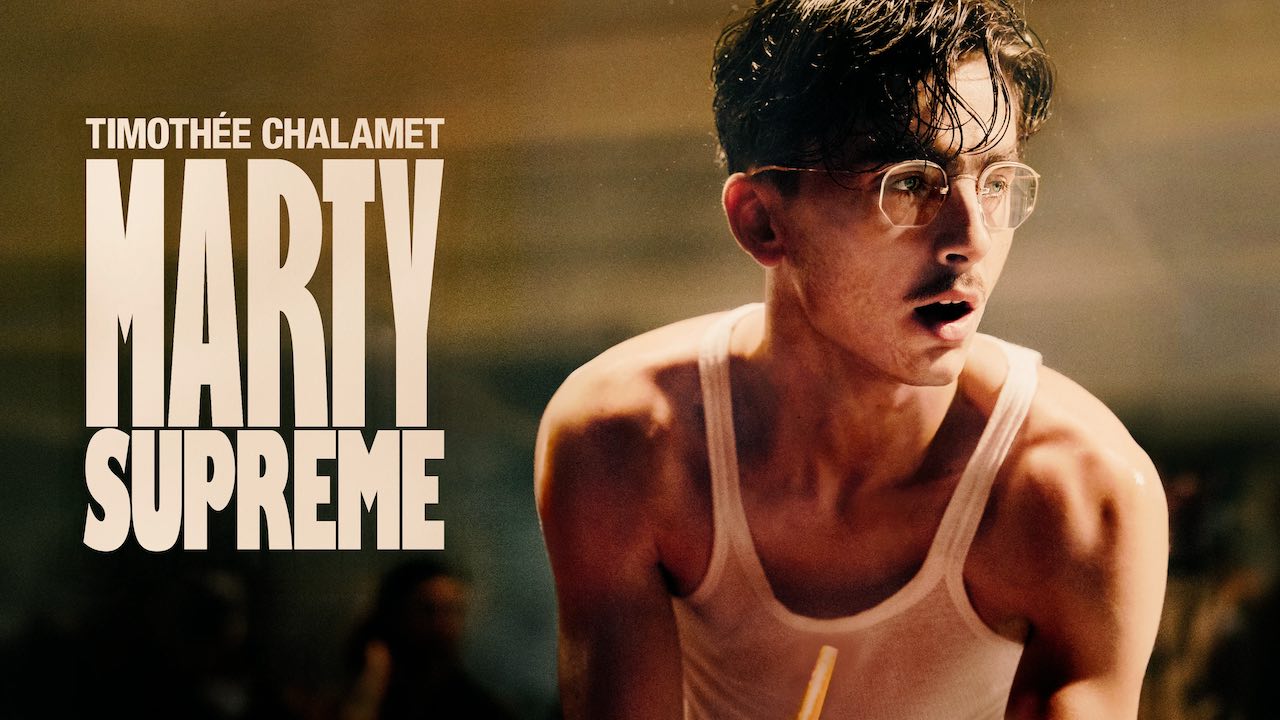
“Marty Supreme”
Spanish Title: Marty Supreme
Year of Production: 2025
Director: Josh Safdie
Director of Photography: Darius Khondji, ASC, AFC
Lenses: Panavision C Series, B Series; Optica Elite
Film Stock: Kodak Vision3 500T 5219
Camera / Format and Aspect Ratio: 35mm anamorphic Panavision, with selected ARRI Alexa 35 material, 2.4:1
Viewed on: DCP
35mm anamorphic, vintage Panavision lenses and carefully matched Alexa 35 material allow Darius Khondji to bring Josh Safdie’s controlled chaos into a warmer, more period-inflected visual world.
The Film
Timothée Chalamet plays Marty Supreme, a young New Yorker in 1952 who works in his uncle’s shoe store. The job does not satisfy him. What he really wants is to make his name in the world of table tennis, and that ambition takes him toward a world championship in London.
Marty has energy, appetite and a fierce desire to force his way into the world. After the tournament, and after meeting a former actress played by Gwyneth Paltrow — now married to a magnate played by Kevin O’Leary — his life becomes increasingly unstable. Each decision produces a new complication, while Marty keeps moving forward as if momentum itself could save him.
In its sense of chaos and narrative acceleration, “Marty Supreme” has a clear connection with “Uncut Gems” (2019), Josh Safdie’s previous film as co-director with his brother Benny Safdie. This new film is also very effective, although perhaps not quite as radical, either thematically or formally. Its use of 1980s songs and electronic music with an eighties imprint gives the period material an additional layer of tension and displacement. The result is still exhausting, in a way that recalls “Uncut Gems,” but the pressure is channeled through a slightly more classical surface. Odessa A’zion, Tyler Okonma and Abel Ferrara, among others, complete the cast.
The Cinematographer
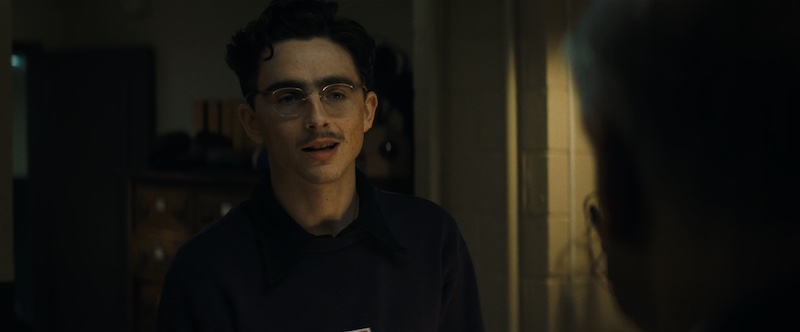
Darius Khondji, ASC, AFC returns here as director of photography for Josh Safdie. Curiously, Benny Safdie also released his own solo feature in 2025, “The Smashing Machine,” photographed by Maceo Bishop, who had been Khondji’s camera operator on “Uncut Gems”.
Khondji is, by now, one of the most respected cinematographers in contemporary cinema. He first emerged in France through his work with Marc Caro and Jean-Pierre Jeunet on “Delicatessen” (1991) and “La Cité Des Enfants Perdus” (1995). He then moved decisively into the international front rank with David Fincher’s “Se7en” (1995), one of the defining cinematographic achievements of the 1990s.
Since then, Khondji has remained consistently visible, while usually attaching himself to directors with a strong authorial identity or clear formal interest. His credits include Alan Parker’s “Evita” (1996), Bernardo Bertolucci’s “Stealing Beauty” (1996), Roman Polanski’s “The Ninth Gate” (1999), several films for Woody Allen beginning with “Anything Else” (2002), Sydney Pollack’s “The Interpreter” (2004), Michael Haneke’s “Funny Games” (2007) and “Amour” (2012), Wong Kar Wai’s “My Blueberry Nights” (2007), and James Gray’s “The Immigrant” (2013), “The Lost City of Z” (2016) and “Armageddon Time” (2022). More recently, he also photographed Alejandro González Iñárritu’s “Bardo” (2022) and “Eddington” (2025).
Visual Style Analysis
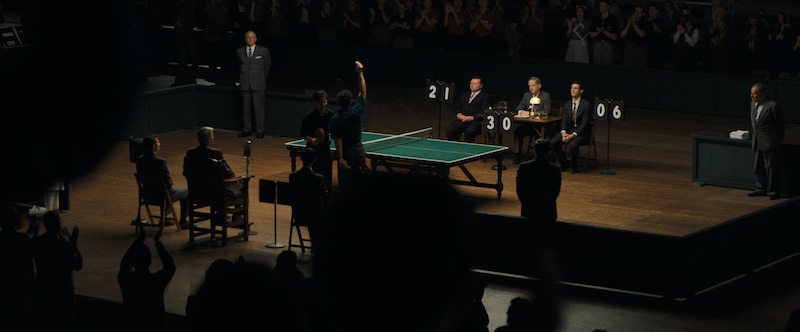
Visually, “Marty Supreme” is less extreme than “Uncut Gems”, but the two films share several important traits. Khondji again works primarily with 35mm film, an anamorphic widescreen frame, older Panavision lenses and a camera style built around movement, compression and nervous proximity to the protagonist. The digital component is still present, this time through the ARRI Alexa 35, apparently used for selected material rather than as the dominant acquisition format.
The difference lies in the period world. Jack Fisk’s production design gives the film a convincing early-1950s environment, and that inevitably changes the visual terms when compared with the contemporary New York of “Uncut Gems.” Interiors tend to be warmer, more yellow, and closer to a tungsten-based atmosphere. Exteriors often move slightly cooler by contrast. There is, at a distance, a faint echo of Gordon Willis’s period work, though “Marty Supreme” is not an especially dark film.
Khondji still uses LEDs and modern sources, but the image feels more rooted in tungsten than in the LED-driven color tension of “Uncut Gems.” That gives the film a more pleasant, rounded and period-inflected texture. It also softens the chaos without neutralizing it. The frame remains active, but the light carries a warmer and more classical surface.
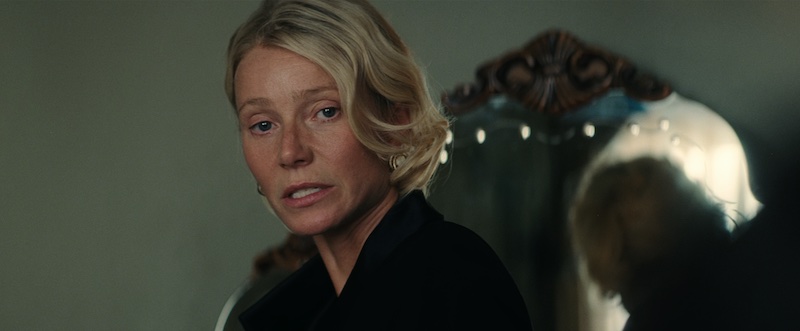
As for the mixture of 35mm and digital acquisition, it is very difficult to separate one from the other in a 2K viewing. The impression is that “Marty Supreme” may contain proportionally less digital material than “Uncut Gems”, where the hybrid workflow was also more clearly documented.
The sequence involving the dog, the car and the gas station seems like one of the stronger candidates for Alexa 35 material. There are also behind-the-scenes images of Gwyneth Paltrow and Timothée Chalamet that show an ARRI Alexa 35 on set. It is therefore possible that the digital component is not limited to complete scenes, but also includes individual shots. In any case, the integration is very accomplished. More importantly, it is conceived with a clear visual purpose, not simply as a practical compromise.
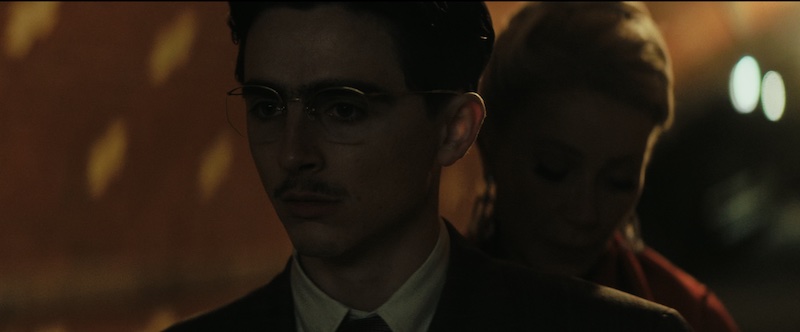
The camera work is by Colin Anderson, who also handles Steadicam. Anderson is especially known for his long association with Paul Thomas Anderson, with whom he has worked at least since “There Will Be Blood” (2007). Here, he represents an excellent replacement for Maceo Bishop, whose handheld and Steadicam work was one of the most admired elements of “Uncut Gems”.
“Marty Supreme” may be more formal and more classical than “Uncut Gems,” if those terms can be used for a Josh Safdie film. But that does not mean the camera becomes passive. It keeps moving, following, reframing and reacting. The difference is that the movements feel slightly more measured and designed. Their execution is one of the film’s strongest visual assets.
Final Thoughts
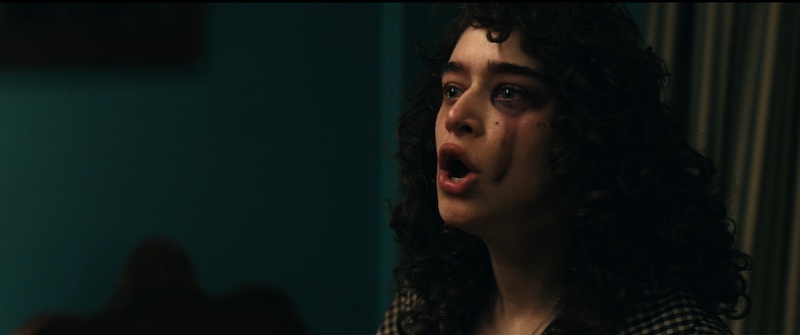
The cinematography of “Marty Supreme” is very strong, with several immediately memorable passages, including the opening table tennis championship. But the film’s real strength lies in the cumulative work from scene to scene and location to location. Khondji builds a soft, sometimes overhead, yellowish and relatively low-level lighting scheme that gives the film a distinctive identity. Once again, he embraces a degree of imperfection as part of the image’s truth. The result feels more alive because it is not over-cleaned.
It is interesting that “Marty Supreme,” while less visually aggressive than “Uncut Gems”, brought Khondji his third Academy Award nomination for cinematography, after “Evita” and “Bardo.” The nomination is entirely understandable. At the same time, Khondji’s filmography contains several works of comparable, and arguably greater, cinematographic importance. That says less against “Marty Supreme” than it does about how selectively his career has been recognized by the Academy. The absence of an Oscar nomination for “Se7en” still remains one of the more striking omissions in modern cinematography awards history.
ON FILM & DIGITAL
© Ignacio Aguilar, 2026.
This article is part of ON FILM & DIGITAL’s English-language cinematography reviews and essays.
The Author
Ignacio Aguilar is available for cinematography work, creative collaborations, lectures, workshops and international projects. He is a Sony Independent Certified Expert (ICE) and Cooke Optics Spanish Ambassador for Cooke SP3 lenses. Contact here.