


“Project Hail Mary”
Spanish Title: Proyecto Salvación
Year of Production: 2026
Director: Phil Lord and Christopher Miller
Director of Photography: Greig Fraser, ASC, ACS
Lenses: ARRI special anamorphic lenses, ARRI Heroes T.One, Atlas Mercury, Viltrox, Ironglass Helios
Format and Aspect Ratio: ARRI ALEXA 65 (ARRIRAW 6.5K) + ARRI ALEXA Mini LF (ARRIRAW 4.5K), 1.90:1 (IMAX Digital) & 2.4:1 (Atlas Scope). In IMAX 70mm, 1.43:1 + 2.4:1.
Viewed on: 4K HDR HDTV
Large-format science fiction, digital capture, photochemical texture and Greig Fraser’s cinematography working at full scale without losing sight of the emotional center.
The Film
Based on the novel by Andy Weir, whose The Martian had already been adapted for the screen by Ridley Scott, Project Hail Mary again comes to cinema through screenwriter Drew Goddard. The story follows Ryland Grace, played with real charm and intelligence by Ryan Gosling: a science teacher who wakes up inside a spacecraft without knowing why he is there, and without any other living crew member on board.
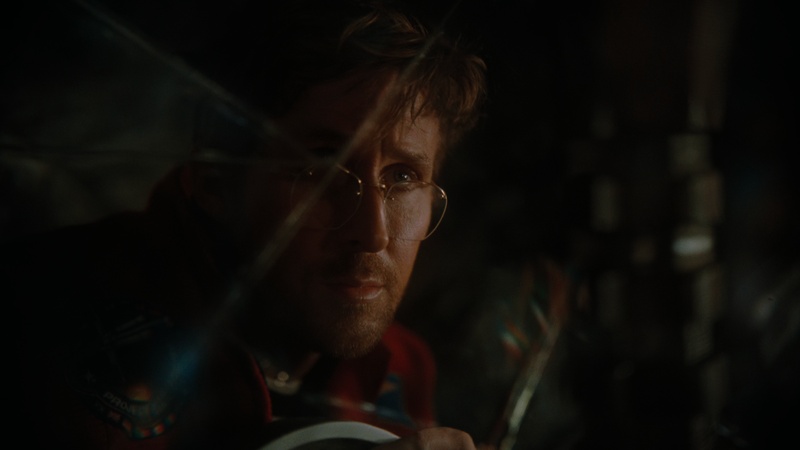
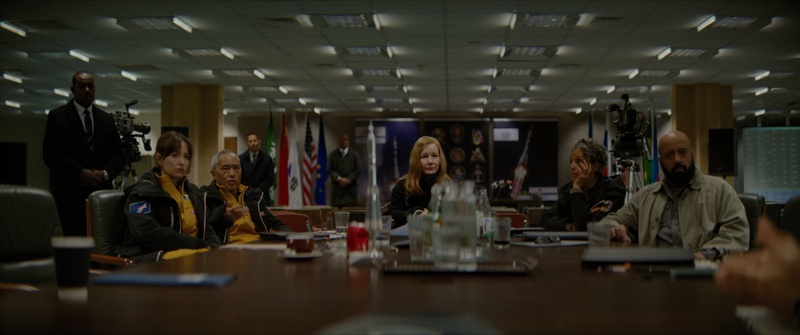
Through flashbacks and fragments of recovered memory, the film gradually reveals that Grace had been recruited for an international scientific mission: to send astronauts into space and try to prevent the Sun from losing its energy, and with it, life on Earth within roughly thirty years. Near the star Tau Ceti, Grace discovers another spacecraft, also apparently occupied by a single living being: an alien he names Rocky because of his physical appearance. Project Hail Mary is a curious mixture of complex science fiction and an often comic treatment of the situation, even though the dramatic stakes remain clear. That tonal balance comes directly from Weir’s book, and Goddard’s screenplay preserves it with the same kind of clarity he brought to The Martian. Phil Lord and Christopher Miller, supported by a very large production, bring that material to the screen with considerable confidence. Above all, they make the improbable friendship between Rocky and Grace work beautifully. In a sense, Project Hail Mary plays as a lighter inverse of the seriousness of Interstellar (2014). It is not opposed to Nolan’s film so much as complementary to it, and it already feels like one of the 2026 films with a real chance of lasting. Sandra Hüller, as the scientist who recruits Grace, and James Ortiz, as the voice of Rocky, complete the main cast.
The Cinematographer
The cinematographer was the Australian Greig Fraser, ASC, ACS, a very logical choice for a project of this nature. His technical command and his visual personality have made him one of the major cinematographers of the decade. With Roger Deakins not taking on the project, Fraser has been entrusted with Sam Mendes’ four films about the Beatles, scheduled for release in 2028. His wider breakthrough probably came with Jane Campion’s Bright Star (2009), soon followed by the excellent Let Me In (Matt Reeves, 2010) and Zero Dark Thirty (Kathryn Bigelow, 2012), as well as Killing Them Softly (Andrew Dominik, 2012), Snow White and the Huntsman (Rupert Sanders, 2012) and Foxcatcher (Bennett Miller, 2014). His definitive consolidation, both in intimate drama and in large-scale cinema, came with the outstanding Lion (Garth Davis, 2016) — for which he received an Oscar nomination and won the ASC Award — and Rogue One: A Star Wars Story (Gareth Edwards, 2017). He won the Academy Award for Dune: Part I (Denis Villeneuve, 2022) and was nominated again for Dune: Part II. His move to the Mendes project prevented him from returning for the third Dune film, where Linus Sandgren has taken over.
Visual Style Analysis
The cinematography of Project Hail Mary is clearly divided between two narrative lines: the space material, and the Earth-bound flashbacks that explain why Ryland Grace is aboard that ship with no memory of how he got there. For the space sequences, the filmmakers had IMAX exhibition in mind. But for reasons of space, logistics and practical filmmaking, Fraser apparently did not want to shoot in the true photochemical IMAX format. Instead, he chose the ARRI ALEXA 65 as a digital large-format route toward an IMAX presentation. To do this, working with ARRI Rental, the filmmakers used a set of special anamorphic lenses configured so that the anamorphic compression acted on the vertical axis. In other words, instead of expanding the horizontal axis like a conventional anamorphic system, the anamorphic treatment in this section of Project Hail Mary appears to operate vertically.
That effect is visible on screen. Instead of the usual vertical ovals, the projected image shows horizontal ovals; and when blue anamorphic flares appear, they are vertical rather than horizontal. This allowed the filmmakers to use the 65mm sensor of the ALEXA 65, whose native aspect ratio is approximately 2.20:1, and move toward the 1.43:1 height of 70mm IMAX projection and compatible IMAX theaters, or toward 1.90:1 in much of digital IMAX exhibition. The film also uses what Fraser calls the “Scooby-Doo” effect to soften and integrate the transitions between full-height sections and the letterboxed flashbacks. These are trails and image distortions that help connect the IMAX present inside the spacecraft with Grace’s memories on Earth. The process was achieved by re-photographing the memory sequences from a 4K monitor onto film with an ARRI 435, using an intentionally offset shutter to create that organic drag in the image.
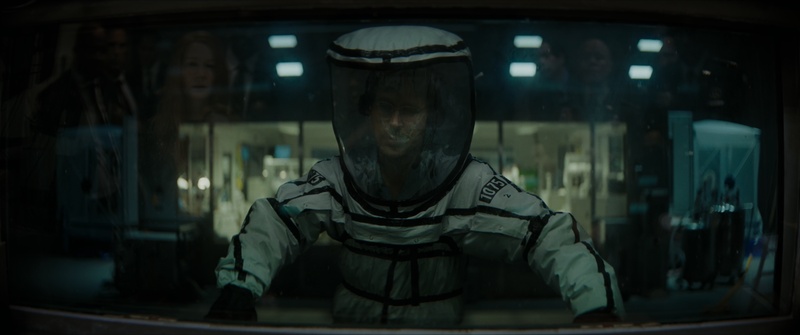
These aspect ratios are not used only to show Grace inside his own spacecraft or inside Rocky’s. They also shape many of the visual-effects shots. But most of Fraser’s work, logically, takes place inside the ship interiors. As a general principle, the lighting is high in contrast and strongly directional. When Ryan Gosling is held in backlight or side-backlight, his face often appears to sit around -2.5 stops. That happens frequently, but the exposure still carries enough information for the face to remain readable. It is a shadow-driven image, even when some moments are luminous. Fraser seems close here to the school of Jordan Cronenweth in Blade Runner, where much of the visual interest comes from the low values, from the shadow side of the image, rather than from what is shown under full, frontal visibility.
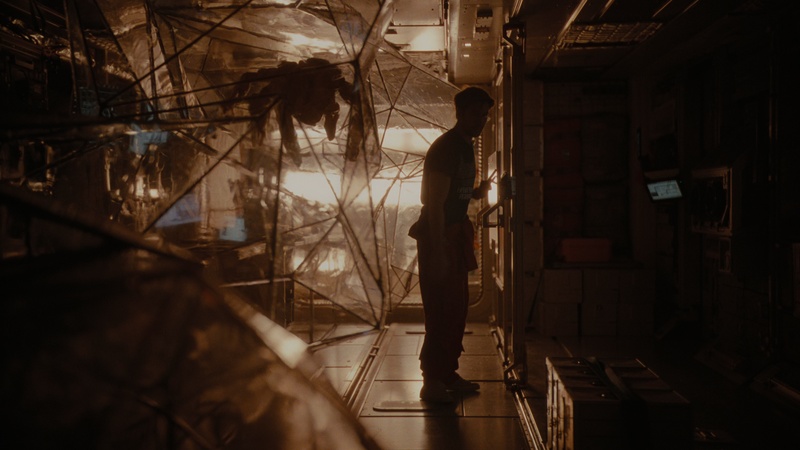
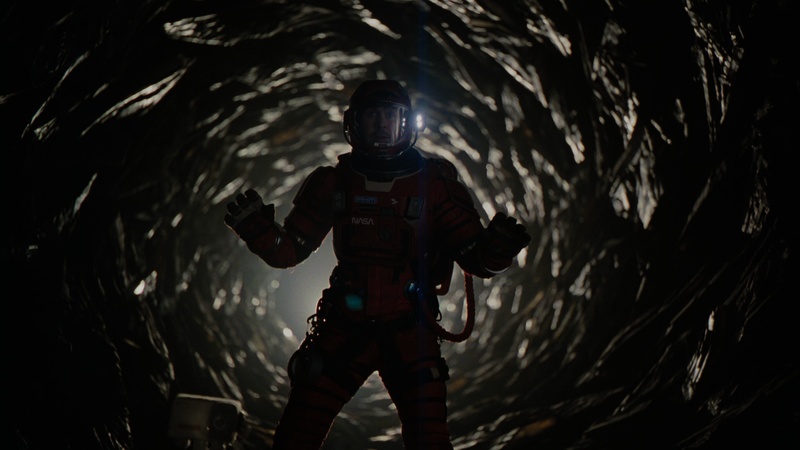
Fraser also avoids, almost always, the obvious overhead light one might expect in this kind of spacecraft interior. Instead, the tubular ship is often lit from one end, producing strong transitions between light and shadow depending on the camera angle and the position of the actor within the set. Many scenes also use constant shifts in color — generally between neutral white and a warmer tungsten-like quality — together with changes in intensity and movement. The result is that the ship seems to be traveling, vibrating and changing state around Grace. The tunnel connecting the two spacecraft makes especially strong use of integrated light and reflections.
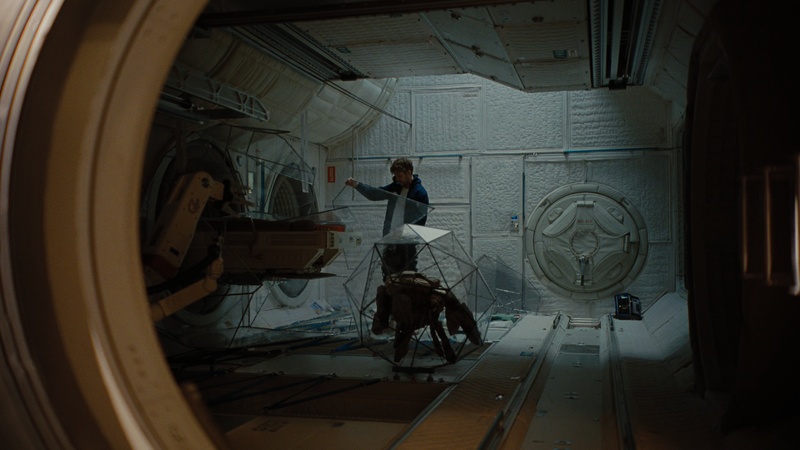
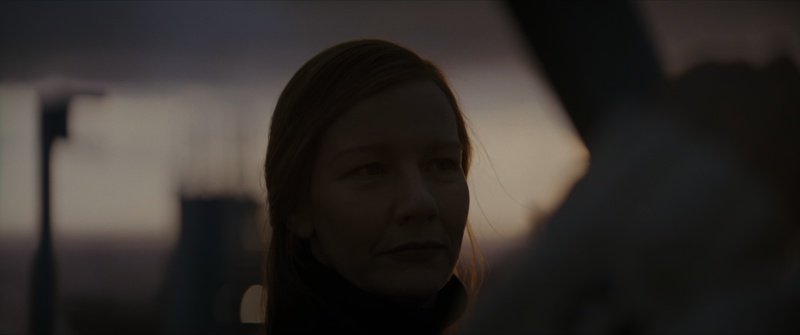
The Earth scenes are different. Their texture is cleaner, because the space material was pushed toward a more pronounced photochemical texture through a film-out process in postproduction. This is not simply an artificial layer of grain placed on top of the finished image. It is a hybrid process in which an image originally captured digitally gains density, grain, slight instability and a more organic highlight response by being recorded back onto film. The change in capture also matters. Instead of the ALEXA 65, the filmmakers moved to the ALEXA Mini LF with Atlas Mercury 1.5x anamorphic lenses, not to be confused with Atlas’ first Orion series, which are 2x anamorphics. In these passages there is a marked use of longer focal lengths, probably from the 54mm upward, with less intense blacks and a great deal of handheld work at fairly open apertures.
This produces a more direct, documentary-like feeling. It is also a little softer, and perhaps closer to the logic of memory, than the main space material shot in Fraser’s unusual form of digital IMAX. The lighting follows related principles and is recognizably Fraser: soft side light from a single source, high contrast, delicate transitions between light and shadow, and relatively low color saturation. Even so, the Earth material is perhaps less visually compelling than the spacecraft material. The interior space work is more spectacular and represents a major technical achievement, especially when the film has to deal with gravity, zero gravity, action and suspense without making the apparatus feel visible.
Conclusion
The result is very strong. What matters is not only that the film looks good — that is almost expected from a production of this scale — but that Fraser makes the considerable technology behind the image feel practically invisible. There are many shots in which a large amount of postproduction work is obviously involved, both inside the spacecraft and, even more clearly, outside it. Yet because Fraser brings a naturalistic and organic visual approach to the material, the image remains believable.
It does not fall into the kind of spectacle where live action and visual effects seem to belong to two different worlds. That is especially important in a film whose emotional center is the friendship between its two main characters. The more invisible the technique becomes, the easier it is for the viewer to stay with that relationship, to accept the humor, and perhaps to be moved by the ending. In the end, that is how it should be: technique in the service of art, and art in the service of story.
ON FILM & DIGITAL
© Ignacio Aguilar, 2026.
This article is part of ON FILM & DIGITAL in English, Ignacio Aguilar AEC’s archive of cinematography essays, technical guides, lens tests and film photography reviews.
These texts are not plot summaries or general film reviews, but cinematography-focused essays written from the perspective of a working cinematographer.
The Author
Ignacio Aguilar, AEC is a cinematographer / director of photography based in Madrid, Spain. His work spans feature films, television, commercials and technical writing on cinematography, with experience in digital cinema, 16mm and 35mm film, anamorphic lenses, large-format digital capture, lens testing and film-based workflows.
He is a member of the Spanish Society of Cinematographers (AEC) and the Spanish Academy of Cinema, a Sony I.C.E. Certified Expert and a Cooke SP3 ambassador. His writing has appeared in American Cinematographer and Camera & Light, and ON FILM & DIGITAL gathers his bilingual essays, technical guides and cinematography reviews.
For professional work, collaborations, lectures, workshops or cinematography consulting, visit his professional biography, selected works or contact page.