

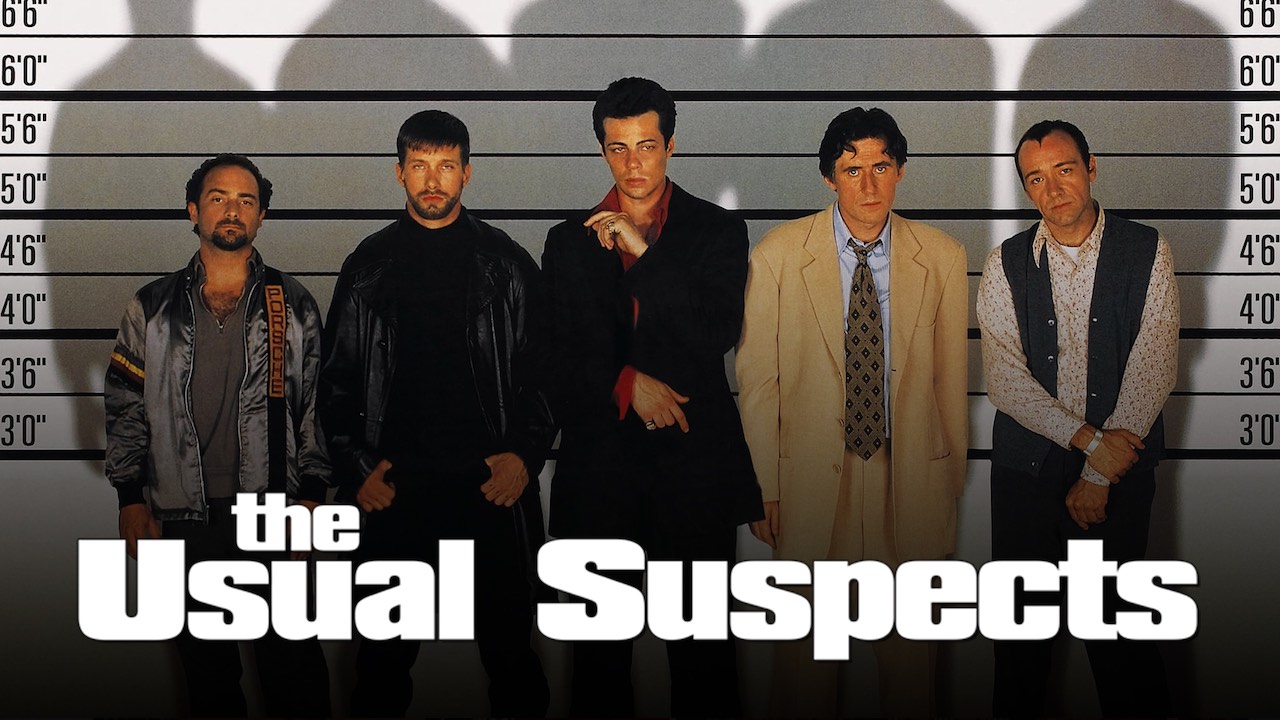
“The Usual Suspects”
Spanish Title: Sospechosos habituales
Year of Production: 1995
Director: Bryan Singer
Cinematographer: Newton Thomas Sigel, ASC
Lenses: Panavision
Format and Aspect Ratio: Super 35, 2.4:1
Newton Thomas Sigel [ASC] gives The Usual Suspects a distinctly 1990s thriller image: Super 35, Panavision zooms, dense blacks, hard light and a carefully stylized form of confusion.
The Film
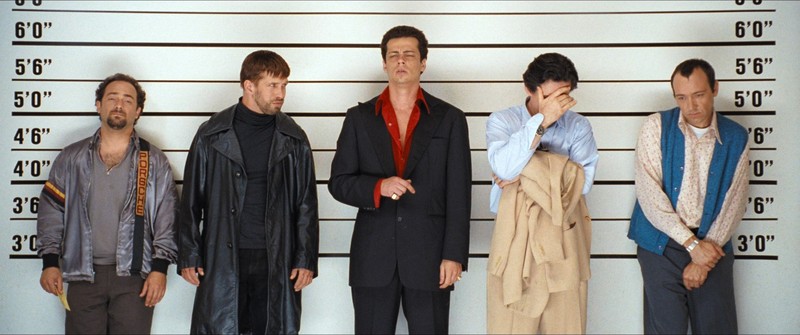
One of the most popular crime thrillers of the 1990s, “The Usual Suspects” consolidated Kevin Spacey’s position in the industry and marked the emergence of screenwriter Christopher McQuarrie — who, like Spacey, won an Academy Award — and director Bryan Singer. The story follows a group of five criminals (Gabriel Byrne, Kevin Pollak, Stephen Baldwin, Benicio Del Toro and Spacey) involved in a series of jobs, the last of which takes place on a ship docked in the harbor, leaving multiple people dead.
A police officer (Chazz Palminteri) interrogates the only survivor, and the film unfolds through a fragmented narrative that gradually reveals what happened.
The concept is powerful, and the film was enormously successful. Yet “The Usual Suspects” is also uneven, deliberately confusing and heavily conditioned by its famous final twist. Singer often seems more interested in protecting the impact of that ending — planting several traps along the way — than in constructing a narrative whose internal logic leads cleanly toward it.
Nevertheless, it remains a prestige thriller. Its most interesting section is, without question, the central stretch, where McQuarrie’s screenplay focuses on the group’s working methods and internal dynamics.
The Cinematographer
The cinematographer was Newton Thomas Sigel [ASC], a regular collaborator of Bryan Singer. Including this film, the two worked together on roughly ten features, among them “Apt Pupil” (1998), “X-Men” (2000), “X-Men 2” (2003), “Superman Returns” (2006), “Valkyrie” (2008) — possibly the strongest of their films together — and “Bohemian Rhapsody” (2018), whose difficult production appears to have marked the definitive end of their professional relationship.
Sigel had a very early feature debut, at the age of 30. After shooting a series of documentaries, he photographed “Latino” (1985), a Lucasfilm production written and directed by none other than Haskell Wexler. Although his relationship with Singer has been his longest-running collaboration, Sigel also photographed “Blood & Wine” (Bob Rafelson, 1996), “Fallen” (Gregory Hoblit, 1998), “Three Kings” (David O. Russell, 1999), “Confessions of a Dangerous Mind” (George Clooney, 2002), “The Brothers Grimm” (Terry Gilliam, 2005), “The Conspirator” (Robert Redford, 2010) and one of the earliest and best-known projects shot on the Arri Alexa, “Drive” (Nicolas Winding Refn, 2011).
Sigel was also closely connected professionally to Robert Richardson, ASC, working under him on second unit during the Oliver Stone period, including titles such as “Platoon” (1986) and “The Doors” (1991).
Visual Style Analysis
The image of “The Usual Suspects” is quite typical of American cinema in the 1990s, even though the film was an independent production. In order to obtain a 2.35:1/2.40:1 release print while shooting on 35mm, the filmmakers chose the format that had become increasingly fashionable at the time: Super 35.
Instead of using anamorphic lenses, which were more expensive to rent and more demanding to handle in many situations, Super 35 allowed the production to work with conventional spherical lenses. The conversion to anamorphic theatrical projection was carried out later, during the photochemical process, through an optical blow-up.
Image quality was usually lower and grainier than direct anamorphic photography, but in the case of “The Usual Suspects” this approach made it possible to shoot a considerable amount of footage with Panavision zoom lenses, probably around T/2.8. There are many examples of their use in the film, sometimes simply to move closer to or farther away from the actors, but also to make small adjustments to the frame during the shot. There are also two or three moments that appear to use extended-depth-of-field effects created with slant-focus lenses or similar optics, producing a curved plane of focus rather than the more familiar split-diopter effect.
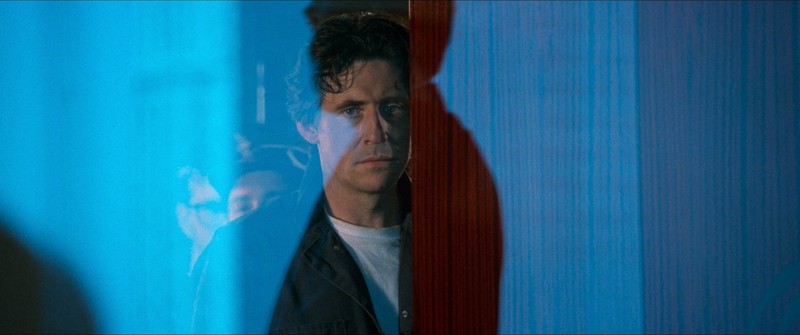
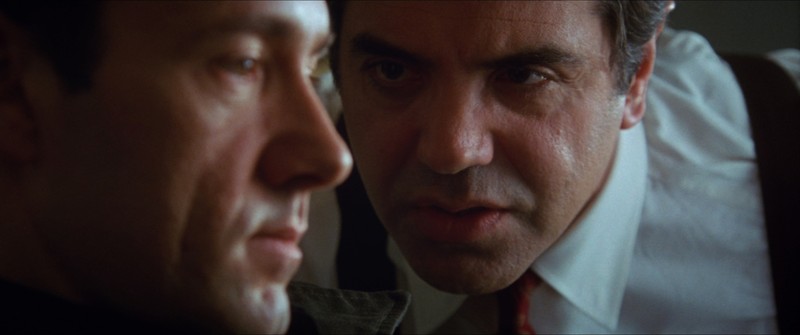
Aesthetically, the film is curious because, at least in some respects, Newton Thomas Sigel seems to be imitating or paying homage to Robert Richardson himself. In the interrogation sequences, one finds the famous overhead source that Richardson turned into one of his trademarks, especially from “JFK” (Oliver Stone, 1991) onward. There are also beams of light, atmosphere and a Pro-Mist-like diffusion — also very fashionable at the time — that strongly recall the cinematographer of “Casino” (Martin Scorsese, 1995).
Sigel’s lighting, in any case, is very competent: from the office and police interiors to the night exteriors on the ship, the group’s encounters with other criminals, the various jobs — such as the police car sequence — the assaults, including the parking-garage scene, and the intimidation scenes, such as the one at the top of the office building and in the elevator.
This is not especially spectacular cinematography, but it is highly representative of its period: elevated color saturation, deep blacks, strongly marked hard or semi-hard sources, and a 35mm texture that places the film firmly within a specific type of American 1990s thriller. It sits within the high level of craft that characterizes Sigel’s work, even if it is not among his very best photography.
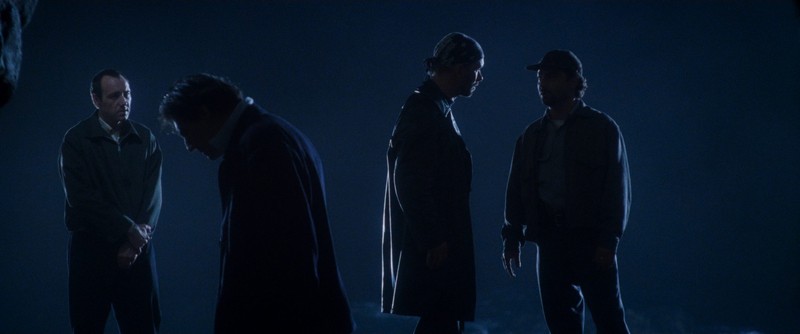
My reservations have more to do with the direction. There are transitions between different temporal layers that are well planned and effectively linked through editing. But the ship sequences, which appear at the beginning and again at the end of the film, are chaotic and quite opaque in terms of dramatic geography. It is not always clear where each character is, what he is doing, who exactly the men on the ship are, or what the immediate logic of the action is.
It is difficult to know whether this is a directing problem — and therefore an incorrect approach to the scenes — or a deliberate strategy to confuse the viewer, as is clearly the case with the fact that the famous Keyser Söze was played by as many as five different actors. In an area where, for example, Brian De Palma has always been a specialist — describing with total clarity everything that is deliberately obscured here — this chaos seems designed to protect the final twist at the expense of narrative clarity.
Conclusion
In other words, instead of being a “Rashomon” (Akira Kurosawa, 1950)-like film that returns to events we have already seen in order to give them a new perspective, “The Usual Suspects” plays the opposite game. Its main tools are concealment, misdirection and confusion.
That strategy can be very effective on a first viewing, but it also limits the film’s solidity when its staging is examined from a certain distance.
ON FILM & DIGITAL
© Ignacio Aguilar, 2026.
This article is part of ON FILM & DIGITAL’s English-language cinematography reviews and essays.
The Author
Ignacio Aguilar, AEC is a cinematographer based in Madrid, Spain. He is available for cinematography work, creative collaborations, lectures, workshops and international projects. He is a Sony Independent Certified Expert (ICE) and Cooke Optics Spanish Ambassador for Cooke SP3 lenses. Contact here.