

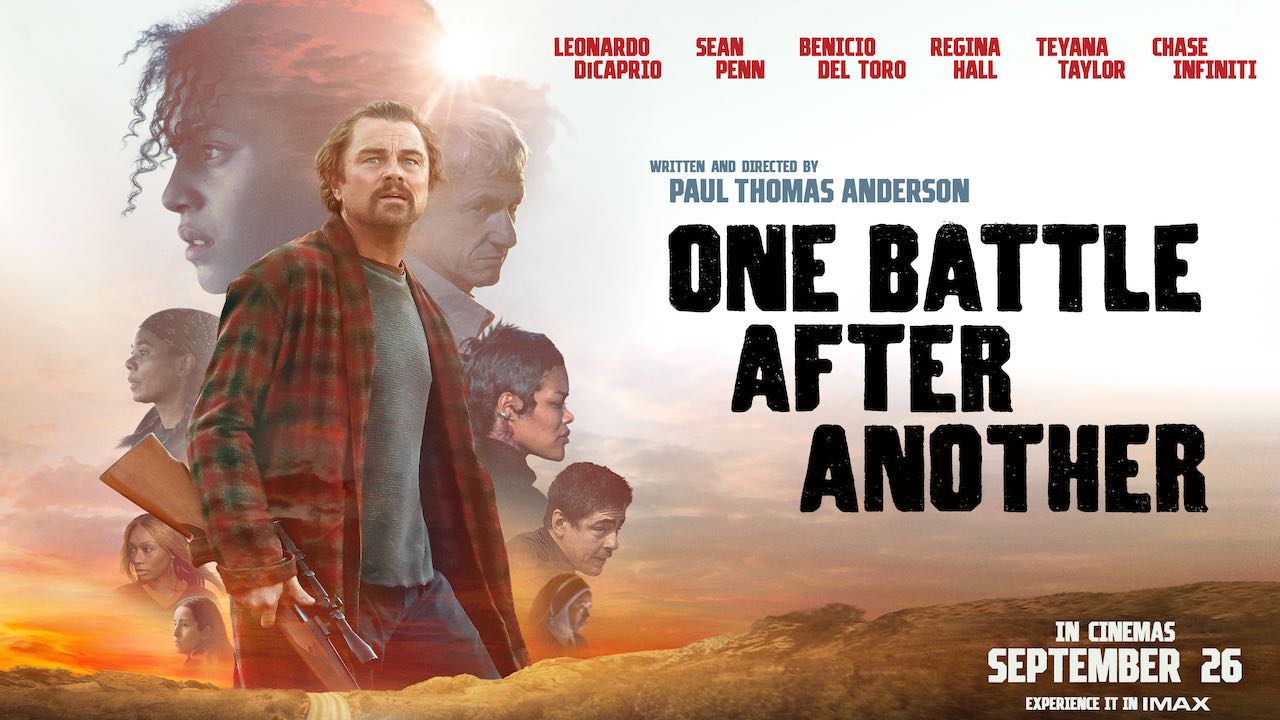
“One Battle After Another”
Spanish Title: Una Batalla Tras Otra
Year of Production: 2025
Director: Paul Thomas Anderson
Director of Photography: Michael Bauman
Lenses: Panavision GW, Panavision Primo
Film Stock: Kodak 5217 200T, Kodak 5207 250D, Kodak 5219 500T
Format and Aspect Ratio: 8-perf 35mm VistaVision + 4-perf 35mm Super 35, 1.85:1
Other: Digital Intermediate; also presented in IMAX, 70mm and VistaVision
Awards: Academy Award nomination for Best Cinematography; ASC, BAFTA and British Society of Cinematographers nominations
Viewed on: DCP and 4K HDTV
Paul Thomas Anderson embraces large-scale auteur spectacle, while Michael Bauman gives the film the force, texture and expressive imperfections of VistaVision.
The Film
One Battle After Another is reportedly a very loose adaptation of Thomas Pynchon, structured across two periods. Sixteen years in the past, Bob, played by Leonardo DiCaprio, and Perfidia, played by Teyana Taylor, belong to a revolutionary terrorist group known as the French 75. In the present, Steve Lockjaw, a military officer played by Sean Penn, tries to find them. He once pursued Perfidia, had a relationship with her, and now believes that her daughter, Willa, played by Chase Infiniti, may be his own child. That possibility threatens his desired acceptance into a white supremacist organization.
Once Bob and Willa are located, they are forced to run. Their escape is helped by Sensei, played by Benicio del Toro, who sympathizes with their cause because he also assists undocumented immigrants. In Paul Thomas Anderson’s hands, the film hides a high-budget auteur work behind the surface of commercial cinema. Its connection to the American cinema of the 1970s is evident, as is often the case with Anderson. But the film also works on a more immediate level: it moves fast, plays broadly, and can be enjoyed simply as a large-scale chase movie with political and absurdist undertones.
That double register is part of its interest. One Battle After Another is not only a plot machine, nor only a political allegory. It is a restless piece of staging, performance and movement, filled with comic anxiety and sudden bursts of action. Alana Haim, Regina Hall, Eric Schweig and John Hoogenakker, among others, complete the ensemble of what is clearly intended as a major cinematic event.
The Cinematographer
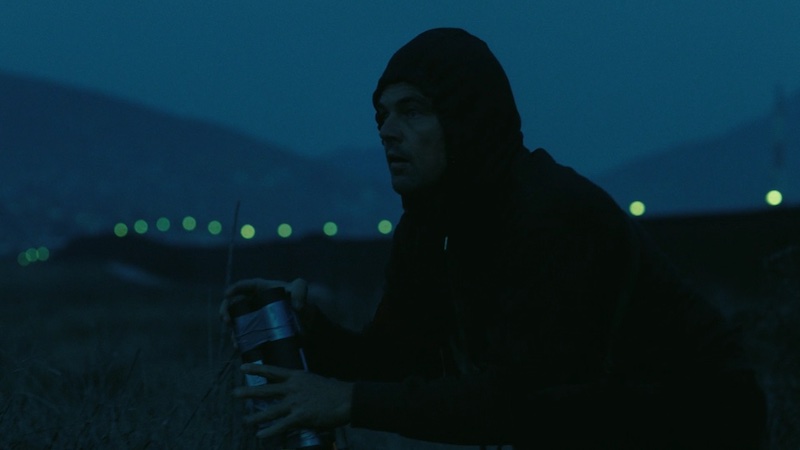
The director of photography is Michael Bauman, who receives sole cinematography credit here after a gradual transition within Paul Thomas Anderson’s team. On Phantom Thread (2017), Bauman was credited as lighting cameraman, an older British-style credit often used for a cinematographer primarily responsible for lighting. On Licorice Pizza (2021), he shared the cinematography credit with Anderson himself.
Before that, Bauman had entered Anderson’s crew as gaffer on The Master (2012), photographed by Mihai Malaimare Jr. He repeated that role on Inherent Vice (2014), this time under Robert Elswit, who had photographed all of Anderson’s features before The Master. Bauman’s career as a gaffer is unusually strong. In recent years alone, his collaborators have included Greig Fraser on Vice, Phedon Papamichael on Ford v Ferrari, Bruno Delbonnel on The Tragedy of Macbeth, and Emmanuel Lubezki on Amsterdam.
That background matters. Bauman’s work here is not the work of a technician suddenly placed in charge of the image. It feels like the work of someone who has spent years understanding how light behaves inside ambitious, director-driven productions. One Battle After Another may be his clearest statement so far as Anderson’s principal cinematographic partner.
Visual Style Analysis
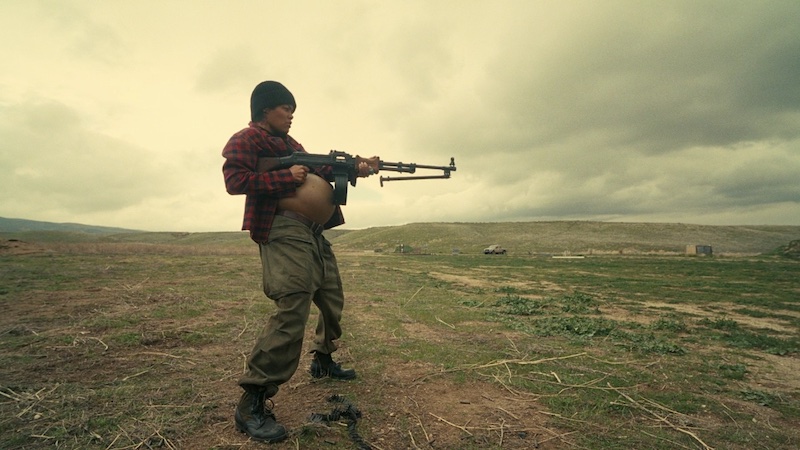
Visually, One Battle After Another belongs to the recent VistaVision revival, using large-format 35mm texture, practical imperfection, mixed color temperatures and Michael Bauman’s freer approach to Paul Thomas Anderson’s staging.
One Battle After Another cinematography belongs to the recent VistaVision revival, alongside titles such as The Brutalist and Bugonia. VistaVision is the horizontal 8-perf 35mm format: essentially twice the negative area of conventional 4-perf 35mm. It had not been used as a principal dramatic feature format for decades, after films such as One-Eyed Jacks (Marlon Brando, 1961). Earlier, Alfred Hitchcock had used it on To Catch a Thief, Vertigo and North by Northwest, while Cecil B. DeMille used it for The Ten Commandments.
In practical terms, VistaVision is very close to what digital cinematographers now call full frame, but on film. The format offers a larger negative, finer grain and a distinct sense of clarity. It also creates logistical problems. VistaVision cameras are bulkier because of the horizontal film movement, and the magazines make the bodies less comfortable to operate. They are also noisy, which can complicate interiors, small rooms and dialogue scenes.
Anderson and Bauman had to deal with all of that. The film includes intimate dialogue, Steadicam work, action, night material and a superb chase sequence. The solution was not to force every scene through the same technical system. The production used a broad camera package, combining conventional 4-perf 35mm Panaflex bodies with multiple VistaVision bodies and a large selection of spherical Panavision lenses. Among them were the Panavision GW prototypes, inspired by the very fast Panavision lenses associated with Gordon Willis in the 1970s and 1980s.
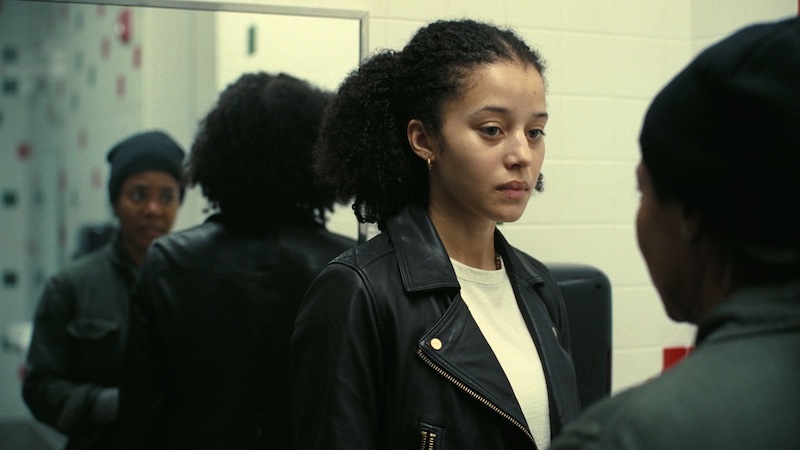
Visually, the film feels modern from its first images, even when it moves into scenes set sixteen years earlier. Much of that impression comes from the color reproduction and sharpness of VistaVision. The image has a muscular clarity, but not a polished or decorative one. It is often bright, exposed with confidence, and willing to let practical sources remain inside the frame.
The key is that Anderson and Bauman do not use those sources to create a perfectly refined look. They seem more interested in a controlled imperfection. Lamps do not always sit at the same level from one scene to the next. Actors are not always held at the most flattering or exact exposure. Rooms appear to be lit as spaces, and then the performers are allowed to move through them. Sometimes the light helps them; sometimes it does not.
That choice gives the film much of its energy. It creates overexposure, uneven practicals and areas of underexposure where grain becomes more visible. The image can look less precise, but it also feels less sealed-off. It behaves as if imperfection were part of the film’s relationship to reality.
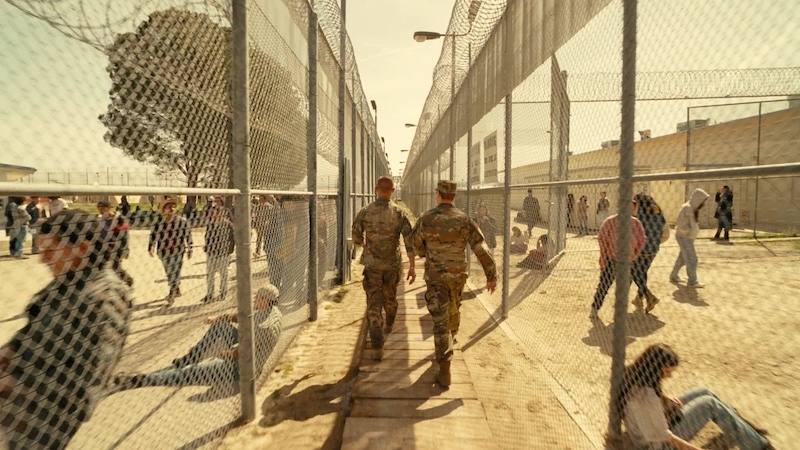
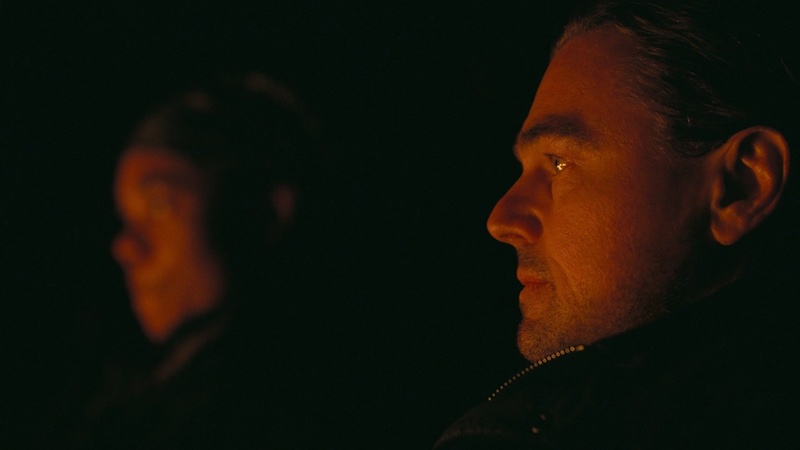
Bauman also works with a broad range of color temperatures. The first section uses industrial sources that suggest mercury-vapor contamination. Elsewhere, cool daylight-balanced fluorescents or LEDs give the image a slightly cold cast. Other interiors push in the opposite direction, becoming intensely warm. The first encounter between Perfidia and Steve Lockjaw is a good example, as are the scenes in which Leonardo DiCaprio speaks by phone from Benicio del Toro’s house.
There is also very strong large-scale lighting, especially during the military incursion into the city in search of Bob and Willa. Bauman and his team use visible LED sources in the background without trying to hide the method. Blue police lights, fire, streetlamps and other sources become part of the texture. The lighting is not invisible. It is integrated into the mise-en-scène as a pressure system.
Smaller interiors often follow the same principle. Ceiling fluorescents act as main sources. Warm table lamps mix with soft exterior coolness in the scenes with Bob and Willa at home. The film is not afraid of color conflict. It uses mixed sources as part of its tonal instability.
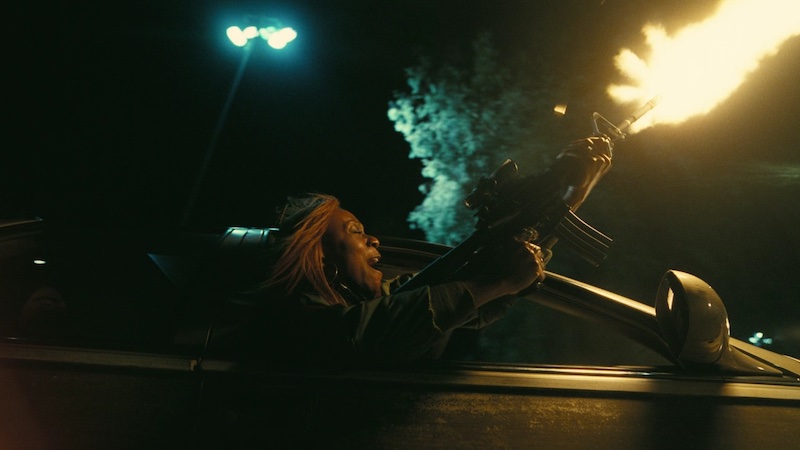
In general, the film is exposed well enough for VistaVision to show its advantages. At times it may even feel slightly overexposed, but that also allows the format to breathe. The larger negative gives the image crispness, color strength and a certain physical presence. When the exposure is healthy, the result can be very striking.
There are, however, clear variations. Some scenes with DiCaprio and Benicio del Toro fleeing by car at night have a more pronounced grain structure, weaker blacks and less density. It is possible that these passages belong to the 20 or 25 percent of the film reportedly shot in Super 35, mainly for dialogue interiors or more difficult setups. The grain is more visible there, and the definition is less crystalline.
It is not always easy to determine which scenes are VistaVision and which are Super 35. The production also used push processing and different Kodak stocks with different speeds, so the texture varies for several reasons at once. Interior dialogue with the camera close to the actors is the most likely candidate for Super 35. Curiously, one of the grainier scenes appears to be the church interior between Chase Infiniti and Sean Penn, even though the space does not seem especially small or dark.
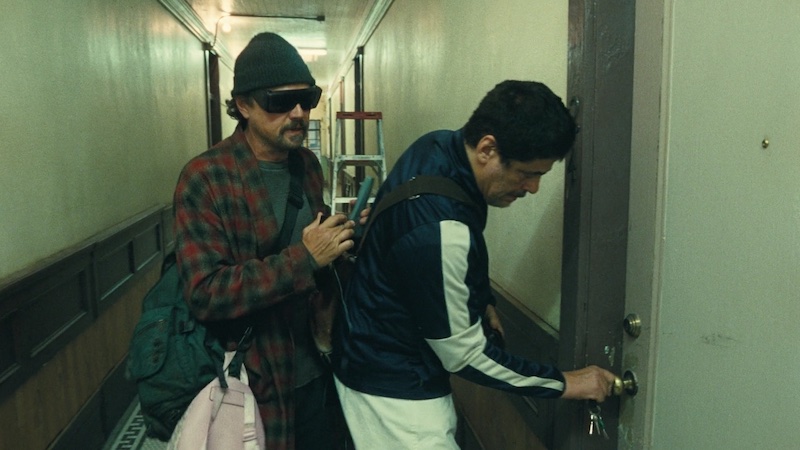
Even with those variations, One Battle After Another is a very sharp film, full of optical character. The chosen lenses are prone to flares, veiling and loss of contrast when strong light hits the glass. Those artifacts are not treated as mistakes. They are part of the visual behavior of the film.
The staging is also exceptional. In addition to the Steadicam work, Anderson and Bauman use cranes, zooms, helicopters and a wide range of vehicle rigs. The final chase contains some extraordinary frontal car shots. They have the physical immediacy of practical photography, while still benefiting from the scale and clarity of the format.
At the same time, the rawness is not the same as realism. Color is clearly being used with expressive intention. The film often feels rough, but not casual. Compared with the best Anderson films photographed by Robert Elswit, the image is less classically refined and less carefully balanced. Elswit also allowed imperfection into Anderson’s cinema, but usually with a firmer sense of visual control. Bauman’s approach is freer, more volatile and more open to inconsistency.
Conclusion
The film shows a radical evolution in Anderson’s visual language. His talent for staging remains unquestionable, but here he seems more willing than ever to embrace inconsistency. Washed-out frames, practical overexposures and shifting exterior light are not always corrected or hidden. In the final section, one can sometimes feel that the first priority is the camera and the moment, rather than the sun, its direction, its intensity or continuity.
That freedom is both the film’s strength and its weakness. Some images have a raw charge that a more polished approach might have reduced. Others feel less controlled than they might have under Elswit, who would probably have resisted some of the looser overexposures and washed practicals. But the energy is undeniable. The film is full of intention, freshness and movement.
For all its irregularities, One Battle After Another remains one of the cinematographic works of the year. It is the strongest of the three films Anderson and Bauman have made together in this evolving collaboration, regardless of the exact credit structure on each project. The image is not perfect, and does not try to be. Its best moments come from that tension: VistaVision precision placed inside a film that wants to feel unstable, immediate and alive.
ON FILM & DIGITAL
© Ignacio Aguilar, 2026.
This article is part of ON FILM & DIGITAL’s English-language cinematography reviews and essays.
These texts are not plot summaries or general film reviews, but cinematography-focused essays written from the perspective of a working cinematographer.
The Author
Ignacio Aguilar is available for cinematography work, creative collaborations, lectures, workshops and international projects. He is a Sony Independent Certified Expert (ICE) and Cooke Optics Spanish Ambassador for Cooke SP3 lenses. Contact here.