


“Frankenstein”
Spanish Title: Frankenstein
Year of Production: 2025
Director: Guillermo del Toro
Director of Photography: Dan Laustsen, ASC, DFF
Lenses: Leica Thalia
Format and Aspect Ratio: ARRI Alexa 65, 1.85:1; RED V-Raptor XL + ARRI Signature Prime for VFX / miniature work
Other: 4K Digital Intermediate
Viewed on: HDTV
Alexa 65, Leica Thalia 24mm and gothic spectacle pushed to the edge: Dan Laustsen gives Guillermo del Toro’s Frankenstein scale, movement and a visual excess that is often as dominant as the drama itself.
The Film
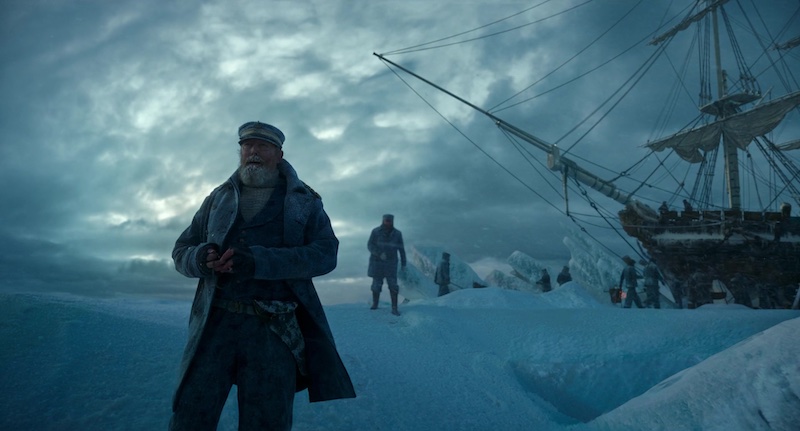
Guillermo del Toro’s Frankenstein is a new adaptation of Mary Shelley’s novel, returning once again to the idea of dead flesh brought back to life by Victor Frankenstein, played by Oscar Isaac. This version begins in the Arctic, where a group of Danish sailors has seen its ship trapped in the ice. After a violent explosion, they encounter Frankenstein and his creature, played by Jacob Elordi — a being who appears unable to die and who pursues his creator in revenge for having been made.
From that prologue, the film divides itself into two large narrative blocks. The first is told by Frankenstein; the second, by the creature. At two and a half hours, this Frankenstein often feels both overextended and overdesigned. Del Toro is not bringing enough that is genuinely new to the material to fully justify the scale, duration and resources placed at his disposal. The film works better, perhaps surprisingly, when it moves closer to its characters — especially in the section in which the creature hides and longs for friendship — than when it turns toward the kind of grandiose imagery that may have been more persuasive as an idea than as a finished cinematic experience. Christoph Waltz and Charles Dance, almost in cameo-like roles, appear alongside Felix Kammerer, Lars Mikkelsen and Mia Goth.
The Cinematographer
The cinematographer, once again in Guillermo del Toro’s career, is the Danish director of photography Dan Laustsen, ASC, DFF. They had first worked together in the 1990s on Mimic (1997), when Del Toro’s regular cinematographer was still his fellow Mexican Guillermo Navarro. After Navarro moved more fully into directing, Del Toro and Laustsen reunited on Crimson Peak (2015), followed almost immediately by the successful The Shape of Water (2017), for which Del Toro won the Academy Award for Best Director and Laustsen received an Oscar nomination for cinematography.
Laustsen was nominated again for Nightmare Alley (2021), which, like Frankenstein, was photographed mainly with the ARRI Alexa 65. Outside his collaboration with Del Toro — the association that has brought him his greatest international prestige — Laustsen is best known for his work on the John Wick films, where his use of LED color mixing became a reference point for contemporary action cinema. His filmography also includes fantasy and genre titles such as Le Pacte des Loups (Christophe Gans, 2001), Silent Hill (Christophe Gans, 2006) and the much less successful The League of Extraordinary Gentlemen (Stephen Norrington, 2003).
Visual Style Analysis
Visually, Frankenstein is built around an unusually aggressive large-format wide-angle strategy: Alexa 65, Leica Thalia lenses, a dominant 24mm focal length, constant camera movement and a gothic lighting style that favors spectacle over restraint.
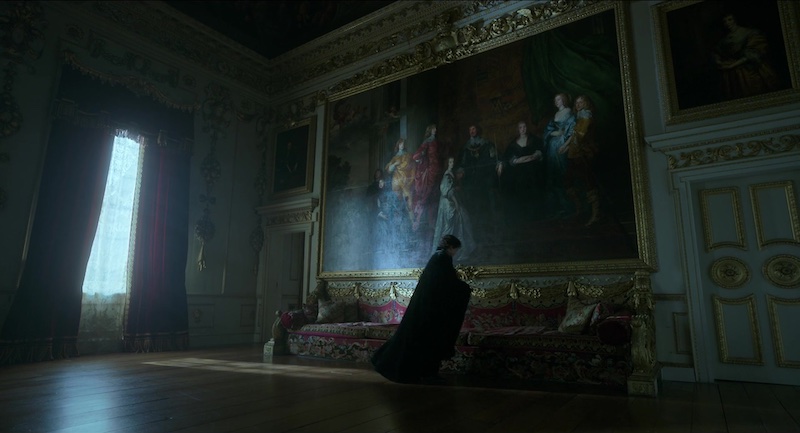
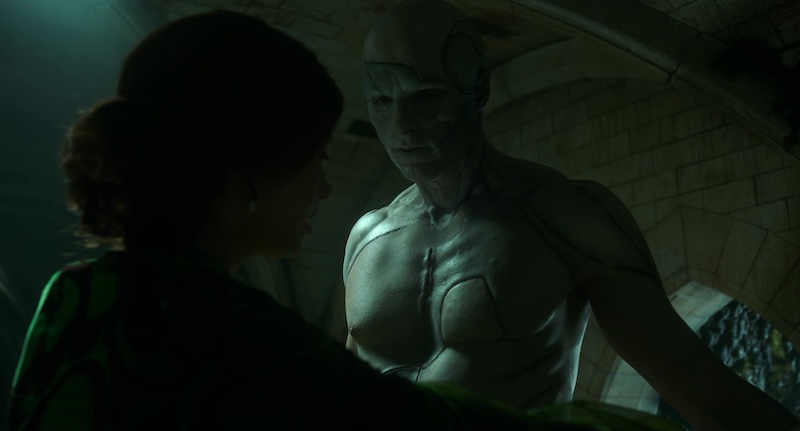
The image of Frankenstein is defined above all by the filmmakers’ decision to shoot much of the film — reportedly around 90 percent — with a single lens: the Leica Thalia 24mm. On the ARRI Alexa 65, composed for 1.85:1, that focal length is roughly comparable to using a 12mm lens in Super 35. In other words, the perspective of Frankenstein is extremely wide, even when Del Toro moves close to the actors. The result is a distorted, slightly grotesque spatial feeling that also makes locations and sets appear larger than they may actually be.
Much of that 24mm work is also shot with movement, either on Steadicam or crane, because the camera of Del Toro and Laustsen is rarely still. The approach gives the film constant visual energy, but it also produces a sense of pressure. The image is always announcing itself. The viewer is rarely allowed to forget the lens, the space, the movement or the design behind the frame.
For a project of this kind, with extensive digital effects, it is not surprising that the filmmakers chose a very high-resolution camera system, even for a period story set in the late nineteenth century. What is more striking is the decision to combine that camera with lenses as clean and sharp as the Leica Thalias. Even with Black Pro-Mist filtration, the image retains an enormous sense of resolution and cleanliness. There is little, if any, post-production grain, and very little interest in simulating a photochemical surface. That can create a certain resistance in the viewer: these are highly contemporary digital images being used to illustrate a nineteenth-century gothic world.
Still, this is not entirely surprising. Frankenstein contains a very high number of shots that have been digitally modified or generated, as well as a substantial amount of visual effects work involving miniatures, which were photographed with the RED V-Raptor XL and ARRI Signature Prime lenses. From the Arctic opening onward, backgrounds, skies, snow, ice and large parts of the environment appear to have been created or extended digitally. Curiously, however, the filmmakers chose to have the creature played by a real actor, rather than turning him into a fully digital figure.
Does the film stand out visually? Certainly. But its visual design is almost as excessive as its narrative structure. Shooting a gothic fantasy on a 24mm lens in 65mm format is already a strong visual statement. On top of that, Laustsen’s lighting is itself highly emphatic.
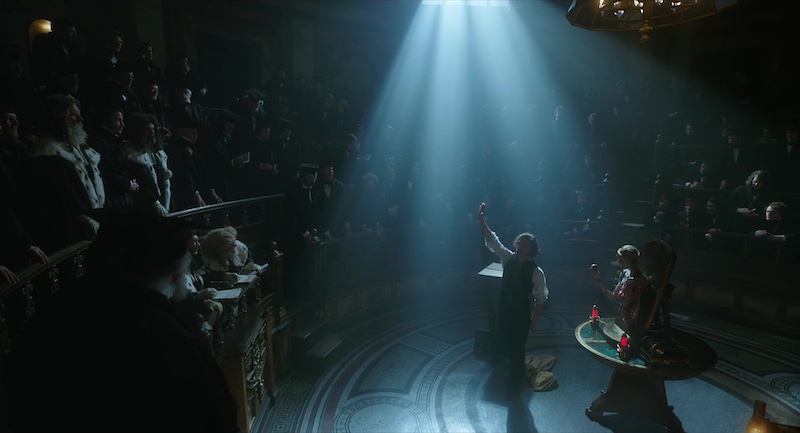
One of the most visible strategies is the repeated use of a single hard source, often treated like a shaft of sunlight entering through one window. The beam is made very clear by the heavy use of smoke in the interiors. This can be seen, for instance, when Victor Frankenstein presents his initial discoveries to his colleagues, and also in many of the laboratory scenes. In other moments, that shaft of light becomes very warm, as if it were trying to suggest the last sunlight of the day.
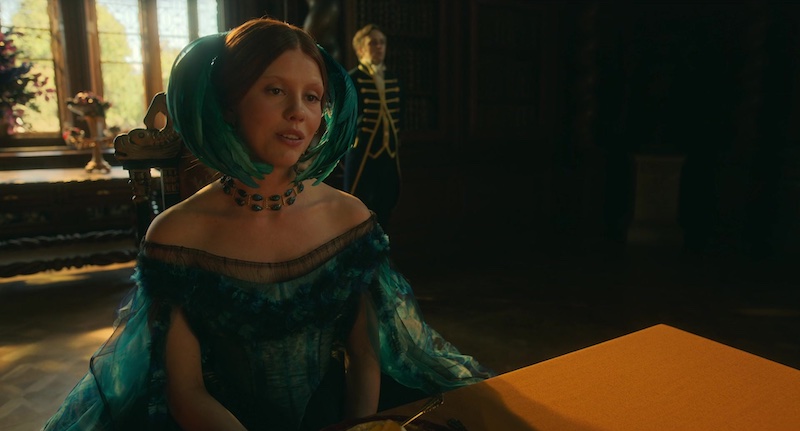
The night work is also notable because it avoids, for the most part, the familiar blue night convention. Instead, many of the nights are deliberately green. Several scenes mix candlelight with the kind of green tone that has long belonged to Del Toro’s visual world. The strategy is coherent with his taste, but it also reinforces the sense that the image is being pushed toward a highly designed surface at almost every moment.
Conclusion
The results are interesting, but also excessive. This is a type of cinematography that does not simply illustrate, nuance or accompany the story. It often imposes itself on it. That is true of the focal-length choice, the repeated shafts of hard light, the green nights and the overall sense of visual insistence.
As with the film itself, Frankenstein works best when the filmmakers look for something less sophisticated, less invasive and less intrusive — particularly when the creature escapes and tries to live among human beings. Those passages allow the image to become more emotionally useful. The film seems to breathe more easily when the visual system stops trying to overwhelm every moment.
For that reason, it is curious to see the stylistic intentions behind the film described as naturalistic in American Cinematographer. Whatever its strengths, this is not a naturalistic piece of cinematography. Its value lies elsewhere: in the scale of its construction, the boldness of its choices and the intensity of its artificial world. But that same artificiality is also the problem. Given the film’s length and degree of elaboration, a small number of more intimate passages cannot fully justify either the new version or the weight of its visual apparatus. One suspects that the whole might have benefited from a smaller, more modest scale — a word that was probably not central to the vocabulary of this production.
ON FILM & DIGITAL
© Ignacio Aguilar, 2026.
This article is part of ON FILM & DIGITAL’s English-language cinematography reviews and essays.
These texts are not plot summaries or general film reviews, but cinematography-focused essays written from the perspective of a working cinematographer.
The Author
Ignacio Aguilar is available for cinematography work, creative collaborations, lectures, workshops and international projects. He is a Sony Independent Certified Expert (ICE) and Cooke Optics Spanish Ambassador for Cooke SP3 lenses. Contact here.