

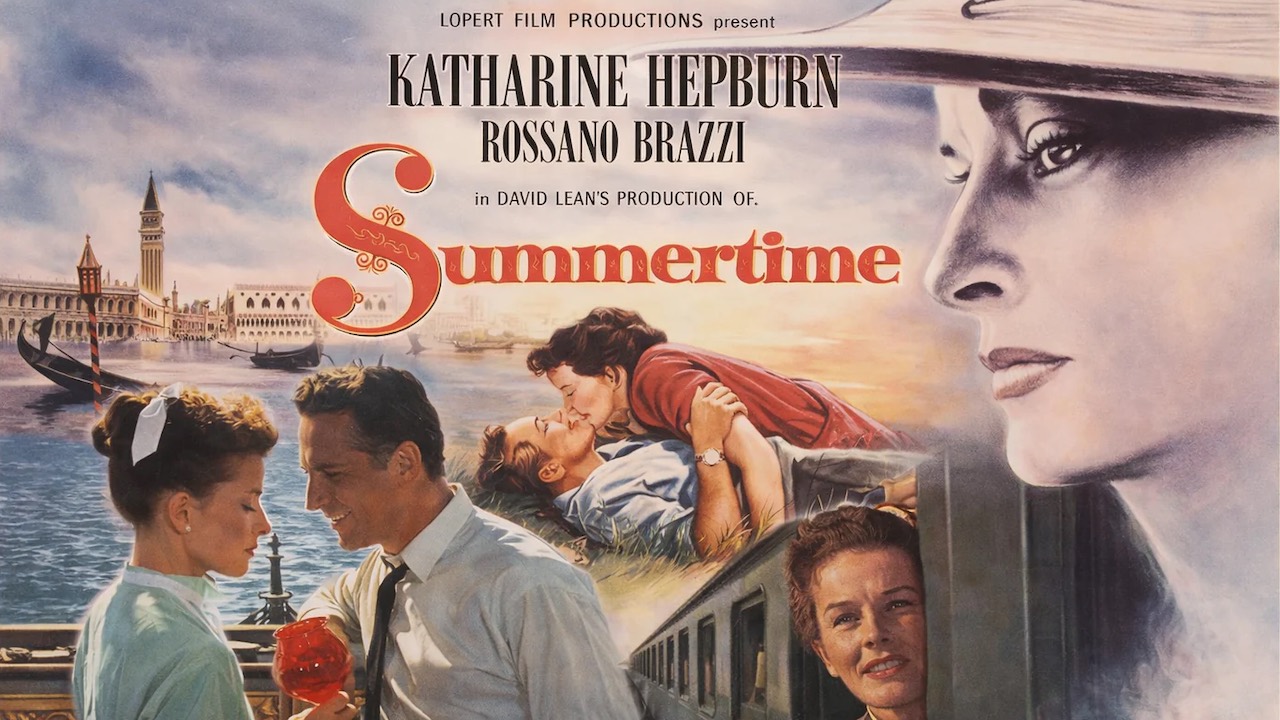
“Summertime”
Spanish Title: Locuras de Verano
Year of Production: 1955
Director: David Lean
Director of Photography: Jack Hildyard, BSC
Lenses: Cooke Speed Panchro
Film Stock: Kodak 5248 (25T)
Format and Aspect Ratio: 35mm spherical, 1.85:1 (Criterion Blu-ray, 1.37:1)
Viewed on: Blu-ray
Venice, Eastmancolor and light from another era: Jack Hildyard joins David Lean in his first major experiment with location-based cinema.
The Film
Summertime is the film adaptation of Arthur Laurents’ stage play The Time of the Cuckoo. Its protagonist is a middle-aged American woman, played by Katharine Hepburn, unmarried and unattached, who saves enough money to travel to Venice. Once there, she immerses herself in the atmosphere of the city and soon meets an antiques dealer, played by Rossano Brazzi. The question is whether she will allow herself to begin a relationship with him or not.
Co-written by David Lean, the film is probably a minor work within his filmography. Even so, it is interesting for two reasons. It contains echoes of the superior Brief Encounter (1945), and it also works as a bridge between Lean’s earlier studio-based period and the second, more spectacular and much better-known phase of his career. From The Bridge on the River Kwai onward, location shooting would become central to his cinema.
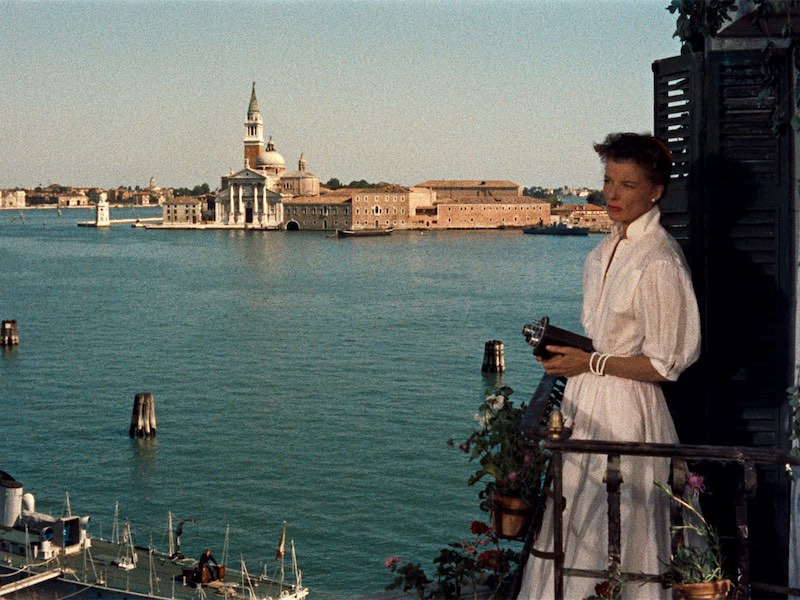
The best element of Summertime, without much doubt, is its use of Venice. The film itself may now feel thematically dated, despite its undeniable charm. But the way Lean films the city of canals gives the picture its real value. Venice is not just a background; it becomes the emotional and visual structure of the film.
The Cinematographer
The cinematographer was the British director of photography Jack Hildyard, BSC. During this period, Hildyard was David Lean’s preferred cinematographer. They collaborated on three other films: The Sound Barrier (1952), Hobson’s Choice (1954) and the aforementioned The Bridge on the River Kwai (1957), for which Hildyard won the Academy Award for Best Cinematography for his work in CinemaScope and color.
Lean apparently would have worked with him again on Lawrence of Arabia (1962), but Hildyard was not available when production began. Beyond his work with Lean, Hildyard also photographed Anastasia (Anatole Litvak, 1956), Suddenly, Last Summer (Joseph L. Mankiewicz, 1959), The Sundowners (Fred Zinnemann, 1960), 55 Days at Peking (Nicholas Ray, 1963), Battle of the Bulge (Ken Annakin, 1965) and two large-scale productions for Moustapha Akkad, The Message (1976) and Lion of the Desert (1980).
Format, Color and Aspect Ratio
Summertime was photographed in color, but not in the three-strip Technicolor process, which by then was already entering its final period of use. Instead, the film used Eastmancolor, a simpler and less expensive process, and therefore much more practical for a picture shot extensively on location.
There is some controversy around the film’s aspect ratio. The mid-1950s were a transitional moment between the classical 1.37:1 frame and wider ratios such as 1.66:1 and 1.85:1. These wider presentations were often obtained by composing more centrally within the negative and then masking the top and bottom of the image during projection.
Some sources indicate that Lean composed the film for 1.85:1, and that ratio can work reasonably well. However, editions such as the Criterion Blu-ray choose to show the full information available in the negative. Personally, I think that is a good decision. There is a considerable amount of visual information that would be lost in a wider version, especially in the many shots of the city, where the 1.37:1 presentation preserves Venice more completely.
Visual Style Analysis
From a technical perspective, Lean and Hildyard’s achievement is considerable. They were working with a 25 ASA film stock and lenses that did not perform well much wider than T2.8. Under those conditions, almost every shot required substantial equipment, time and crew. To photograph an intimate story within that production framework is more difficult than it might appear today.
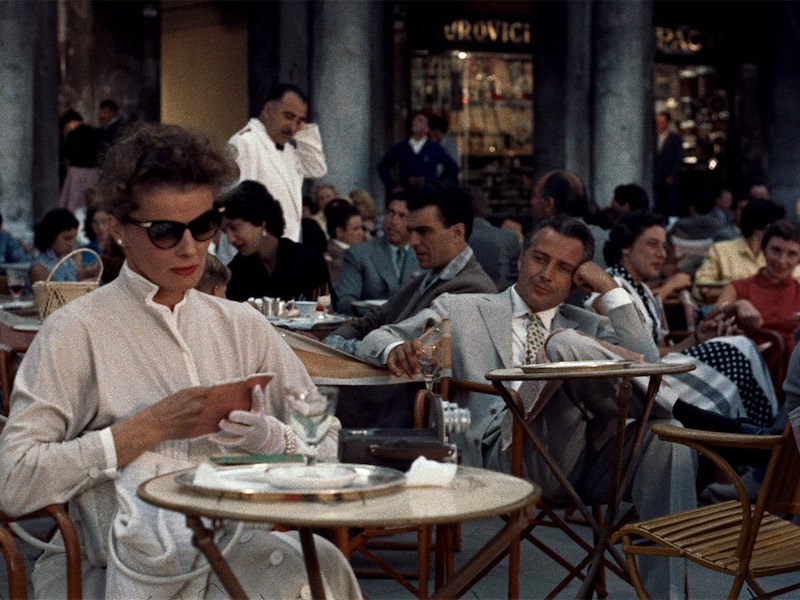
The interiors naturally reveal the use of large hard-light units aimed at both actors and locations. In many cases, there was simply no other way to produce a usable image. But Hildyard does not merely flood the spaces with light. He creates zones of light and shadow, without pushing the image into excessive drama. There is also a clear concern with presenting the actors, especially Katharine Hepburn, as attractively as possible. Her close-ups include a slight diffusion.
That diffusion is more subtle than in many other films of the period. Some 1950s color films suffer from visible continuity problems when filmmakers introduce very heavy filters for close-ups. In Summertime, the effect is more controlled, and those shots integrate better with the rest of the film.
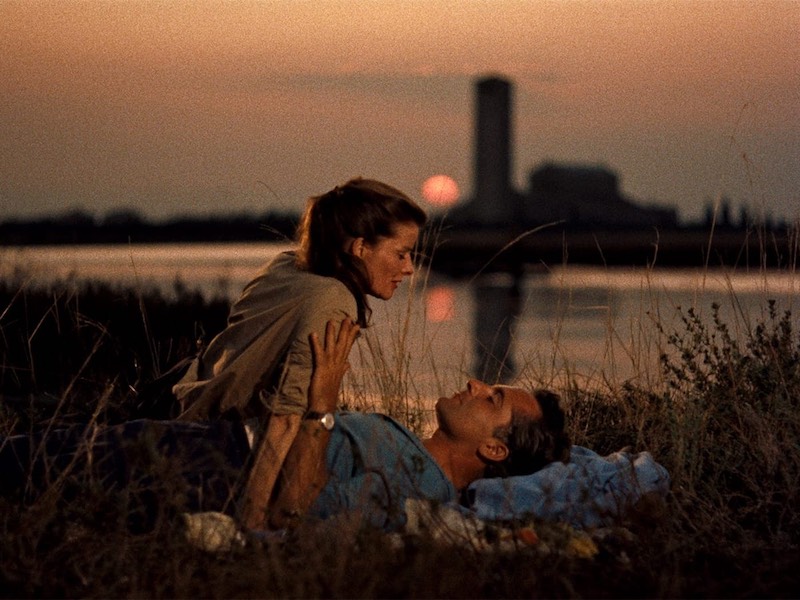
There are many moments in which Hildyard uses the classical technique of crossed backlights on the lovers. From behind each actor, the key light of one performer becomes the backlight of the other, and vice versa. The result is contrast, separation and three-dimensionality. Considering the amount of light that had to be used, the lighting can even be described as relatively subtle when compared with other color films of the same period. In that context, Summertime can look almost naturalistic, although strictly speaking it is not.
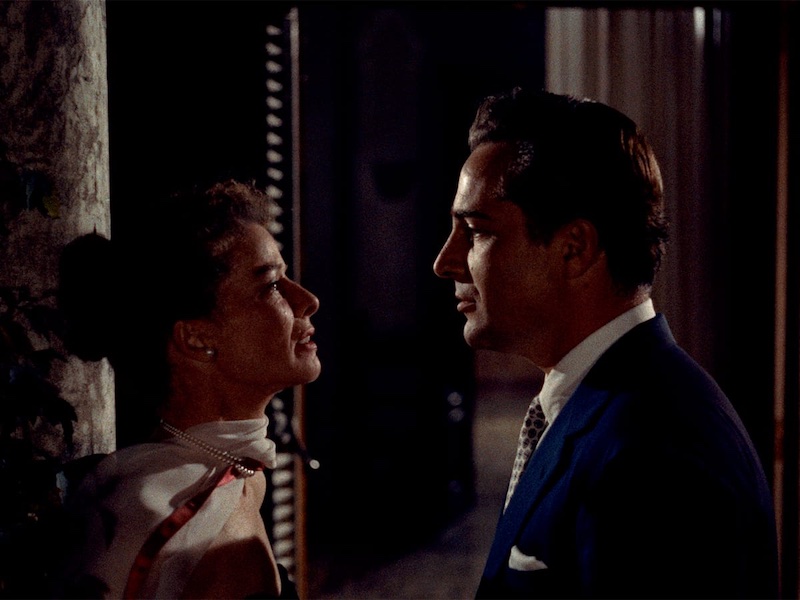
The most interesting aspect, however, is the portrait of Venice. One can clearly sense that Lean spent time in the city searching for the best angles. The film becomes especially interesting when he has to shoot at dawn, sunset, magic hour or against the sun with available light. For the cinema of the period, this was almost counterintuitive. In those moments, the film acquires a surprisingly realistic texture, even though Eastman color negative had a very limited range at the time.
The daytime exteriors may be the most immediately attractive, for obvious reasons, because they were technically simpler. But the night work is more revealing. When Lean and Hildyard have to light Venice at night, they create a certain magic and an interesting atmosphere that reinforces the romantic aura of the story. In the process, they also construct an idealized version of the city.
The limitations are still visible. In very wide night shots, such as some views of St. Mark’s Square, the images can become too dark. But within the film’s visual context, those moments remain acceptable. More importantly, they belong to the same romanticized idea of Venice that the film is building.
Conclusion
The results are generally strong. From a contemporary perspective, the film seems limited more by the technical constraints of the period than by the talent of its filmmakers, especially Lean. His following films would connect to one of the most extraordinary cinematographic runs in film history: four consecutive Academy Awards for Best Cinematography for The Bridge on the River Kwai (1957), Lawrence of Arabia (1962), Doctor Zhivago (1965) and Ryan’s Daughter (1970). His final film, the excellent A Passage to India (1984), was also nominated.
As a transitional film, Summertime is also valuable because it shows Lean shooting for the first time in what would become his natural habitat: real locations. Compared with his later cinema, the scale is still much smaller and the results, while estimable, cannot really be compared with the three great Freddie Young collaborations: Lawrence of Arabia, Doctor Zhivago and Ryan’s Daughter. Those films remain among the most respected achievements in the history of cinematography.
Viewed on Blu-ray
ON FILM & DIGITAL
© Ignacio Aguilar, 2026.
This article is part of ON FILM & DIGITAL’s English-language cinematography reviews and essays.
These texts are not plot summaries or general film reviews, but cinematography-focused essays written from the perspective of a working cinematographer.
The Author
Ignacio Aguilar, AEC is a Spanish cinematographer based in Madrid. His work spans feature films, television, commercials and technical writing on cinematography, with experience in digital cinema, 16mm and 35mm film, anamorphic lenses, large-format digital capture and practical lens testing.
Read more articles and reviews in Spanish at ON FILM & DIGITAL, or visit the main cinematography portfolio at ignacioaguilardop.com.