

“Ferris Bueller’s Day Off”
Spanish title: Todo en un Día
Year of Production: 1986
Director: John Hughes
Cinematographer: Tak Fujimoto, ASC
Lenses: Panavision Ultra Speed Mk2
Film Stock: Kodak 5247 (125T) & 5294 (400T)
Format and Aspect Ratio: Super 35, 2.4:1
Viewed on Bluray 4K HDR
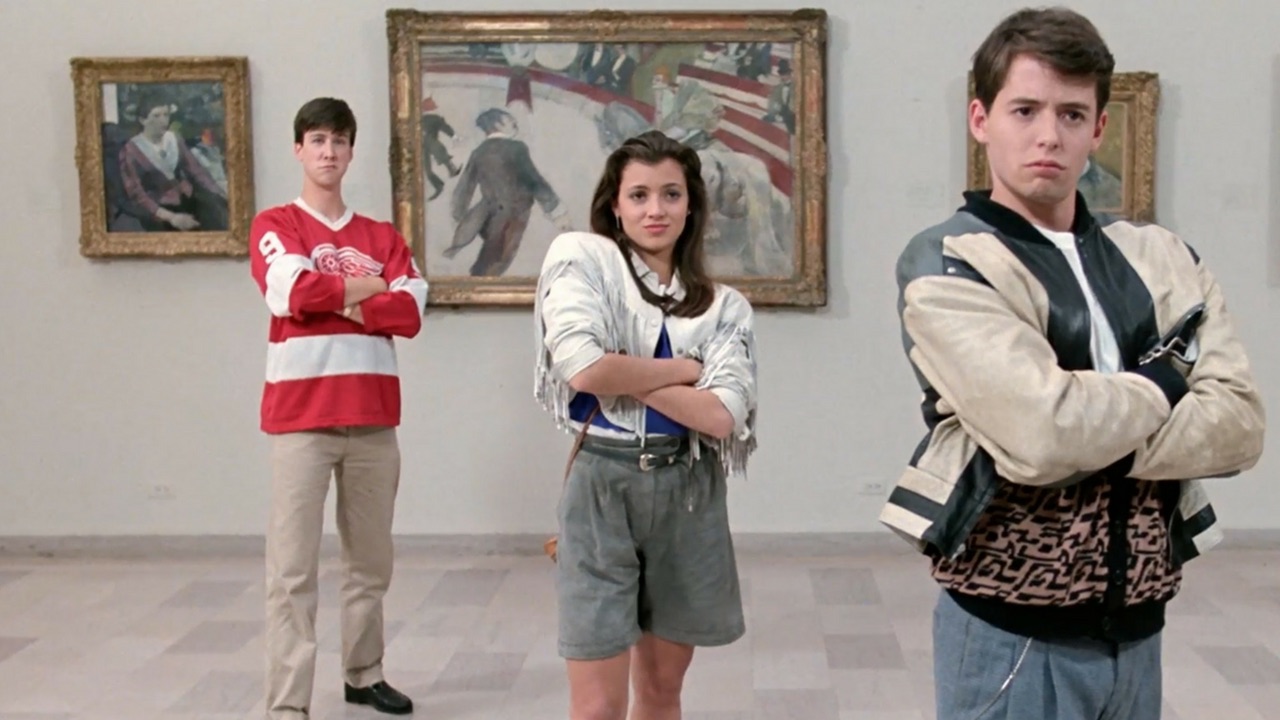
A teenage comedy by John Hughes that looks far more carefully made than its reputation might suggest: Tak Fujimoto [ASC] gives the film a polished, daylight-driven Super 35 image with real cinematic ease.
The Film
A wonderful John Hughes production, “Ferris Bueller’s Day Off” captures much of the free spirit of the 1980s through the figure of Ferris Bueller (Matthew Broderick). The son of a wealthy family, Ferris fakes an illness in order to skip school for a day, persuading his friends (Alan Ruck and Mia Sara) to join him on a series of adventures across Chicago.
But the school principal (Jeffrey Jones), convinced that Ferris is lying, decides to go after him. “Ferris Bueller’s Day Off” is enormously entertaining, but what separates it from more conventional teen comedies or coming-of-age films is the precision of Hughes’s screenplay and the superb presence of Broderick in the leading role. He plays Ferris as a young rascal determined to enjoy his day away from school, without anxiety, guilt, or any real thought for tomorrow. Jennifer Grey, Charlie Sheen, Cindy Pickett and Lyman Ward complete the cast.
The Cinematographer
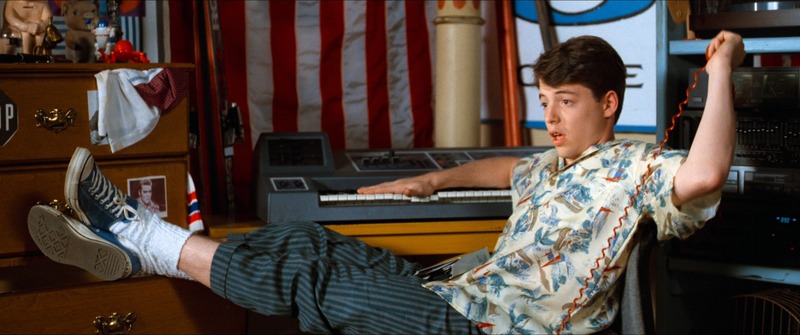
The cinematographer was Tak Fujimoto [ASC], best known for his long collaboration with director Jonathan Demme. Fujimoto shot eleven films for Demme between “Caged Heat” (1974) and “The Manchurian Candidate” (2004), including some of the director’s most accomplished and best-known work: “Something Wild” (1986), “Married to the Mob” (1988), “Philadelphia” (1993) and, above all, “The Silence of the Lambs” (1991), the multiple Academy Award-winning film starring Jodie Foster and Anthony Hopkins.
Later in his career, Fujimoto also worked on several of M. Night Shyamalan’s most famous films, including “Signs” (2002) and “The Happening” (2008), as well as the film that made Shyamalan internationally known, “The Sixth Sense” (1999), for which Fujimoto received an ASC Award nomination. He had also been one of the second-unit cinematographers on “Star Wars” (1977), one of the cinematographers involved in Terrence Malick’s debut feature “Badlands” (1973), and the cinematographer of Tom Hanks’s directorial debut, “That Thing You Do!” (1997).
Visual Style Analysis
The cinematography of “Ferris Bueller’s Day Off” is remarkably good, and in some ways surprisingly so. Not because John Hughes or Tak Fujimoto were careless filmmakers, but because the film has a degree of refinement one might not immediately expect from what appears, on the surface, to be a simple teenage comedy.
It was also one of the first American features to adopt Super 35 for a 2.39/2.4:1 composition, alongside films such as “Silverado” and “Top Gun”. Since there do not seem to have been detailed articles about the decision, the reasons remain partly speculative. But the choice suggests that the filmmakers wanted something beyond the usual 1.85:1 format in which this kind of 1980s comedy was often shot. At the same time, Super 35 allowed for full-frame video and television versions without the same image loss associated with the dreaded Pan & Scan treatment of anamorphic films. Or perhaps, more simply, Fujimoto did not want to shoot anamorphic, a format he used only sparingly in his career.
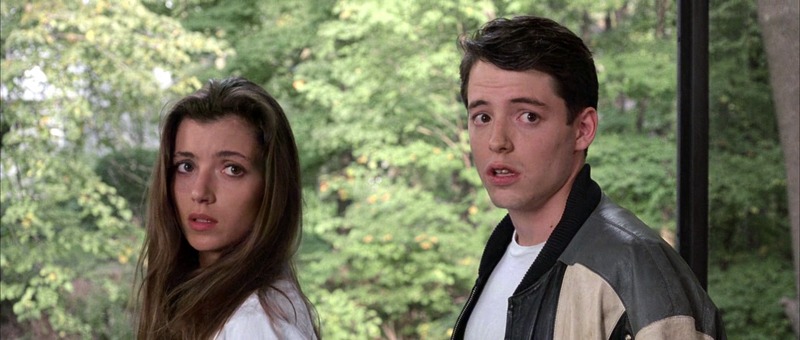
In any case, Super 35 allowed Hughes and Fujimoto to shoot much like a conventional spherical 35mm film while still composing and releasing the film theatrically in a wide aspect ratio. At the time, Super 35 was optically blown up to a 35mm anamorphic interpositive, and that was where much of the format’s quality loss occurred.
In this case, to counter that problem, it seems clear that Fujimoto gave the negative plenty of exposure and, most likely, printed it down. The result is color that feels intense, vibrant and very pure; the shadows are rich, the grain is generally restrained, and the film looks excellent on the Bluray 4K, which comes from the original negative, before that optical blow-up entered the chain. Only a few isolated moments, usually with lower light levels, credit titles or graphic elements probably derived from second-generation materials, look noticeably weaker.
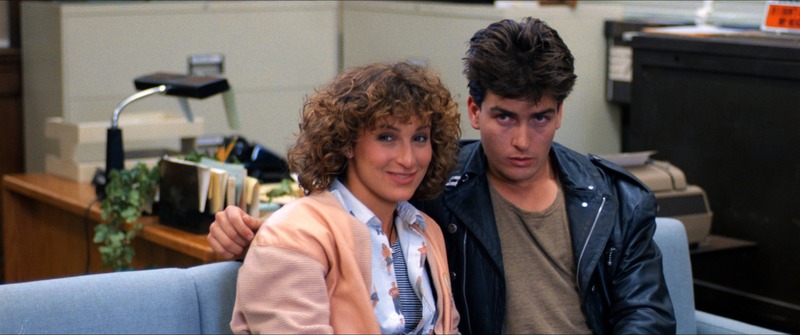
Aesthetically, this is an almost entirely daylight film with a clearly naturalistic appearance, although that should not be confused with simply shooting available light. Of course Fujimoto uses available light when it is useful, but the film is extensively and very carefully lit. The light is soft, flattering and controlled. It helps the actors, creates a polished but discreet surface, and gives the film the clean finish one would expect from a major Hollywood production.
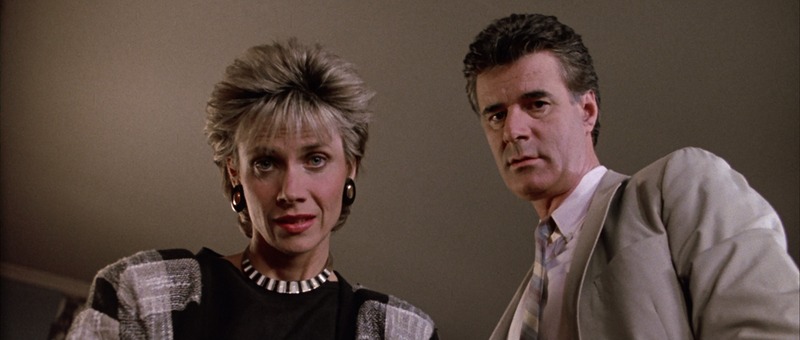
In other words, the film is heavily lit, but often does not look that way. Beyond specific scenes such as the police station, or the occasional eye light that calls attention to itself, Fujimoto’s intervention tends to feel almost invisible. This also implies a careful choice of shooting hours for exteriors, and a consistent preference for shaded areas within Chicago’s broad city streets, in order to reduce contrast and create simpler, more favorable conditions for the camera.
The light is not especially decorative in itself. The key is how well it is integrated into the storytelling. It maintains a low profile, produces strong results, and preserves a delicate contrast throughout. Perhaps for that reason, unlike other more emphatic films from the same decade, the cinematography of “Ferris Bueller’s Day Off” has aged extremely well.
Conclusion
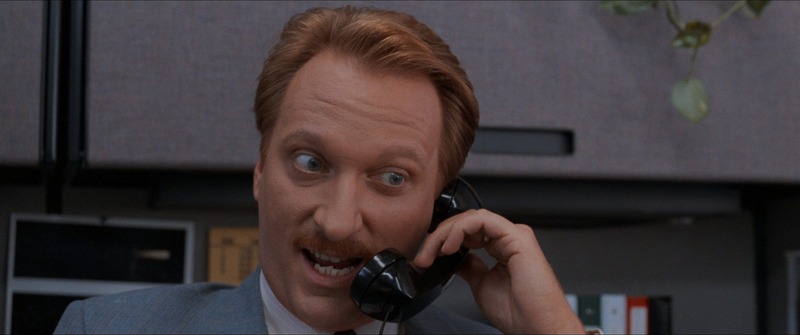
John Hughes was known primarily for his screenplays, his productions — including “Home Alone” — and his interest in teenage stories. But this film also contains many gags and situations that are very well handled through staging and editing: the kitchen fight between Jennifer Grey and Jeffrey Jones, Rooney’s encounters with the dog, Ferris and his girlfriend hiding from her father in the taxi, or Ferris’s frantic race home during the final section of the film. And, of course, there are the famous fourth-wall breaks, with Ferris looking and speaking directly into the camera.
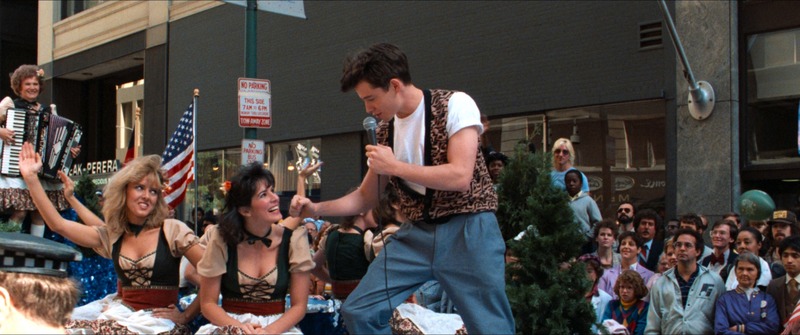
That also elevates the film, as does Jamie Anderson’s work as camera operator. There are numerous wide compositions that work beautifully in the film’s true aspect ratio, 2.4:1. They show that the decision to exhibit the film in this format was not a mere whim, but a conscious aesthetic choice that Hughes, Fujimoto and the rest of the team clearly wanted to exploit.
For that reason, especially for those of us who remembered the film from full-frame television broadcasts, its look is surprisingly refined and cinematic. Hughes, Fujimoto and the entire crew took the film seriously, and the results reflect that. They are unusually accomplished for a teenage comedy of this kind.
Viewed on Bluray 4K HDR
ON FILM & DIGITAL
© Ignacio Aguilar, 2026.
This article is part of ON FILM & DIGITAL’s English-language cinematography reviews and essays.
These texts are not plot summaries or general film reviews, but cinematography-focused essays written from the perspective of a working cinematographer.
The Author
Ignacio Aguilar is available for cinematography work, creative collaborations, lectures, workshops and international projects. He is a Sony Independent Certified Expert (ICE) and Cooke Optics Spanish Ambassador for Cooke SP3 lenses. Contact here.