

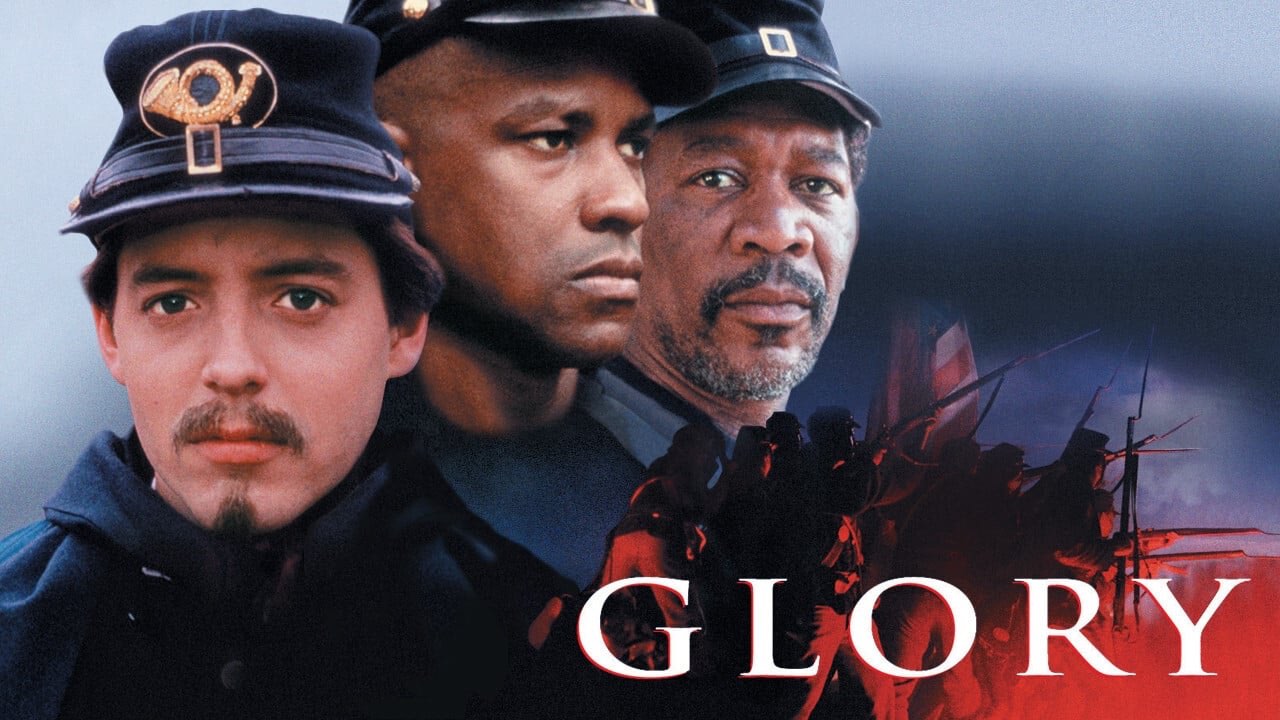
“Glory”
Spanish Title: Tiempos de Gloria
Year of Production: 1989
Director: Edward Zwick
Director of Photography: Freddie Francis, BSC
Lenses: Cooke Varotal, Panavision Ultra Speed MKII
Film Stock: Kodak 5247 125T, Kodak 5294 400T
Format and Aspect Ratio: 35mm spherical, 1.85:1
Awards: Academy Award for Best Cinematography; British Society of Cinematographers Award; BAFTA nomination
Viewed on: 4K HDR Blu-ray
Classical craft, visible control and an old-school approach to light in the second Academy Award-winning cinematography of Freddie Francis, BSC.
The Film
Based on historical events and drawing on several sources — including books by Lincoln Kirstein and Peter Burchard, as well as the real letters of Robert Gould Shaw — Glory is set during the American Civil War. Shaw, played by Matthew Broderick, is appointed to form and train one of the Union’s first all-Black regiments: a unit of free volunteers prepared to fight against the Confederacy.
The material has obvious dramatic weight. Shaw must bring together men who have every reason to distrust the system they are being asked to serve, while also facing resistance from within the Union itself. The Union allows the regiment to exist, but often treats it more as a symbolic gesture than as a real fighting force. That tension gives the story its strongest foundation.
Even so, Kevin Jarre’s screenplay can feel too softened, too schematic, and often too predictable. Edward Zwick directs the film with efficiency and scale, but not always with a strong personal signature. Glory is effective, handsomely made, and moving in several places. Yet it can also feel impersonal and dramatically thin. Cary Elwes, Morgan Freeman, and Denzel Washington — who won the Academy Award for Best Supporting Actor — complete the main cast. James Horner’s score is also one of the film’s most prominent elements.
The Cinematographer
The cinematographer was Freddie Francis, BSC, one of the major British figures of his generation. His career had two clearly distinct phases. In the first, he won an Oscar for Sons and Lovers (Jack Cardiff, 1960) and photographed such landmark works as The Innocents (Jack Clayton, 1961). Then, after spending roughly sixteen years working mainly as a director — particularly in horror films — he returned to cinematography with David Lynch’s The Elephant Man (1980).
Francis continued his association with Lynch on Dune (1984) and, much later, The Straight Story (1999). During this second stage of his career, he also photographed The French Lieutenant’s Woman (Karel Reisz, 1981), The Man in the Moon (Robert Mulligan, 1991), Princess Caraboo (Michael Austin, 1994), and, of course, Cape Fear (Martin Scorsese, 1991). But it was Glory that restored much of his prestige and brought him his second Academy Award.
Visual Style Analysis
Visually, Glory is built around a classical form of cinematographic control: readable faces, strong separation, carefully positioned camera angles, and a lighting style that belongs more to an older pictorial tradition than to the naturalism that was becoming common by the late 1980s.
It makes sense that a veteran with Francis’s experience, both as a cinematographer and as a director, would be assigned to a relatively young Edward Zwick. This was only Zwick’s second feature, although he would later become a director of large-scale productions. Francis gives the production exactly what it seems to have required: control, legibility, classical pictorial strength, and the assurance of a cinematographer who understands how to support scale.
One can wonder whether budget considerations, or the rise of home video and pan-and-scan transfers, influenced the decision not to shoot Glory in anamorphic widescreen. Given the subject, the period setting, and Francis’s presence, anamorphic might have seemed the more natural choice. Instead, the film was shot in 35mm spherical 1.85:1. Even so, the camerawork is one of its strongest qualities.
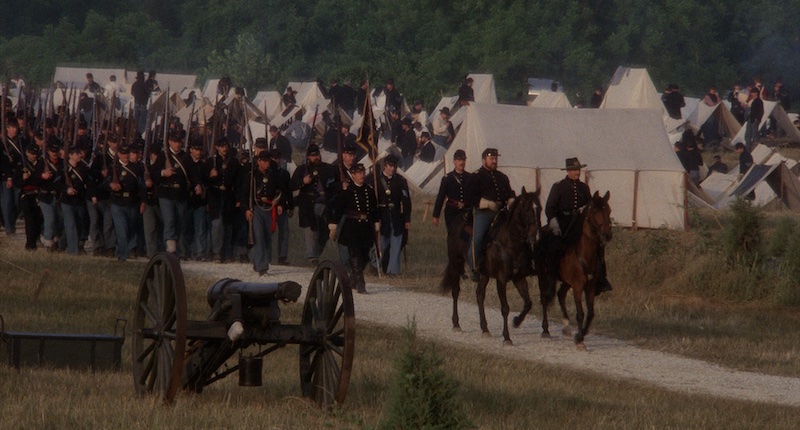
Francis and Zwick often place the camera in precisely the right position to read the dramatic intention of a scene. In exteriors, long lenses are frequently used to compress distance and give the battle scenes a stronger graphic shape. Elsewhere, the camera simply finds the clearest and most effective point of view. The work is not dazzling in a modern sense, except in occasional moments. But it has the confidence of a cinematographer who knows exactly what the production needs.
It is also interesting that the film appears to have been shot mainly with zoom lenses, not generally for visible zoom moves, but as variable focal-length tools. The primes seem to have been reserved for scenes with lower light levels. “Lower” is the key word, because this is not low-light cinematography in any contemporary sense.
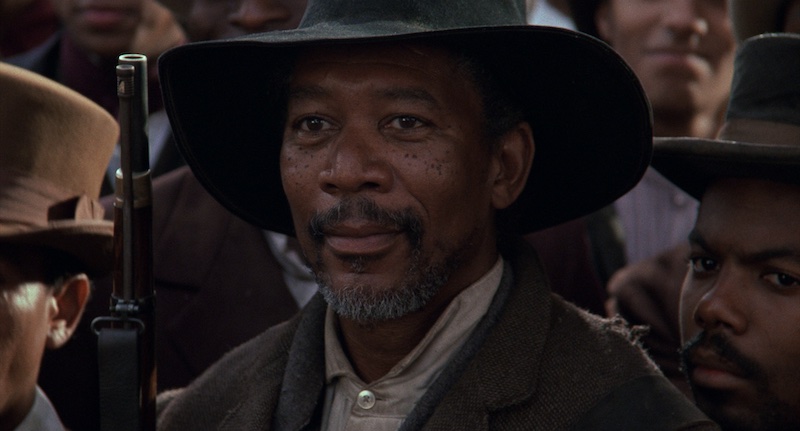
Francis lights Glory from a classical position. His priority is not naturalism, but dramatic readability: faces must carry weight, figures must separate from the background, and the frame must remain clear even in large-scale scenes. In that sense, his work is closer to Freddie Young or Douglas Slocombe than to the more naturalistic cinematography that had become increasingly common by the late 1980s.
In exteriors, this often means visible fill light, or even direct light aimed at the actors. The basic method still belongs to color cinematography of the 1950s and 1960s, though Francis tries to make it slightly less obvious. He often works under cloudy skies, uses smoke and atmosphere outdoors, and allows the image to become somewhat desaturated, grainier, and dirtier than a purely studio-classical approach would have been.
But his lighting remains visible. Faces are strongly shaped and often heavily filled. Catchlights from artificial sources can frequently be seen in the actors’ eyes. The result is polished, but not always seamless. At times the fill is too evident; at others, there are small technical irregularities, such as HMI light drifting slightly green. The style was already somewhat out of step with the period in which the film was made.
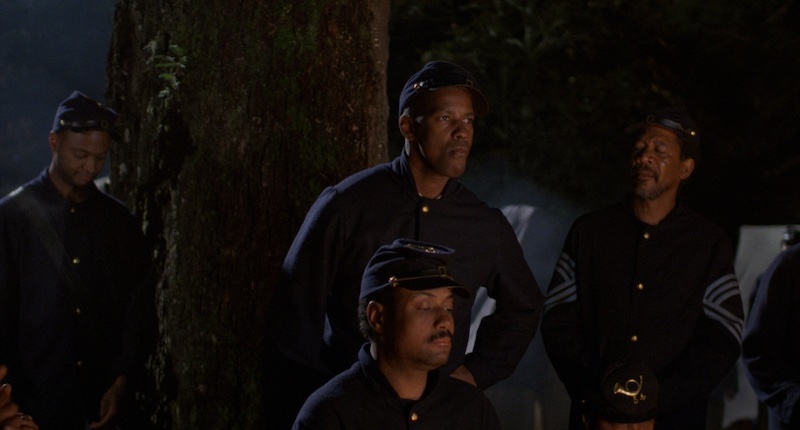
That becomes even clearer in interiors and night scenes. Francis was not Conrad Hall, nor David Watkin. He was not looking for radical naturalism. Even scenes with candles in frame, where the candles are meant to motivate the light, are in practice photographed with hard Fresnel sources, warmed with gels. His moonlight is usually blue, backlit, and openly classical. In day interiors, there is often an attempt to suggest light coming from windows or other natural sources within the set. But Francis is more interested in contrast, separation, and pictorial clarity than in strict naturalism.
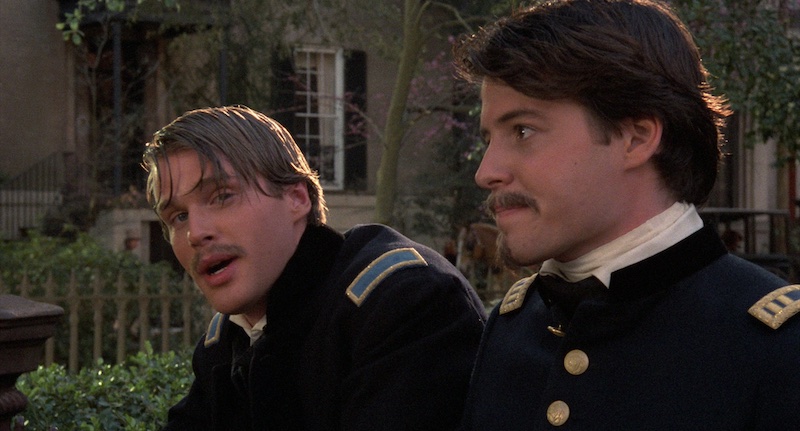
This does not make the work less enjoyable. On the contrary, there are excellent sequences in almost every type of setting. Indoors, the scene in which Matthew Broderick and Cary Elwes ask their superior, played by Bob Gunton, to allow their men to fight is beautifully controlled. In night exteriors, the moment in which Morgan Freeman and Denzel Washington address the soldiers has a strong theatrical dignity. In day exteriors, the regiment’s first skirmish with Confederate soldiers, staged among the trees, is especially fine: the light is soft, restrained, and unusually well judged.
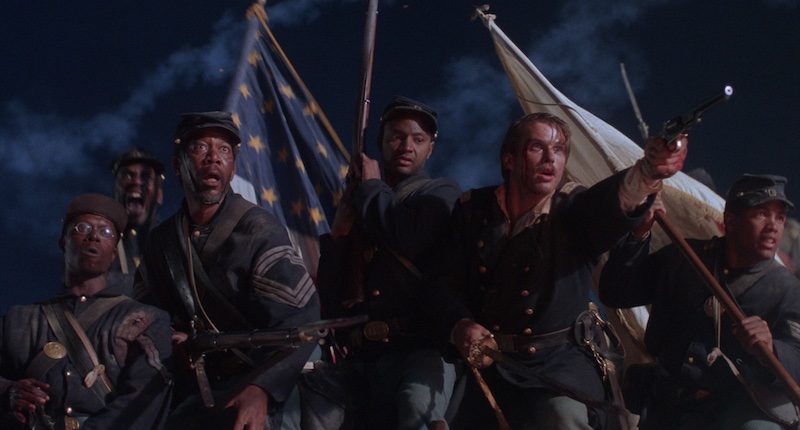
The climax is, unsurprisingly, the final battle. It is very well shot, and the fact that it takes place at night gives Francis a strong visual framework. Blue backgrounds, smoke, gunfire, cannon fire, rockets, and explosions provide much of the illumination and movement within the frame. Zwick would later ask John Toll for something comparable in Legends of the Fall, and Toll would also win the Oscar.
Conclusion
What remains striking about Glory is the general anachronism of its cinematography. In this case, that anachronism is acceptable because the film is a period piece. The classical lighting, strong faces, visible separation, and carefully composed images help give the film weight and a certain historical distance. But it is still unusual that, for many years, Glory was the only film to win the Academy Award for Best Cinematography without even being nominated by the American Society of Cinematographers, after the ASC Awards began in 1986. The same situation would later occur with Guillermo Navarro’s Oscar win for Pan’s Labyrinth.
There are two possible explanations. The ASC may simply have missed the film because of its late release: Glory opened at the end of December 1989 for Oscar qualification, before expanding more widely weeks later. Or perhaps American cinematographers saw Francis’s work as too classical, and preferred more contemporary achievements. That year’s competition was very strong, including Robert Richardson’s Born on the Fourth of July and Mikael Salomon’s The Abyss.
Francis’s win was therefore something of a surprise. From a technical and industrial standpoint, it is understandable. Glory is a handsome, solid, large-scale period film, photographed with great assurance. But from a more strictly cinematographic point of view, the choice is less clear. Richardson’s Born on the Fourth of July was more modern and expressive, while Salomon’s work on James Cameron’s The Abyss was probably the most difficult and technically adventurous achievement of that year.
ON FILM & DIGITAL
© Ignacio Aguilar, 2026.
This article is part of ON FILM & DIGITAL in English, Ignacio Aguilar AEC’s archive of cinematography essays, technical guides, lens tests and film photography reviews.
These texts are not plot summaries or general film reviews, but cinematography-focused essays written from the perspective of a working cinematographer.
The Author
Ignacio Aguilar, AEC is a cinematographer / director of photography based in Madrid, Spain. His work spans feature films, television, commercials and technical writing on cinematography, with experience in digital cinema, 16mm and 35mm film, anamorphic lenses, large-format digital capture, lens testing and film-based workflows.
He is a member of the Spanish Society of Cinematographers (AEC) and the Spanish Academy of Cinema, a Sony I.C.E. Certified Expert and a Cooke SP3 ambassador. His writing has appeared in American Cinematographer and Camera & Light, and ON FILM & DIGITAL gathers his bilingual essays, technical guides and cinematography reviews.
For professional work, collaborations, lectures, workshops or cinematography consulting, visit his professional biography, selected works or contact page.