

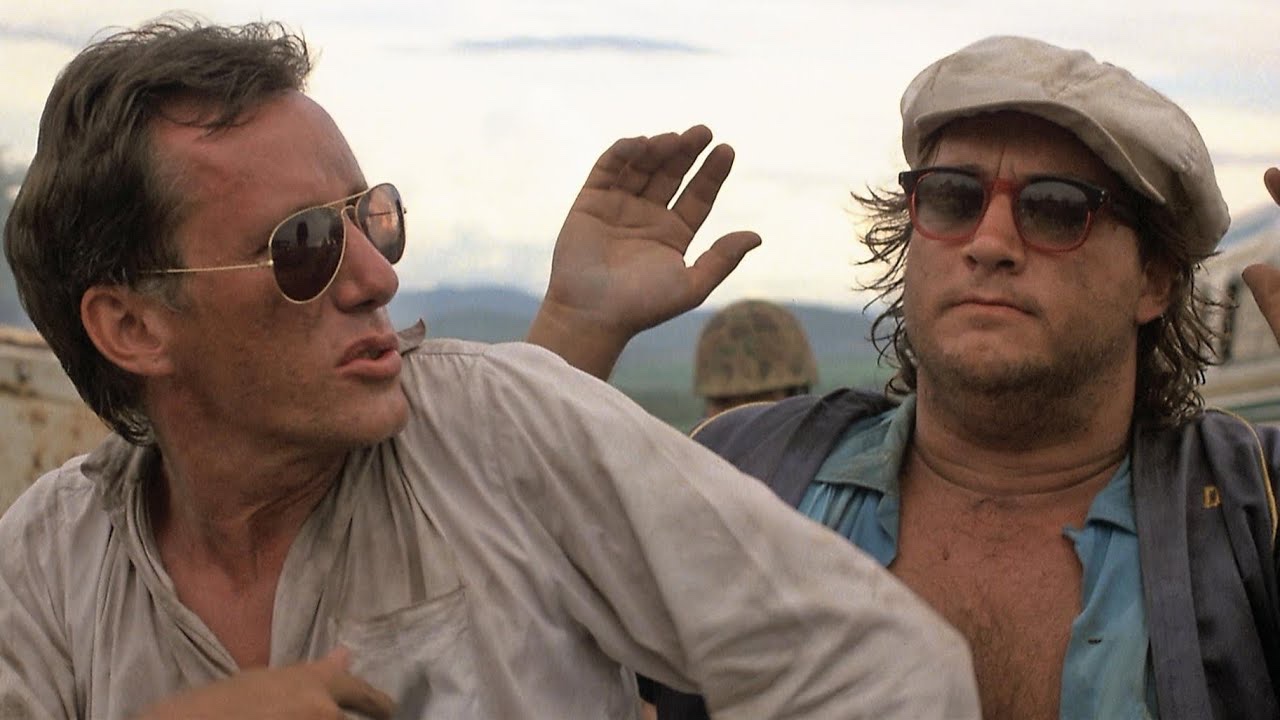
“Salvador”
Spanish Title: Salvador
Year of Production: 1986
Director: Oliver Stone
Director of Photography: Robert Richardson, ASC
Lenses: Zeiss Super Speed T1.3
Format and Aspect Ratio: 35mm spherical, 1.85:1
Viewed on: 4K HDR Blu-ray
Hard realism, Mexico locations and a strikingly mature feature debut: Robert Richardson’s work on “Salvador” already shows the control of a first-rate cinematographer.
The Film
Salvador was Oliver Stone’s third feature as a director, shot shortly before the major success of Platoon (1986), which would win him the Academy Award for Best Director. Here, Stone adapts the true story of Richard Boyle, a photojournalist who covered several wars and civil conflicts, including the massacres in El Salvador around 1980 and 1981. Boyle himself co-wrote the screenplay with Stone. James Woods plays Boyle, while James Belushi plays the friend who travels with him to Central America.
Salvador belongs to the kind of political, denunciatory cinema that Stone often pursued, with a strong sense of historical urgency and moral outrage. But the film is also uneven. The main problem is tone. Stone shows massacres, suffering and sexual violence, while Belushi’s character is used as a comic counterpoint that does not always belong to the same dramatic world. When Belushi largely disappears in the second half, Stone concentrates more directly on the essential material and the film improves, although the narrative remains chaotic. At times it is difficult to follow what is happening, or to understand the motivations behind some of the characters’ decisions.
None of this prevented the film from receiving major recognition. The same year Stone won the Oscar for Platoon, he and Boyle were nominated for Best Original Screenplay, and James Woods received a nomination for Best Actor. John Savage, Michael Murphy and Elpidia Carrillo complete the cast.
The Cinematographer
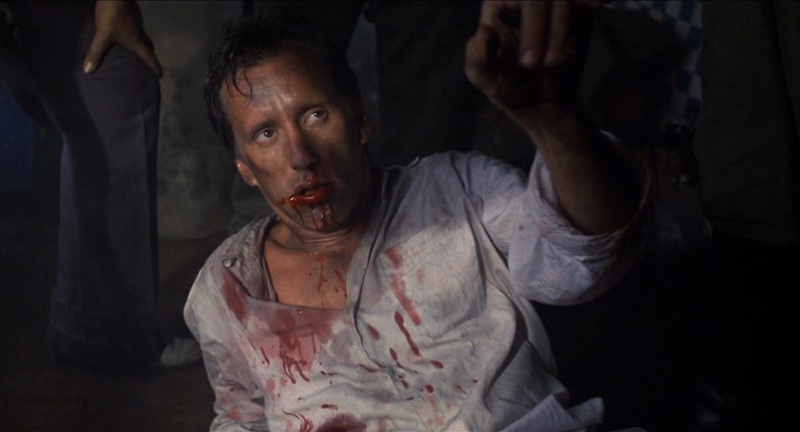
The cinematographer was Robert Richardson, ASC, now one of the most recognizable and celebrated directors of photography in contemporary American cinema. Salvador was his feature-film debut, made when he was around thirty years old. Richardson had previously shot several documentaries, some of them in combat zones, and was recommended to Stone by colleagues from the American Film Institute. Stone and Richardson connected immediately and began a highly productive collaboration that would last until U Turn (1997).
Before that, they made major films such as Born on the Fourth of July (1989) and JFK (1991). Richardson won his first Academy Award for the latter. Later, he became a regular collaborator of Martin Scorsese, beginning with Casino (1995) and continuing with films such as Bringing Out the Dead (1999), The Aviator (2004) and Hugo (2011), winning his second and third Oscars for the last two. Richardson has also worked extensively with Quentin Tarantino, from Kill Bill (2003) to Once Upon a Time in Hollywood (2019), including Inglourious Basterds (2009), Django Unchained (2012) and The Hateful Eight (2015).
Visual Style Analysis
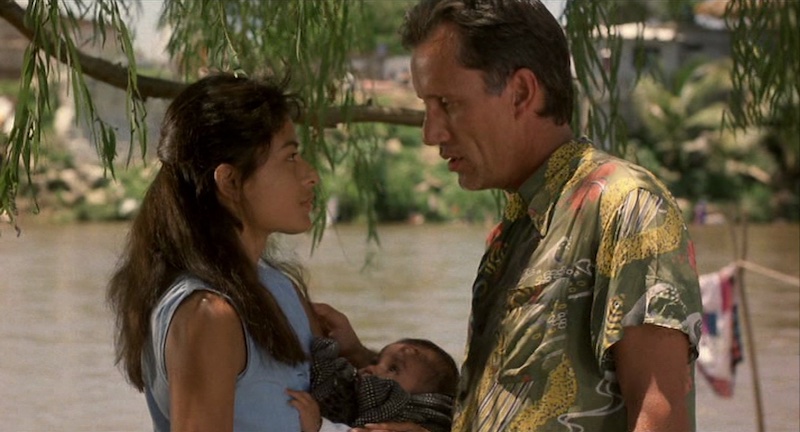
If Salvador demonstrates anything, it is that Richardson was already fully mature when Stone chose him for the project. The film does not look like the work of a cinematographer making his first dramatic feature, with the uncertainty that this might normally imply. Shot primarily in Mexico, it has a generally direct and realistic surface. At the same time, it contains clear signs of a more cinematic visual instinct. It looks like a film, not like a documentary, even when it draws on documentary methods and political immediacy.
In that sense, Richardson’s work here is not far from John Alcott’s cinematography on Under Fire (Roger Spottiswoode, 1983), a film with a similar premise: journalists moving through an armed civil conflict in Central America. Some of the technical choices are also comparable. Salvador was shot with fast spherical lenses, the Zeiss Super Speed T1.3, often used near maximum aperture. This would have given Richardson greater flexibility, allowed him to work with less lighting equipment, and helped him adapt to available light in difficult locations.
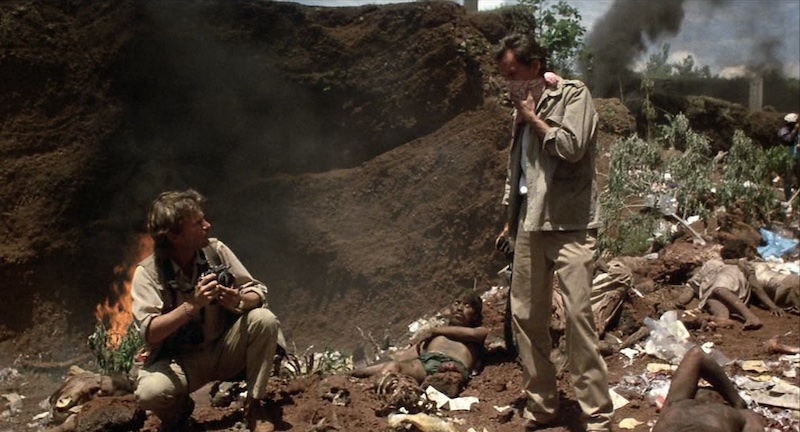
Even so, the photography is not especially simple in terms of means. Richardson uses large blue backlights, probably from HMI units, and in some scenes hard lateral sources become the main lights. These are the moments in which he is clearly lighting the scene, often because he needs to balance foregrounds and backgrounds under demanding conditions. In some early exterior landscapes, he also appears to use graduated filters to darken the sky and slightly alter its tone, a very common technique in the 1980s.
Smoke, another typical element of the period, is also used in some interiors. In many exteriors, however, Richardson seems to work primarily with the available light, shaping it through position and control rather than through an obvious lighting package. He often places the sun as backlight, uses negative fill, and probably employs textiles, silks and bounce materials to return natural or artificial light onto the action.
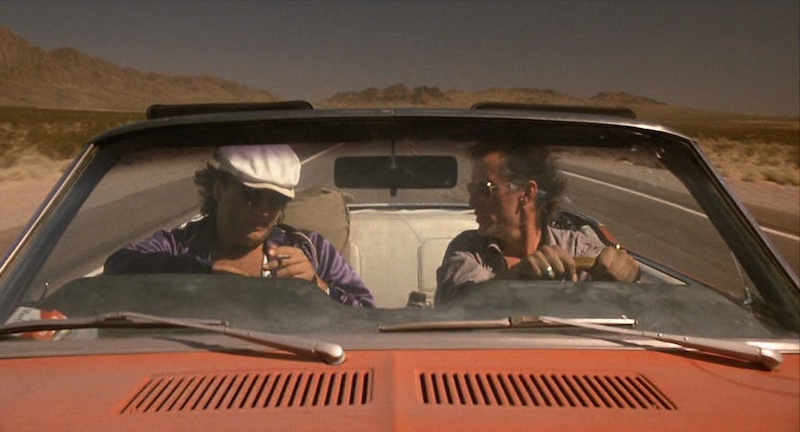
This is not yet the sophisticated Richardson of many later films. But Salvador already shows a cinematographer with real command of camera and light. He had not yet arrived at the fully identifiable personal signature that would later make him, in my view, the most important American-born cinematographer of the last forty years. Still, the foundations are present. Platoon was only his second feature, and it already began the long sequence of Academy Award nominations that would define his career.
There are also some typical traces of a fast, chaotic shoot. At least a couple of times, the shadow of the camera appears over the action, and in other moments lighting units can be seen clearly within the frame. These issues are probably less a matter of carelessness than of limited takes, difficult circumstances and the need to use whatever material worked best overall. There is also, at times, more light than one might expect in certain night scenes.
Even with those reservations, the level is high. Seen in 4K, the film shows no major grain problems or serious loss of image quality from the use of faster film stocks of the period, which often left much to be desired. If Richardson used them, as seems likely, he exposed them well enough to keep the negative dense and as clean as possible.
Conclusion
The production design, atmosphere and cinematography — with permission from Georges Delerue’s score — are probably the strongest elements of a film that remains very uneven. Stone can create powerful scenes: John Savage and James Woods photographing piles of corpses, the rape sequence, or the final bus scene. All of them carry considerable dramatic force. But he also combines them with comic touches associated with James Belushi’s buddy-movie persona, and those moments feel markedly out of place within this material.
Still, the strongest passages in Salvador clearly anticipate Stone’s two major works from this period: Born on the Fourth of July and JFK. The film’s tonal instability and narrative problems prevent it from becoming fully successful as a whole. But visually, it already contains a great deal of Richardson’s future force: hard light, controlled disorder, an ability to work under pressure, and a photographic instinct that turns political chaos into cinematic energy.
ON FILM & DIGITAL
© Ignacio Aguilar, 2026.
This article is part of ON FILM & DIGITAL’s English-language cinematography reviews and essays.
These texts are not plot summaries or general film reviews, but cinematography-focused essays written from the perspective of a working cinematographer.
The Author
Ignacio Aguilar, AEC is a Spanish cinematographer based in Madrid. His work spans feature films, television, commercials and technical writing on cinematography, with experience in digital cinema, 16mm and 35mm film, anamorphic lenses, large-format digital capture and practical lens testing.
Read more articles and reviews in Spanish at ON FILM & DIGITAL, or visit the main cinematography portfolio at ignacioaguilardop.com.