

English version of the Spanish article Cinerama, CinemaScope and Panavision.
This article continues the Film Formats series begun in Film Formats (I): 35mm, Silent Cinema, Sound and Technicolor.
This article is part of the Film Formats series. For the complete guide —35mm, CinemaScope, Panavision, VistaVision, 70mm, Technirama, Techniscope and IMAX— see the Film Formats Guide.
The arrival of television forced Hollywood to rethink what theatrical cinema could offer. The answer was not only bigger screens, but a new relationship between image area, lenses, aspect ratio, sound and spectacle.
This article explains the difference between Cinerama, CinemaScope and Panavision, and how anamorphic 35mm reshaped widescreen cinematography in the 1950s and 1960s.
Key technical points:
- Cinerama used three synchronized 35mm images, 6-perf negative, 26 fps projection and seven-channel magnetic sound.
- CinemaScope brought widescreen cinema into standard theaters through 2x anamorphic photography on 35mm film.
- The CinemaScope aspect ratio evolved from 2.66:1 to 2.55:1 and later 2.35:1 because of sound-format compatibility.
- Early CinemaScope lenses suffered from anamorphic mumps, a facial distortion caused by the original front anamorphic adapters.
- Panavision’s integrated anamorphic lenses solved many of CinemaScope’s optical and focusing limitations and became the dominant professional system.
Quick answer: CinemaScope vs Panavision
CinemaScope and Panavision are both associated with widescreen anamorphic 35mm cinema, but they are not the same thing. CinemaScope was the early Fox system that brought 2x anamorphic widescreen photography into standard theaters in the 1950s. Panavision later developed integrated anamorphic lenses that solved many of the original CinemaScope optical and focusing problems, including the facial distortion known as anamorphic mumps.
Cinerama was different again. It was not a single-lens anamorphic 35mm system, but a multi-camera and multi-projector exhibition process designed to surround the audience with a very wide curved-screen image and multichannel sound. It offered enormous spectacle, but it was too expensive and complex to become a general production standard.
| System | Capture / exhibition method | Why it matters |
|---|---|---|
| Cinerama | Three synchronized 35mm images projected onto a deeply curved screen | Created an immersive widescreen event with multichannel sound |
| CinemaScope | 2x anamorphic photography on standard 35mm film | Made widescreen cinema commercially practical for ordinary theaters |
| Panavision | Integrated professional anamorphic lenses and camera systems | Improved optical quality, focusing and the professional anamorphic workflow |
Introduction
Faced with this new competitive landscape, the studios decided to confront television with the strongest weapon cinema could offer: spectacle. Color was given a renewed industrial push, since television was still largely black and white. At the same time, the studios began to promote widescreen formats and stereophonic sound as a way of presenting epic films with a scale that domestic viewing could not match.
Cinerama: curved-screen widescreen spectacle
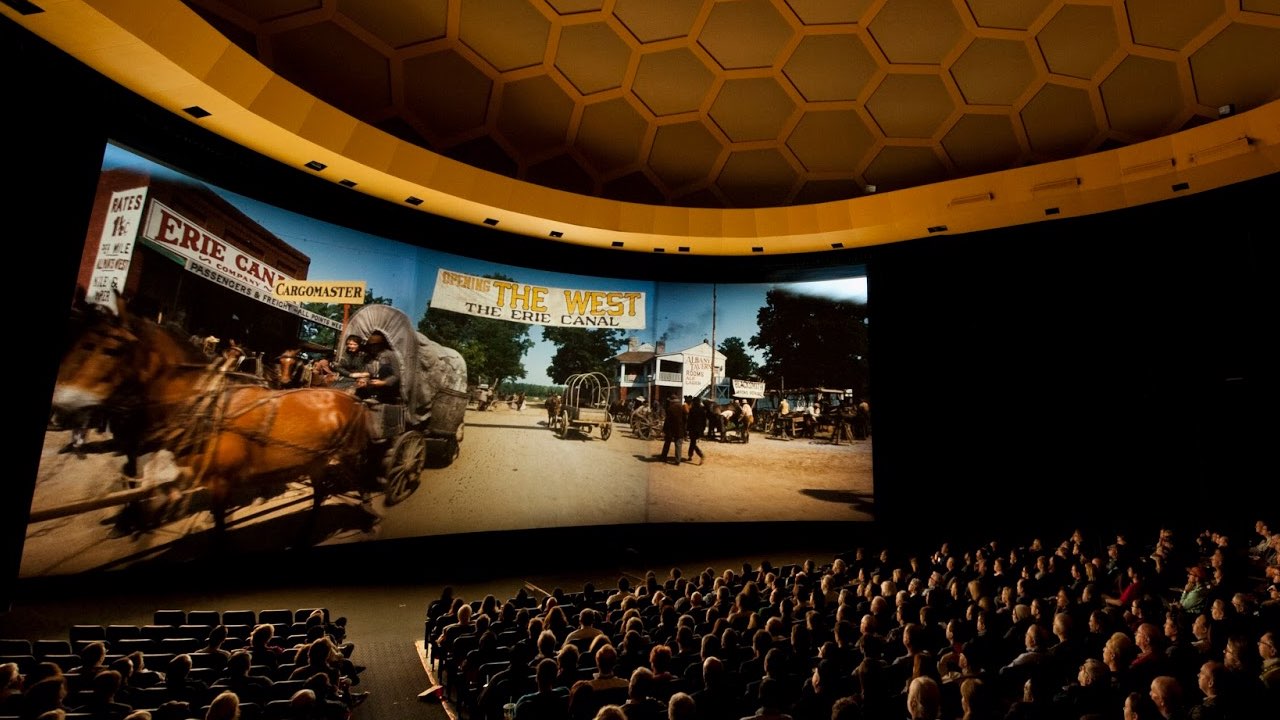
Although experiments such as Fox Grandeur had already pointed toward wider and larger formats, the true birth of modern widescreen presentation came in 1952 with Cinerama. Invented by Fred Waller, the system was introduced to the public through the promotional documentary This Is Cinerama (1952), produced by Michael Todd.

This Is Cinerama (1952).
Cinerama used three separate 35mm negatives, photographed with three synchronized cameras. The three images were then projected by three synchronized projectors onto a huge screen with a 146-degree curve. The result was an enveloping visual experience with an approximate aspect ratio of 2.59:1.
The system also ran at 26 frames per second, two frames per second faster than the theatrical standard. Each 35mm strip used six perforations per frame instead of the usual four, increasing the negative area of each panel by 50 percent. The visual quality was extraordinary for its time. More importantly, the scale of the presentation was unlike conventional cinema: the curved screen, the extreme field of view and the use of three different camera angles created a level of immersion that no ordinary 35mm format could reproduce.
Each camera used a 27 mm lens, so the combined angle of view of the three-camera system was extremely wide. During theatrical exhibition, sound was reproduced from seven independent magnetic tracks carried on a fourth synchronized 35mm strip. Five channels were placed behind the screen — left, left-center, center, right-center and right — while two additional surround channels extended around the auditorium.

Diagram of the Cinerama system, with three projectors covering a curved screen.
Nine titles were photographed in Cinerama. The two final three-panel productions, The Wonderful World of the Brothers Grimm and How the West Was Won, both released in 1962, remain the best known.
These films are easy to recognize in television broadcasts because both contain two visible vertical seams where the three panels meet. Later restorations and Blu-ray editions, including How the West Was Won and Search for Paradise, greatly reduced those seams. Some editions also include a SmileBox version, which attempts to represent on a flat screen the curvature and perspective of a genuine three-panel Cinerama presentation.

The same frame in SmileBox format, simulating the effect of Cinerama’s curved screen.
Cinerama did not become a standard production format for several reasons, but three were decisive:
- First, it was extremely expensive, both to shoot and to exhibit. Projection required four operators: one for each image projector and one for the separate sound system. Combined with the cost of installing the necessary exhibition equipment, this made broad commercial adoption very difficult.
- Second, it was not well suited to intimate scenes. Cinerama was designed for spectacle. The distortion of the side panels in relation to the center panel, together with the size and weight of the camera system, made conventional dramatic staging complicated. Some shots in How the West Was Won were reportedly made using more practical formats for logistical reasons.
- Third, other widescreen systems soon appeared. They never matched Cinerama’s scale or visual quality, but they were far cheaper, easier to install and more adaptable to ordinary studio production.
One precursor to Cinerama was Cineorama, presented by Grimoin-Sanson at the Paris Exposition of 1900. It used ten synchronized projectors to cover a cylindrical screen surrounding the audience. Because of the fire risk created by the heat from its arc lamps, the system was banned after its third presentation.
In 1927, Abel Gance used the juxtaposition of three images for certain sequences in Napoléon, a system known as Polyvision.
Fred Waller’s Cinerama also had a Soviet counterpart, Kinopanorama, as well as several descendants, including Cinemiracle and Circarama. Like Cinerama itself, however, none of these systems achieved regular theatrical adoption beyond special venues and event presentations.
CinemaScope: 2x anamorphic 35mm widescreen
To respond to television on an industrial scale — since Cinerama could not be used for every kind of film — the first Hollywood major to move decisively was Twentieth Century-Fox with CinemaScope in 1953.

The unmistakable Fox CinemaScope presentation logo.
CinemaScope used conventional 35mm cameras. In its original form, it exposed essentially the same negative area as silent cinema: a 1.33:1 35mm frame, four perforations per frame, running at 24 frames per second. The key difference was optical. Early CinemaScope used a front anamorphic attachment placed in front of a conventional prime lens.
Anamorphic lenses, also known in their early form as Hypergonar lenses, were invented in the 1920s by the French optical designer Henri Chrétien for military applications. In cinema, the anamorphic element applies a 2x horizontal squeeze to the photographed image, compressing a wide field of view onto the standard 35mm frame. The full image height is preserved while twice as much horizontal information is recorded on the negative. For a more detailed explanation, see this guide to 2x anamorphic lenses and the anamorphic format.

An image simulating a negative or positive from The Robe, showing the 2x anamorphic squeeze on 35mm film.
During projection, a second anamorphic lens expanded the image horizontally, producing a widescreen theatrical image with an aspect ratio of 2.66:1 — twice the width of the silent-era frame.
Without the projection anamorphic, the image would occupy the same screen area as a conventional film, but everything would appear severely stretched vertically. Many spectators have seen this by accident when a Scope print or file is projected without the correct desqueezing lens or setting. That distorted image is not a fault in the print. It is the way the anamorphic image is recorded.

The same image after projection through the anamorphic desqueezing lens, producing a correct widescreen image.
CinemaScope did not only offer a wider image. It also made it possible to carry four magnetic soundtracks on 35mm film: left, center, right and surround. These were discrete, independent channels.
From the beginning, in order to place those four magnetic channels on the same 35mm print as the image — rather than on a separate sound carrier, as in Cinerama — the aspect ratio was reduced from the initially planned 2.66:1 to 2.55:1. Part of the print area had to be given over to the sound stripes. This is the aspect ratio used by classics such as The Bridge on the River Kwai (1957).

David Lean already making full expressive use of the wide Scope frame.
Unlike Cinerama, CinemaScope was quickly accepted by theaters around the world. Installation was comparatively simple. Exhibitors mainly needed an anamorphic projection lens and a wider screen. In practice, many theaters adapted the image but did not install new sound equipment, so numerous CinemaScope presentations remained monophonic.
That exhibitor decision led to a further reduction of the format to 2.35:1 by the end of the 1950s. Release prints began to use Magoptical sound: four-channel magnetic stereo plus a monophonic optical track. This guaranteed compatibility with theaters equipped for either sound format, but it also reduced the available image area slightly more.

Fox advertising emphasizing the commercial impact of CinemaScope.
The film that launched the format was The Robe (1953), directed by Henry Koster and photographed by Fox’s chief cinematographer Leon Shamroy, ASC. The film became an immediate success, in large part because of Fox’s very aggressive promotion of CinemaScope as a new theatrical experience.
As a practical precaution, The Robe was shot in two versions: one in CinemaScope and another in Academy Standard Flat, since most theaters were not yet equipped for the new format. Metro-Goldwyn-Mayer and Walt Disney quickly joined the success by signing agreements with Fox to use CinemaScope, as in 20,000 Leagues Under the Sea (1954). The rest of the majors then began searching for their own widescreen systems to bring audiences back into theaters.

CinemaScope advertising with emphasis on four-track magnetic stereophonic sound.
CinemaScope, however, had a serious optical problem. The center of the image could become distorted in a way that slightly compressed faces, especially in close-ups. For years this encouraged cinematographers and directors to avoid tight frontal close-ups, or to place actors away from the center of the frame whenever possible.
This defect came from the original Henri Chrétien anamorphic system. In practice, those early CinemaScope lenses were front adapters placed over conventional primes, often Baltars or Cookes. Both the primary lens and the anamorphic adapter had to be focused, which complicated camera work and made critical focus more demanding. The distortion eventually acquired its own name: anamorphic mumps.
Panavision: solving CinemaScope’s anamorphic problems
Fox turned to the then-small company Panavision with a clear set of needs. The new lenses had to solve the problem of anamorphic mumps. They also had to offer a wider range of focal lengths for CinemaScope production. Ideally, the primary spherical lens and the anamorphic element would be integrated into a single body. Finally, the system needed one common focusing mechanism, eliminating the need for two focus pullers working at the same time.

A classic comparison between a conventional anamorphic lens and a Panavision anamorphic lens.
By the end of the 1950s, films released under the CinemaScope banner began using Panavision’s new Auto Panatar anamorphic lenses, sometimes with a small “Filmed in Panavision” credit.
The adoption of Panavision lenses was gradual. The last film photographed with the original CinemaScope lenses was In Like Flint (1967). Even before that, some films credited as CinemaScope had used other, less publicized lenses. The Blue Max (1966), for example, reportedly used Franscope lenses without an onscreen credit, because they offered better optical performance. The CinemaScope logo was still used, probably for marketing reasons, even when the films were no longer being photographed with Chrétien’s original optical system.
It has even been said that stars such as Frank Sinatra refused to work in CinemaScope, as reportedly happened on Von Ryan’s Express (1965), because of the way close-ups could flatten faces. That helps explain why the CinemaScope brand continued to appear on films photographed with Panavision optics.

Steve McQueen looking through the finder of a Mitchell BNC fitted with a Panavision anamorphic lens during the shooting of The Sand Pebbles (1966).
For many decades, Panavision has not only manufactured spherical and anamorphic lenses, but also cameras and a broad range of motion-picture equipment. Its anamorphic lenses, based on the same general optical principle, replaced the obsolete CinemaScope system and remain central to professional cinematography today.
The anamorphic lens series that emerged from this period, especially the 1960s, are known as the B Series and C Series. Of the two, the C Series has been by far the most widely used by cinematographers shooting anamorphic over the last forty years.
These lenses are generally compact and relatively light, often around 2 kg. Their primary elements come from different optical origins, including Cooke Speed Panchro cinema lenses, Zeiss Contax and Nikon designs, among others. This produces variations in performance, shape, construction and character between different sets and focal lengths. But the C Series also produces the classic anamorphic look, with its distinctive aberrations, distortions, falloff and spatial behavior.

The classic Panavision PSR-200, essentially a Mitchell BNC modified and improved by Panavision.
Although CinemaScope quickly became obsolete as a specific optical system, the shortened term “Scope” survived as a generic name for widescreen anamorphic presentation.
Other formats that appeared in the late 1970s and early 1980s, such as Technovision and J-D-C Scope, were conceptually similar to Panavision. The difference was that the cameras and anamorphic lenses did not come from Panavision itself. From this point, the historical path continues with the development of new large formats and exhibition systems in Film Formats (III).
Even though 35mm anamorphic cinema had proved successful, the studios of the 1950s continued to look for ways to make theatrical presentation more spectacular. That meant not only wider images, but also better negatives, larger formats and more ambitious sound and projection systems.
Continue the Film Formats Series
The evolution of large-format and 70mm exhibition systems continues in Film Formats (III): VistaVision, Todd-AO and 70mm Film Formats Explained.
Film Formats Series
This page belongs to the ON FILM & DIGITAL series devoted to motion-picture film formats. The complete guide traces the evolution from silent 35mm and Academy ratio to Cinerama, CinemaScope, Panavision, VistaVision, Todd-AO, 70mm, Technirama, Techniscope and IMAX.
Read the complete Film Formats Guide
Previous part: Film Formats (I): 35mm, Silent Cinema, Sound and Technicolor
Next part: Film Formats (III): VistaVision, Todd-AO and 70mm
For a broader view of the series and related reading, see also:
- Film Formats Guide: 35mm, CinemaScope, VistaVision, 70mm and IMAX
- Film Formats (I): 35mm film, silent cinema, sound and Technicolor explained
- Film Formats (III): VistaVision, Todd-AO and 70mm film formats explained
- Film Formats (IV): Technirama vs Techniscope vs IMAX film formats
- A Guide to Cinema Lenses (III): Cooke Speed Panchro and classic cinema lenses
- The Anamorphic Format in Cinema: a guide to 2x anamorphic lenses
Sources
Widescreen Museum
American Cinematographer Manual, 10th Edition
Motion Picture Lens Database, Richard Bradbury
Film Style and Technology: History and Analysis, Barry Salt
Panavision
2026 update note: this version has been revised to improve search intent, heading structure, readability, internal links and image ALT text, while preserving the article’s original content and approach.
ON FILM & DIGITAL
© Ignacio Aguilar, 2015. Revised in 2026.
This article is part of ON FILM & DIGITAL in English, Ignacio Aguilar AEC’s archive of cinematography essays, technical guides, lens tests and film photography reviews.
The Author
Ignacio Aguilar, AEC is a cinematographer / director of photography based in Madrid, Spain. His work spans feature films, television, commercials and technical writing on cinematography, with experience in digital cinema, 16mm and 35mm film, anamorphic lenses, large-format digital capture, lens testing and film-based workflows.
He is a member of the Spanish Society of Cinematographers (AEC) and the Spanish Academy of Cinema, a Sony I.C.E. Certified Expert and a Cooke SP3 ambassador. His writing has appeared in American Cinematographer and Camera & Light, and ON FILM & DIGITAL gathers his bilingual essays, technical guides and cinematography reviews.
For professional work, collaborations, lectures, workshops or cinematography consulting, visit his professional biography, selected works or contact page.