

Spanish Title: La Rosa Púrpura del Cairo
Year of Production: 1985
Director: Woody Allen
Director of Photography: Gordon Willis, ASC
Format and Aspect Ratio: 35mm spherical, 1.85:1Viewed on: HDTV
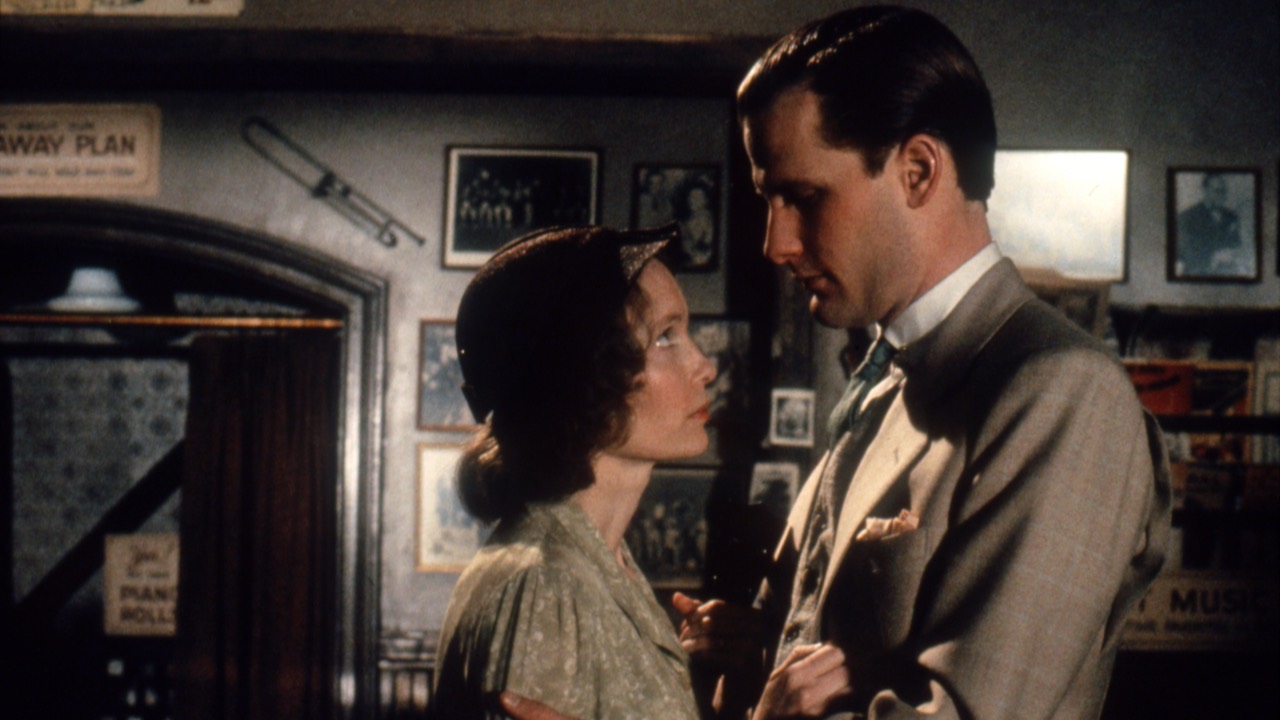
A romantic fantasy built on invisible craft: Gordon Willis turns Woody Allen’s apparently modest fable into a precise exercise in exposure, projection work and controlled period cinematography.
The Film
An unusual romantic fantasy within Woody Allen’s filmography, The Purple Rose of Cairo is set during the Great Depression and follows Cecilia, played by Mia Farrow, a shy and submissive woman married to a lazy, violent husband, played by Danny Aiello. She escapes her everyday life whenever she can by going to the movies. During one of those screenings, one of the characters in the film, played by Jeff Daniels, steps out of the screen and runs away with her.
The premise — used years later in “Last Action Hero” — is handled by Allen with a very accurate sense of tone. The film works less as realism than as a fable, and it rests beautifully on Mia Farrow, who is ideally cast as a fragile but deeply imaginative woman. The results are excellent, even if the film’s simplicity and relatively modest profile can make its achievement easy to underestimate. It has a clear idea, a precise personality and a final note that defines the whole film. Dianne Wiest and Stephanie Farrow complete the cast.
The Cinematographer
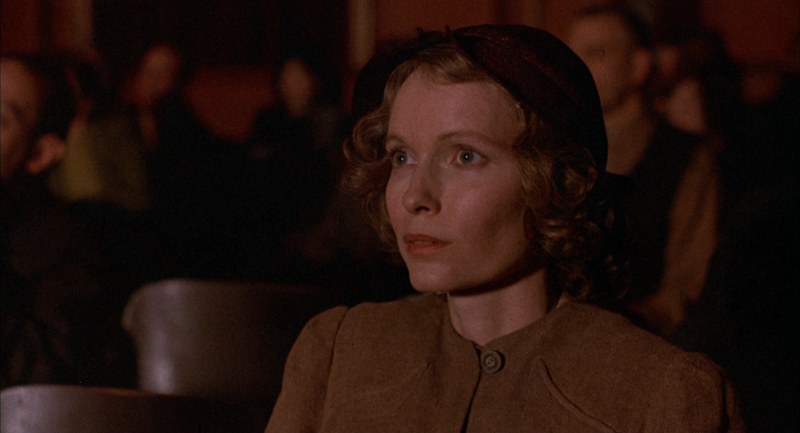
The cinematographer was Gordon Willis, ASC, in his final collaboration with Woody Allen. Allen seems to have hired Carlo Di Palma for his next film, Hannah and Her Sisters, after Willis was unavailable, beginning a new creative relationship.
Allen always said that he learned a great deal from Willis after they began working together on “Annie Hall” (1977). Their collaboration continued through Interiors (1978), “Manhattan” (1979), Stardust Memories (1980), A Midsummer Night’s Sex Comedy (1982), Zelig (1983), Broadway Danny Rose (1984) and finally The Purple Rose of Cairo. Willis brought to Allen’s cinema the same extraordinary sense of control that had defined his work with Francis Ford Coppola on “The Godfather” and The Godfather, Part II (1972 and 1974), and with Alan J. Pakula on “Klute”, “The Parallax View” and “All the President’s Men” (1971, 1974 and 1976). Those films placed him among the most innovative, daring and important cinematographers in American cinema. His later work also includes “The Godfather, Part III” (Francis Ford Coppola, 1990) and “Presumed Innocent” (Alan J. Pakula, 1990).
Visual Style Analysis
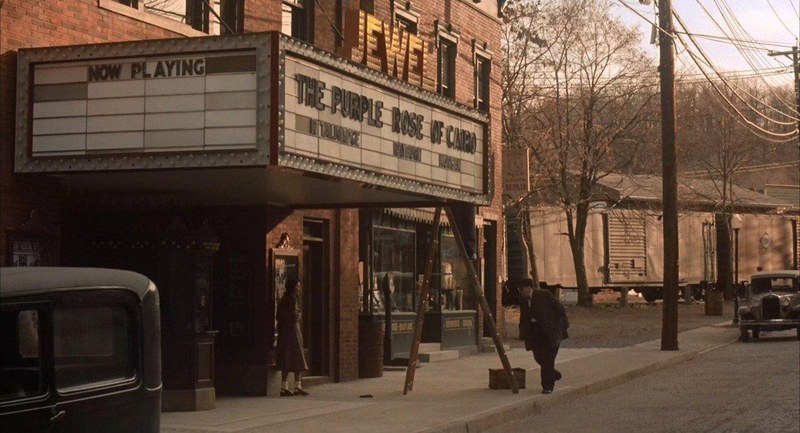
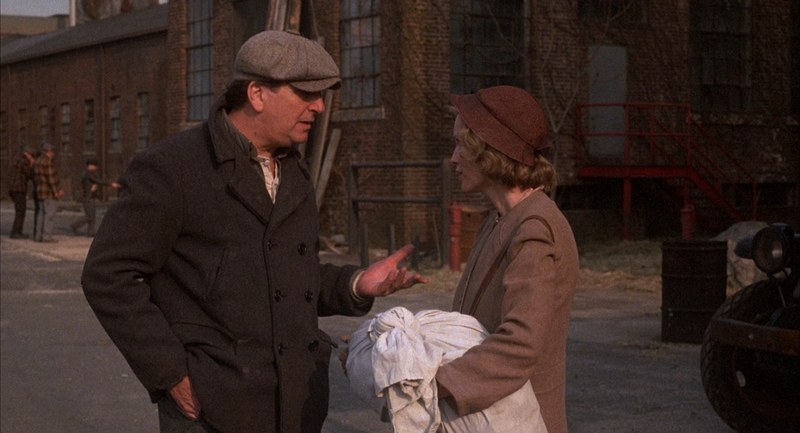
The Purple Rose of Cairo looks, at first, like a very simple and direct film. In fact, it hides a much more complex visual mechanism than its surface suggests. The production is divided very clearly into two visual worlds: the black-and-white film that Cecilia watches — and eventually enters — and the color scenes that belong to her everyday reality.
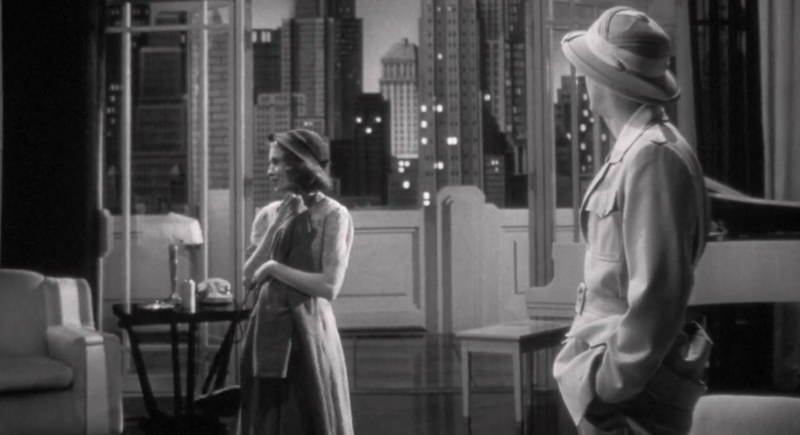
The film-within-the-film is photographed in an openly classical 1930s and 1940s black-and-white style: high light levels, Kodak 5222 Double-X, some diffusion in camera, direct sources, harder shadows and an Academy-like frame close to 1.33:1. By contrast, the main film, framed in 1.85:1, uses very controlled locations and sets, designed as a period piece with a deliberately nostalgic tone.
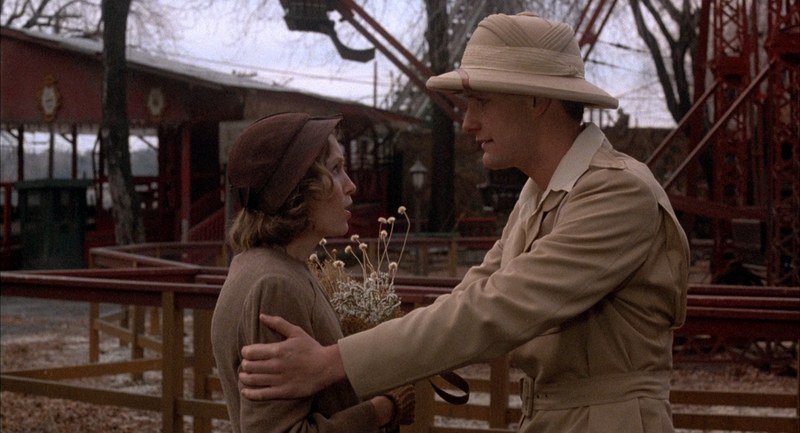
The color palette is tightly held within browns, grays and muted reds. In a certain sense, it recalls the world of The Godfather, but in a gentler, sweeter and far less dark form. There is still chiaroscuro, shadow and contrast, but the characters tend to live more in the light than in the darkness. It is also interesting that Willis, one of the American cinematographers who helped establish softer lighting in the 1970s, uses a notable amount of hard light here.
By this point in his career, Willis was no longer depending only on 100 ASA stocks pushed in processing. Faster stocks made it possible for him, in some cases, to do the opposite: choose a 400 ASA stock and expose it at 200 ASA. That approach reduced grain and gave more protection to the shadows, although perhaps some of the danger and mystery of his earlier method was also reduced by the change. In purely technical terms, The Purple Rose of Cairo is a very clean film. In this specific case, Willis used Kodak 5294 400T for that overexposure strategy, possibly alongside Kodak 5247 125T, and a Low-Contrast #1 filter.
The most impressive part of Willis’s technique appears in the theater scenes, with the projected image — the film within the film — and the actors sitting in front of it. Beyond the logistical difficulty of planning eyelines, camera angles and screen direction, the real challenge was exposure and synchronization. The projected image had to be re-photographed in color, without flicker and with the correct density, while remaining believable as an image on a cinema screen.
There were really only two possible outcomes: either the work would be invisible, or it would be wrong. Thanks to extensive testing, patience and careful preparation, the result is exactly as it should be. What is striking is that very few viewers, except those who work in film, are likely to imagine how difficult these scenes were to achieve in the photochemical era. There are also duplication effects involving Jeff Daniels that appear to be optical or laboratory composites, especially because of visible artifacts in the print and the refusal to move the camera. Within those limits, the results are still very satisfying.
Conclusion
The Purple Rose of Cairo is therefore, like all of Woody Allen’s films with Gordon Willis, a visually fascinating work. Its particular virtue is that much of its perfection remains almost invisible. It does not call attention to its own difficulty, but the control is there in almost every decision.
As lighting or period recreation, it may not be Willis’s most radical achievement, even if it remains a highly accomplished one. His most important and exploratory years were probably coming to an end by this point. But in terms of control, camera discipline and mise-en-scène, The Purple Rose of Cairo belongs completely to the sober, rigorous side of his filmography. Its frontal compositions, symmetry and preference for medium focal lengths are clearly visible on screen, regardless of which director he was working for.
ON FILM & DIGITAL
© Ignacio Aguilar, 2026.
This article is part of ON FILM & DIGITAL’s English-language cinematography reviews and essays.
These texts are not plot summaries or general film reviews, but cinematography-focused essays written from the perspective of a working cinematographer.
The Author
Ignacio Aguilar is available for cinematography work, creative collaborations, lectures, workshops and international projects. He is a Sony Independent Certified Expert (ICE) and Cooke Optics Spanish Ambassador for Cooke SP3 lenses. Contact here.