

“The Shawshank Redemption”
Spanish Title: Cadena Perpetua
Year of Production: 1994
Director: Frank Darabont
Director of Photography: Roger Deakins, ASC, BSC
Lenses: Zeiss Standard, Zeiss Super Speed
Film Stock: Kodak EXR 5248 (100T) and EXR 5293 (200T)
Format and Aspect Ratio: 35mm spherical, 1.85:1
Awards: Academy Award nomination for Best Cinematography; American Society of Cinematographers Award
Viewed on: 4K HDR Blu-ray
Roger Deakins’ first major American breakthrough is built on refined naturalism, invisible control and prison light that feels plausible while remaining carefully shaped.
The Film
Based on a novella by Stephen King, The Shawshank Redemption is set inside an American prison from the late 1940s onward. Andy Dufresne, played by Tim Robbins, is a banker accused of murdering his wife and sentenced to life imprisonment. His first years in prison are brutal, but he gradually becomes part of a group of inmates led by Red, played by Morgan Freeman. Over time, the two men develop a friendship that becomes the emotional center of the film.
The Shawshank Redemption is a strong classical drama, supported by a very effective screenplay and by excellent performances from the whole cast. Bob Gunton, William Sadler, Clancy Brown and James Whitmore complete a particularly solid ensemble. At times, the film’s emotional design can feel slightly softened, even idealized. But as an optimistic story about survival, friendship and personal dignity, it remains highly effective.
Although it received seven Academy Award nominations, The Shawshank Redemption was largely overshadowed on release by the success of Forrest Gump. Its reputation grew much later. For many years, Frank Darabont’s film has been considered, especially on major user-voted websites, one of the most beloved films ever made. That label may be too large for the film itself, but it does explain the depth of its popular appeal.
The Cinematographer
The cinematographer was the British director of photography Roger Deakins, ASC, BSC. At that point, Deakins had only recently begun working regularly in the United States. He was already known for his collaborations with the Coen brothers, beginning with Barton Fink (1991) and The Hudsucker Proxy (1994), as well as for Mountains of the Moon (Bob Rafelson, 1990) and Passion Fish (John Sayles, 1992).
The Shawshank Redemption was his major breakthrough. It brought Deakins his first Academy Award nomination and also earned him the American Society of Cinematographers Award for the year’s best cinematography. After thirteen previous Oscar nominations, he finally won for Blade Runner 2049 (Denis Villeneuve, 2017), and later won again for 1917 (Sam Mendes, 2019). He would also receive another nomination for Empire of Light (Sam Mendes, 2022). Taken as a whole, his career probably makes him the most influential cinematographer in world cinema from the mid-1990s onward.
Visual Style Analysis
Frank Darabont was making his feature-film directing debut with The Shawshank Redemption, after earlier work in television. In later interviews, he praised Deakins’ narrative instincts. The cinematographer was reportedly recommended for the film by Tim Robbins, who had just worked with him on The Hudsucker Proxy. The following year, Deakins photographed Robbins’ own directorial debut, Dead Man Walking.
The film already shows the restrained shooting style that Deakins would bring to much of his later work: spherical 35mm, classical focal lengths, a concise single-camera approach, and a form of naturalism that does not ask to be noticed. The camera is generally operated by Deakins himself, and the lens choices tend to stay within a controlled dramatic range, often between 32mm and 75mm. Nothing feels decorative. The images are composed and lit with great care, but the craft is always subordinated to narrative clarity.
The lenses were among the best non-Panavision cinema optics available at the time: Zeiss Standard T2.1 and Zeiss Super Speed T1.3. It seems likely that the Standards were used to complete focal lengths absent from the faster T1.3 set, such as 28mm or 40mm. This combination gives the film a clean, precise and relatively neutral optical character, without imposing a strong lens signature on the drama.
Deakins was also one of several major cinematographers of that period who avoided 500T stocks when possible, largely because of their coarser grain. The Shawshank Redemption was photographed only on Kodak EXR 5248 (100T) and EXR 5293 (200T). Both were slower than Kodak’s 500T stock of the period, but they offered a finer and more controlled image. That decision is central to the film’s polished texture.
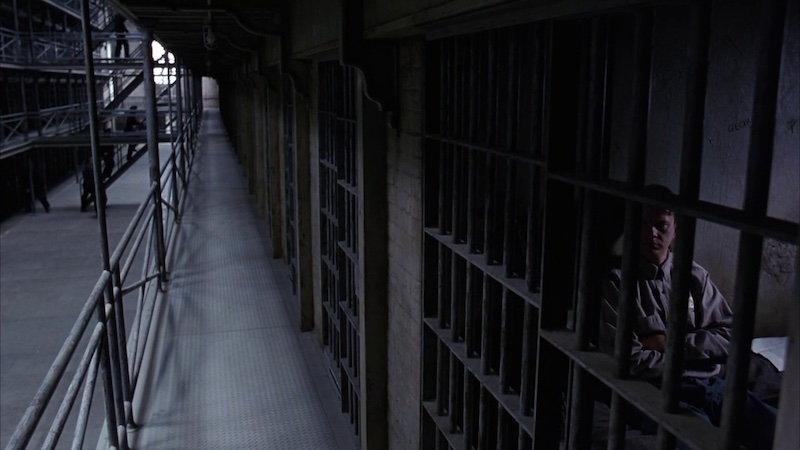
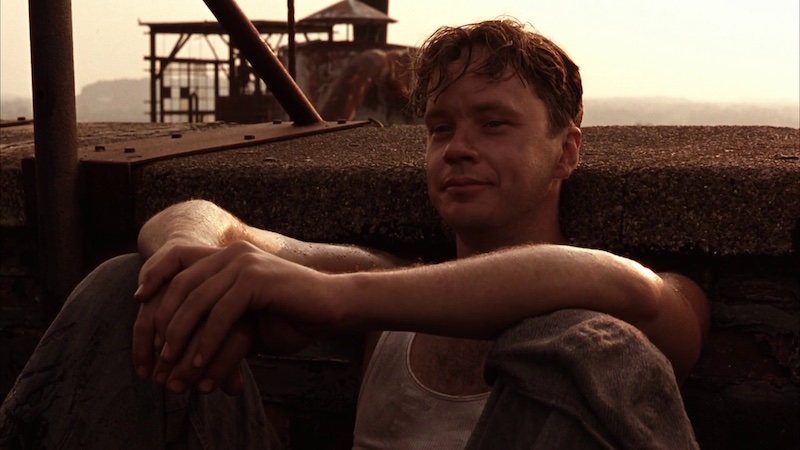
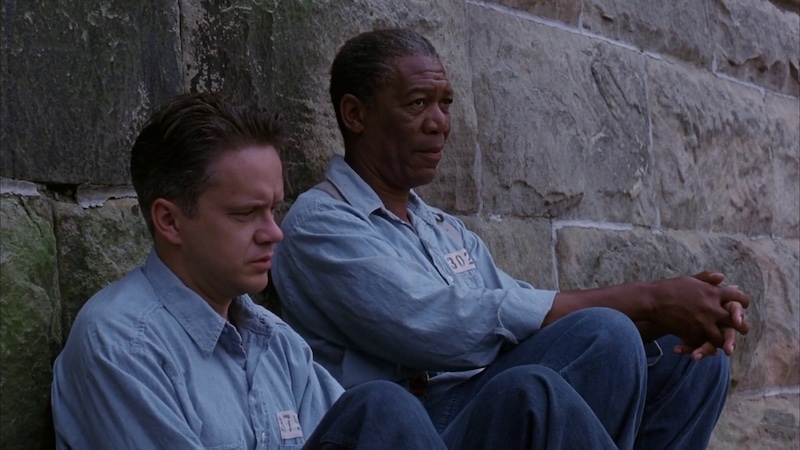
Aesthetically, the film is defined by sober naturalism, but perhaps even more by a restricted color palette. Greys and blues dominate, especially in the prison exteriors. The prison itself is introduced with a spectacular aerial shot that gives the setting a strong institutional weight. In a few selected moments, Deakins allows direct sun and possibly some in-camera filtration, in the direction of Chocolate, Tobacco or Antique Suede-type effects, to create warmer golden tones.
The clearest example is the rooftop beer scene, one of the film’s most openly happy moments and probably one of its most emblematic passages. It demonstrates the narrative precision that Darabont admired in Deakins. The scene needs a different visual register, and Deakins gives it one. He is not a cinematographer given to display, but here the controlled change of tone is dramatically correct.
For most of the film, however, the color range remains deliberately limited. As in much of Deakins’ period work, there is no imposed photographic texture that announces the past. He relies instead on Terence Marsh’s excellent production design — including the constructed prison interior — and on lighting to create the film’s visual identity.
Deakins has sometimes remarked, half-jokingly, that some viewers believed the prison interior was lit only by daylight entering through the windows. In reality, the effect was produced by dozens of HMI units placed by his crew. The confusion is revealing. It would probably please Deakins, because the light succeeds precisely by disappearing into the logic of the space. At the same time, this type of invisible craft may also explain why his work was so often underestimated in awards contexts: when it works, many viewers do not register it as cinematography.
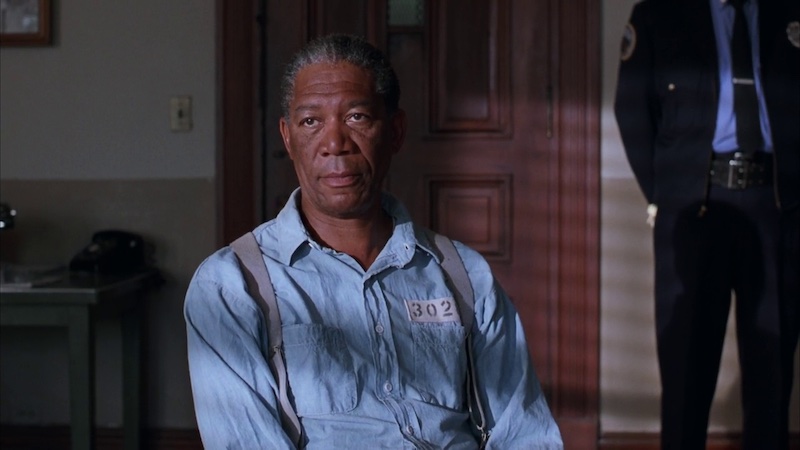
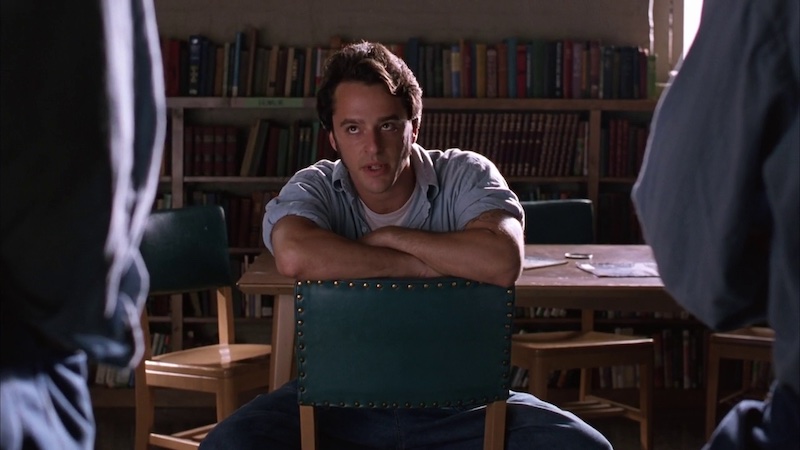
In exteriors, often under cloudy skies, Deakins appears to use very large soft bounces and negative fill to shape faces without breaking the natural tone of the environment. But the interiors are where his authorship becomes clearest. The soft light is always motivated by a plausible source within the set, usually a window or architectural opening, while the contrast remains carefully controlled.
Near the actors, Deakins seems to refine the effect with fabrics, silks, reflectors and subtle shaping tools. On the opposite side, negative fill probably helps preserve density and avoid a flat image. The method allows him to maintain a relatively high-contrast naturalism. We understand where the light comes from, but the faces are still worked.
In my view, this also means that The Shawshank Redemption is not strictly realistic in a raw sense. The image is too polished, too carefully held, and often too clean for that. The film may include harsh passages in its first third, but it is ultimately a softer prison film than many others. It belongs more to myth, memory and moral fable than to a documentary-like reconstruction of prison life. It is far removed from the harder observational surface of Escape from Alcatraz, the violence of Midnight Express, or even the physical severity of Papillon.
For that reason, it makes sense that Deakins protects the characters photographically. The film looks less like a crude prison chronicle than like a sophisticated moral tale. Even the famous narrative reversal, with its lightning effects and heightened atmosphere, confirms this approach. Deakins begins from something truthful, but modulates it toward a slightly more elevated register.
Conclusion
The Shawshank Redemption may not be Deakins’ greatest work. If one had to simplify, that distinction would probably be disputed by Fargo (1996), No Country for Old Men (2007), Skyfall (2012) and Prisoners (2013). But it already shows Roger Deakins being Roger Deakins.
Once established in the United States, Deakins was already deploying the essential elements of his style: simple camera placement, controlled focal lengths, naturalistic motivation, high technical precision and an unusual ability to make complex lighting appear inevitable. In later years, that language would become even more refined, reaching a more spectacular form after his transition to digital cinematography from In Time (2011) onward.
Even so, the main traits are already present here. The Shawshank Redemption probably gave Deakins the confidence and industrial recognition to continue developing one of the most important careers in modern cinematography. Few directors of photography in film history have sustained such a level for so long.
ON FILM & DIGITAL
© Ignacio Aguilar, 2026.
This article is part of ON FILM & DIGITAL’s English-language cinematography reviews and essays.
These texts are not plot summaries or general film reviews, but cinematography-focused essays written from the perspective of a working cinematographer.
The Author
Ignacio Aguilar, AEC is a Spanish cinematographer based in Madrid. His work spans feature films, television, commercials and technical writing on cinematography, with experience in digital cinema, 16mm and 35mm film, anamorphic lenses, large-format digital capture and practical lens testing.
Read more articles and reviews in Spanish at ON FILM & DIGITAL, or visit the main cinematography portfolio at ignacioaguilardop.com.