


“Eyes Wide Shut”
Spanish Title: Eyes Wide Shut
Year of Production: 1999
Director: Stanley Kubrick
Director of Photography: Larry Smith, BSC
Lenses: Zeiss Super Speed T1.3, ARRI Variable Primes T2.1, Cooke Varotal 20-100mm T3.1
Film Stock: Kodak EXR 5298 (500T)
Format and Aspect Ratio: 35mm spherical, 1.85:1
Viewed on: 35mm and 4K HDR Blu-ray
Stanley Kubrick and Larry Smith combine available light, aggressive push processing and fast lenses to create a soft, grainy, deeply dreamlike image.
The Film
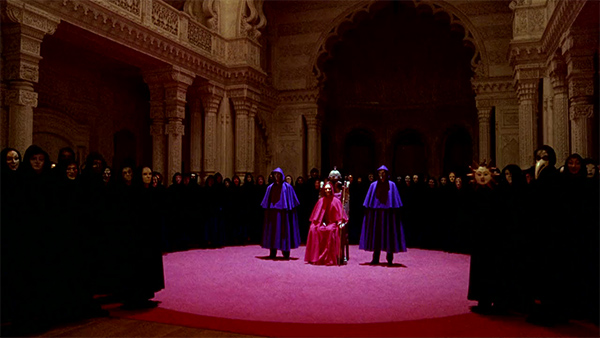
Stanley Kubrick’s final film adapts Arthur Schnitzler’s novel, relocating the story from turn-of-the-century Vienna to New York at the end of the 1990s. Tom Cruise and Nicole Kidman play a married couple whose relationship is shaken by jealousy, sending Cruise’s character into a spiral of encounters linked by sex and culminating in an elaborate masked orgy that is more disturbing than provocative.
Todd Field, Marie Richardson and Sydney Pollack complete the cast of this remarkable final film. With four months still remaining before release, Kubrick would almost certainly have continued refining details and trimming the running time; he died just after delivering his first version of the film to the studio executives.
The Cinematographer
The cinematographer was Larry Smith, BSC, John Alcott’s former gaffer on both Barry Lyndon (1975) and The Shining (1980). As a longtime member of Kubrick’s crew, Smith ultimately took charge of Eyes Wide Shut, although the cinematography had first been offered to Douglas Milsome, another former Alcott assistant who had already shot Full Metal Jacket (1987) for Kubrick.
Eyes Wide Shut was Smith’s first feature as cinematographer. His later career was relatively selective rather than prolific, but two of his most notable subsequent credits were for Nicolas Winding Refn: Bronson (2008) and Only God Forgives (2013).
Visual Style Analysis
Kubrick again worked with production designer Roy Walker, who had designed The Shining, and once more chose to keep the production in England. The crew therefore reconstructed a New York Soho street entirely on a stage, while a second unit captured background plates in the city. For several shots, Cruise walked on a treadmill in front of rear-projection plates, creating the illusion that he was moving through New York or traveling to different locations by taxi.
From a visual standpoint, however, the most striking decision was to rely on Kodak EXR 5298, a 500T stock that was being phased out. Kodak agreed to supply enough of it for the production, and Smith had the negative force-developed by two stops throughout the film, including day exteriors, to keep the look consistent. In practice, that two-stop push delivered roughly a stop and a quarter to a stop and a half of effective speed, placing the working index at around 1600 ASA.
The process increased contrast and color saturation, exaggerated highlights and produced very prominent grain in the 35mm release prints. In the four theatrical screenings I saw at the time of release, there was also noticeable variation in black density and timing from print to print — hardly surprising given such a deliberately non-standard laboratory process.
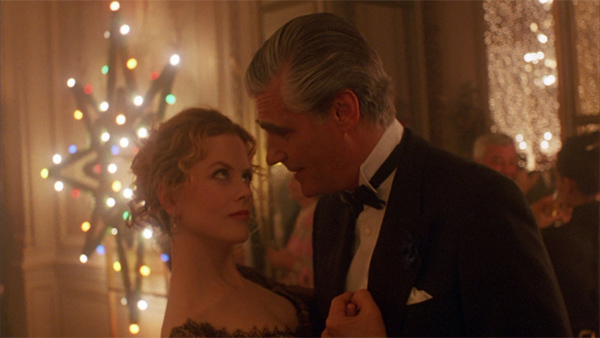
Kubrick combined the pushed stock with fast Zeiss Super Speed lenses, shooting most of the picture at or near T1.3. That made it possible to work at extremely low light levels and let the practical sources within the frame carry much of the exposure, with conventional movie lighting reduced to a minimum.
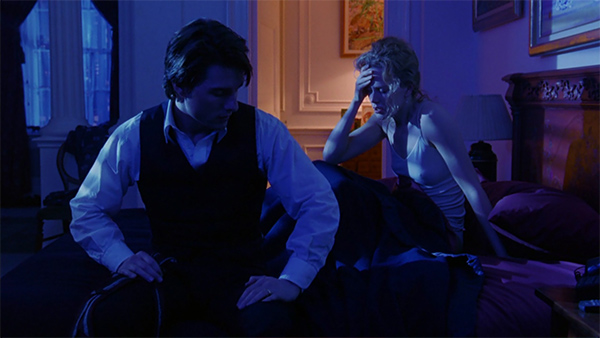
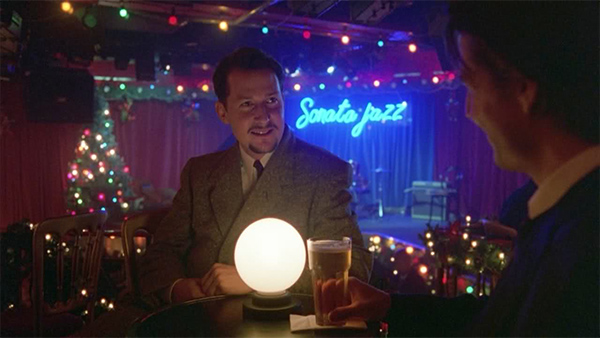
As a result, much of Eyes Wide Shut is lit from the sources visible within the frame: table lamps, Christmas trees, decorative party lighting, street lamps, shop windows and similar practicals. Smith supplements them with Chinese lanterns for close-ups and with off-camera units when a stronger environmental effect is required, most notably the intensely blue light entering through windows in the night interiors.
Because the color saturation is so high, the contrast between the warm interiors and the blue night light through the windows becomes extreme. Combined with the importance of red throughout the production design and the almost omnipresent Christmas lights, the palette may even suggest some influence from the work of Slawomir Idziak or Piotr Sobocinski for Krzysztof Kieslowski, whose films were particularly prominent at the time.
To counteract the added contrast from the push processing and reinforce the film’s atmosphere of unreality, Kubrick and Smith used a Tiffen Low Contrast 1 (LC-1) on many night interiors. The filter lowers contrast while allowing practical sources to bloom gently, giving the image a subtly surreal edge without detaching it from a recognizable photographic base.
The film, of course, bears Kubrick’s characteristic visual signature, with frequent, elegant Steadicam moves and remarkable precision in the choice of camera angles. Even when the movement is complex, the staging is reduced to such clarity that each camera position feels inevitable.
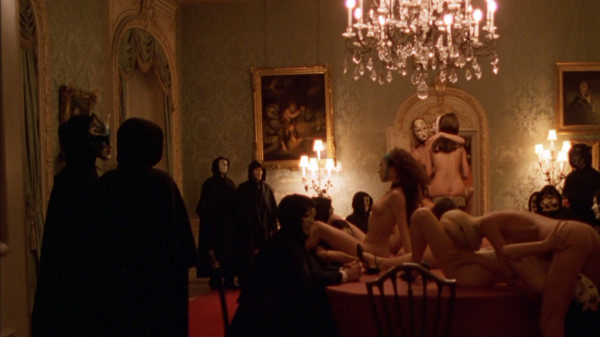
The 18mm is overwhelmingly dominant, with most of the film photographed on that focal length and relatively few setups going beyond 35mm. As was customary for Kubrick, zooms also appear throughout. The most conspicuous example comes in a low-angle shot during the orgy sequence, where the Steadicam combines circular movement, tracking and forward motion without sacrificing spatial clarity.
Conclusion
It is neither Kubrick’s strongest film nor the most technically consistent piece of cinematography in his body of work. Even so, it is photographed with enormous sophistication. The grain, saturated color, near-wide-open lenses, practical-driven lighting and low-contrast filtration transform essentially realistic spaces into a world that feels only slightly displaced from reality. That tension is the key to the film’s visual power: the image remains tangible while simultaneously becoming dreamlike, precisely matching the emotional territory of the story.
The weakest element, without question, is the black-and-white fantasy material — more precisely, Bill Harford’s jealous imaginings — with awkward slow motion and emphatic musical cues that fall below the level of both the rest of the film and Kubrick’s work more generally.
The Criterion 4K restoration, supervised and approved by Larry Smith, BSC, offers extraordinary image quality and a distinctly filmic texture. As a digital presentation, it is an exceptionally convincing approximation of the original 35mm release prints, which I had the opportunity to see in four separate screenings at the time of the film’s original release.
ON FILM & DIGITAL
© Ignacio Aguilar, 2013. Revised in 2026.
This article is part of ON FILM & DIGITAL’s English-language cinematography reviews and essays.
These texts are not plot summaries or general film reviews, but cinematography-focused essays written from the perspective of a working cinematographer.
The Author
Ignacio Aguilar, AEC is a cinematographer / director of photography based in Madrid, Spain. His work spans feature films, television, commercials and technical writing on cinematography, with experience in digital cinema, 16mm and 35mm film, anamorphic lenses, large-format digital capture, lens testing and film-based workflows.
He is a member of the Spanish Society of Cinematographers (AEC) and the Spanish Academy of Cinema, a Sony I.C.E. Certified Expert and a Cooke SP3 ambassador. His writing has appeared in American Cinematographer and Camera & Light, and ON FILM & DIGITAL gathers his bilingual essays, technical guides and cinematography reviews.
For professional work, collaborations, lectures, workshops or cinematography consulting, visit his professional biography, selected works or contact page.
The Spanish-language archive is available at ON FILM & DIGITAL.