


“United 93”
Spanish Title: United 93
Year of Production: 2006
Director: Paul Greengrass
Director of Photography: Barry Ackroyd, BSC
Lenses: Cooke S4, Arri/Zeiss Variable Primes, Angénieux Optimo
Film Stocks: Fuji Super F-8562 (250D) and Super F-8572 (500T)
Format and Aspect Ratio: Super 35, 2.40:1
Other: 2K Digital Intermediate
Awards: BAFTA Award for Best Cinematography (nomination)
Viewed on: 35mm and Blu-ray
Paul Greengrass and Barry Ackroyd turn the reconstruction of Flight 93 into an experience of raw documentary immediacy, deliberately rejecting conventional cinematic spectacle.
The Film
United 93 is an extraordinary reconstruction of the events that unfolded in the United States on the morning of September 11, 2001, seen from the perspectives of air-traffic controllers, military personnel and, above all, the passengers and crew of United Airlines Flight 93. It was the only one of the four aircraft hijacked by Al-Qaeda suicide terrorists that failed to reach its intended target, after the passengers, once they understood what was happening, confronted the hijackers in an attempt to regain control of the plane.
Perhaps because the production worked with a relatively modest budget by the standards of this kind of film, and because most of the shoot took place in England, Paul Greengrass was able to avoid overtly manipulative or triumphalist treatment and reconstruct the events as a docudrama from a strikingly objective point of view.
Working with a cast of largely unfamiliar actors, non-professionals and, in several cases, people portraying versions of themselves, Greengrass creates a raw, unsentimental account of the confusion of that morning and of the passengers’ fight for survival. Combined with his direct shooting style and superb editing, this made United 93 one of the defining films of its decade and, above all, an extraordinary achievement of direction.
The Cinematographer
To give the film an unusually immediate, documentary-based visual language far removed from the polish of large Hollywood productions, Greengrass turned to British cinematographer Barry Ackroyd, BSC, one of Ken Loach’s regular collaborators.
Ackroyd’s documentary background, his experience working with limited resources, and his familiarity with handheld operating and zoom lenses made him an ideal choice. Greengrass had already achieved a similarly immediate result with British cinematographer Oliver Wood on the second and third Jason Bourne films, even though Wood’s earlier work included far more conventionally polished imagery, such as Die Hard 2 (1990).
Ackroyd later received his first Academy Award nomination, among many other honors, for his Super 16mm work on The Hurt Locker (2008). He also rejoined Greengrass for the less successful Green Zone (2010) and the more accomplished Captain Phillips (2013), which returns quite openly to much of the same visual and dramatic approach.
Visual Style Analysis
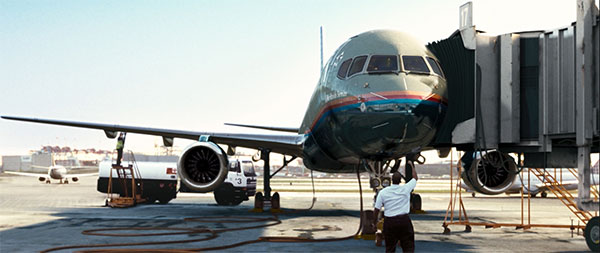
The film makes extensive use of real environments: air-traffic control rooms, military command spaces, airport areas in the opening scenes and, most importantly, the interior of a Boeing 757, the same aircraft type as United 93.
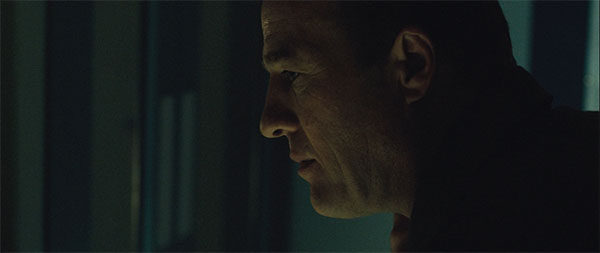
The air-traffic-control and military sequences are conceived in very similar terms, because Ackroyd does one of the hardest things a cinematographer can be asked to do: almost nothing. The circumstances and the visual strategy force him to rely almost entirely on practical sources from control panels, screens and consoles, many of which are allowed to run visibly overexposed.
Ackroyd lets the performers move through these spaces without creating the slightest impression that conventional “movie lighting” has been added around them.
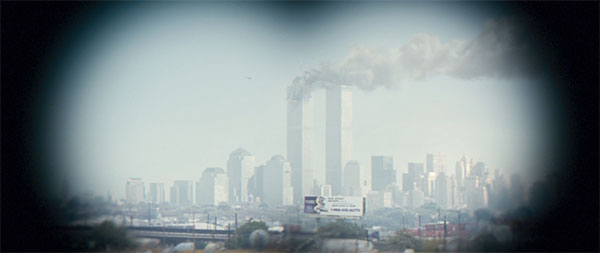
This connects directly with Greengrass’s shooting method. Working with two or three cameras, generally handheld and fitted with zoom lenses, he stages long stretches of continuous action — sometimes twenty, thirty or forty minutes at a time — almost like theatre. The operators cover the scene as documentary cameramen would, following broad instructions rather than fixed marks for either actors or cameras.
The result is an extraordinary sense of immediacy. Largely unfamiliar actors and participants playing versions of themselves recreate the events of that morning while the cameras appear to discover the action rather than impose a predetermined visual design on it. Few dramatic films have produced a stronger impression of documentary truth.
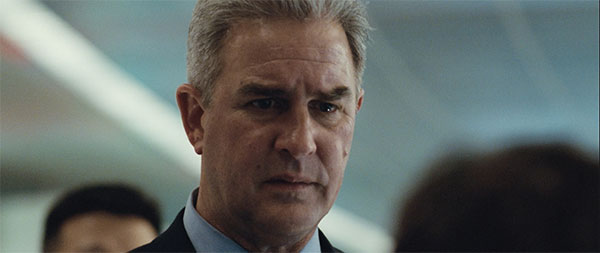
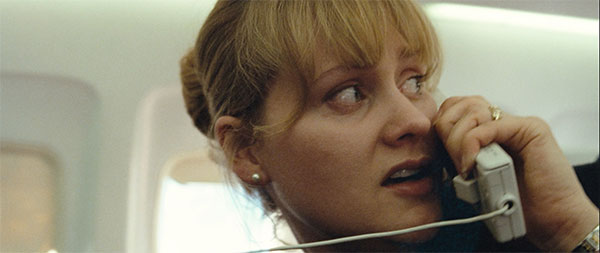
Inside the aircraft, Ackroyd again relies heavily on the real practical fixtures. More striking, however, is the way he creates a sense of flight and movement with large exterior lighting units — at least 10 or 12 kW — moved outside the fuselage to simulate shafts of sunlight as the aircraft travels.
Characters caught directly by these units are often heavily overexposed, with large lens flares that can almost obscure them. Yet these technically “incorrect” exposures are central to the effect. They make the photography feel uncontrolled, raw and contingent — less like a designed image than something the camera happened to witness.
Conclusion
This is not a film whose images are meant to look especially beautiful. The filmmakers are completely comfortable with characters appearing heavily underexposed, reduced to silhouette, slipping slightly out of focus or standing in spaces where the light could scarcely be flatter or more ordinary. Nor does it matter if many compositions feel unbalanced or only loosely organized.
Greengrass’s intention is clearly to reconstruct what happened that morning in front of the cameras and allow his crew to capture it as though they were documenting a real event. The lack of polish is not a failure of technique but the technique itself: every conventional sign of photographic control is stripped back in order to preserve immediacy. In that respect, the result is almost impossible to fault.
ON FILM & DIGITAL
© Ignacio Aguilar, 2014. Revised in 2026.
This article is part of ON FILM & DIGITAL’s English-language cinematography reviews and essays.
These texts are not plot summaries or general film reviews, but cinematography-focused essays written from the perspective of a working cinematographer.
The Author
Ignacio Aguilar, AEC is a cinematographer / director of photography based in Madrid, Spain. His work spans feature films, television, commercials and technical writing on cinematography, with experience in digital cinema, 16mm and 35mm film, anamorphic lenses, large-format digital capture, lens testing and film-based workflows.
He is a member of the Spanish Society of Cinematographers (AEC) and the Spanish Academy of Cinema, a Sony I.C.E. Certified Expert and a Cooke SP3 ambassador. His writing has appeared in American Cinematographer and Camera & Light, and ON FILM & DIGITAL gathers his bilingual essays, technical guides and cinematography reviews.
For professional work, collaborations, lectures, workshops or cinematography consulting, visit his professional biography, selected works or contact page.
The Spanish-language archive is available at ON FILM & DIGITAL.